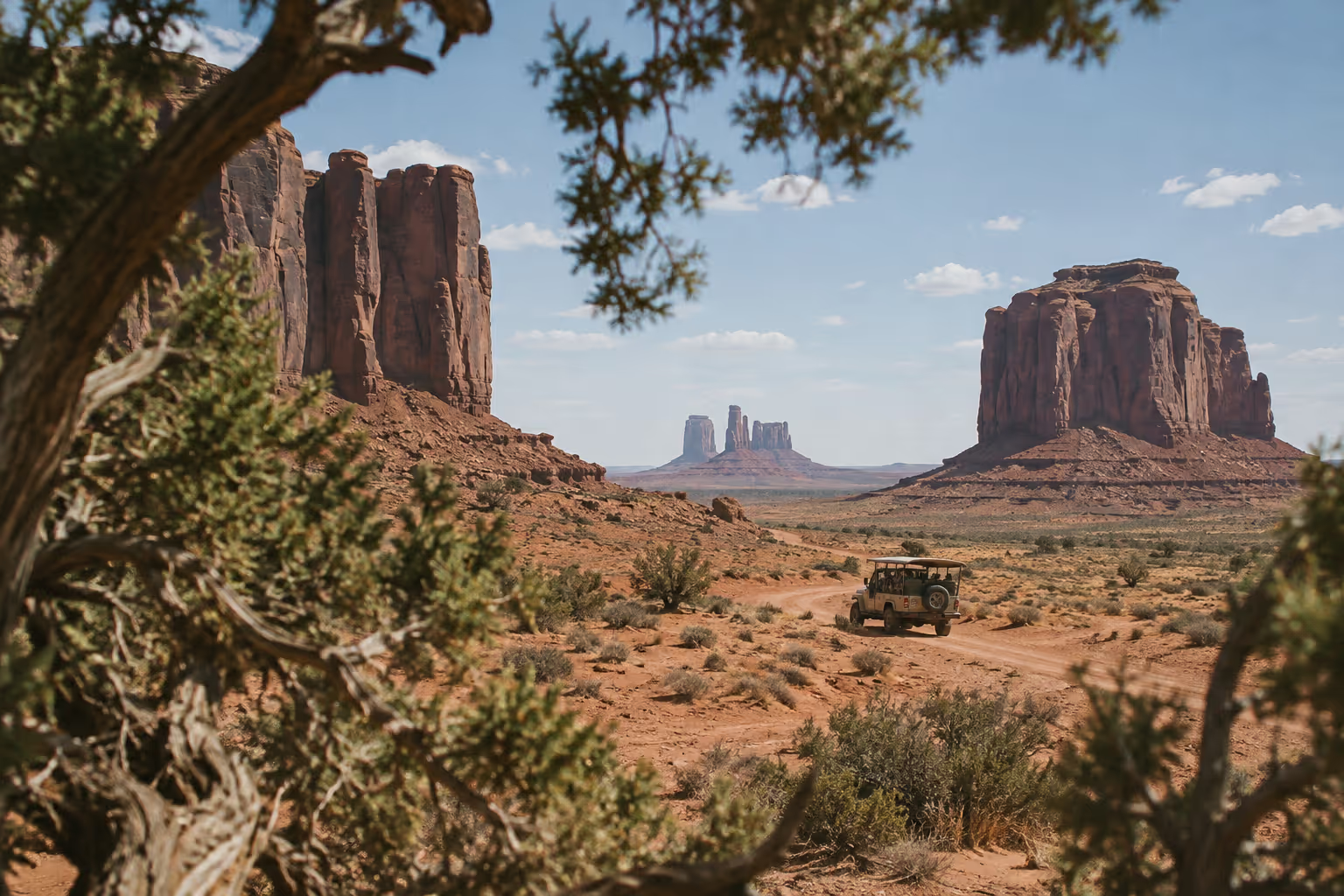
Monument Valley sits on the Arizona-Utah border as a 91,696-acre Navajo Tribal Park. The Navajo name for it is Tse’Bii’Ndzisgaii, and its sandstone buttes rise 400-1,000 feet (122-305 m) above the valley floor (1). The main draw is a 17-mile (27 km) unpaved loop that most visitors need about 3 hours to drive (8). You can self-drive it or pay a Navajo guide to take you deeper. Plan on half a day for the loop plus a night nearby if you want sunrise or stars.
Monument Valley: where it is and why it’s famous
Monument Valley Navajo Tribal Park straddles Utah and Arizona inside the Navajo Nation, at an elevation of 5,564 feet (1,696 m) above sea level (1). So the honest answer to “Utah or Arizona?” is both. The park’s own size listing notes that it spans the two states (1). The Navajo Nation manages it, not the National Park Service. Federal park passes don’t cover entry (7)(8), and Navajo Nation rules apply from the moment you pass the fee booth.
The scenery is the reason people come. The buttes and spires were sculpted over 300 million years and are framed by surrounding mesas and open desert (8). Visit Utah calls it one of the most photographed places on earth (8). The best-known formations are The Mittens, Three Sisters, John Ford Point, Totem Pole, Yei Bi Chai and Ear of the Wind (8). The Navajo Tribal Council established the park in 1958 (8). The land itself is sacred to the Diné, and visitor rules reflect that.
How to get there
The park’s GPS coordinates are N 37.00414, W 110.09889 (1). Mexican Hat, Utah, is a short 20-mile drive from the visitor center on US-163, and Kayenta is the closest Arizona town (8). By car, the visitor center is about five hours from the Phoenix airport and about seven from the Salt Lake City and Las Vegas airports (8). The nearest towns are small, and services thin out quickly. Fill your tank before you commit to the drive in.
Arches and Canyonlands national parks are less than three hours away by car, Zion about four and Bryce Canyon about 4.5 (8), so the valley fits naturally into a Southwest national parks circuit. To link all five Utah parks in one drive, our Utah national parks road trip lays out a 7- to 10-day route from Zion to Moab.
Not the only “valley of buttes” out West
Utah’s Valley of the Gods, reached from US-163 about seven miles east of Mexican Hat, is known as a “Miniature Monument Valley” (9). It is Bureau of Land Management land with its own 17-mile gravel and clay loop, no fee, and a driving time of one to two hours; the road suits passenger cars when it is dry (9). If a listing promises “Monument Valley-style” buttes somewhere else, check whose land it is before assuming the fees, rules or guide requirements below apply.
Is it overrated?
No, but the self-drive version is more limited than many first-timers expect. These are the main trade-offs:
Pros
- Sandstone formations at a scale few other places in the US match
- Navajo guides provide cultural context and access to the backcountry
- Famous landmarks are visible from the Visitor Center and from hotel balconies
Cons
- Rough, unpaved roads with deep sand
- A remote location, a long way from the closest services
- Park fees are charged separately from lodging, even for guests inside the park
- Several named landmarks are off-limits without a guide
Driving the 17-mile loop: route, timing, and rules
As of November 2026, the Monument Valley scenic drive is open and entry is first-come, first-served (1). You don’t need to reserve. In peak season, though, the park warns you to expect long waits and inclement weather (1), and its tour page warns that bad weather can close the park (6).
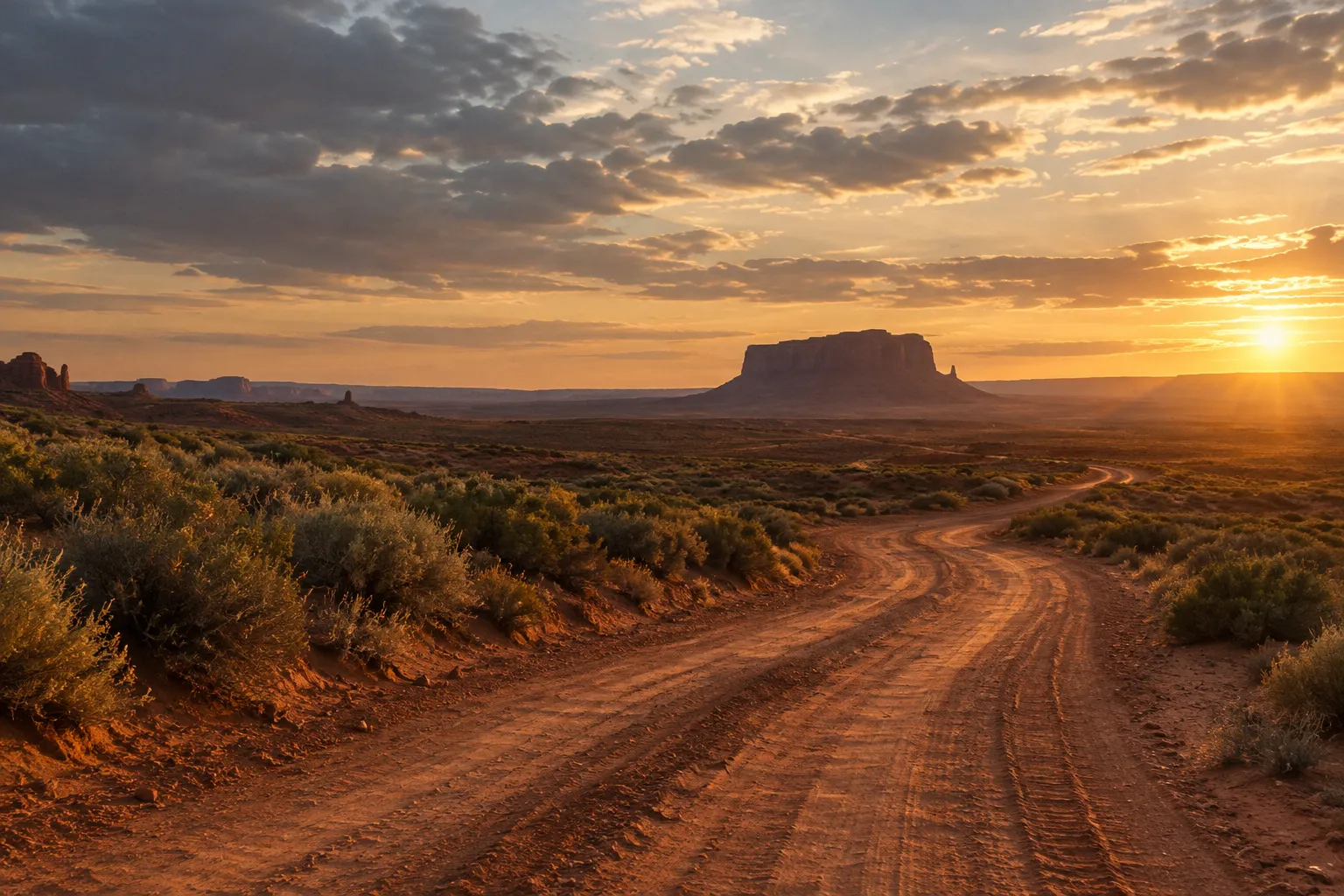
Hours shift with the season, and the gap that catches people is the one between last entry and closing. Winter hours began on October 17, 2026: the drive runs from 8 a.m. to 5 p.m., with last entry at 2:30 p.m. (1). The park’s tour page gives the same hours through January 31 and a longer schedule from March 8 (6). If your trip falls near a change of season, check which schedule applies to your date.
Here is the math most guides skip. A typical loop visit takes about 3 hours (8). From the 2:30 p.m. cutoff to the 5 p.m. close is only 2.5 hours. If you roll in at last entry, you will be hurrying through the back half of the loop. Aim to be on the dirt by 2 p.m. at the latest, and earlier is better (1)(8).
The Visitor Center viewpoint and museum keep their own hours. Under winter hours, the viewpoint patio is open from 8 a.m. to 5 p.m. and the museum from 8 a.m. to 4:45 p.m. (1). That means you can still catch the Mittens from the patio after the loop has stopped admitting cars.
Rough terrain, deep sand, and why motorcycles aren’t allowed
The park bars motorcycles from the loop because of rough terrain and deep sand dunes (1). It also disclaims liability for vehicle damage, so a scraped oil pan is your problem. Visit Utah recommends a high-clearance vehicle (8). A low-slung rental sedan is the wrong tool here. The park’s tour page also bars RVs, camper vans, large SUVs and off-road vehicles from the valley drive (6), while its fee page says an SUV or truck would be preferable (7). Ask at the fee booth if you’re unsure whether your vehicle qualifies. Stay on the designated route and obey every sign (1).
Planning a self-drive visit, step by step
The checklist below covers the whole loop from hours to fees, so you don’t have to piece it together from the sections above.
Plan a self-drive visit to Monument Valley
About 3 hours for the loopUse the seasonal schedule and road requirements to plan a self-drive loop that fits before last entry.
- 1
Check the hours for your date
Confirm the current seasonal opening, closing and last-entry times on the park's official page before setting out.
- 2
Arrive with enough time for the loop
Allow about three hours for the drive and aim to reach the dirt road by around 2 p.m. under winter hours.
- 3
Choose a suitable vehicle
Use a high-clearance vehicle if possible; motorcycles, RVs and camper vans are not permitted on the loop.
- 4
Pay the required fees
Pay the per-person entry and per-vehicle fees at the booth; overnight stays do not replace park admission.
- 5
Follow the route and posted rules
Stay on the designated route, obey signs and carry water.
Guided Jeep tours vs. self-drive exploring
Choose between self-driving and Monument Valley tours based on one question: do you want to see Ear of the Wind and the other backcountry landmarks? Those sites are reachable only with a Navajo guide (1). If the main viewpoints along the loop are enough, drive yourself.
Self-driving costs only the entry and vehicle fees. You set your own pace and stop where you like, but you need a suitable vehicle and you get no narration. A Navajo-operated Jeep tour takes the vehicle question off your hands and adds commentary on the land and its history. It also opens up the guided-only locations (1). The trade-off is that you follow the operator’s schedule and pay the tour price on top of park entry.
You don’t have to book ahead. The park’s tour page lists the Navajo operators and says you can buy a tour on arrival (6). Guides wait at the lower-level parking lot (6). Booking in advance makes sense mainly if you’re working around a tight last-entry window in peak season. If your route continues to Page, Arizona, our Antelope Canyon and Horseshoe Bend plan covers a Navajo tribal park where every visit is guided.
What requires a guide: Ear of the Wind and other backcountry sites
Ear of the Wind is the best-known landmark you can’t reach on your own, and the park says other named locations also require a guided tour (1). If those formations are the reason you’re coming, book the tour and skip the self-drive. Driving the loop first and then adding a tour the same day is hard to fit in once the afternoon cutoffs kick in.
Self-drive or Navajo-guided tour?
| Best for flexibility Self-drive loop | Best for backcountry access Navajo-guided tour | |
|---|---|---|
| Cost beyond park entry | No tour fee | Tour price applies |
| Pace | Set your own pace | Follow the operator's schedule |
| Backcountry access | No access to guided-only sites | Access to guided-only sites |
| Cultural context | No tour narration | Guide provides commentary |
| Vehicle needed | Suitable vehicle recommended | Tour vehicle provided |
Fees, permits, and rules on Navajo Nation land
As of November 2026, entry to Monument Valley Navajo Tribal Park costs $10 per person per day, plus a $15 vehicle fee (1). The Navajo Nation announced a fee increase covering park locations, permits and entry fees, effective January 1, 2026 (6). Older listings still show $8 per person, including a block further down the park’s own fee page (7), so budget from the $10 rate.
Those fees apply to everyone who enters, including overnight guests (3). The other rules that matter:
- Drones are prohibited on Navajo Nation land, and the parks department warns they will be confiscated (5)(7).
- Rock climbing on the monuments is prohibited (7).
- Dogs are prohibited at all Navajo Tribal Park locations (6).
- Entering tribal park land is at your own risk (5).
Permits for photography, weddings, and backcountry access
A Backcountry Permit is available at the Visitor Center, and the San Juan River Permit is sold at the Welcome Center (1). Special-use permits are required for photography, filming, weddings and painting (1). Film and photography permits are invoiced on request, and Navajo guides must be used (5).
Holiday closures and hours worth double-checking
All Navajo Tribal Parks, including Monument Valley, close on Thanksgiving Day, NN Family Day (the day after Thanksgiving), Christmas Day and New Year’s Day (6). The park page lists Thanksgiving as November 26 (1), so in 2026 the park is also closed on Friday, November 27. Hours change with the season, so recheck the official page the week you travel.
Best month to visit
Autumn is the strongest choice. Most visitors come in spring or autumn, and autumn brings some of the most stable weather of the year, with clear, warm days and cool nights (8). Summer heat usually runs from late May to mid-September, with temperatures reaching the mid-90s F in July and August, while winter highs sit in the 40s (8). From October 17 the shorter winter hours apply, so plan the loop for late morning or early afternoon (1).
Hiking the Wildcat Trail
The Wildcat Trail is the park’s listed self-guided hike. The park lists it at 1.5 miles (2.4 km), and you must sign in and out at the Visitor Center (1). Visit Utah’s trail guide describes a 3.2-mile (5.1 km) lasso loop around West Mitten Butte, nearly 4 miles with the return, starting at the northwest corner of the visitor center parking area and taking 2 to 3 hours (10). Plan on the longer figure. Do the sign-in. It’s how staff know someone is still out on the trail at closing time.
Every other hike in the valley needs a Backcountry Permit, and those outings are done with a guide (5). Hiking or camping in unauthorized areas without a permit can lead to removal and additional fees (7). Designated trails are open from 8 a.m. to 5 p.m. (6), so start early enough to finish well before closing. In summer, heat and the lack of shade can make the loop too hot (10). Carry plenty of water at any time of year.
Where to sleep: The View Hotel and nearby camping
The View Hotel is the only lodging inside the park (8). It is Navajo-owned, and most of its rooms have a private balcony facing the formations (4)(3). Staying here gets you sunrise from your room without a dark drive in.
Booking a room does not cover park admission. The View states that the tribal park and the hotel are separate entities, and that the $10 per-person and $15 per-vehicle fees apply to all guests entering the park and hotel (3). Budget for both.
Some practical details: the hotel has no pets and no pool. It skips the pool out of respect for valley residents who haul water daily (3). There are no laundry facilities on the grounds either, only at laundromats nearby (3). The View also rents private valley-rim cabins, which it promotes as having even better views than the hotel rooms (2). Goulding’s Lodge, two miles west of the park, is another option, with a campground of its own (8).
StarView rooms and first-floor options for families
All the StarView rooms are on the third floor. The hotel markets them for their views of the Mittens and for stargazing (3). Families should ask about first-floor rooms instead: the hotel says those balconies are larger and recommends them for families with children (3).
The View Campground: RV and wilderness sites
The View Campground offers RV sites and wilderness campsites as an alternative to a hotel room (2). Each site has its own view of the valley (2).
Frequently Asked Questions
- Can I enter Monument Valley with a federal park pass?
- No; Monument Valley is managed by the Navajo Nation, so federal park passes do not cover admission. Pay the tribal park's entry fees separately.
- Can I buy a Navajo-guided tour at the park?
- Yes; Navajo operators listed by the park sell tours on arrival, with guides waiting at the lower-level parking lot. Advance booking is most useful when your schedule is tight.
- Can I visit Ear of the Wind without a tour?
- No; Ear of the Wind and other named backcountry locations are accessible only with a Navajo guide. The self-drive loop does not provide access.
- Does staying at The View Hotel include park admission?
- No; hotel guests pay park admission separately because the hotel and tribal park are separate entities. Include entry fees in your lodging plans.
- Can I hike anywhere in Monument Valley without a guide?
- No; the Wildcat Trail is the listed self-guided hike. Other valley hikes require a Backcountry Permit and a guide.
- What should I do if I arrive near the seasonal last-entry cutoff?
- Choose the Visitor Center viewpoint instead of starting the loop if there is not enough time to finish before closing. The viewpoint has separate hours.
Planning the visit
Decide first whether you want a guide. Self-driving the loop is the cheaper, more flexible option. A Navajo tour is the only way to reach Ear of the Wind and the other backcountry sites. Either way, you pay $10 per person and $15 per vehicle, wherever you sleep. Arrive with at least 3 hours before closing, which means by 2 p.m. under winter hours, and check the park’s seasonal schedule for your exact date before you book anything else.