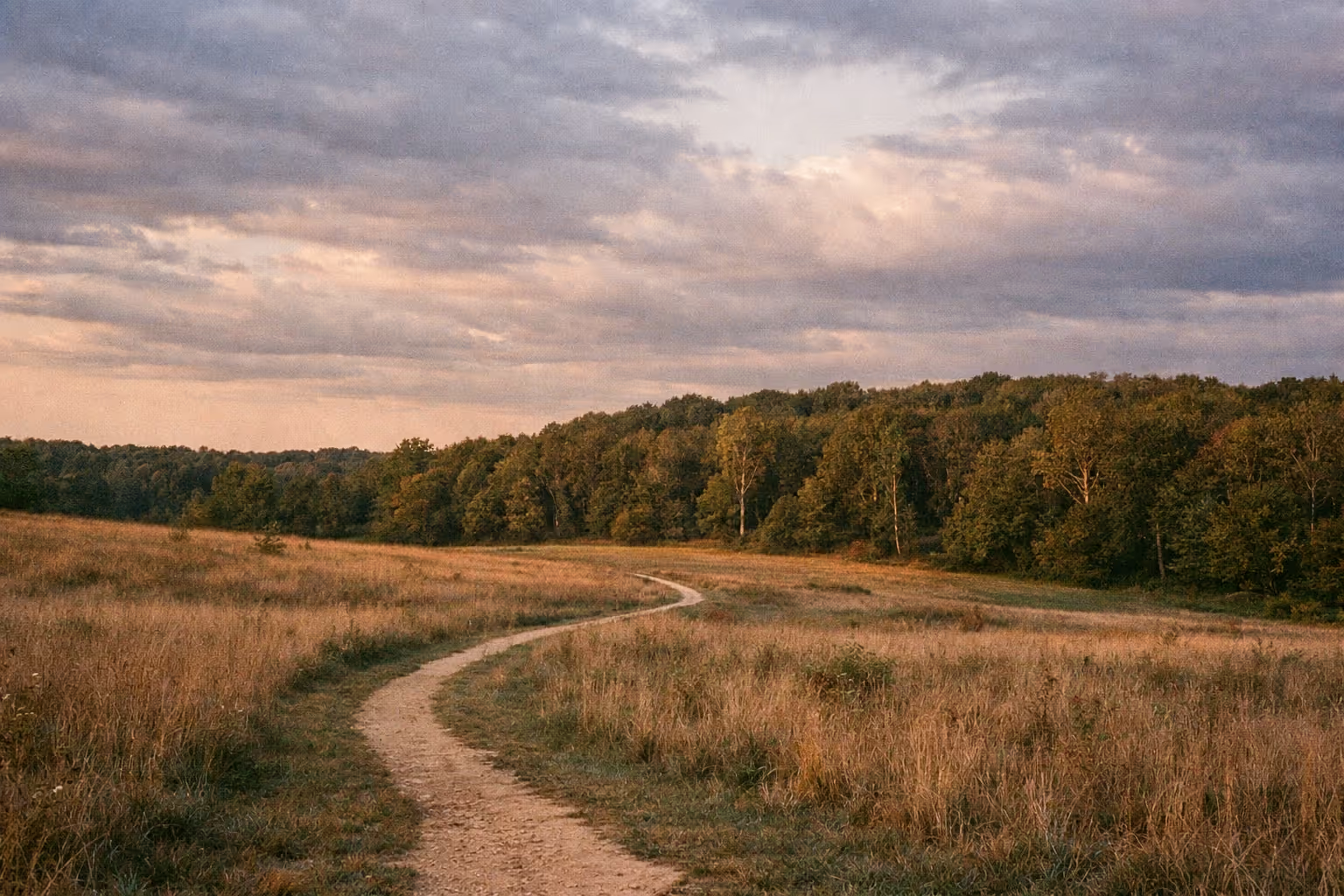
Okehocking Preserve serves hikers, birders, and dog owners on the same 180 acres, its charm and its friction both. Seven miles of trails, from a one-mile family loop to a six-mile creek circuit, cross land William Penn granted to the Lenni Lenape in 1701. Before you unclip the leash: the off-leash meadow is not fully fenced, so a dog without solid recall drifts toward the road. Admission and parking are free, but weekend lots fill by 10 a.m., and the meadow grass carries deer ticks in warm months.
What to expect
Okehocking Preserve packs a surprising amount of habitat into 180 acres: mown meadows, mature woods, wetlands, and the Ridley Creek riparian corridor (7)(10). That mix is why birders, photographers, and dog owners all end up here - often in the same morning, occasionally in each other’s way.
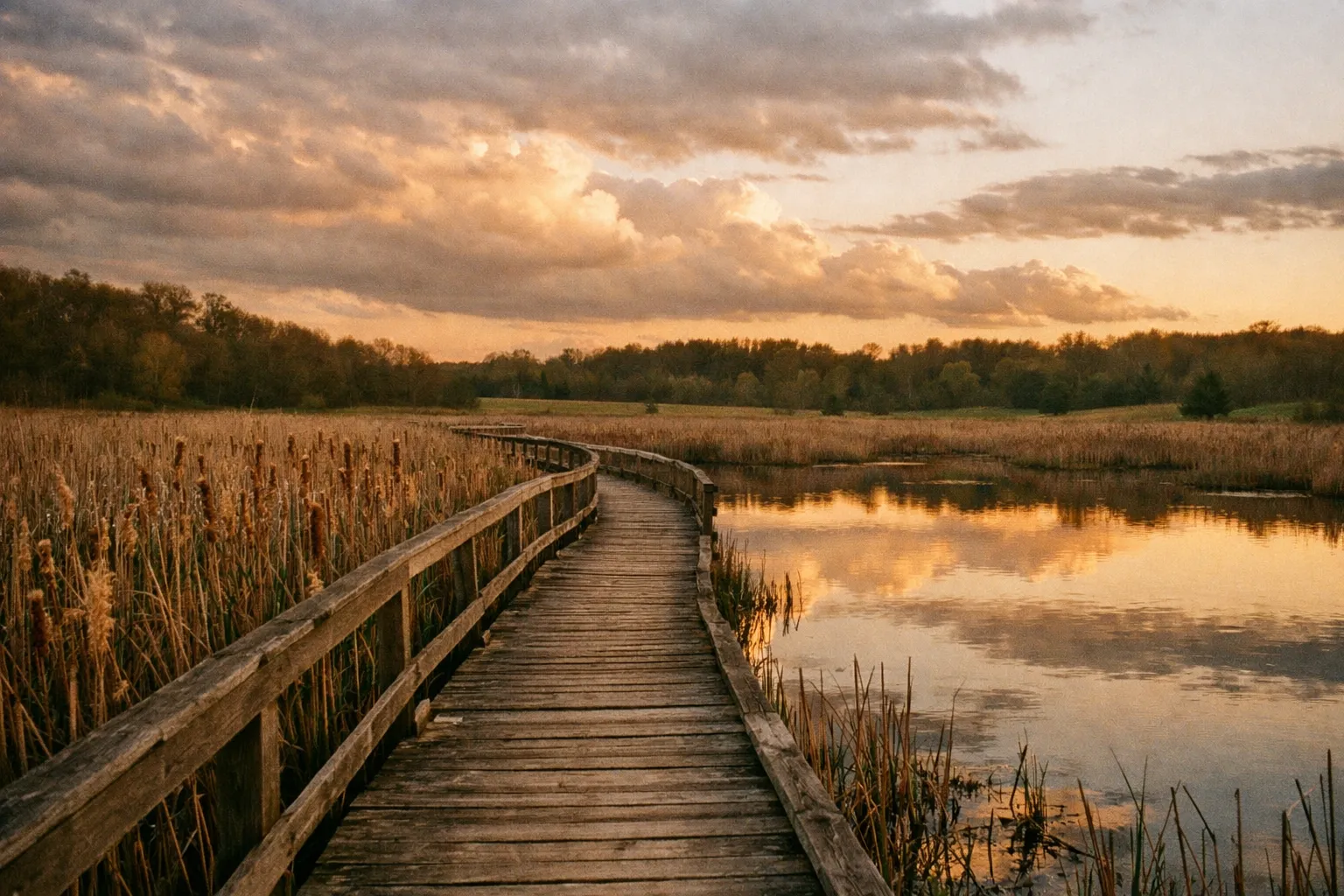
The trail system runs more than seven miles across mown grass and wooded natural-surface paths (7). TrailForks now maps 19 individual trails inside the Preserve, which means you can string together loops of almost any length - from a 1-mile family stroll to a 6-7 mile circuit (4). Near the Delchester Road entrance, there’s an off-leash dog meadow and, at the bottom of some trails, a brook that’s deep enough for dogs to swim in during warm months.
What most guides get wrong: they call it a fenced dog park. It isn’t. The off-leash field is not fully fenced, so a dog without solid recall can wander toward the road or into off-limits areas (5). Plan accordingly.
No drinking fountains, no shelters, no concessions. The Preserve is open dawn to dusk, seven days a week, with no seasonal closures - bring your own water.
✓ Pros
- Free access with dawn-to-dusk hours year-round
- Diverse habitats packed into a compact area
- Leash-free dog meadow with swimming brook
- Historical significance as a Penn-era Native American land grant
- Multiple trail loops ranging from 1 to 7 miles
✗ Cons
- Off-leash dog area is not fully fenced, requiring strong recall
- No water fountains or shelters on site
- Parking lots fill early on pleasant weekends
- Heavy deer tick presence in warmer months
- Trail system can be confusing without a map
Okehocking Preserve Trails and Trail Map
The trail network is denser than the acreage suggests. Willistown Township and local groups report more than seven miles of trails across 19 named routes. Older hiking blogs cite about 5 miles with 11 self-guided tour points, which suggests the system has been expanded or reclassified at some point - the Willistown Conservation Trust has added and remarked paths over the years as the Preserve absorbed adjacent parcels (1). TrailForks now maps all 19 trails, and the difference between the old 5-mile figure and today’s 7-plus miles is real: the newer outer loops push into the wooded creek corridor that wasn’t publicly accessible a decade ago.
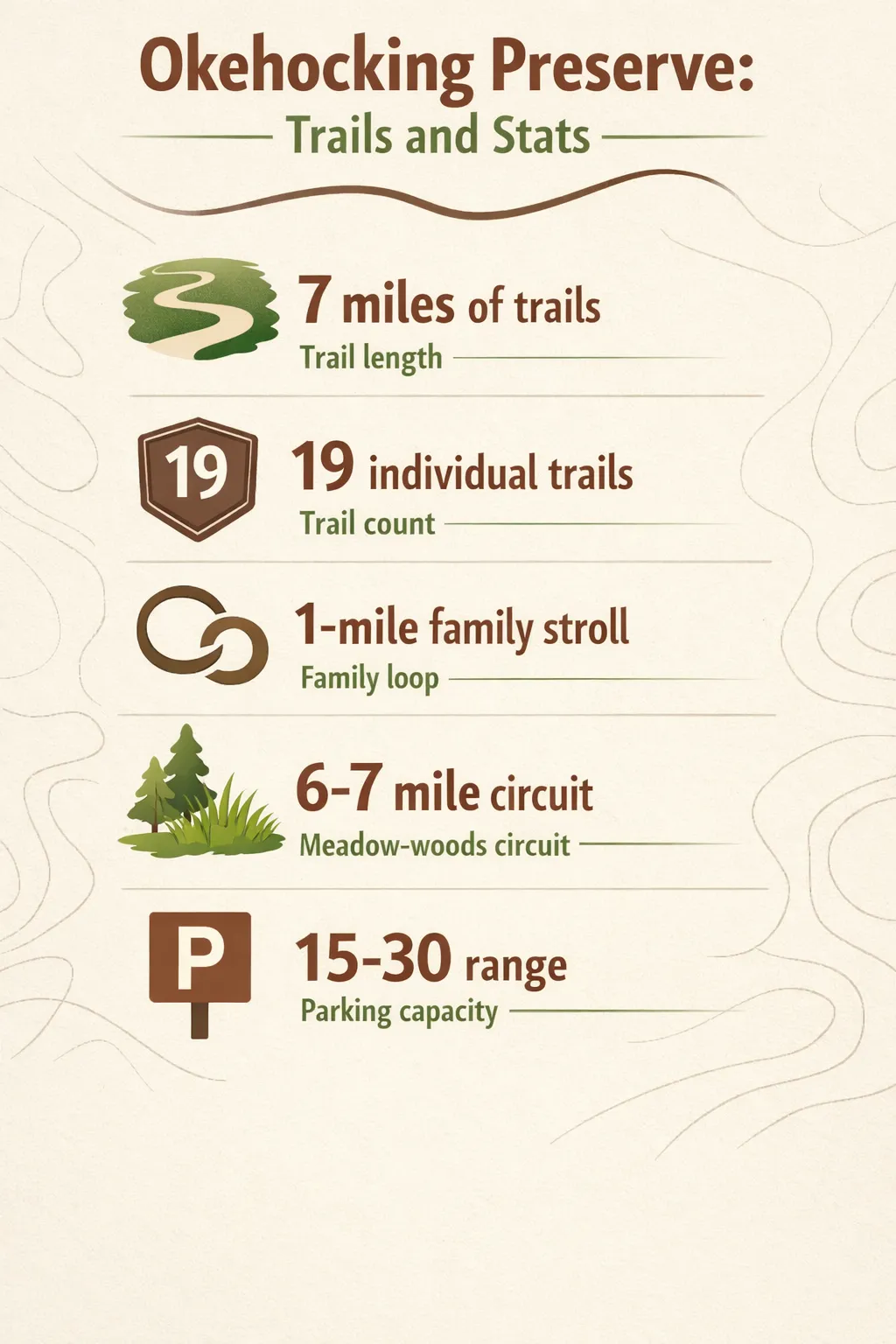 Seven miles of trails across 19 named routes, including a 1-mile family stroll and a 6-7 mile meadow-woods circuit, with two free parking lots offering 15-30 spaces.
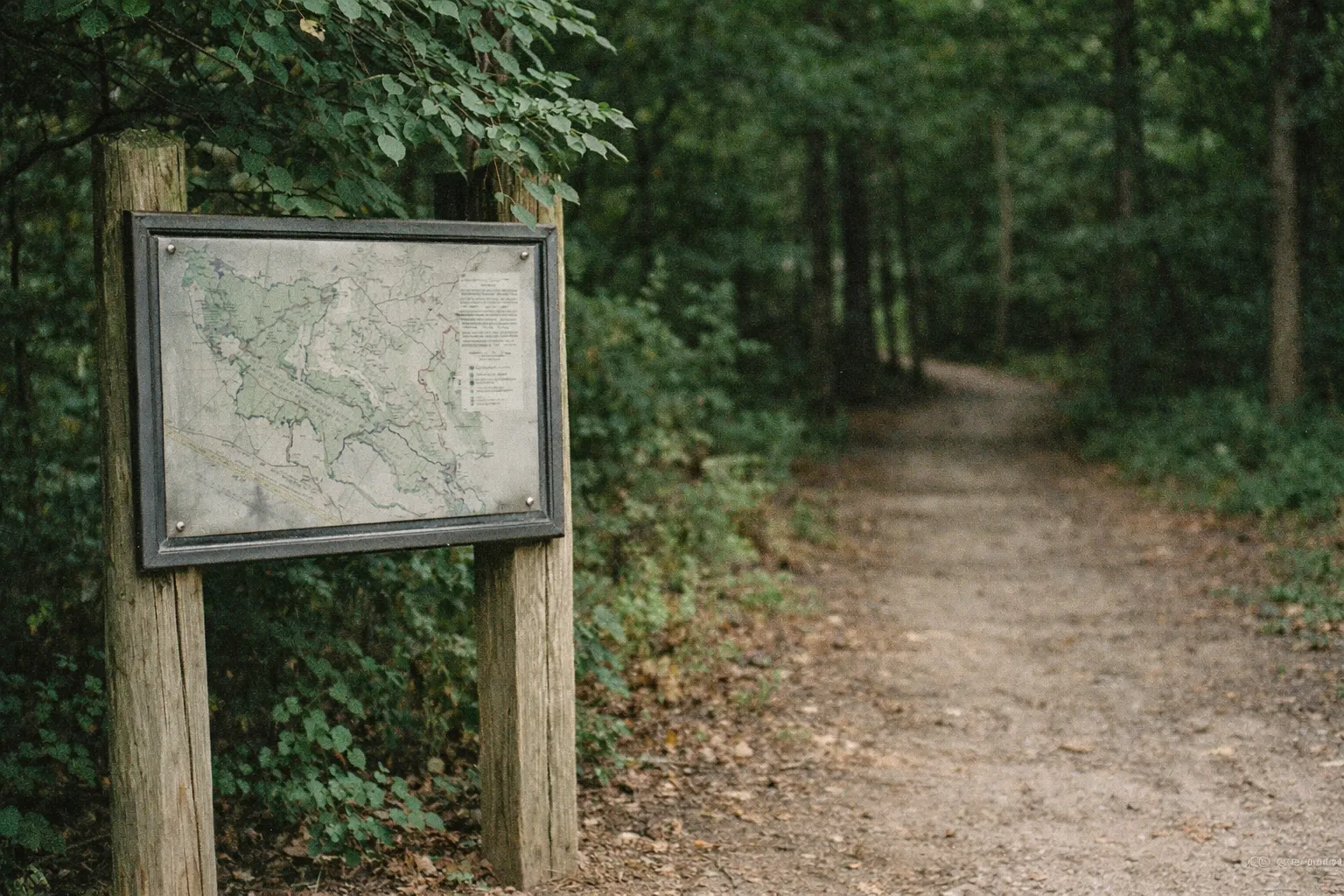
Here’s how the trails break down by use case, ranked by whether they’re worth your time:
- Worth the detour - the full meadow-and-woods loop. Link the marked and secondary trails for a 6-7 mile circuit covering meadows, woods, and Ridley Creek. Budget 3-4 hours at a moderate pace. This is the route to choose if you want variety without driving to a larger park like Ridley Creek State Park, which sits about 4 miles north and covers 2,606 acres.
- Worth it for families and dogs - the short Delchester loops. From the Delchester Road lot, the off-leash field plus nearby short loops make a 1-2 mile walk, 45-60 minutes, with minimal elevation gain.
- Worth it for runners. Rolling natural-surface trails make solid 5-7 mile trail runs. Wear trail shoes - there are roots, mud, and uneven ground throughout.
- Skip if short on time - the disconnected secondary spurs. Some secondary paths dead-end or duplicate ground you’ve already covered. Without a map, it’s easy to add miles you didn’t plan for.
That last point is the real reason to carry a map. With 19 named trails and a mix of marked and unmarked paths, new visitors routinely turn a planned 2-3 mile walk into a 5-plus mile slog and end up racing dusk (4). I’ve watched it happen from the parking lot - people heading back to their cars 45 minutes later than they intended, headlamps nowhere in sight.
Okehocking Preserve trail map
Download or print the Willistown Township Trail System Map before you arrive (7). The PDF - hosted by the township and by local watershed groups - shows marked versus secondary trails and clearly outlines the leash-free area, which generic mapping apps don’t. Cell signal in the wooded sections can be spotty, so a printout beats relying on your phone.
How to get there
The Preserve has two free parking lots, each serving different trailheads:
- 996 Delchester Road - serves the off-leash dog area and the meadow and woodland loops. Most dog owners use this one.
- 5316 West Chester Pike (Route 3) - gives quicker access to the wooded and creek-side trails.
Between them, the lots hold roughly a few dozen vehicles, with each fitting somewhere in the 15-30 range depending on configuration. On pleasant weekends they fill fast. Arrive before 9-10 a.m. if you want a guaranteed spot rather than roadside parking.
From Philadelphia: Take I-95 South, then connect west toward Route 3 (West Chester Pike) heading into Willistown Township. The Route 3 lot at 5316 West Chester Pike is the more direct approach from the east.
From West Chester: Head east on Route 3 toward Newtown Square. The Preserve is bounded by Route 3 to the south and Delchester and Garrett Mill Roads east-west (5). It’s roughly 6-8 miles out.
One navigation trap worth knowing: the Preserve uses a Newtown Square zip code but physically sits in Willistown Township, not Newtown Township(7). If you’re calling the township or troubleshooting a mapping app, that distinction matters more than you’d expect. Google Maps and Apple Maps both route correctly to the parking lots using the street addresses above, but searching “Okehocking Preserve” alone sometimes drops a pin on the wrong side of the Route 3 boundary - use the street address, not the name, for the final navigation step.
Cost to visit: Admission and parking are free. Your only real expenses are gas - figure $4-$10 for a 20-30 mile round trip - and whatever gear you bring.
How to Get to Okehocking Preserve
30 minutesStep-by-step directions and parking tips for visiting Okehocking Preserve.
- 1
From Philadelphia
Take I-95 South, then west on Route 3 (West Chester Pike) to the Preserve. Use the Route 3 parking lot at 5316 West Chester Pike for quickest access.
- 2
From West Chester
Drive east on Route 3 toward Newtown Square. The Preserve lies between Route 3 and Delchester/Garrett Mill Roads.
- 3
Parking
Choose between the Delchester Road lot for dog meadow access or the West Chester Pike lot for wooded trails. Arrive before 9-10 a.m. on weekends.
History
This is the part most “where to hike” articles skip, and it’s genuinely the most interesting thing about the place.
The Preserve occupies part of the original 500-acre Okehocking Reservation, granted by William Penn in 1701 to the Okehocking band of the Lenni Lenape(9). It’s regarded as one of the first Native American reservations in what is now the United States - a distinction documented by the Chester County Historical Society and referenced in Willistown Township’s own land records. Today, roughly 180 acres of that original grant survive as public open space - which is why this matters beyond a typical township park (9)(3). The remaining acreage was lost to private development over the 18th and 19th centuries; what exists now is what conservation easements and township acquisition managed to protect starting in the late 20th century.
The name carries the history. “Okehocking” is reported to translate as “encircling land” - from the Lenape “okay,” meaning encircled, and “hocking,” meaning land or earth.
The Willistown Conservation Trust has kept this heritage visible with events like the 2022 Lenape Sojourn, which interpreted the reservation’s history on-site (3). If you want to layer this into a visit, bring printouts on the Lenape Okehocking Reservation and read them at trail stops. Knowing the meadows and paths may follow historic routes changes how the walk feels (3)(9)(6). Budget 1-2 hours on-site plus some background reading if history is your main draw.
Dogs
Dogs are a big part of the draw here, and the rules are specific. There’s one designated leash-free zone - the meadow near the Delchester Road lot - and dogs must be on leash on every other trail (2)(10).
The catch, again: the off-leash field is not fully fenced (5). Recall training isn’t optional here - it’s the difference between a relaxed visit and your dog heading for the road. Community complaints about off-leash dogs have already pushed the township to discuss new or extended fencing near the Delchester entrance, including post-and-rail segments (2). Letting dogs off leash outside the designated meadow risks fines, conflicts, and tighter restrictions for everyone (2).
A few practical notes for dog visits:
- The brook at the bottom of some Delchester-side trails is deep enough for dogs to swim - a real highlight in summer.
- Carry waste bags and stay within the informal boundaries of the dog area. Keeping the township supportive of leash-free access is on the regular users (2).
- Typical off-leash visits run 45-90 minutes.
The bigger health issue is ticks - which hits dogs harder than people here.
Ticks, weather, and what to pack
No shelter at the Preserve, no water source. A little planning covers both.
Ticks are the real hazard. Recent 2025-2026 reviews report heavy deer tick presence, with at least one Yelp reviewer describing dogs “covered in deer ticks”. The tall meadow grass is the worst offender. Use tick preventative for dogs - monthly medications run roughly $20-$60 - and do post-hike checks on both dogs and yourself. Skipping this risks Lyme disease and other tick-borne illnesses. Late fall and winter are the safest seasons: ticks are dormant, vegetation is low, and the trails are actually easier to follow.
Weather and seasonal conditions. Check the regional forecast before you go - there’s nowhere to shelter from a thunderstorm except your car. In summer, heat indices in this part of Chester County can reach 90-100°F, so plan early-morning or late-afternoon hikes and carry 1-2 liters of water per person. Routes with wooded segments give you shade the open meadows don’t. In winter, wind chill can drop below 20°F and the ground near Ridley Creek gets icy. Spring meadows turn muddy, and by late summer the grass is deep - both make some paths harder to follow and increase tick exposure.
What to pack:
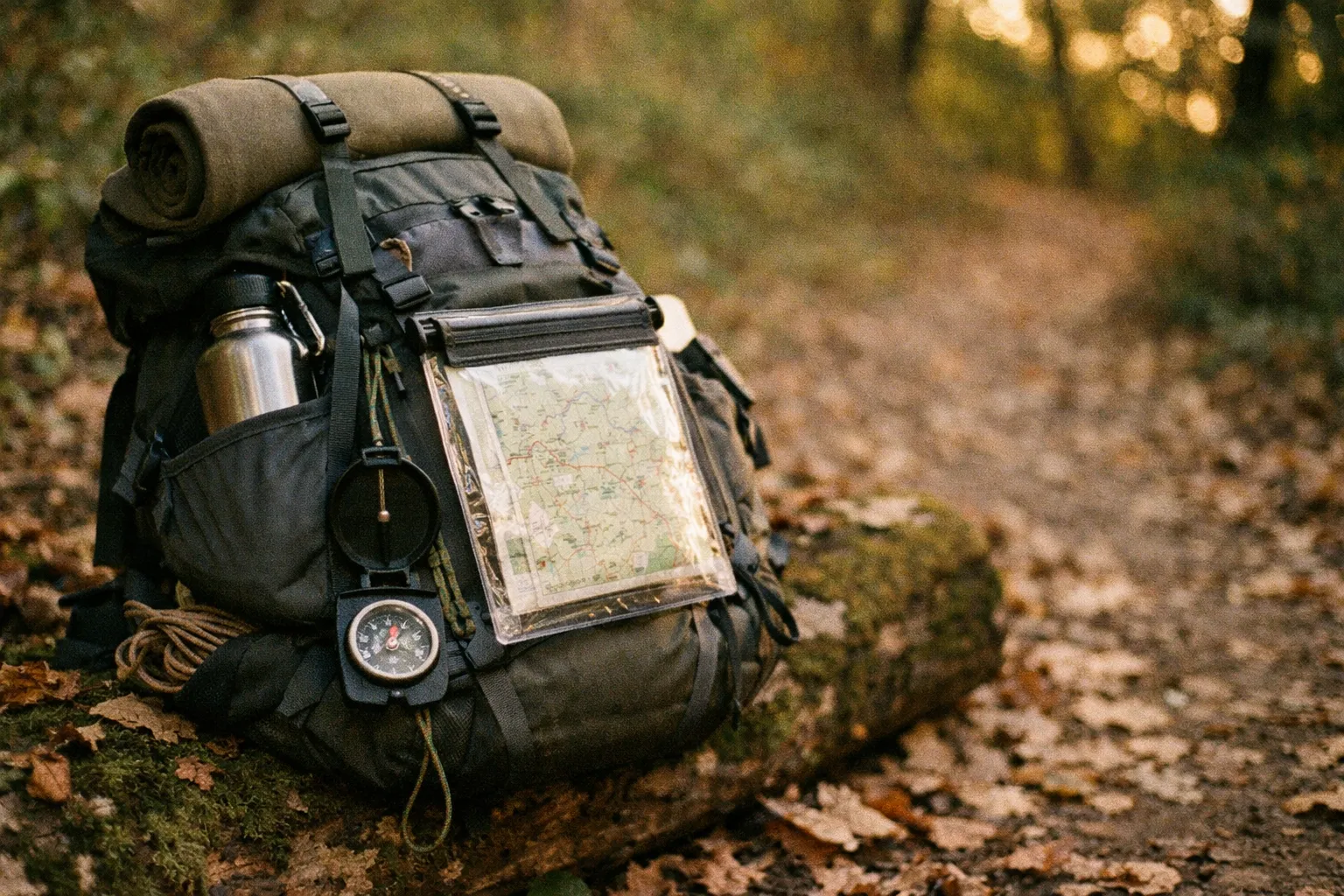
- 1-2 liters of water per person (no fountains on-site)
- Tick repellent and a plan for post-hike checks
- Trail shoes - the surface is uneven with roots and mud
- A printed Willistown Township trail map (7)
- Layers, since open meadows and shaded woods feel very different temperature-wise
What Visitors Are Saying
Visitor feedback is broadly positive, with consistent themes. People praise the variety of trails, the meadow-and-woods scenery, and the easy free access. Wildlife sightings come up often - deer, foxes, and the occasional eagle - and the riparian habitat along Ridley Creek makes it a reliable spot for seasonal birding, particularly during spring and fall migration when warblers move through the creek corridor. Dog owners consistently flag the off-leash meadow and the swimming brook as highlights.
The recurring complaints in Okehocking Preserve reviews are worth knowing before you go: deer ticks (the loudest recent gripe, with multiple 2025 reviewers on Google and Yelp specifically calling out the meadow grass as the worst zone), the lack of full fencing in the off-leash area, and weekend parking that fills early(2). None of these are dealbreakers. They’re just the things experienced visitors plan around. The tick issue in particular has pushed some regulars to shift their visits to November through February, when the meadow grass is low and deer tick activity drops sharply - a trade-off worth making if you’re bringing a dog without a current tick preventative.
Best time to visit
Best month: November. Ticks are dormant, the leaf-off canopy opens up long sightlines through the woods, and the parking lots don’t fill until mid-morning. You’ll also get the clearest views of the Ridley Creek corridor - in summer, the understory closes in and you’re hiking through a green tunnel. Temperatures in November typically run 40-55°F during the day, which is comfortable for a 2-3 hour loop with a dog.
Spring (March-May) is the second-best window for wildflowers and birding, but tick activity picks back up by late April and the meadow paths get muddy after rain. Summer works if you go early - before 8 a.m. - and stick to the wooded creek trails for shade. Avoid the open meadow loops between 11 a.m. and 3 p.m. in July and August when heat indices push past 90°F.
Booking mechanics note: Okehocking Preserve requires no reservation and charges no fee. The Willistown Township trail map PDF is updated periodically - check the Willistown Conservation Trust website before your visit to confirm you have the current version, since trail reclassifications have happened without much public notice.
Frequently Asked Questions
- How many acres is Okehocking Preserve?
- Okehocking Preserve covers 180 acres, encompassing meadows, mature woods, wetlands, and the Ridley Creek riparian corridor.
- What does Okehocking mean?
- "Okehocking" translates as "encircling land" in the Lenape language, from "okay" (encircled) and "hocking" (land or earth).
- What is the history of the Okehocking Preserve?
- The Preserve sits on part of the original 500-acre Okehocking Reservation, granted by William Penn in 1701 to the Lenni Lenape. About 180 acres survive as public open space.
- What is the longest hiking trail in Pennsylvania?
- The Mid State Trail is the longest at roughly 327 miles. Okehocking Preserve has over seven miles of trails in a compact area.
- What is the best hike in Pennsylvania?
- For dramatic terrain, Glen Onoko Falls and Pinnacle are top. Okehocking is notable for free access, dog-friendly areas, and Penn-era history near West Chester.
- Are dogs allowed off leash everywhere in Okehocking Preserve?
- No, only in the designated meadow near Delchester Road. Dogs must be leashed on all other trails.
- Is the off-leash dog area fenced?
- No, the off-leash meadow is not fully fenced, so dogs need reliable recall to prevent wandering.
- When is the best time to avoid ticks at Okehocking Preserve?
- Late fall and winter are best since ticks are dormant and vegetation is low, reducing exposure risk.
- Are there any facilities like water fountains or shelters at the Preserve?
- No, there are no drinking fountains or shelters; visitors should bring their own water and plan accordingly.
Bottom line
Okehocking Preserve is a low-friction stop: free, open dawn to dusk, and reachable in under half an hour from West Chester or Newtown Square. Come for a quick dog walk in the off-leash meadow, a 6-7 mile loop through meadows and Ridley Creek woods, or a history walk on land the Lenape received from William Penn in 1701 (3).
Do three things before you go: download the Willistown Township trail map, check the forecast, and pack tick repellent. Arrive before 10 a.m. on weekends. Everything else figures itself out.
And if you’re chaining destinations together, consider taking the road to Tennessee after this spot. For another quiet Pennsylvania escape, Cherry Springs State Park is worth the drive north.