The granite stairway beside Vernal Fall gets its name from the spray: in spring and early summer, the waterfall throws enough water across the steps that you climb through a steady soaking (1). The Mist Trail, a very popular Yosemite Valley hike (1), runs from Happy Isles to the top of Vernal Fall and on to Nevada Fall. Through October 2026, repair work closes the stairway section above the Vernal Fall Footbridge from Monday to Thursday in daytime hours, which makes the John Muir Trail the default detour on those days (1). This guide covers distances, elevation gain, water, closures, and the return route. It will help you pick a turnaround point (footbridge, Vernal Fall, or Nevada Fall) and a way back down that fit your legs, your clock, and the calendar.
✓ Pros
- You can choose a short outing or a strenuous summit hike without changing trailheads.
- The route puts you beside two major waterfalls rather than relying on distant viewpoints.
- The JMT gives you a less stair-heavy descent option when conditions allow.
✗ Cons
- Wet, polished granite makes the steepest section a poor place to rush or pass.
- The only water refill is early on the route and seasonal, so longer hikes require carrying most of your water.
- Closures can remove the waterfall stairway from your route even when the trailhead remains accessible.
Mist Trail Yosemite: Route Overview From Happy Isles
The Mist Trail starts at Happy Isles shuttle stop #16 in eastern Yosemite Valley and climbs past Vernal Fall to Nevada Fall. You return either the same way or by the longer John Muir Trail (1). The structure is simple. A paved, steady climb takes you to a footbridge. A short spur leads to a junction. From there, two trails head for the same high ground by different lines: the Mist Trail goes straight up beside the water, and the JMT switchbacks away from it.
Happy Isles to the Vernal Fall Footbridge
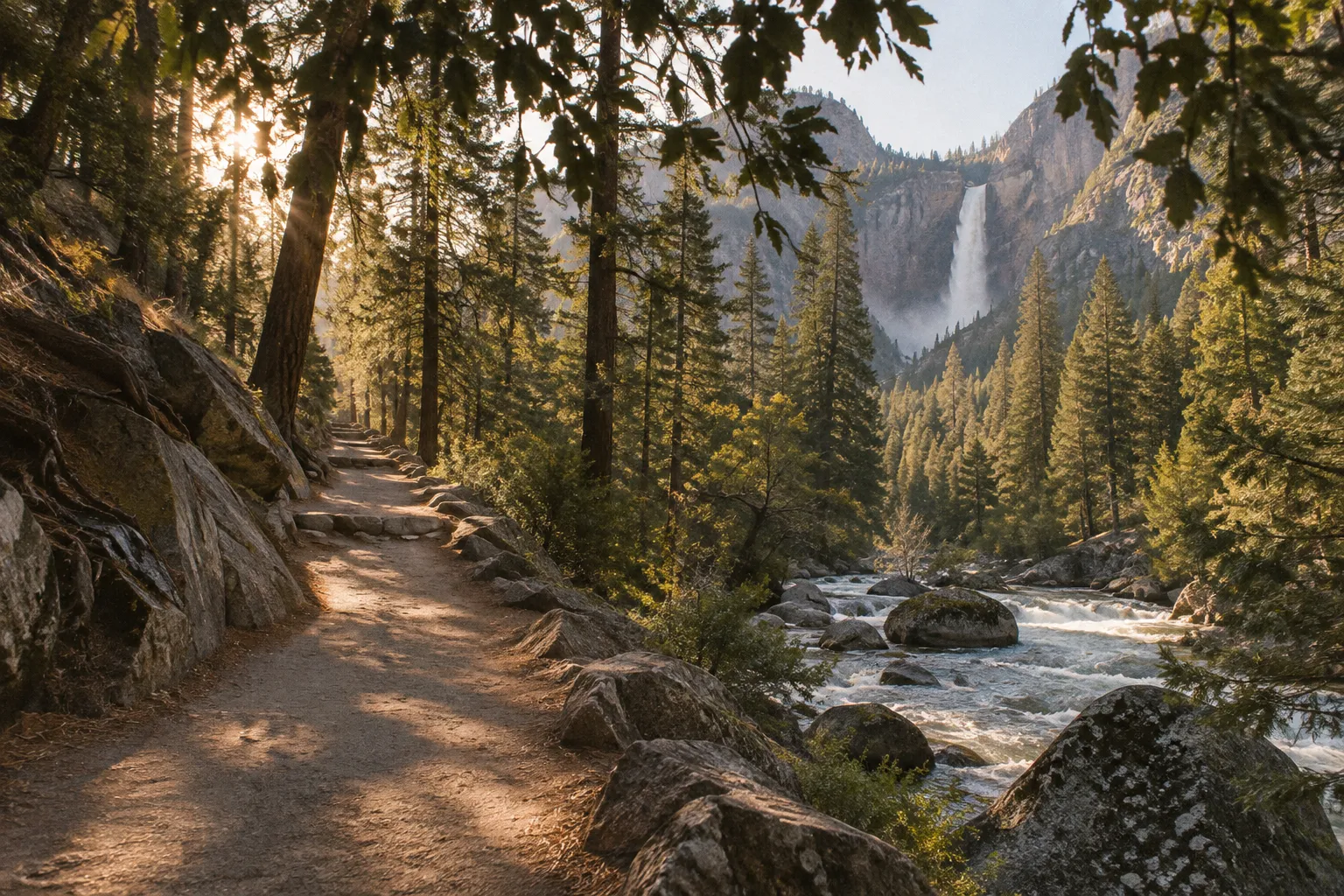
The Vernal Fall Footbridge is 0.8 mi (1.3 km) from Happy Isles. The out-and-back to the bridge is 1.6 mi (2.6 km) with 400 ft (120 m) of gain (1). This first stretch climbs steadily on a wide, well-used trail above the Merced River. The grade is noticeable, but it isn’t the part that wrecks people.
The footbridge itself is the first real stop. It gives you a straight-on view of Vernal Fall up the canyon. Past the tap at the trailhead shuttle stop, it has the only drinking water on the trail, plus a restroom, both available May through October (1). In spring, when water levels peak, you may be able to see Illilouette Fall from this first section of trail (1).
If you’re hiking with small kids, have a sketchy knee, or arrived without enough water, the bridge is a legitimate destination. It is not a consolation prize.
Where the Mist Trail splits from the John Muir Trail
The Mist Trail and the John Muir Trail split about 0.2 mi (0.3 km) past the Vernal Fall Footbridge (1). At the junction, the Mist Trail stays close to the river and heads for the stairway. The JMT climbs away on longer switchbacks toward Clark Point.
This junction matters more than usual in 2026. The closed section during weekday repair hours runs from this junction to the top of Vernal Fall (1). If you arrive Monday through Thursday between 7 a.m. and 3:30 p.m., the junction is where you turn onto the JMT, whether that was your plan or not. Read the signs here. Don’t assume the morning’s posted status still holds when you get there.
Mist Trail Difficulty: Segment by Segment
Mist Trail difficulty depends on your turnaround point. NPS rates the footbridge hike moderate, and it rates both the Vernal Fall and Nevada Fall hikes strenuous (1). The gap between those ratings is mostly steepness, not distance. Going from the footbridge to the top of Vernal Fall adds only 0.8 mi of round-trip distance but 600 ft (180 m) of additional gain, and most of that gain sits on stone steps.
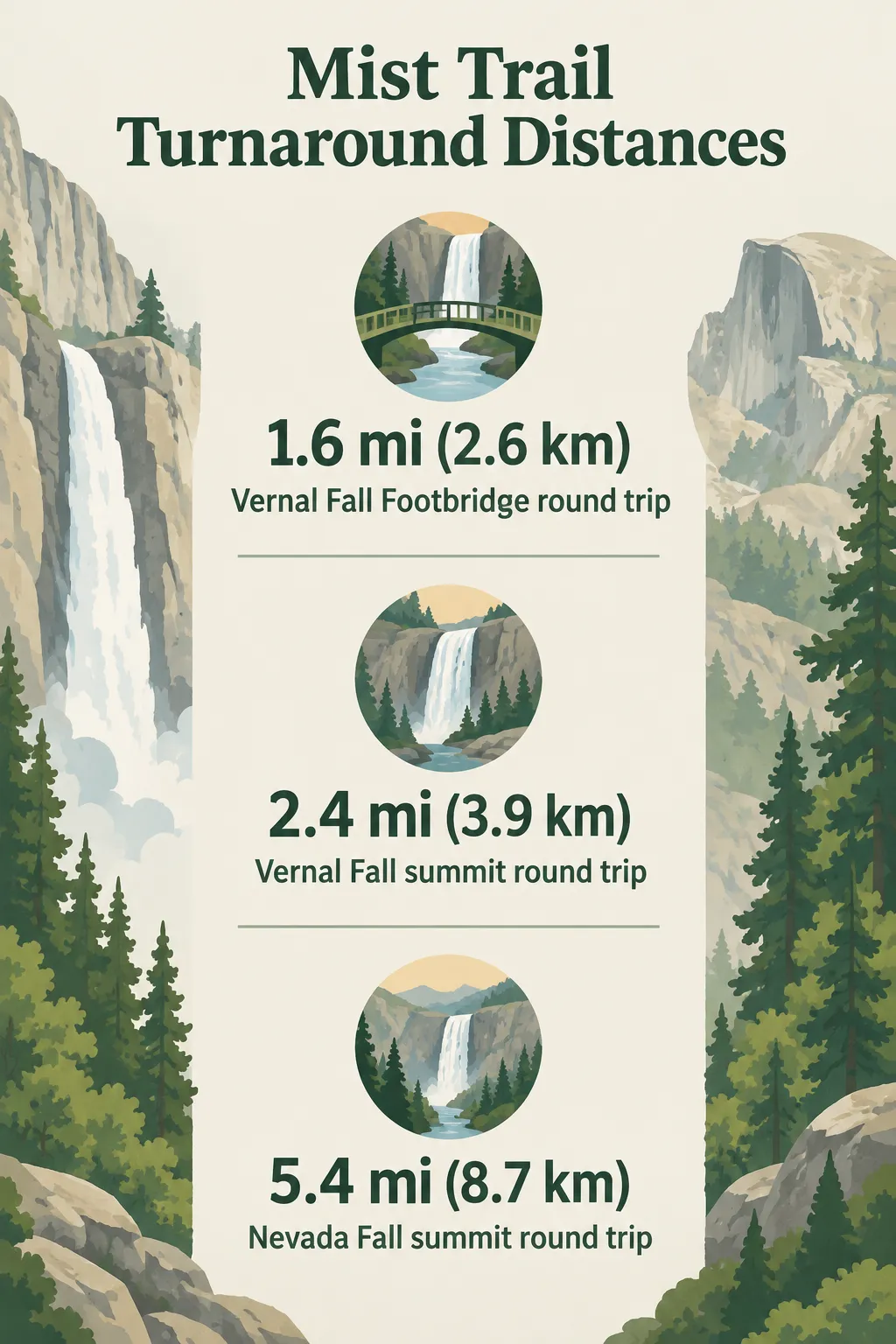 NPS-listed Mist Trail round trips range from 1.6 mi (2.6 km) to the Vernal Fall Footbridge to 5.4 mi (8.7 km) to Nevada Fall, with the Vernal Fall summit at 2.4 mi (3.9 km).
The hazards are specific and named. NPS identifies water, loose rock, and steep steps as footing hazards, and notes that sprained ankles and knee injuries are common on this trail (1). Wet granite is the main cause. The stairway takes spray for months in spring and early summer. Granite that’s been polished by thousands of boots and then coated in mist gives you less grip than you’d expect.
Footbridge hike: rated moderate
The Vernal Fall Footbridge round trip is rated moderate by NPS: 1.6 mi (2.6 km), 400 ft (120 m) of gain, and 1-1.5 hours (1). The trail is steady uphill without technical footing. The grade will get your heart rate up if you’re coming from sea level, but you don’t need to scramble.
For most fit adults, this is a warm-up. For families, older hikers, or anyone uneasy on stairs, it’s the full hike. The water, restroom, and view of the falls make it a complete outing.
Vernal and Nevada Fall hikes: rated strenuous
The defining feature of the Vernal Fall push is the stairway: more than 600 granite steps packed into 0.3 mi (0.5 km) from the junction toward the top of the fall (1). The steps aren’t uniform, and some are tall enough that shorter hikers will be using their hands or taking big step-ups. Coming down is harder on knees than going up. That’s why the return route question in a later section matters.
Nevada Fall adds rocky switchbacks above Vernal and doubles the elevation gain. Expect sustained climbing on uneven rock.
Here is the quick comparison:
- Vernal Fall Footbridge: 1.6 mi (2.6 km) round trip, 400 ft (120 m) gain, moderate, 1-1.5 hours (1)
- Top of Vernal Fall: 2.4 mi (3.9 km) round trip, 1,000 ft (300 m) gain, strenuous, about 3 hours (1)
- Top of Nevada Fall: 5.4 mi (8.7 km) round trip, 2,000 ft (610 m) gain, strenuous, 5-6 hours (1)
All three figures assume the Mist Trail both ways. Coming down the JMT changes the Nevada Fall numbers, as covered below.
Mist Trail Vernal Fall Hike: Distance, Elevation, and Views
The Mist Trail to the top of Vernal Fall ends beside a 317 ft (97 m) waterfall that you can look straight down from behind railings (1). This is the shortest strenuous option. It’s the one most people mean when they say they “did the Mist Trail.”
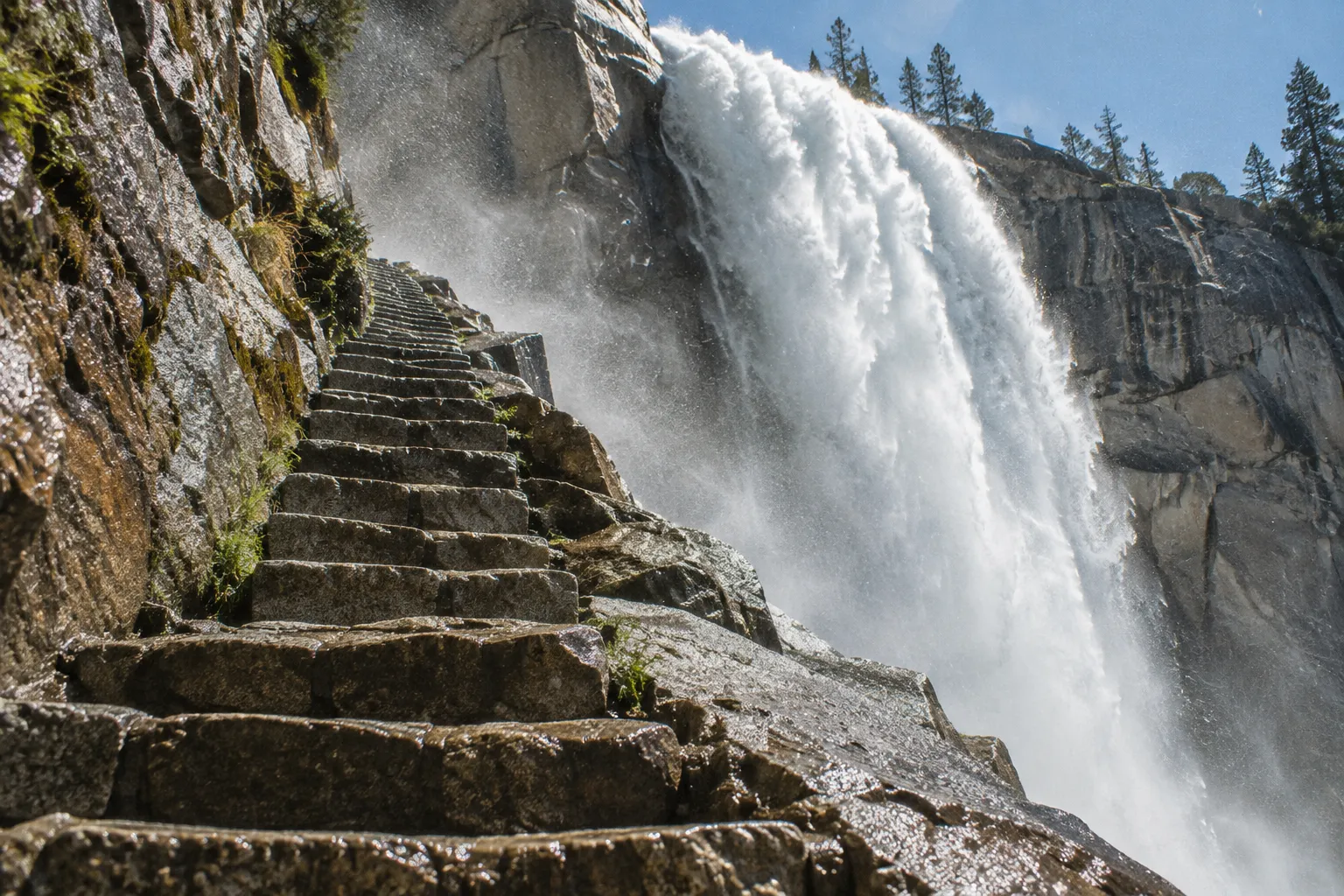
Along the way you get views of the Merced River and Yosemite Valley (1). The stairway climbs with the fall directly beside you, so you’re looking at moving water for most of the steep part rather than at the back of the hiker in front.
Footbridge to the top of Vernal Fall: distance and gain
The stretch from the Vernal Fall Footbridge to the top of Vernal Fall adds 0.4 mi each way and 600 ft (180 m) of the hike’s 1,000 ft (300 m) total gain. That stretch includes the stairway of over 600 granite steps (1). Put plainly: you’ve done 40% of the climbing at the bridge, and the remaining 60% comes in a much shorter distance.
From the bridge, walk 0.2 mi (0.3 km) to the junction. Then the steps begin: 600-plus over 0.3 mi (0.5 km) (1). Pace this section by breathing, not by the people around you. Stopping on the stairs is normal. Step to the side so you don’t block traffic coming down.
At the top, the trail levels out above the fall. Here you get the view down the full 317 ft (97 m) of Vernal Fall (1). Above the fall sits Emerald Pool, with the Silver Apron feeding into it: smooth, sloping granite with water sheeting across it. On a hot afternoon, after a sweaty climb, it looks like the obvious place to cool off.
Do not enter the water at Emerald Pool or the Silver Apron. NPS states that swimming there is illegal and dangerous because of the hazardous current (1). The water at the top of Vernal Fall is moving toward a 317 ft (97 m) drop. The calm surface of the pool doesn’t tell you what the current is doing, and the polished granite of the Silver Apron offers almost no grip if you slip.
Wet granite steps and where the spray hits hardest
The spray on the Mist Trail is heaviest on the granite stairway below the top of Vernal Fall during spring and early summer, when NPS says flow and spray peak (1). In that window, expect to get soaked from the shoulders down even on a sunny day. A rain shell is worth carrying. Cotton is a bad idea, because you’ll be wet in the shade on the way down. By later summer the falls shrink and the mist fades (4). The stairs are drier then, but the steps are just as steep.
Footwear matters more here than anywhere else on the route. NPS warns of slippery footing on the steps (1), and one trail guide insists on shoes with good traction (4). Translated into gear: you want a sticky rubber outsole with defined lugs. A rock-oriented shoe like the La Sportiva TX4 or a lugged hiker like the Merrell Moab 3 will grip wet granite better than worn running shoes or slick-soled casual sneakers. Waterproofing is optional. Grip is not.
Plant your whole foot rather than toeing onto step edges. On the descent, use the handrail where one exists and keep your weight over your feet rather than leaning back.
Mist Trail to Nevada Fall: Distance and Elevation Gain
The Mist Trail to Nevada Fall ends at the top of a 594 ft (181 m) waterfall (1). That’s double the gain of the Vernal Fall hike and more than double the distance. Treat it as a different outing, not “Vernal plus a bit.”
Nevada Fall is fullest in spring and early summer (1). In high water, the noise near the top makes conversation difficult. The payoff is a much bigger fall than Vernal, viewed from above, and a broader look at the granite around the upper canyon.
From Vernal Fall to the Nevada Fall footbridge
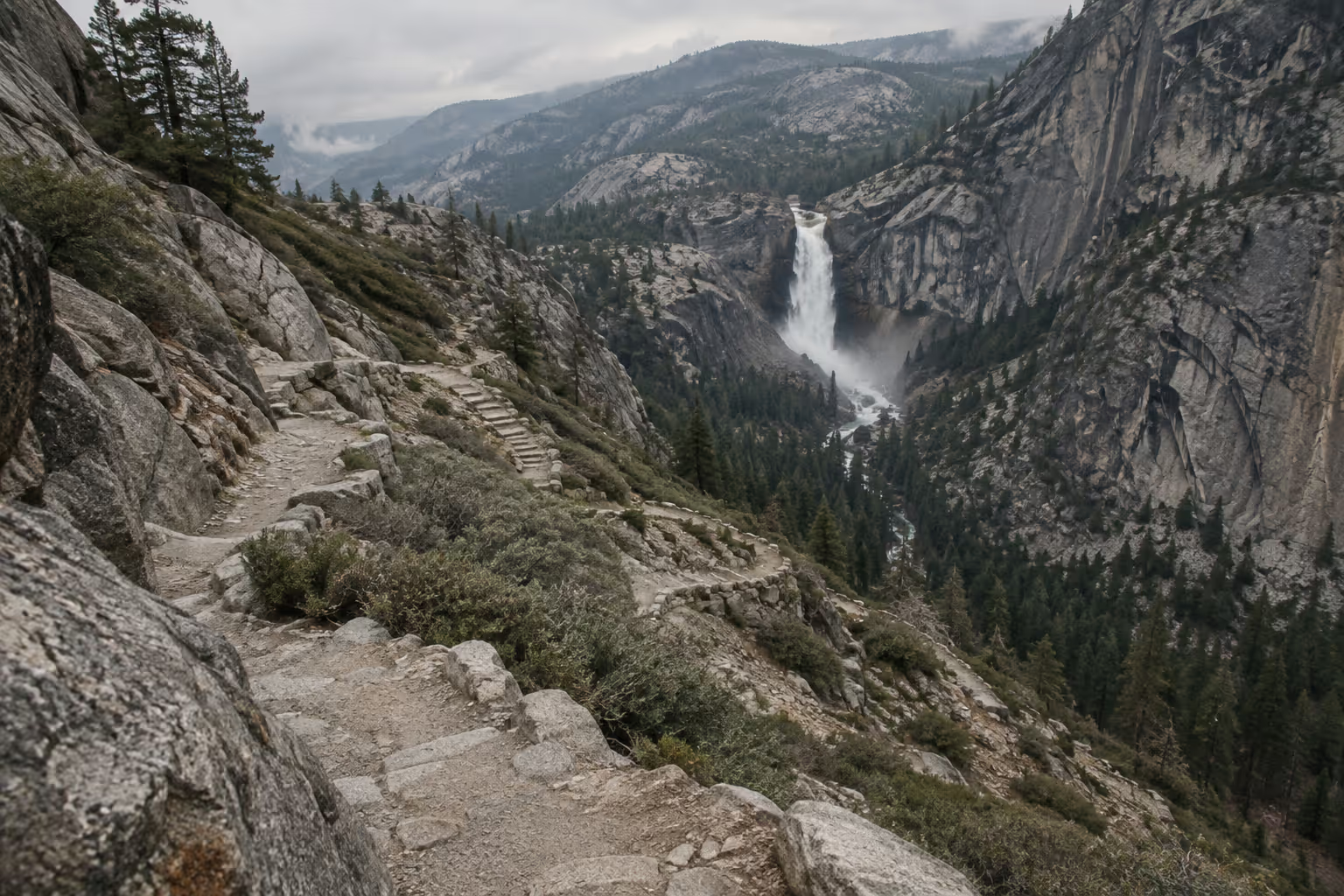
From the top of Vernal Fall, the Mist Trail climbs 1.5 mi (2.4 km) of steep, rocky switchbacks to Nevada Fall (1). After the stairway, this section feels different. It’s less a staircase and more a sustained grind on uneven rock, with steps and loose material mixed in. Loose rock is one of the footing hazards NPS calls out (1), and it gets worse on descents when tired legs stop placing feet carefully.
This segment carries the second 1,000 ft (300 m) of gain, the gap between the NPS figures for the two falls (1); one trail guide gives the same 1.5 miles and 1,000 ft for it and calls it steeper and more exposed than the Vernal Fall steps (2). Vault toilets are available at Nevada Fall (1), which helps on a long day.
At the top, you’ll reach the Nevada Fall footbridge. This is the decision point for your return. Cross it and you’re on the JMT. Stay on this side and you’re heading back down the Mist Trail. Some hikers continue from the top of Nevada Fall toward Half Dome (1); that hike and the park’s other headline sights are covered in our guide to the top things to do in Yosemite.
Pacing a strenuous climb: heat and hydration
NPS flags dehydration and heat exhaustion on this hike. Its advice is to pace yourself, drink often, rest in shade, and eat salty snacks (1). Carry the NPS-recommended 3-4 liters of water for this hike (1). Remember that the footbridge is your only refill on the trail, and only from May through October (1).
The 5-6 hour figure is hiking time. Add breaks, photo stops, a lunch at the top, and any detour, and a realistic day runs longer. Leave early enough that you aren’t climbing the switchbacks in the hottest part of the afternoon.
Pack a headlamp with fresh or spare batteries, as NPS advises, in case the hike runs late (1). Descending wet granite steps in fading light is how a sprained ankle happens. A compact light like the Black Diamond Spot 400 weighs little and prevents the “using my phone flashlight on wet stairs” problem. Put the spare batteries in a zip bag so the spray doesn’t get to them.
Turn around if you’re out of water, feeling dizzy, or behind schedule. Nevada Fall will be there next time. A descent on loose rock while dehydrated is where small problems become rescues.
The John Muir Trail Return From Nevada Fall
From Nevada Fall, the John Muir Trail return is about 4 miles (6.4 km) one way, compared with 2.5 miles (4 km) back down the Mist Trail (1). The JMT is longer, but it skips the steep wet stairway a second time. That trade is the whole decision.
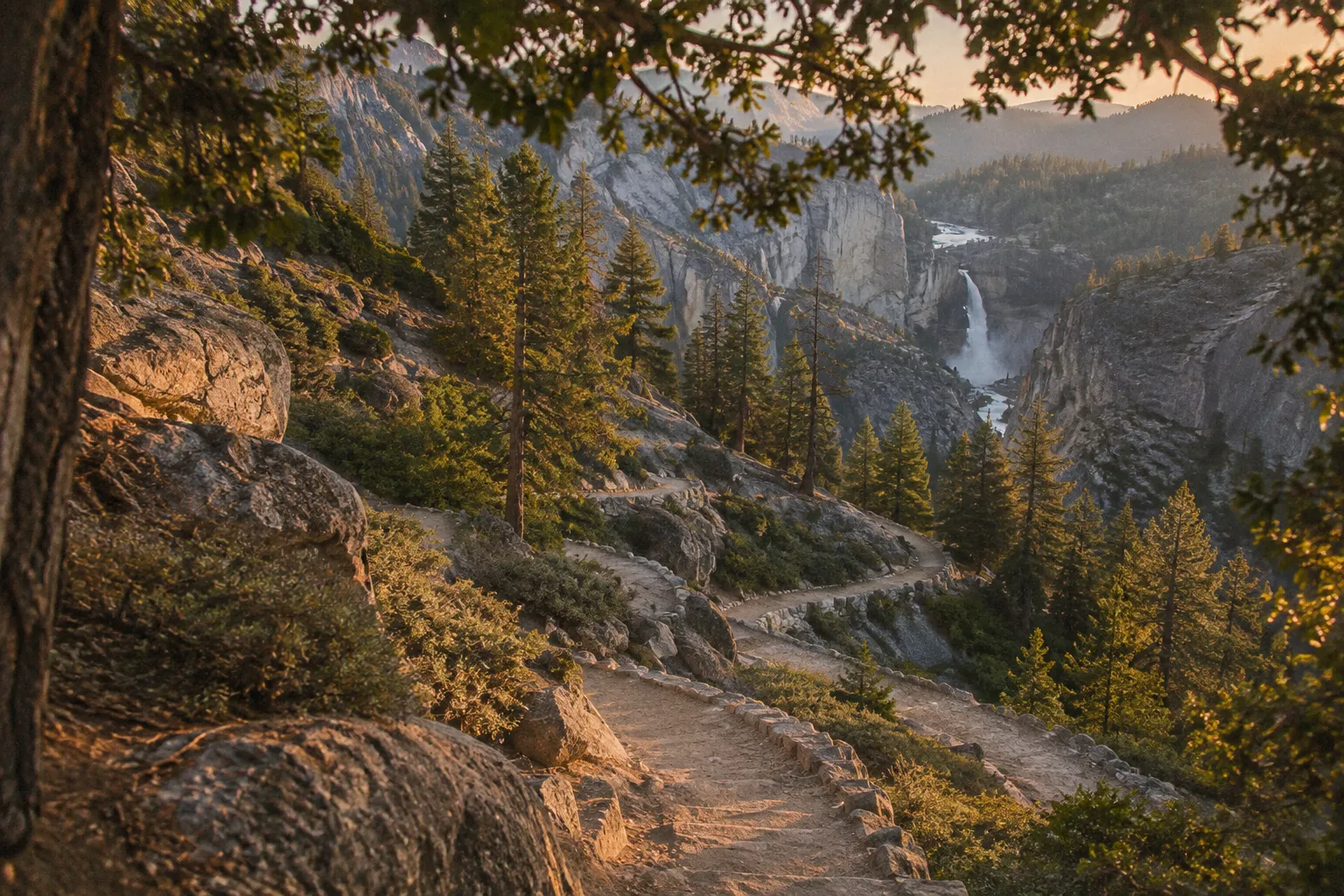
To take the JMT down, cross the Nevada Fall footbridge and follow the trail on the far side (1). NPS recognizes the Mist Trail up and JMT down as a loop (1). For a lot of hikers it makes the most sense, for one reason: going down 600-plus wet granite steps on tired legs is harder on your knees and riskier for your ankles than going up them.
The decision rule:
- Retrace the Mist Trail if you’re short on time, your knees are fine on steep descents, and the spray has eased. It’s the faster return at about 2.5 mi (4 km) (1).
- Take the JMT if your legs are cooked, your knees hate steep steps, the stairway is soaked, or the stairway section is under its Monday-Thursday repair closure. You add roughly 1.5 mi of walking, and the trail is a more even, switchbacking descent away from the spray.
Don’t assume the extra distance is quick just because the grade is gentler. NPS simply tells hikers to plan accordingly (1): budget extra time and water.
The JMT stretch known as the Ice Cut, between Clark Point and the Panorama Trail junction, was listed by NPS as open as of July 27, 2026, following repairs, and the trail page still listed it open on October 28, 2026 (1). Check it again before you go, because trail repair status changes.
You can also skip Nevada Fall and still avoid the stairway on the way down: NPS suggests continuing past the top of Vernal Fall and Emerald Pool, taking the cutoff trail to Clark Point, and hiking down the John Muir Trail (1). Follow the trail signage at each junction.
Seasonal Conditions, Closures, and the 2026 Repair Schedule
The Mist Trail closes for two reasons: winter ice on specific segments, and the 2026 repair project, which shuts the stairway above the footbridge from Monday to Thursday in daytime hours, July 27 through October (1). Season decides which version of the trail exists on the day you show up. Spring and early summer bring full flow and peak spray (1). Later summer brings smaller falls and drier steps (4). Winter brings snow or ice, and with it closures (1). As of October 23, 2026, NPS reported Vernal Fall and Nevada Fall as low (7), so a late-season hike brings little spray. If you’re choosing when to visit more than one park, our guide to the best national parks in the USA sorts them by region and season.
NPS says you can hike to both waterfalls all year: in winter, a specific route stays open while some sections close (1).
Why the Mist Trail closes on weekdays in 2026
The 2026 Mist Trail weekday closure covers the section from the John Muir Trail junction above the Vernal Fall Footbridge to the top of Vernal Fall. It runs Monday-Thursday, 7 a.m.-3:30 p.m., from July 27 through October, subject to change (1); the park’s conditions page, updated October 23, 2026, still listed it (7). The detour exists so crews can do Mist Trail repair work, and the JMT is the alternate route to the top of Vernal Fall during closed hours (1).
The section is open:
- Fridays through Sundays
- Holidays
- Mondays through Thursdays from 3:30 p.m. to 7 a.m., when safe (1)
This is the real gatekeeper for your trip. If the granite stairway is the reason you came, plan a Friday-through-Sunday or holiday visit. Your other option is to get through the closed section before 7 a.m. on a weekday. That means clearing the junction-to-top-of-Vernal stretch before 7, not starting from Happy Isles at 7. Getting from Happy Isles to the junction is 1.0 mi (1.6 km) of climbing before the stairs even start (1). An early start in the dark also means you’ll want that headlamp. Valley shuttles start at 7 a.m. (6), so a pre-dawn start means walking in from the Curry Village parking, less than 1 mile (1.6 km) away (1).
Coming down the stairway after 3:30 p.m. Monday through Thursday is another way to fit it in, if you’re comfortable descending wet steps late in the day. The “when safe” qualifier means NPS can keep it shut outside posted hours.
Winter: a marked detour via the John Muir Trail
In winter, NPS closes the lower Mist Trail beside Vernal Fall because of falling ice and rock, and the upper JMT between Clark Point and Nevada Fall because of icy conditions (1). The winter route to the top of Vernal Fall follows the John Muir Trail to Clark Point, where the JMT fork is gated; the left fork descends to the Mist Trail junction a few minutes upstream of Vernal Fall. Turn left there for the top of Vernal Fall, or right to climb the Mist Trail to Nevada Fall (5). The sections that stay open can still be very icy or snowy, so check current conditions before you commit (1).
Even the lower stretch to the bridge can need microspikes or extra caution. Closure start and end dates vary with conditions; NPS posts past opening and closing dates for this trail alongside its current-conditions page (1).
The upside: even a short winter walk to the footbridge still puts Vernal Fall in front of you (1).
Getting There, Water Refills, and Restroom Stops
The Mist Trail starts at Happy Isles shuttle stop #16. NPS directs hikers to use the Valleywide or East Valley Shuttle, because there is no parking at the trailhead itself (1). The nearest parking is at Curry Village, less than 1 mile (1.6 km) away (1). If you park there and walk, add that distance to both ends of your day. The Valley shuttles are free and run from 7 a.m. to 10 p.m. (6).
Pets, bicycles, and strollers are prohibited on the trail (1). If you planned to push a stroller to the footbridge, you can’t. A child carrier is the workaround for toddlers. Stay on the established trail. Keep food within arm’s reach and don’t feed the wildlife (1).
Water: one refill point, so carry most of it
Past the tap at the trailhead shuttle stop, the only drinking water on the Mist Trail is at the Vernal Fall Footbridge, available May through October (1). NPS recommends carrying:
- 1 liter to the footbridge
- 2 liters to the top of Vernal Fall
- 3-4 liters to Nevada Fall (1)
That’s a hard planning constraint. Outside May through October, there’s no refill on the route, so a full Nevada Fall trip means hauling all 3-4 liters from the trailhead (1). Even in season, the bridge is early in the hike. Top off there before the climb rather than counting on anything above it. Don’t plan on the river either: NPS tells hikers not to wade in it or walk along its edge (1). The safest plan is to carry what NPS recommends.
Restrooms along the route
Restrooms on the Mist Trail are at Happy Isles stop #16 and at the Vernal Fall Footbridge, about 1 mile up, May through October. Vault toilets are farther along, beyond Vernal Fall and at Nevada Fall (1). Use the trailhead facilities before you start. The next one is a climb away, and the bridge facility is seasonal.
Plan Your Mist Trail Hike
Check current trail status, choose a realistic turnaround point, and prepare for the route and conditions before leaving the Valley.
- 1
Check current conditions
Check the NPS current-conditions page the morning of your hike for seasonal closures and the weekday repair detour.
- 2
Choose your turnaround point
Pick the footbridge, top of Vernal Fall, or top of Nevada Fall based on your fitness and available time.
- 3
Get to the trailhead
Take the Valleywide or East Valley Shuttle to Happy Isles stop #16; before the 7 a.m. first bus, walk in from Curry Village.
- 4
Carry enough water
Bring 1 liter to the footbridge, 2 liters to Vernal Fall, or 3-4 liters to Nevada Fall; the footbridge is the only refill point.
- 5
Plan around the weekday closure
During the 2026 repair period, hike the stairway Friday through Sunday or on a holiday, or clear the closed section before 7 a.m. on a weekday.
- 6
Prepare for wet footing and low light
Wear shoes with grippy, lugged rubber soles and pack a headlamp with fresh or spare batteries.
Safety, Crowds, and Hiking With Kids
The Mist Trail is safe for kids only if you match the turnaround point to the child. The moderate footbridge hike suits most families. The strenuous stairway to Vernal Fall and beyond calls for steady footing and close supervision.
Start with the injuries NPS itself flags. Sprained ankles and knee injuries are common on this trail, driven by water, loose rock, and steep steps (1).
Stay behind the railings near the top of Vernal Fall and do not walk along the river’s edge. NPS warns visitors to observe railings and warning signs, and asks hikers not to cross the railings at the top of the 317 ft (97 m) fall (1). The view over the edge is the same from behind the rail.
Picking a kid-friendly turnaround point
For young kids, the Vernal Fall Footbridge is the right destination: it is the only turnaround NPS rates moderate (1). It has water and a restroom in season (1) and a full view of the fall. Strollers aren’t allowed (1), so plan on a carrier for kids who can’t walk the distance.
Older kids who handle steep stairs well can attempt the top of Vernal Fall. Keep these conditions in mind:
- Hold hands or stay within arm’s reach on the stairway, especially when it’s wet.
- Make the railing rule absolute before you reach the top, not after.
- Set the “no water” rule at Emerald Pool and the Silver Apron in advance. Kids see a pool. You need to see a current above a cliff (1).
- Leave time for the descent, which is harder than the climb on short legs.
Nevada Fall is a big day for adults. It suits only experienced young hikers with real stamina and enough water carried by the adults.
Crowds on the stairway
Crowding on the Mist Trail concentrates on the narrow granite stairway below the top of Vernal Fall. Uphill and downhill traffic share the same wet steps there, and passing room is limited. Crowding raises the footing risk: people stop suddenly, step around each other onto wetter rock, and rush to keep up.
Crowds build through the morning: one trail guide describes a line of hikers on the staircase by 10 a.m. on a spring weekend (2), and in 2026 Fridays through Sundays and holidays are also the only days the stairway is open in daytime (1). An early start helps for both reasons. When it’s congested, slow down, step aside at wider spots, and let faster groups pass rather than hurrying on wet stone. If the crowd makes you uneasy, the JMT is the calmer, longer alternative for the return.
Frequently Asked Questions
- How difficult is the Mist Trail, and where should I turn around?
- The footbridge is the moderate option; continue to Vernal Fall or Nevada Fall only if you're prepared for sustained strenuous climbing and steep, wet footing.
- Why might the Mist Trail be closed when I arrive?
- Repair work and winter ice can close different sections, so check the NPS current-conditions page on hike day rather than relying on an older schedule.
- What is the prettiest hike in Yosemite?
- There is no single objective answer; choose the Mist Trail for close waterfall views, then compare it with routes focused on domes or high-country lakes.
- Is the Mist Trail safe for kids?
- The footbridge is the most manageable family turnaround; beyond it, wet steps and exposed waterfall terrain call for close supervision and sure footing.
- Can I return from Nevada Fall on the John Muir Trail?
- Yes; cross the Nevada Fall footbridge and follow the JMT, but allow extra time because its gentler descent is longer than the Mist Trail.
- Can I refill water above the Vernal Fall Footbridge?
- No; NPS lists the footbridge tap (May to October) as the only drinking water on the trail, so carry enough for the climb and the return.
- Are Yosemite Valley buses free?
- Yes; the Valleywide and East Valley Shuttles are free, serve Happy Isles stop #16, and run from 7 a.m. to 10 p.m.
Choosing Your Turnaround and Return
Pick your turnaround by fitness and time, carry the water NPS recommends for that segment, and treat the 2026 weekday closure and winter ice as hard gates. The morning of your hike, check the NPS current-conditions page before you choose between the Mist Trail and the John Muir Trail (1); the posted status is the one that counts.