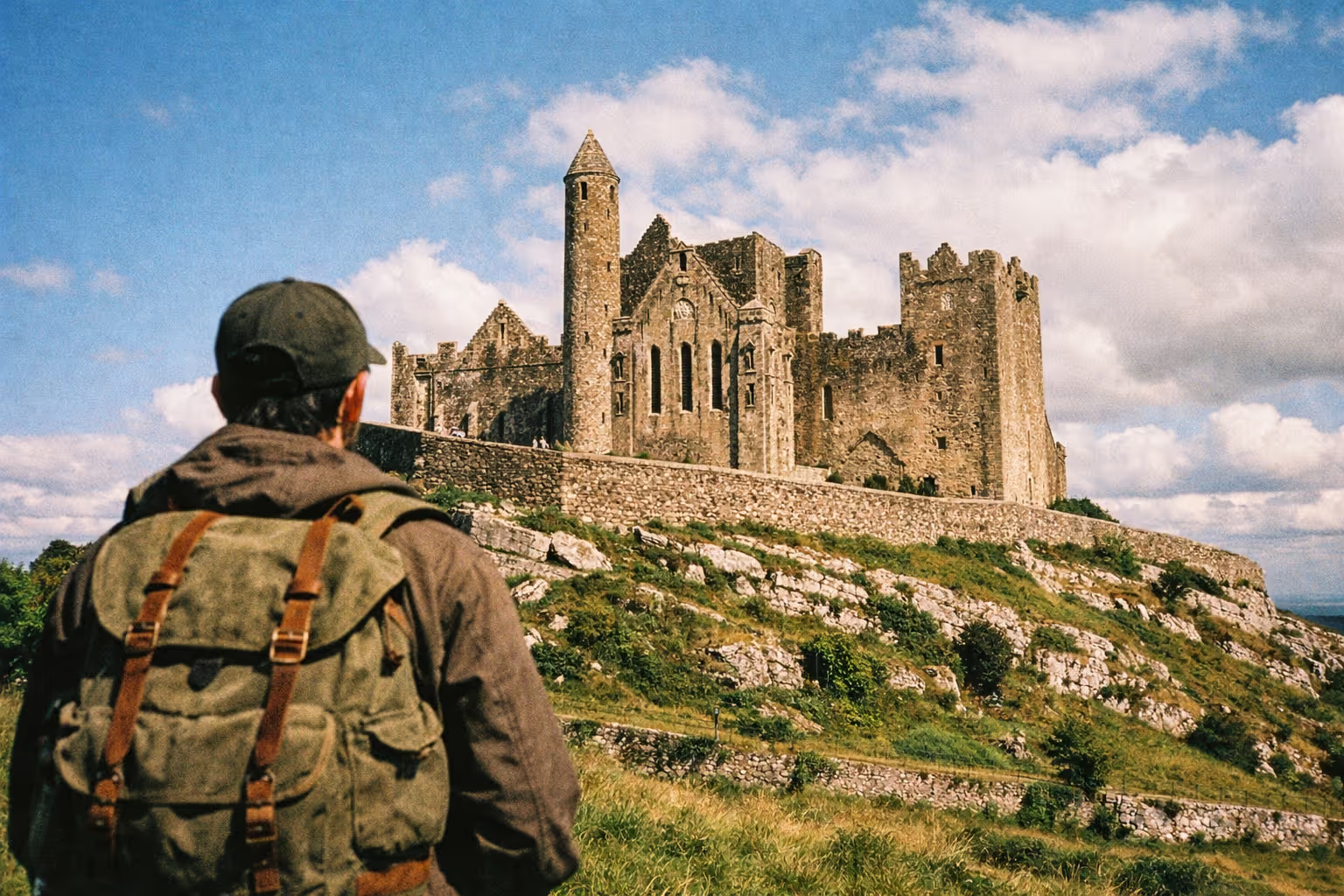
Munster Ireland is the island’s largest province by area, which is exactly why treating it as one destination backfires. Six counties (Clare, Cork, Kerry, Limerick, Tipperary, and Waterford) hold the Cliffs of Moher, Blarney Castle, the Ring of Kerry, and the Slea Head Drive, spread far enough apart that a car is non-negotiable. The workable plan is three to seven days across two or three counties, based in Cork or Killarney. Try to sweep all six and you will spend the trip behind the wheel.
Which part of Ireland is Munster?
Munster is one of Ireland’s four historic provinces, sitting in the southwest alongside Leinster, Connacht, and Ulster. It covers six counties: Clare, Cork, Kerry, Limerick, Tipperary, and Waterford (4)(9).
Here’s a common point of confusion: Munster isn’t a town or a single county. It’s a province. People often use “Munster” to mean Cork, but Cork is just one part of it (1). If someone says they’re heading to Munster, it’s worth asking which county - the province spans about 24,684 km² (9,531 sq mi), making it Ireland’s largest province by land area (4)(9).
It’s also the third most populous province, with a 2022 population of 1,373,346 (4). The main urban centers you’ll pass through are Cork city, Limerick city, Waterford city, Killarney, Tralee, and Ennis.
Reading a Munster map of Ireland: Most travel maps break the province down by county rather than outlining Munster’s full boundary. When you look at a Munster map of Ireland, orient yourself by county lines. Kerry and Cork occupy the southwest corner; Clare is up in the northwest along the Atlantic; Limerick and Tipperary sit inland; Waterford hugs the southeast coast. Flying into Shannon Airport works best for Clare and the northern counties, while Cork Airport is the logical entry for the south. Both help minimize long drives across the province.
What is Munster Famous For?
Munster packs a lot into one region - rugged coastline, medieval castles, monastic ruins, and a deep well of traditional music (1)(4). If you picture Ireland’s classic sights, many belong here.
The top draws include:
- Cliffs of Moher (County Clare) - towering 214-meter sea cliffs and one of Ireland’s most visited natural landmarks.
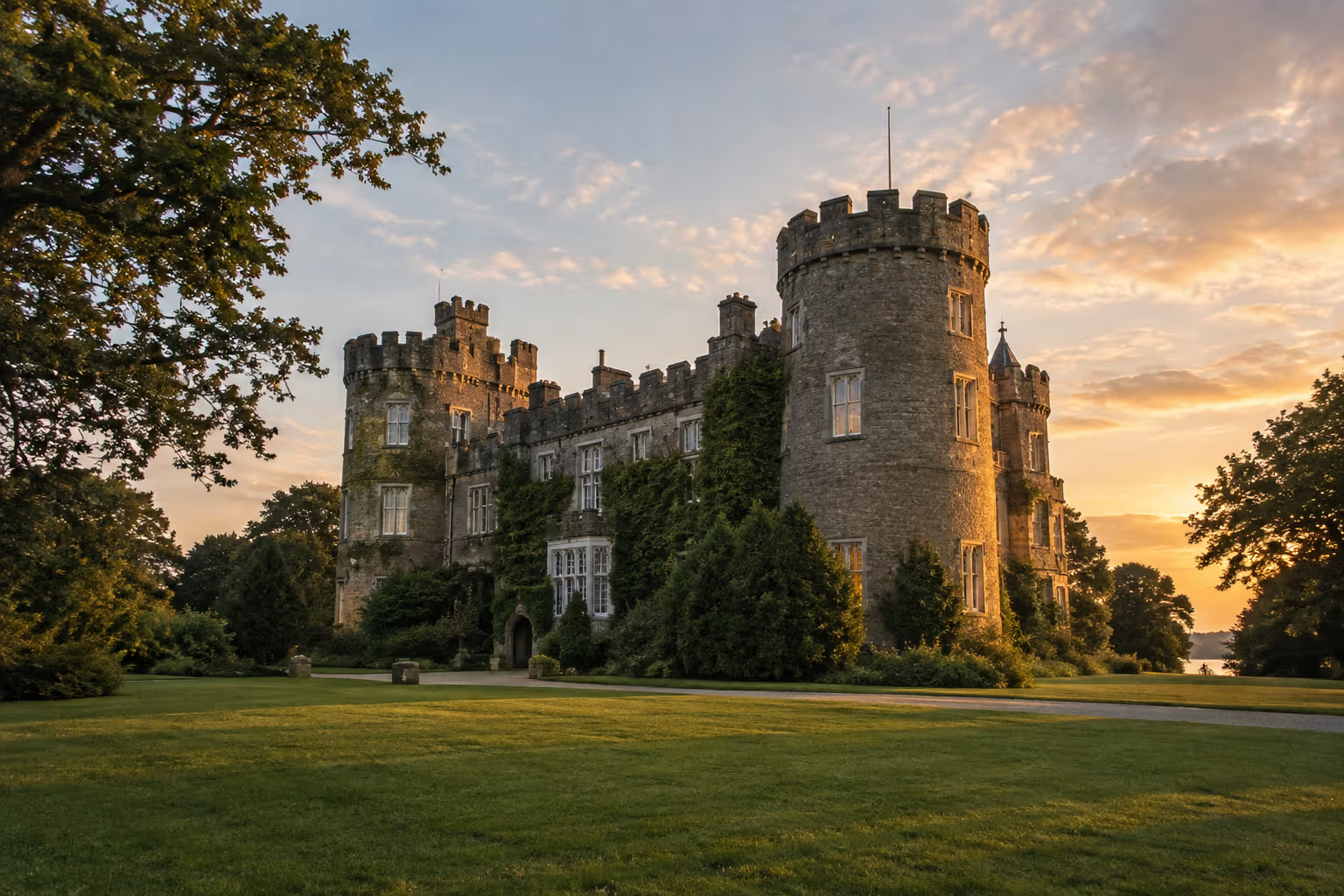
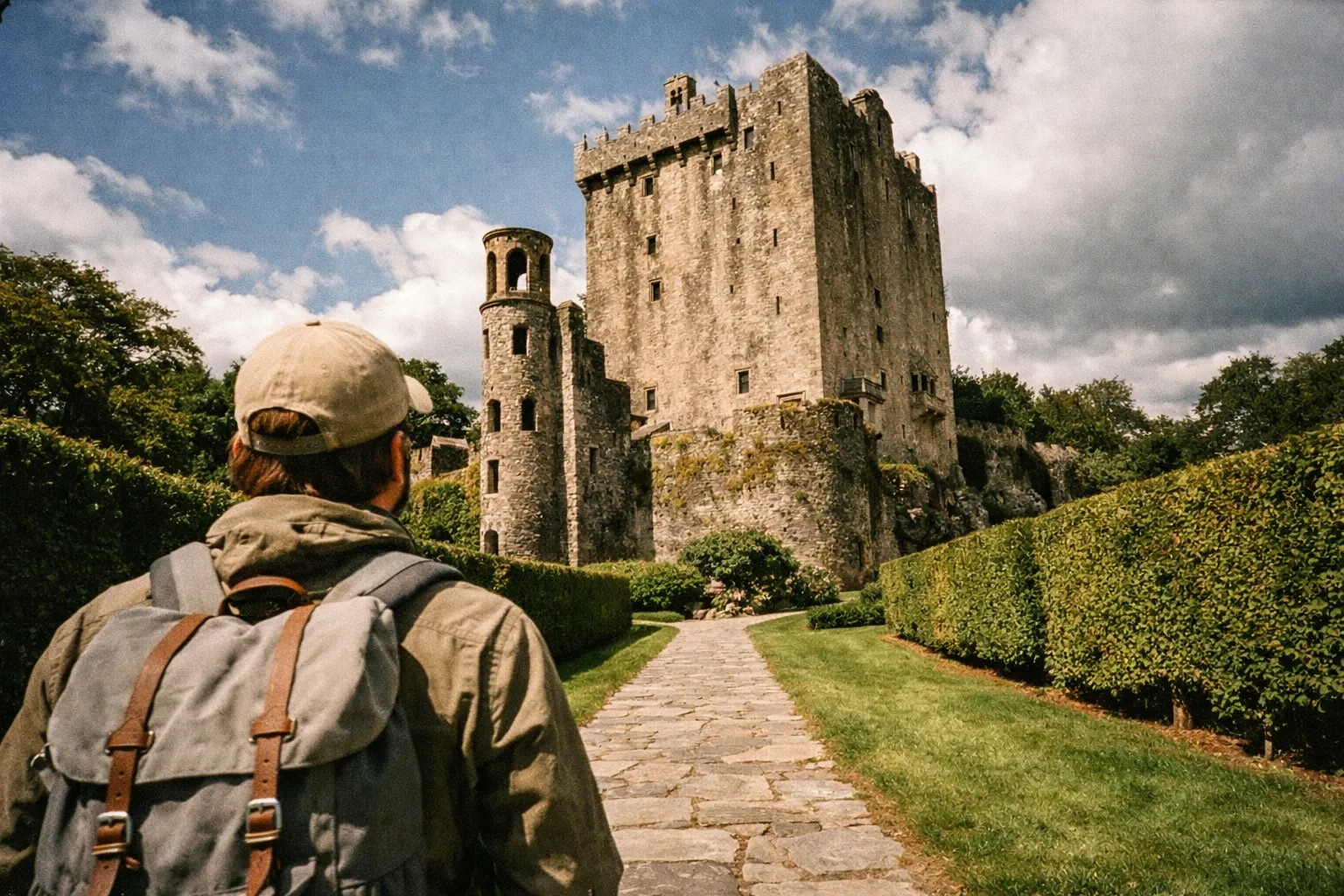
- Blarney Castle (County Cork) - home to the Blarney Stone, famous for granting the “gift of the gab.”
- Killarney National Park (County Kerry) - lakes, mountains, and Ireland’s first national park.
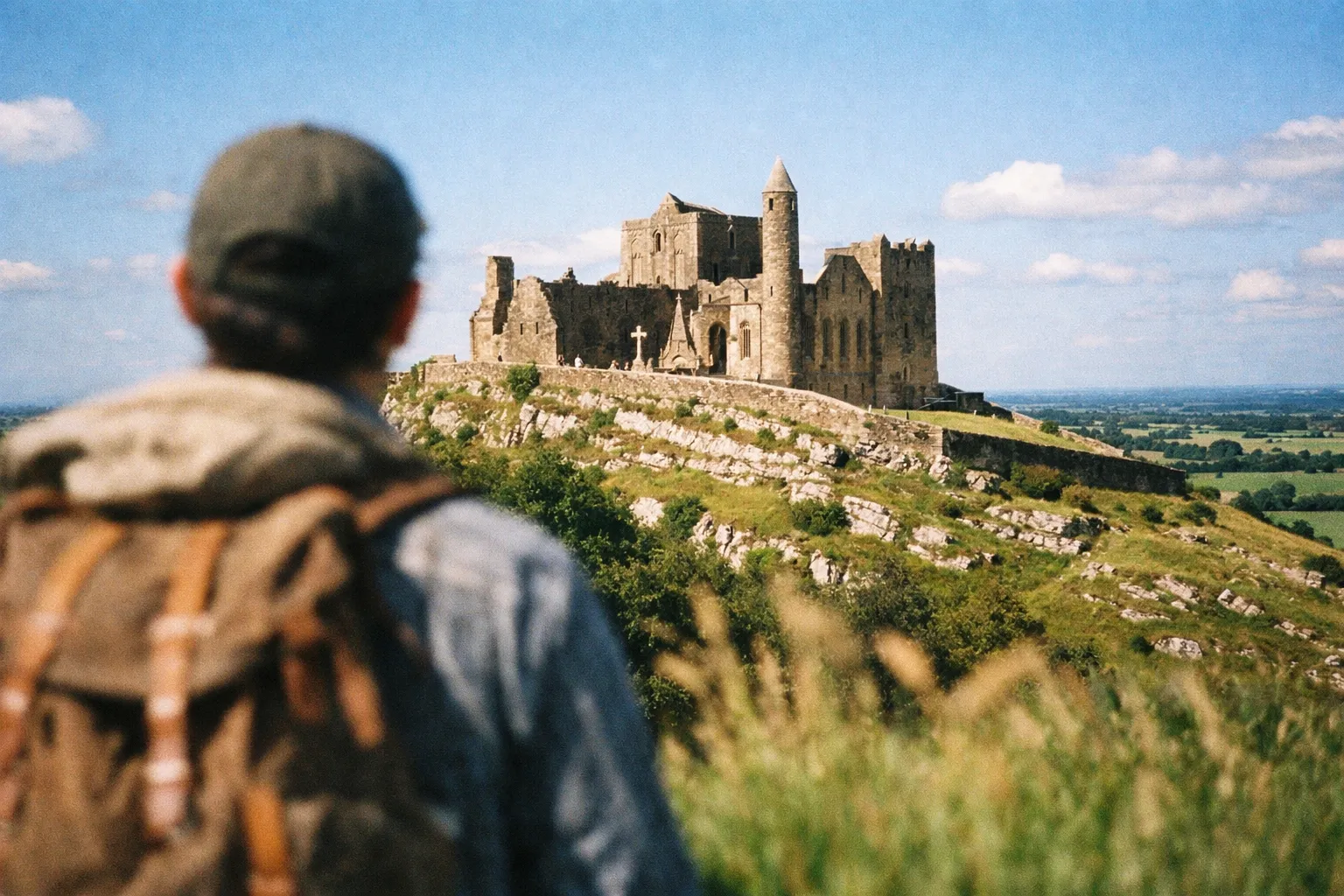
- Rock of Cashel (County Tipperary) - the ancient seat of Munster’s kings, with 365,505 visitors in 2024, up from 357,273 in 2023, making it the third most visited heritage site managed by the Office of Public Works (6).
- Waterford crystal (County Waterford) - Ireland’s oldest city and its centuries-old glassmaking tradition.
- Bunratty Castle and the harbor town of Kinsale - both regularly recommended stops (6).
Munster also carries a strong sports identity. It’s a heartland for Gaelic Athletic Association (GAA) games - both hurling and Gaelic football. County Kerry, known as “the Kingdom,” has won the All-Ireland Senior Football Championship more times than any other county (1). Cork has its own reputation, sometimes calling itself “the People’s Republic of Cork.”
Unveiling the rich history of Munster
Munster’s history stretches back to Ireland’s earliest days, with layers of power struggles and cultural change shaping the landscape you’ll see today.
The province was once split into two powerful kingdoms: Desmond in the south and Thomond in the north (9). That division dates to 1118 and marked a turning point. The Eóganachta dynasty ruled from the 7th to 10th centuries, leaving a lasting cultural imprint.
Then came the Dál gCais dynasty in the 10th and 11th centuries, whose most famous figure was Brian Boru, High King of Ireland in the early 11th century. His rise is one of those moments where you can almost feel the political tension and battlefield drama.
The Norman invasion in the late 12th century added another chapter. The Earldom of Desmond was created, bringing feudal rule and Norman-style castles that still stand in Munster.
No trip here is complete without visiting Blarney Castle. Whether or not you believe in the magic of kissing the Blarney Stone, the views from the battlements are worth the climb.
What surnames are from Munster?
If you’re digging into Irish genealogy, Munster is a solid place to start. Many well-known surnames trace back to its dynasties and Norman settlers.
Here are some names linked to Munster (9):
- O’Brien - descended from Brian Boru’s Dál gCais line, mainly Clare and Thomond.
- McCarthy - from the Eóganachta dynasty, rooted in Cork and Kerry.
- O’Callaghan and O’Keeffe - tied to Cork.
- Fitzgerald - the Norman family behind the Earldom of Desmond.
- Butler - another Norman family strong in Tipperary.
FamilyTreeDNA runs a Munster Irish DNA project connecting people to historic dynasties, including lines back to Olioll Olum (7).
A practical note: surnames cluster by county and lineage. If your family is from Kerry rather than Waterford, focus on county-specific records instead of broad Munster lists (7). It saves time and dead ends.
Is Munster, Ireland Catholic or Protestant?
Munster has a strong Catholic heritage, visible in its monasteries, cathedrals, and St. Patrick traditions (2)(4). Early Christian monastic sites like Skellig Michael and the Rock of Cashel are central to its historical significance.
That said, modern Munster is more religiously mixed, reflecting Ireland’s broader secularization and immigration trends (2). So the province is historically Catholic but more diverse today.
Etiquette note: when visiting active churches or monastic sites, dress modestly - cover shoulders and knees - and keep noise low during services. Photography is usually allowed outside and in visitor areas, but check for signs before taking pictures inside functioning churches.
Natural wonders and landscapes
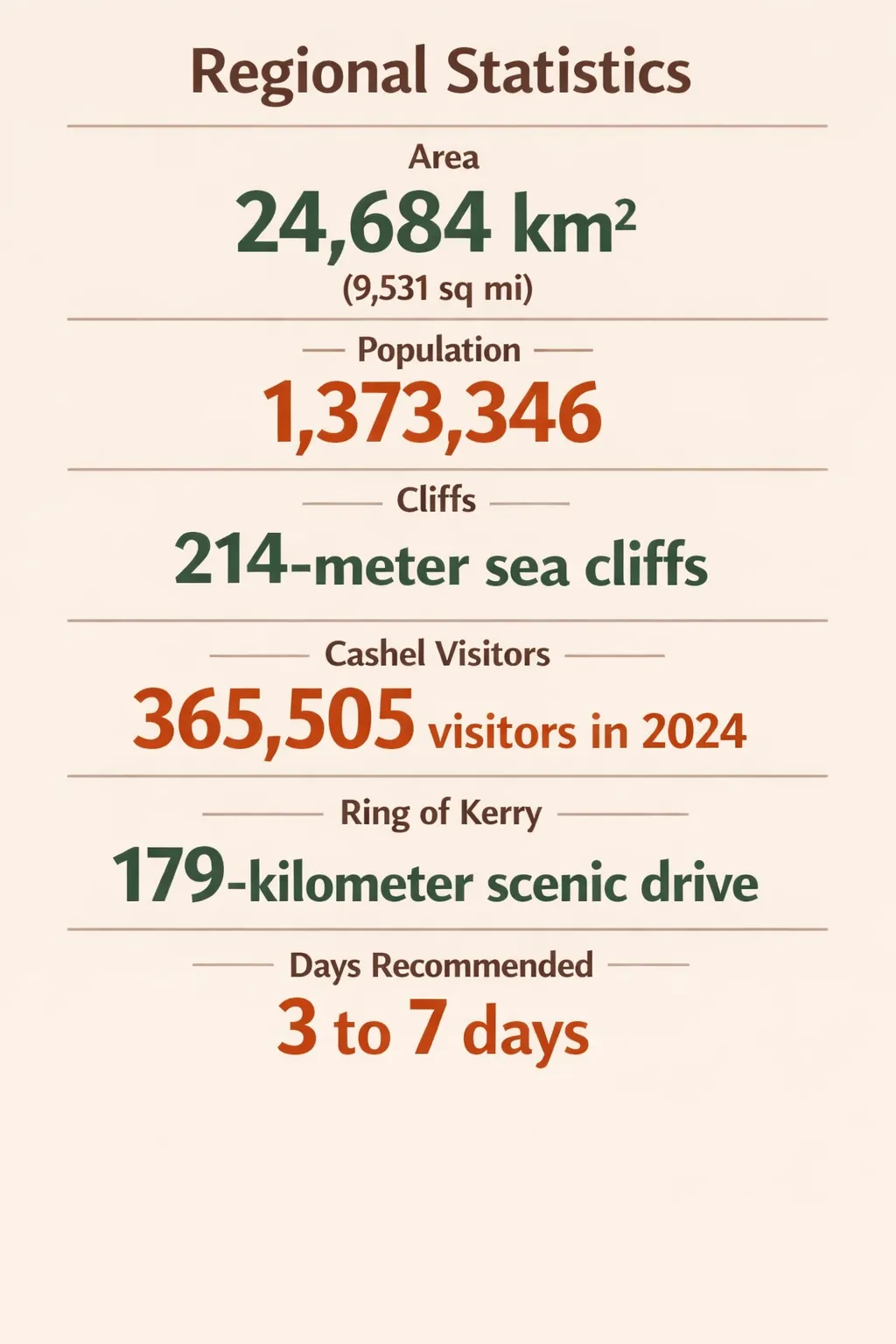 Munster spans 24,684 km² (9,531 sq mi) and has a 2022 population of 1,373,346; Cliffs of Moher rise 214-meter cliffs; Ring of Kerry is a 179-kilometer scenic drive; Rock of Cashel drew 365,505 visitors in 2024.
Munster holds its own among Ireland’s best landscapes.
The Ring of Kerry is a 179-kilometer scenic drive winding through rugged coastline, misty mountains, and frequent postcard views. It takes a full day; the roads are narrow and often slow, especially behind tour buses.
On my last trip, I spent a day exploring the Dingle Peninsula. It’s a quieter alternative to the Ring of Kerry, with clifftop hikes, dolphin sightings, and evenings spent in pubs with live traditional music. The Slea Head Drive here is just as rewarding.
The Cliffs of Moher are probably Munster’s most iconic natural site. Standing at the edge, 214 meters above the Atlantic, leaves a mark. Go early or late to avoid crowds - and book parking and timed entry ahead in summer.
Don’t skip the Lakes of Killarney in Kerry. Set in Ireland’s first national park (established 1932), the three lakes sit below MacGillycuddy’s Reeks, the country’s highest mountains. You can walk, cycle, or take a jaunting car tour.
Other natural highlights worth a detour:
- The Burren - a limestone landscape in Clare that looks lunar, with rare wildflowers.
- Skellig Michael - a UNESCO World Heritage island monastery off Kerry’s coast (boat trips depend on weather and book quickly).
- Copper Coast Geopark - Waterford’s coastline of sea stacks, coves, and mining history.
Culture and traditions that still matter
Munster stands out for how much its traditions remain part of everyday life. The Munster Irish dialect still lives on in Gaeltacht areas of Kerry, Cork, and Waterford. It’s a treat to hear locals switch into it naturally.
Irish folk music is everywhere. I found myself tapping along to jigs and reels in pubs, where sessions are genuine gatherings of musicians, not tourist performances.
Sports are woven into Munster’s identity. I caught a hurling match last trip and was struck by the pace and skill - it’s fast and intense.
History buffs will find plenty to explore. The Rock of Cashel in Tipperary is the standout - a former royal seat perched on a limestone outcrop, its stones layered with stories of power and faith. It gets busy, so aim for a morning visit. With 365,505 visitors in 2024, it’s one of the busiest heritage sites in Ireland (6).
| Cultural aspect | Notes |
|---|---|
| Language | Munster Irish dialect in Gaeltacht areas of Kerry, Cork, Waterford |
| Music | Strong folk tradition with real pub sessions |
| Sports | GAA games (hurling, Gaelic football) are central |
| Historical sites | Ancient royal sites, castles, early Christian monasteries |
Pub session etiquette: the music comes first. Don’t talk over tunes or treat sessions like a jukebox. Buying a drink for the musicians is the local way to say thanks.
✓ Pros
- Diverse landscapes from cliffs to lakes and mountains
- Rich cultural traditions including music, language, and sports
- Historic sites spanning early Christian to Norman eras
- Compact cities and towns offering practical bases for exploration
✗ Cons
- Large province requiring multiple days to explore properly
- Narrow roads and slow traffic on popular scenic drives
- Summer crowds at top attractions like Cliffs of Moher and Rock of Cashel
Exploring Munster’s cities and towns
Munster’s rural landscapes get the postcards, but its towns and cities have their own character - and they make practical bases for exploring.
Cork, the largest city, has a compact center. The English Market, dating to 1788, is a food lover’s stop with local produce and artisanal stalls. Cork is the province’s food capital. Discover more about this vibrant city in Discover Cork : Ireland’s hidden gem of culture and charm.
Limerick sits on the River Shannon, mixing medieval and Georgian architecture. King John’s Castle dominates the riverfront with strong views. The Hunt Museum, housed in the old Custom House, offers a deep dive into Irish history. Limerick tends to have better-value lodging than resort towns. For more on this city, see Discovering Limerick : Ireland’s hidden gem on the Shannon.
Waterford, Ireland’s oldest city, was founded by Vikings in 914 AD. It retains much of its medieval layout. The House of Waterford Crystal showcases its glassmaking heritage, and the Viking Triangle packs three museums into a few streets.
Add to that list charming towns like Killarney, Cobh (Titanic’s last port), Kinsale (a harbor town with a strong food reputation), Adare (thatched cottages and one of Ireland’s prettiest villages), and Ennis - all good spots for history, culture, and comfortable stays.
Tipping note: tipping isn’t expected in Ireland. In sit-down restaurants, 10-15% is standard for good service. At pub bars, you don’t tip for drinks. Taxi fares are usually rounded up rather than calculated as a percentage.
Planning a Munster trip: how many days and where to base yourself
The biggest mistake I see is trying to cover all of Munster in a weekend. The province covers roughly 24,684 km², and drive times between main sights often run 1-3 hours each way - longer than a glance at the map suggests (4). Give yourself 3 to 7 days to explore one to three counties at a comfortable pace.
How to choose your base:
- Short trip / beginner: Stay in Cork or Killarney and take day trips to two or three nearby sights within about 90 minutes’ drive. This covers the Cork-Kerry-Clare triangle, where most headline sights cluster (1).
- Culture focus: Base in Waterford, Limerick, or Cashel for museums, cathedrals, and medieval sites (1)(6).
- Nature focus: Prioritize County Clare and County Kerry for cliffs, coastal drives, and national parks.
- Family trip: Pick shorter visits like Blarney Castle and Bunratty Castle, plus town strolls to avoid too much driving.
- Budget: Stay in larger towns like Limerick or Cork city, book 3-star hotels or guesthouses, and group sights by county to save on fuel and transfers.
Costs (early 2026): Self-driving for two people runs about $120-$220 per day before flights, covering car rental, fuel, parking, and modest lodging. Coastal stays in Cork, Kerry, and Clare during peak season can push that above $300 per day. Book accommodation early for June through August when the coast fills up.
Logistics that matter:
- Renting a car is the most flexible way to see Munster’s spread-out sights, especially along the Wild Atlantic Way and inland heritage spots.
- Fly into Cork or Shannon to cut down on long drives.
- Bring a cashless payment method; cards are accepted almost everywhere.
- Book timed entries ahead for the Cliffs of Moher, Blarney Castle, and Killarney National Park boat trips during summer.
Frequently Asked Questions
- What is Munster, Ireland famous for?
- Munster is known for many top sights including the Cliffs of Moher, Blarney Castle, Killarney National Park, and Waterford crystal.
- What surnames are from Munster?
- Common Munster surnames include O'Brien, McCarthy, O'Callaghan, O'Keeffe, Fitzgerald, and Butler, reflecting Gaelic and Norman heritage.
- Is Munster, Ireland Catholic or Protestant?
- Munster has a strong Catholic heritage but today reflects a more religiously mixed and secular population.
- Which part of Ireland is Munster?
- Munster is Ireland's southwestern province, comprising six counties: Clare, Cork, Kerry, Limerick, Tipperary, and Waterford.
- What is the best way to get around Munster?
- Renting a car is the most flexible way to explore Munster's spread-out sights and scenic coastal drives.
- When is the best time to visit the Cliffs of Moher?
- Early morning or late afternoon visits help avoid crowds; book timed entry and parking in advance during summer.
- Are there any dress codes when visiting religious sites in Munster?
- Visitors should dress modestly, covering shoulders and knees, and keep noise low during services at active churches.
Before you book
Pick your counties before your dates. The best move is to avoid trying to cover all six counties in one trip. Two or three counties in a week beats a frantic loop.
Base yourself in Cork or Killarney for the classic southwest. Add Clare if the Cliffs of Moher are non-negotiable. Lean on Limerick or Waterford to find better lodging value and escape resort-town prices.
Book summer accommodation and timed entries early, keep a car for the coastal drives, and hit the Rock of Cashel in the morning to stay ahead of crowds. Do that, and Munster delivers what it promises - a solid mix of culture and nature without the rush.