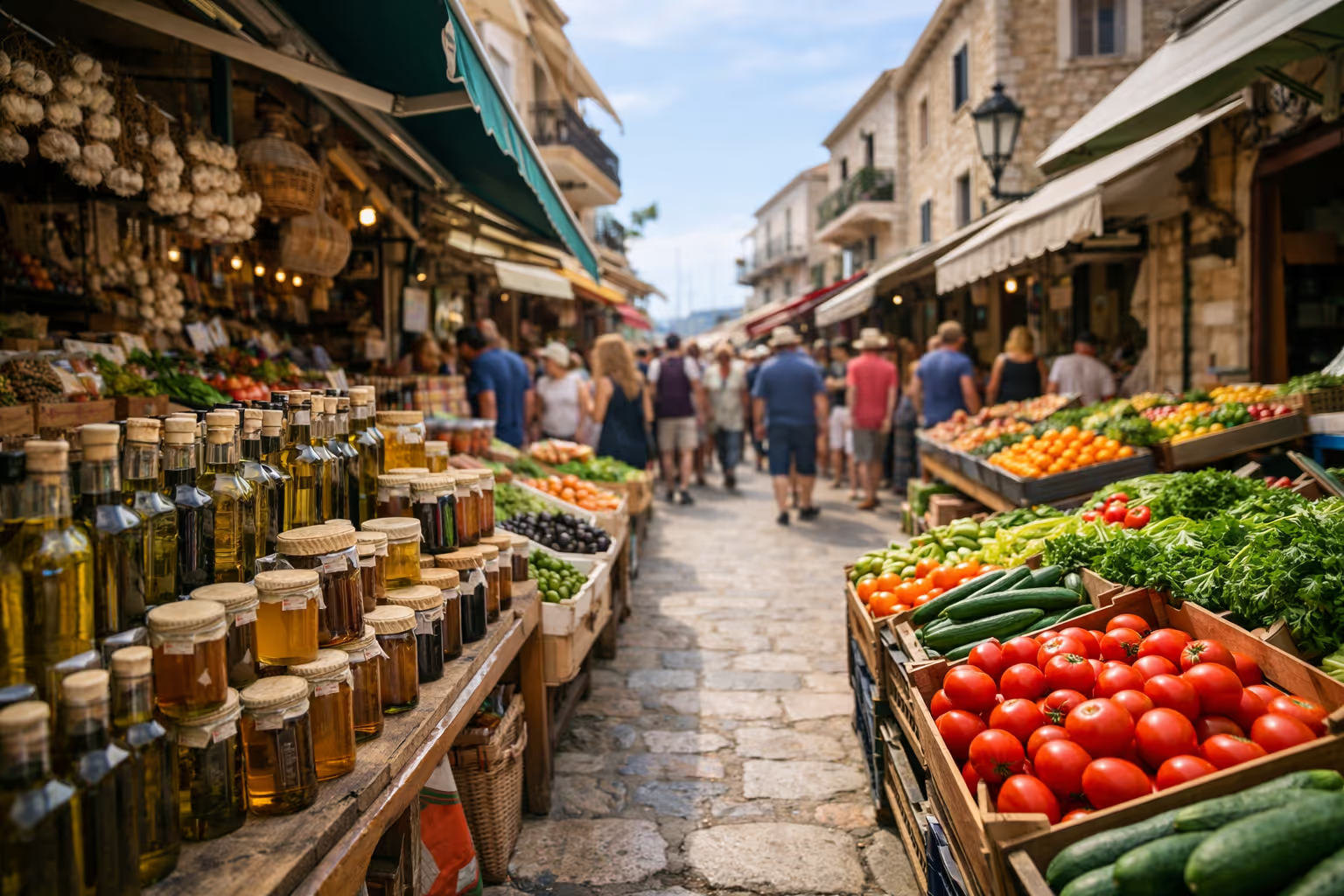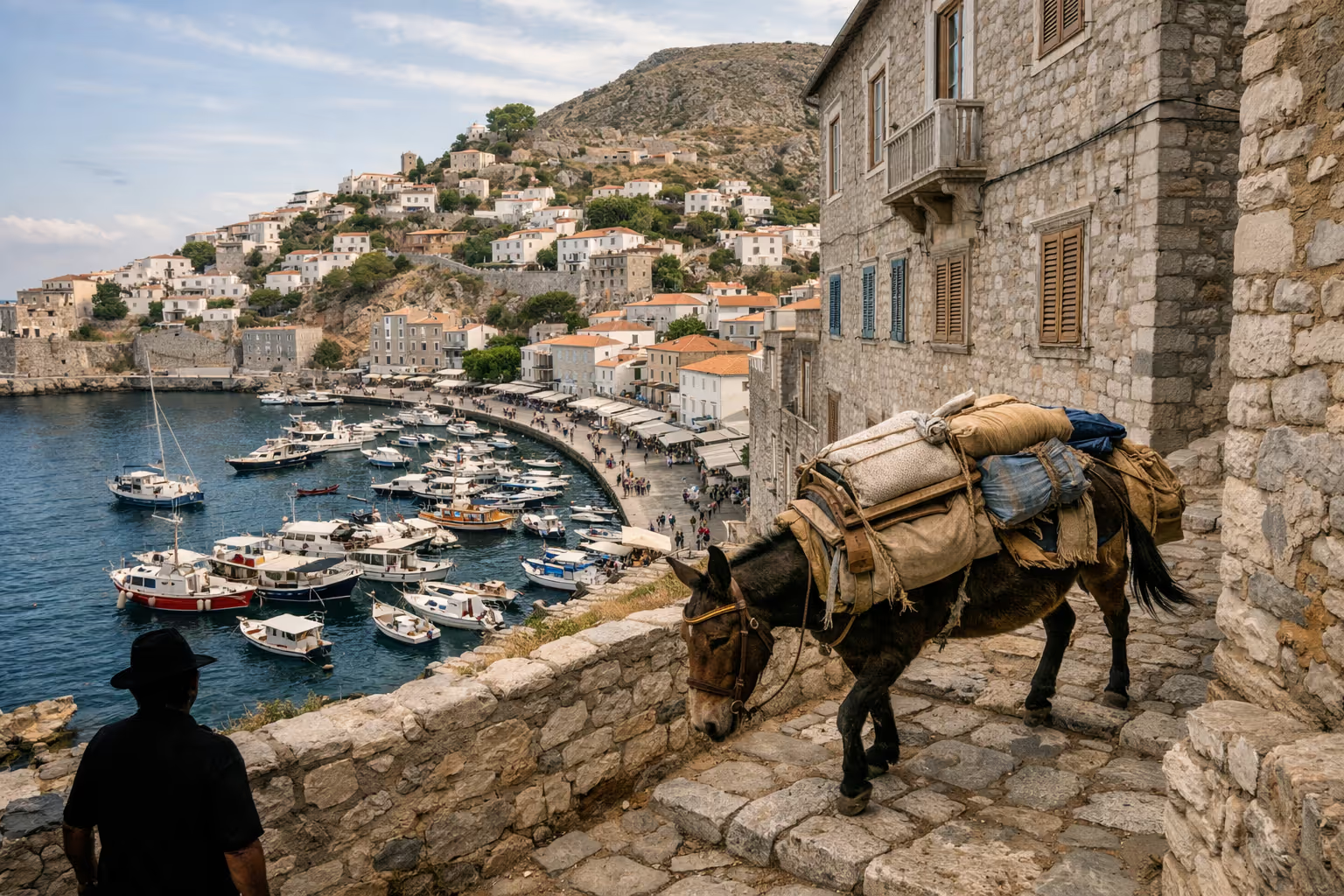
The best time to visit Greece is the shoulder, mid-May into June or mid-September into early October, when the sea is still warm and rooms cost 20 to 30 percent less than peak. Avoid the August 1-to-20 crush, when ferries sell out months ahead and prices jump. Winter is cheapest but shutters most island hotels and boats, so stick to Athens and Thessaloniki then. And match the island to the month: Crete stays swimmable into October long after Santorini and Mykonos wind down.
Greece Travel: Best Time to Visit by Island and Budget
Determining the best time to visit Greece depends on what you want from your trip, but the sweet spots are clear. Spring (April to June) and early fall (September to October) are when I keep coming back. Major travel guides, including Rick Steves, consistently point to May, June, September, and October as the strongest months for comfortable weather and manageable crowds (9).
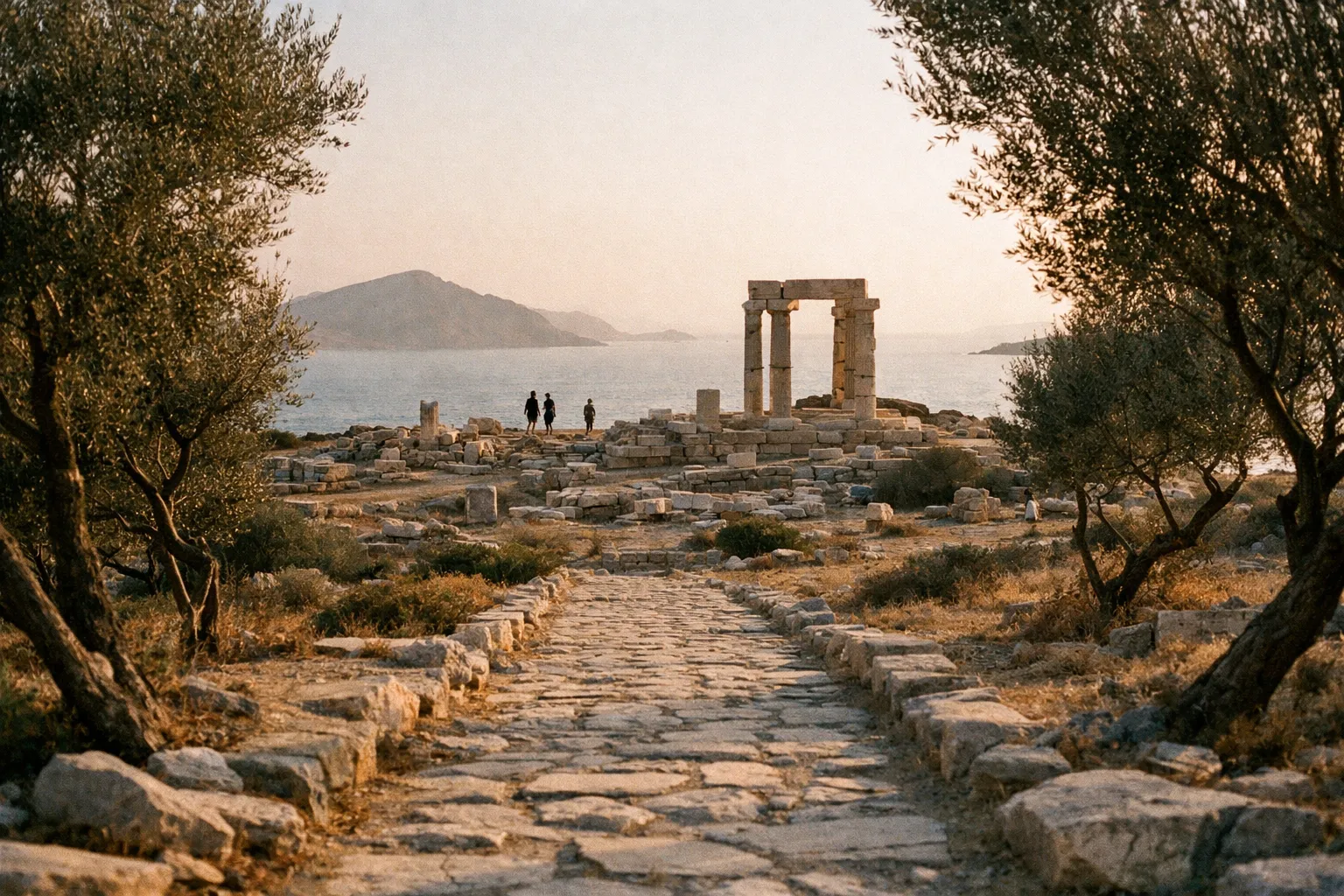
During those shoulder months, you get:
- Daytime temperatures in the 22-28°C range
- Fewer crowds at the Acropolis, Santorini’s caldera, and Knossos
- Most island hotels, ferries, and tavernas fully operational
- Good conditions for hiking, sightseeing, and long walks
I’ll never forget trekking the Samaria Gorge in Crete one crisp May morning. Wildflowers were in full bloom, the 16-kilometer descent felt manageable in the mild air, and I had long stretches of the trail to myself - nothing like the crush of July.
If you’re set on beaches, a Greek summer delivers, but you’ll pay for it. July and August bring highs regularly topping 32°C (90°F), with Athens heat waves exceeding 38°C, packed beaches, sold-out ferries, and the steepest prices of the year for flights and rooms.
One thing worth knowing: October often brings the “summer of Agios Dimitrios” (a Greek folk term for a warm, settled spell in late October, named after the feast day of Saint Dimitrios on October 26th), which makes Crete and the Dodecanese exceptionally pleasant with a fraction of the crowds. Sea temperatures also tend to peak in September, so you get warmer water than midsummer without the July-August scramble.
When is peak season in Greece?
Vacation season on most islands runs April through late October, but peak season is squarely July and August. Within that, there’s a “super peak” - roughly 1-20 August - when Greek families take their own holidays and everything from Santorini to Corfu hits maximum capacity and pricing.
Book July or August without a plan and you’ll find sold-out ferries, hotels reserved two to four months out, and rates up to 40% higher than May or September (5). If summer is your only window, book early and lock in ferry tickets the moment they release. This is where most first-timers get caught out.
What is the cheapest time to go to Greece?
January is the least expensive month overall for flights and accommodation, followed by February and November (2). Winter rates on the mainland can be a fraction of summer prices, and shoulder months like April, May, and October save you 20-30% compared with peak (2)(5).
The trade-off is real. Many island hotels, restaurants, and ferry routes shut down from November through March, especially on smaller islands (9). Athens, Thessaloniki, and the larger destinations stay lively year-round, so winter is better spent on the mainland than chasing empty island resorts.
Greek Seasons at a Glance
| Spring (April-June) | Summer (July-August) | Fall (September-October) | Winter (November-March) | |
|---|---|---|---|---|
| Pros | Mild weather, fewer crowds, wildflowers, 20-30% savings | Warmest seas, lively nightlife, all services open | Warm sea (peaks in Sept), fewer tourists, lower prices | Lowest prices, quiet cities |
| Cons | Some island facilities not fully open in early April | Crowded, 20-40% pricier, intense heat | Some islands wind down by late October | Cool, rainy, limited island access and ferries |
During a winter stay in Athens, I saw a different city. The Acropolis - usually shoulder-to-shoulder - was calm. I spent afternoons in cafés around Kolonaki and long dinners in Psyrri tavernas. But when I checked ferry schedules to the Cyclades, most routes had thinned to a trickle and half the accommodations were closed.
What is the temperature in Greece by month?
Weather varies more than people expect between Athens and the islands. Here’s what to plan around:
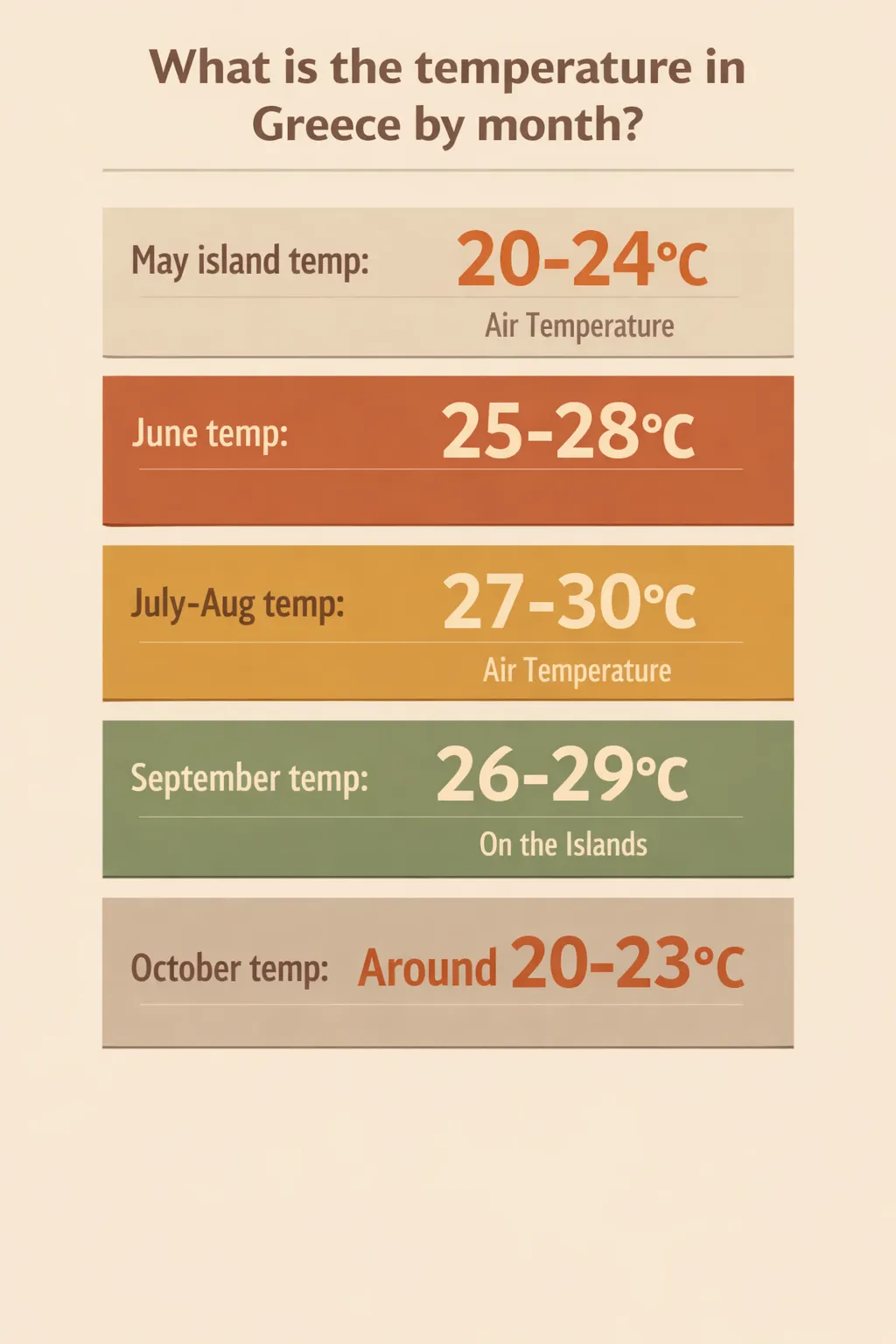 Monthly temperature ranges: May 20-24°C, June 25-28°C, July-Aug 27-30°C, September 26-29°C, October around 20-23°C.
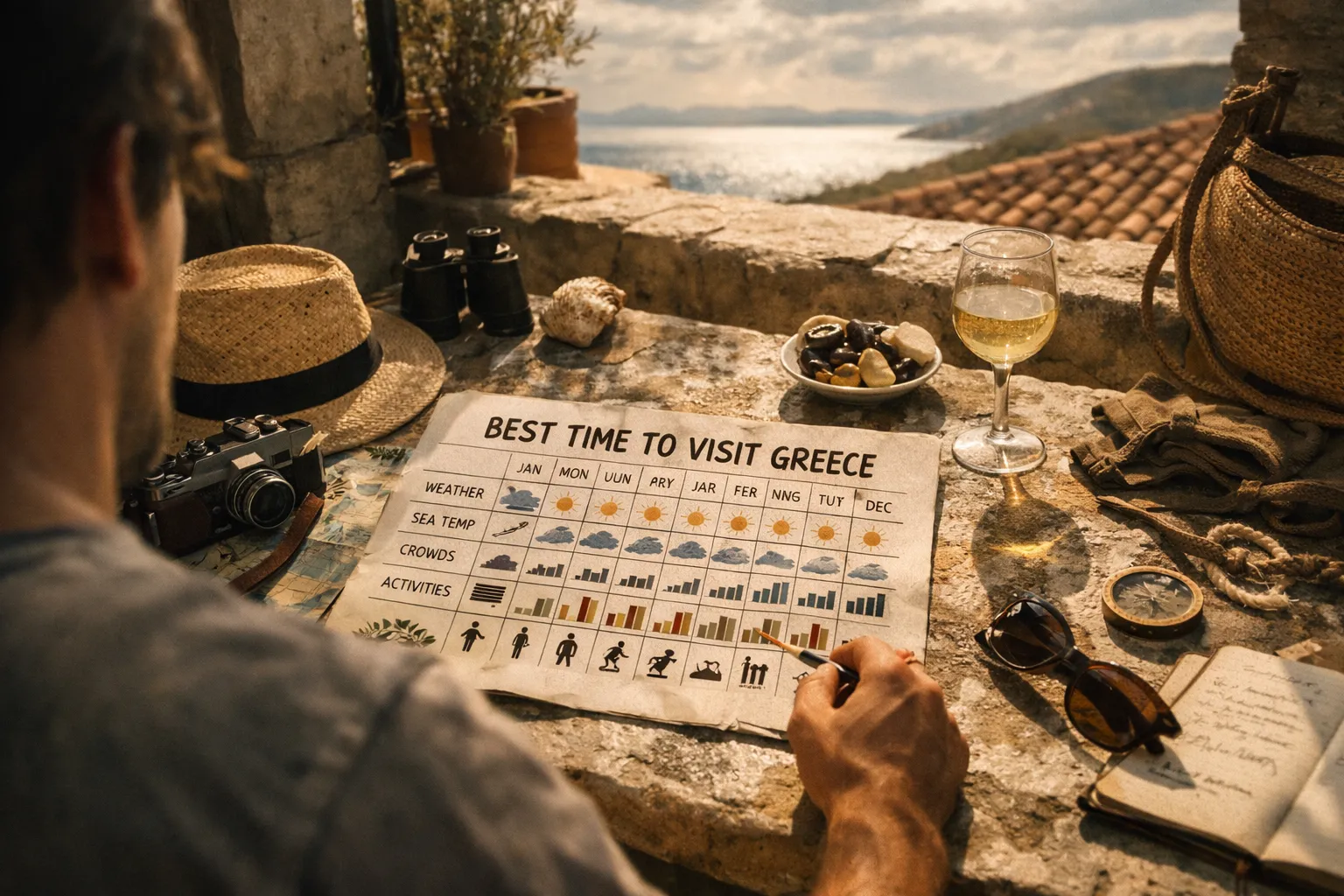
- January-February: Athens sits around 10-15°C; islands are cool and often rainy. Mainland skiing (yes, Greece has ski resorts) is at its best.
- March-April: Warming to 15-20°C. Wildflowers peak in April. The sea is still cold for swimming.
- May: Islands reach 20-24°C air temperature; the sea is warming but still bracing. Excellent for hiking and sightseeing.
- June: Reliably warm, 25-28°C, seas comfortable. The last of the shoulder-price windows before peak.
- July-August: Islands hit 27-30°C air, seas around 24-26°C; Athens can exceed 35°C with heat waves over 38°C.
- September: Still 26-29°C on the islands, with the year’s warmest sea temperatures.
- October: Around 20-23°C, seas still swimmable in Crete and the southern Dodecanese.
- November: Milder days at 15-20°C, more rain, prices low; swimming largely over (2).
- December: Cool and wet, 10-15°C on the mainland, festive in the cities.
Rule of thumb: for sightseeing in Athens and the archaeological sites, aim for March-May or September-November, when you’re walking in sub-28°C weather rather than midday furnace heat.
Choosing your season by travel style
Your ideal timing depends on what you actually want to do.
For culture and archaeology: March-May and September-November are best for Athens, Delphi, and the Peloponnese, when you can walk the sites below 28°C. The Athens and Epidaurus Festival (also called the Hellenic Festival) runs roughly June to September with ancient theater, music, and dance.
For beaches and clear skies: June through September gives you guaranteed sun and warm seas, with September offering the warmest water and fewer people than August (6). I spent a week island-hopping the Cyclades one August - the beaches were packed, but the water and the nightlife made it worth it. Just barely.
For budget travel: Target January, February, or November for the deepest discounts, or April, May, and October for a balance of savings and good weather (2). I still remember a December evening in a taverna on Naxos, sharing ouzo (an anise-flavored aperitif) and stories with the owner’s family long after the kitchen had closed.
For hiking and nature: April-June and September-October, when temperatures sit at 18-25°C and the trails through Crete’s gorges, Pelion, and Meteora aren’t crowded.
Best time to visit the top Greek islands and Athens
Each destination peaks at a slightly different moment, so timing your trip to a specific island pays off.
Best time to visit Santorini Greece: The island is warm and open from late April to early November, with June-September best for swimming and nightlife (6). May and October give you the caldera views and sunsets in Oia without the summer crush. Book accommodation well ahead in any season - Santorini sells out fast.
Best time to visit Mykonos Greece: Most alive June-August for beach clubs and nightlife, but noticeably more relaxed and cheaper in May and September. If you want the party scene, come in peak summer. If you want the same beaches at half the intensity, come in the shoulders.
Best time to visit Crete Greece: At its finest in May-June and September-October for hiking the Samaria Gorge, beach days, and thinner crowds. Crete’s size means it stays viable later into fall than the Cyclades, and its southern coast holds the warmest seas into October.
Best time to visit Corfu Greece: The Ionian island is lush and mild in May-June, hot and busy in July-August, and quietly warm in September. Corfu’s greenery makes spring especially striking. I celebrated Greek Orthodox Easter here once and watched thousands of clay pots hurled from balconies on Holy Saturday - bizarre, loud, and genuinely hard to top.
Best time to visit Athens Greece: Skip the summer furnace if you can. March-May and September-November are ideal for the Acropolis, the Ancient Agora, and long walks through Plaka and Monastiraki (9). If you’re stuck visiting in summer, do the sites before 11:00 or after 17:00. Midday at the Acropolis in 35°C is a mistake I’ve made so you don’t have to.
What is the nicest Greek island to visit?
There’s no single answer, and anyone who gives you one is selling something. It depends on what you’re after:
- Santorini for the caldera views, sunsets, and volcanic beaches - the postcard version of Greece.
- Crete for the most variety: gorges, ancient Minoan sites, mountain villages, and long beaches. Worth prioritizing if you have a week and want range.
- Mykonos for nightlife, beach clubs, and design-forward hotels.
- Corfu for green landscapes, Venetian architecture, and a softer Ionian feel.
- Naxos, Paros, or Milos if you’ve done the headliners and want quieter Cycladic islands with strong food and fewer crowds.
For a first trip, Santorini and Crete cover the widest range of what people picture when they think of Greece.
How many days are enough for a trip to Greece?
Five days is a realistic minimum for a first trip combining Athens and one island. Seven to ten days lets you add a second or third island comfortably. The mistake I see most often is cramming too many islands into a short window - ferries between islands run two to eight hours, and the Athens-Santorini route alone can take five to eight hours. Two islands in five days means you’ll spend a big chunk of your trip on boats.
Sample itineraries to plan your stay:
- 5 days: 2 nights Athens, 3 nights Santorini or Mykonos.
- 7 days: 2 nights Athens, 2 nights Mykonos, 3 nights Santorini - or 4 nights Crete, 3 nights Athens.
- 10-14 days: Athens plus three islands (Santorini, Naxos, Paros), or a Peloponnese road loop paired with Hydra or Spetses.
Budget-wise, a five-day trip commonly runs EUR 1,000-2,300 / USD 1,100-2,500 per person (May 2026 reference), covering flights, mid-range hotels, food, and activities - with shoulder season saving you 20-30% over peak (5).
Must-visit sites for first-time visitors
If it’s your first trip, build around these:
- The Acropolis and Acropolis Museum, Athens - the Parthenon plus the museum that gives it context.
- The Ancient Agora and Plaka, Athens - walkable ancient ruins and the old town’s stepped lanes.
- Oia and Fira, Santorini - the caldera-edge villages for sunsets and the cable car down to the old port.
- Knossos and the Heraklion Archaeological Museum, Crete - the Minoan palace and its restored frescoes.
- Delphi, mainland - the ancient oracle site, an easy day trip from Athens.
- Meteora, central Greece - monasteries perched on sandstone pillars, best in spring or fall.
Do Americans need a visa for Greece?
Not right now. U.S. citizens can enter Greece - part of the Schengen Area - visa-free for up to 90 days within any 180-day period for tourism (3). Your passport should be valid at least three months beyond your planned departure, and it’s worth checking the U.S. State Department’s latest advisory for Greece before you go.
The catch is coming. From late 2026, visa-exempt travelers including Americans are expected to need ETIAS travel authorization - a small online application, valid for multiple entries (3). It’s not a visa, but you’ll need to apply before you fly once it’s live, or risk being denied boarding (3). Check the requirement status before booking any 2026 trip.
What to pack for Greece
A few things make Greek travel smoother, especially with island ferries and cobbled streets in the mix:
- Power adapter: Greece uses Type C/F plugs. Bring a universal adapter.
- Power bank: A 10,000-20,000 mAh pack (Anker makes reliable ones) covers long ferry days and full sightseeing days off the grid.
- eSIM or roaming plan: Set up data before you land so you’re not hunting for Wi-Fi in the port.
- Travel insurance: Comprehensive plans with medical and trip-interruption coverage typically run EUR 37-73 / USD 40-80 per person for a week (2026 rates).
- Luggage: A hard-shell 40-45L carry-on (Samsonite and similar) handles ferry loading and dragging over cobblestones far better than an oversized checked bag.
Can I wear black in Greece? Yes - black is completely acceptable year-round, and Greeks wear it often. The only real issue is heat: black absorbs sun, so during 30-35°C summer days you’ll want light, breathable linen and cotton to stay comfortable. Save the black for evenings and cooler shoulder-season trips.
Packing by season:
- Summer: SPF 30+ sunscreen, sun hat, UV sunglasses, linen and cotton, sandals, swimsuit.
- Shoulder: A light jacket for 15-18°C evenings, plus closed shoes for cobbled streets and hikes.
- Winter: Waterproof jacket, layers, and an umbrella - November to March sees the most rain.
One etiquette note worth flagging: when visiting monasteries and churches - including the ones at Meteora - shoulders and knees need to be covered. Many sites keep wraps available at the entrance, but carrying a light scarf saves the awkward scramble at the door.
Where to stay: two standout luxury options
If you’re planning a splurge, two properties anchor the high end of Greek travel.
Amanzoe, near Porto Heli in the Peloponnese, is a hilltop resort of pavilions and villas, some with private pools and chefs (7). High-season suites (July-August 2026 rates) often run EUR 1,650-2,750 / USD 1,800-3,000+ per night, with multi-bedroom villas climbing well past EUR 2,750-7,350 / USD 3,000-8,000+. It pairs naturally with visits to Hydra and Spetses.
Four Seasons Astir Palace Hotel Athens, on the Vouliagmeni coast south of the city, is a seafront resort with easy access to Athens proper (8). Standard summer rooms (July-August 2026 rates) commonly land at EUR 825-1,375 / USD 900-1,500 per night, with suites considerably higher (8).
For both, book three to six months ahead for June-September stays, and watch for shoulder-season packages with breakfast and late checkout that quietly lower your effective nightly cost (7)(8).
Festivals worth planning around
Tying your trip to Greek culture is easier than it sounds:
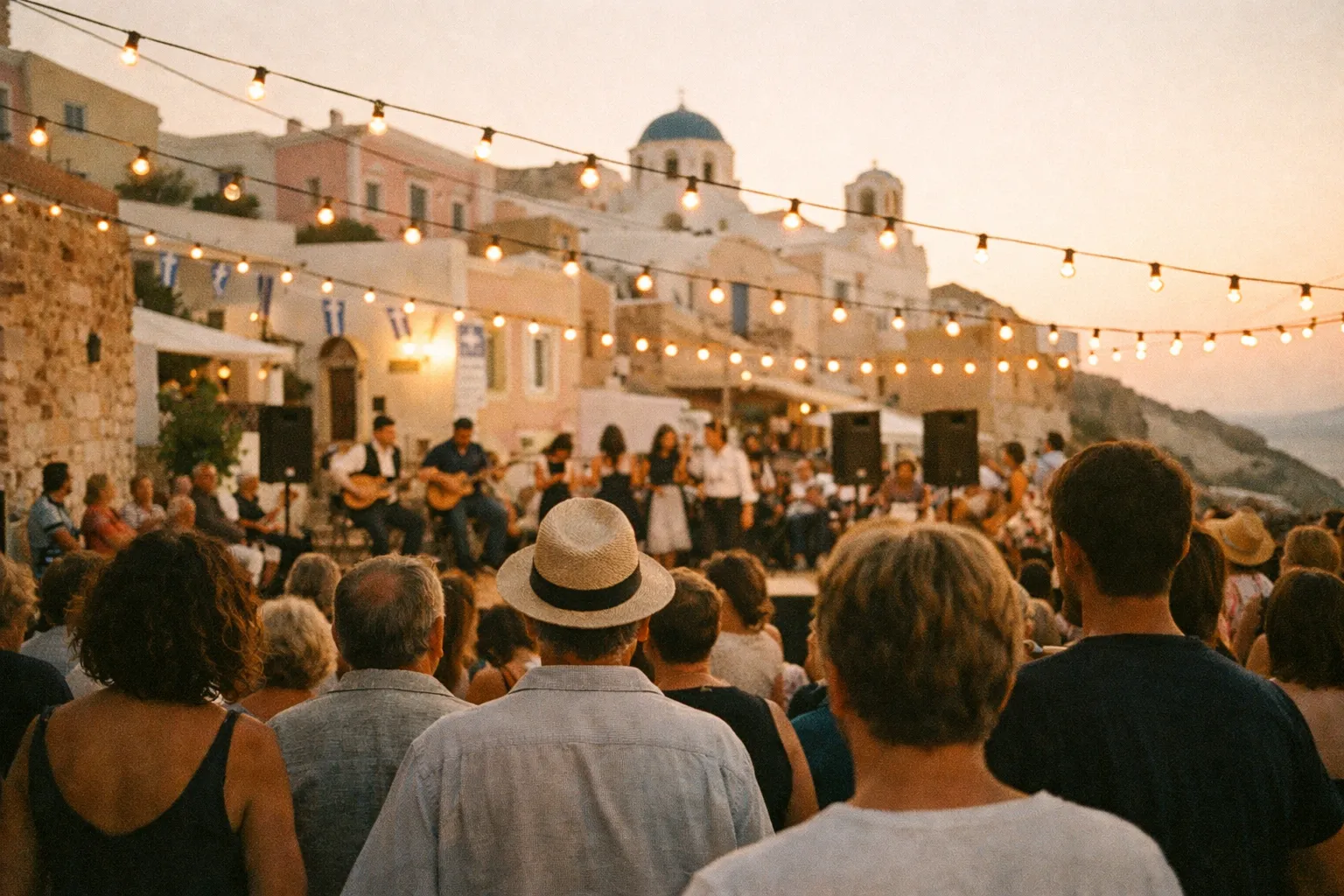
- Greek Orthodox Easter: Usually in April, the country’s biggest holiday - candlelit processions, midnight fireworks, and roast-lamb feasts. Corfu’s pot-throwing on Holy Saturday is worth the trip on its own.
- Athens and Epidaurus Festival (Hellenic Festival): June to September, with ancient Greek theater, music, and dance performed at the very sites they were written for.
- Ohi Day: October 28th, marked by parades commemorating Greece’s 1940 refusal to surrender to Italian forces.
Common mistakes to avoid
- Booking July or August without realizing it’s peak and super-peak season - expect sold-out ferries and prices up to 40% higher than May or September (5).
- Assuming every island is open in winter. Seasonal hotels and restaurants widely close November through March, especially on smaller islands (2).
- Overpacking your itinerary. Too many islands in five to seven days means multi-hour ferries eat your relaxation time.
- Sightseeing at midday in summer heat instead of scheduling the Acropolis and open-air sites for early morning or late afternoon.
- Ignoring the coming ETIAS requirement for 2026 travel and getting caught out at the gate (3).
Frequently Asked Questions
- Is it safe to swim in the Greek islands in October?
- Yes, sea temperatures in Crete and the southern Dodecanese remain warm enough for swimming in October.
- Do all Greek islands operate ferries year-round?
- No, many smaller islands reduce or suspend ferry services from November through March.
- Can I visit Greece without a visa if I am a U.S. citizen?
- U.S. citizens can enter Greece visa-free for up to 90 days within 180 days for tourism currently.
- When should I book ferry tickets for peak summer travel?
- Book ferry tickets as soon as they are released, often several months in advance, for July and August.
- What is the ETIAS travel authorization for Greece?
- Starting late 2026, travelers including Americans will need to apply online for ETIAS before entering Greece.
- Is black clothing appropriate in Greece?
- Black is acceptable year-round, but wear light fabrics in summer to stay cool as black absorbs heat.
The verdict
For most travelers, the best time to visit Greece is mid-May to mid-June or mid-September to early October - the window where good weather, swimmable seas, thinner crowds, and lower prices all overlap. Come in peak summer only if beach clubs and guaranteed heat are the whole point, and lock in ferries and hotels months ahead. Come in winter if you want quiet cities and rock-bottom prices, and base yourself on the mainland rather than the islands.
Whenever you land, plan your sightseeing around the heat, book the popular islands early, and check the ETIAS status before you fly. Yamas (a Greek toast meaning “cheers”).
✓ Pros
- Best travel windows offer mild weather, fewer crowds, and lower prices
- Greek islands have distinct seasonal rhythms affecting services and crowds
- Winter offers quiet cities and budget options on the mainland
✗ Cons
- Peak summer is hot, crowded, and expensive with sold-out ferries
- Many islands close or reduce services in winter months
- Travel planning requires early booking for peak season and ferries