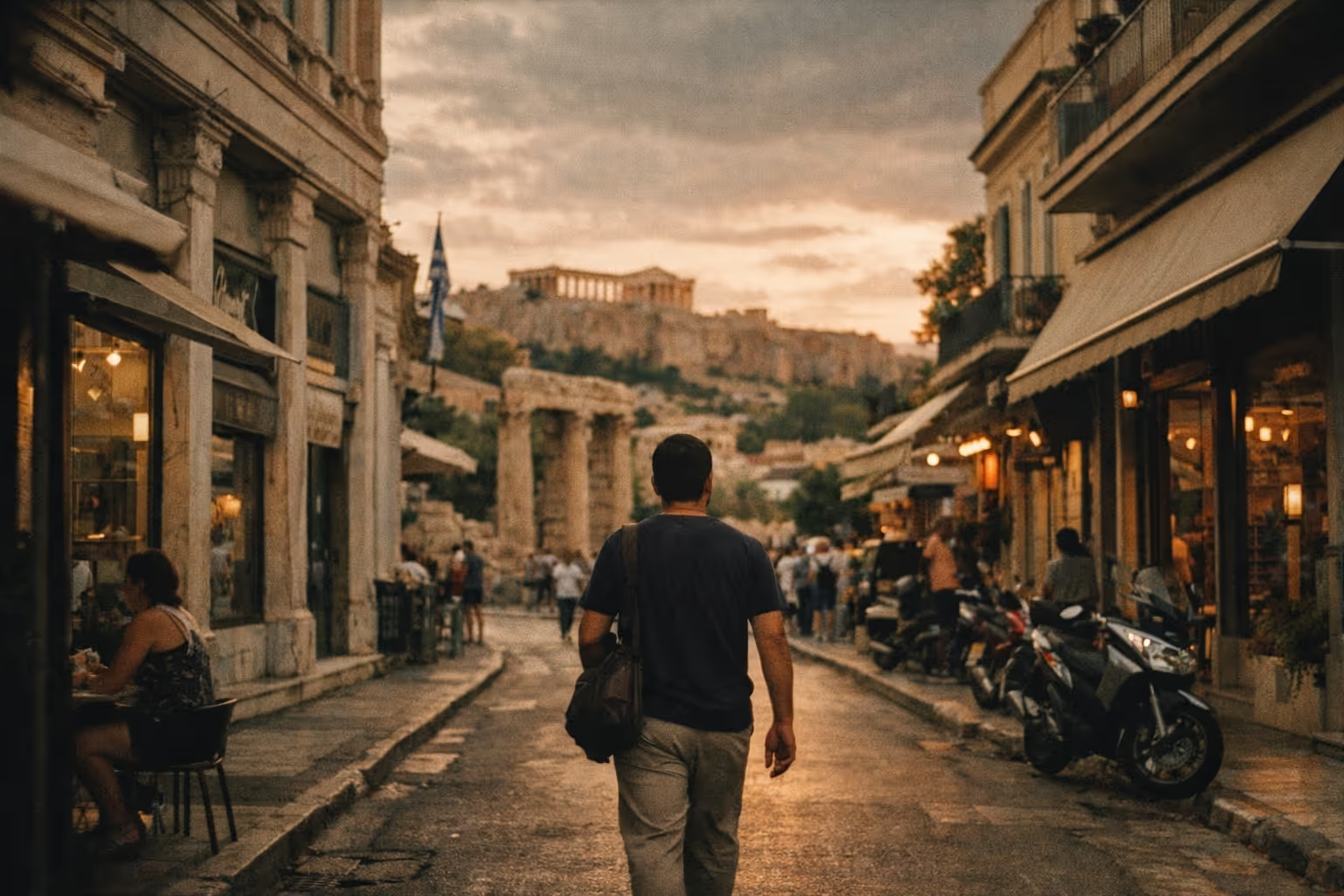
The top cities in Greece each earn a trip for a completely different reason, which is why lumping them together does none of them justice. Athens is the one for ancient ruins, Thessaloniki quietly out-eats it with a mezze-and-bougatsa food scene, and unglamorous Larissa is simply the cheapest base for reaching the clifftop monasteries of Meteora. Go in spring or early autumn to dodge the heat. Match the city to what you actually want, and Greece beyond the islands opens up.
Why Greece’s Top Cities Deserve More Than a Beach Week
Greece’s cities pull off something most European destinations can’t: you can stand in front of a 2,500-year-old temple, then walk ten minutes to a natural-wine bar where the bartender went to school in Berlin. This guide covers the top cities in Greece for travelers who want more than a beach - places where the streets, food, and museums carry the trip on their own. I’ve spent months working remotely from Athens and Thessaloniki, weekended in Patras during carnival, and based myself in Larissa to explore Thessaly. Here’s how they actually compare.
A quick note before we start: this is an urban guide. Santorini and Mykonos appear in every Greece list, but they’re island destinations, not cities in the way Athens or Heraklion are. I’ll point you toward island coverage at the end, but the focus here stays on city breaks.
Why travel to Greece right now
Greece drew 33 million visitors in 2023 (1), and numbers held through 2024 - which means two things for city travelers. First, the infrastructure is dialed in: airports, metro, intercity buses, and hotel inventory have all scaled up. Second, summer in the big cities is genuinely crowded, and prices reflect it.
The country has 19 UNESCO World Heritage Sites packed into an area smaller than Alabama, and several sit inside or beside major cities. That density is the real argument for an urban-first trip. You can sleep in a walkable neighborhood, eat dinner at 10 p.m., and still be at a 5th-century BC ruin by breakfast.
The other reason to come now: Greek cities have quietly become some of Europe’s better-value city breaks outside July and August. Athens hotel rates in shoulder season often undercut Lisbon or Barcelona for comparable quality.
When is the best time to visit Greece?
For city travel - not beach travel - the windows that actually work are mid-April to early June and mid-September to late October. Daytime highs sit between 65-80°F (18-27°C), the archaeological sites aren’t punishing, and hotels run roughly 20-35% below August peaks.
July and August are the months to avoid for urban sightseeing. Athens regularly clears 95°F (35°C), and the Acropolis offers almost no shade. If you must travel in summer, start sightseeing at 8 a.m., break from noon to 5 p.m., and pick up again in the evening - that’s what locals do, and there’s a reason cafés don’t fill until after dark.
Winter (December-February) is underrated for Athens and Thessaloniki. Museums are nearly empty, hotel rates drop to their annual lows, and the food scene actually improves because tavernas focus on regulars instead of tour groups. Pack a real jacket - Thessaloniki gets cold, and Larissa can dip below freezing.
Athens, Greece: the heart of ancient civilization
Athens is the obvious first stop, and for first-time visitors to Greece, it’s non-negotiable. The Athens municipality counted 643,450 residents in the 2021 census, with the broader metro area pushing past 3.6 million - by far the largest urban center in the country.
The sightseeing density here is unmatched in Europe. In a single walkable zone you have:
- The Acropolis and the Parthenon
- The Acropolis Museum (one of the best museum buildings built this century)
- The Ancient Agora and the Temple of Hephaestus
- The National Archaeological Museum in Exarcheia
- The Roman Agora and Hadrian’s Library
Three days covers the headline sights without rushing. Five gives you time for day trips to Cape Sounion - the Temple of Poseidon on a cliff over the Aegean, about 90 minutes by bus - or Delphi, which is three hours each way and long but genuinely worth it.
Where to stay and eat in Athens
For first stays, base yourself in Koukaki or Plaka - both walkable to the Acropolis, both safe to wander at night. Pangrati is where I’d send a second-time visitor: residential, full of good neighborhood tavernas, and a 20-minute walk from the center. Skip Omonia for hotels unless you’re on a tight budget; it’s improving but still rough at night.
Budget hotels and well-located hostels run $25-$40/night in shoulder season. Mid-range design hotels in Koukaki sit around €110-€180 (~$120-$200)/night. Peak-summer luxury near Syntagma can clear €350/night.
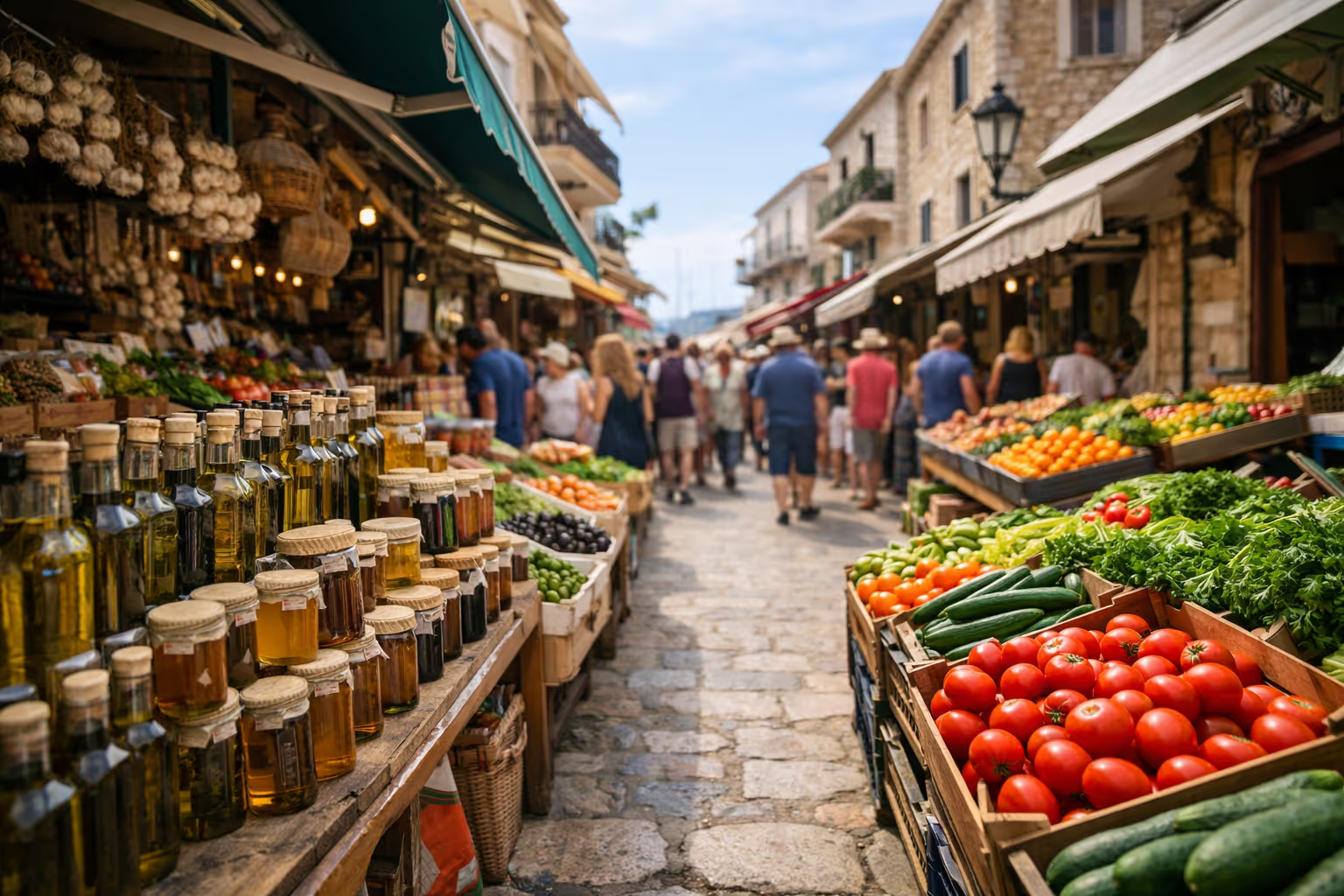
For food, walk the streets around Athinas for the central market, then eat souvlaki at Kostas on Agia Irini square - one shop, one thing done well, around €3.50. For a sit-down meal, Diporto in the market area is the kind of basement taverna that hasn’t changed its menu in decades: house wine from the barrel, whatever the cook felt like making that day.
Etiquette note: Tipping in Greece is genuinely optional. Round up the bill or leave 5-10% for good service in a taverna; nothing more is expected. Locals often leave loose coins, not a percentage.
Thessaloniki, Greece: the food capital
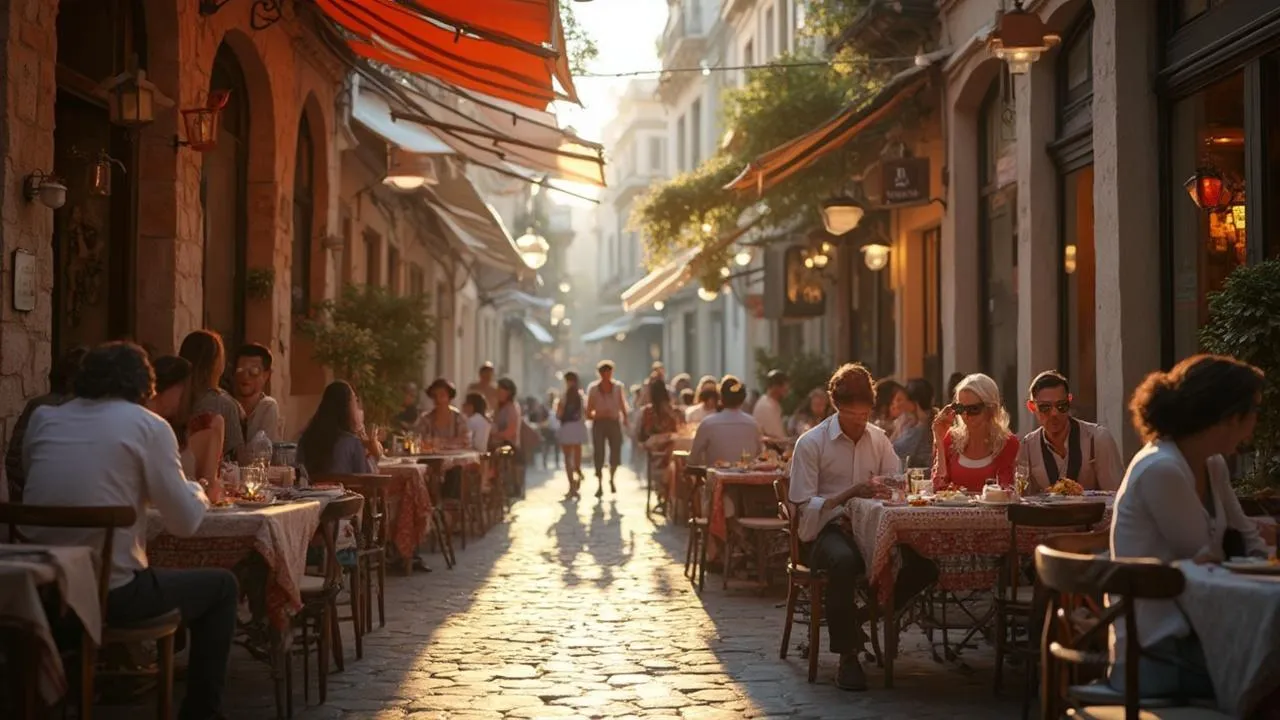
Thessaloniki, Greece is where I’d send anyone who’s already done Athens and wants to see what modern urban Greece actually looks like. Population around 1 million in the metro area, capital of the Macedonia region, and home to the largest university in Greece - which keeps the café scene relentless and the bars open late.
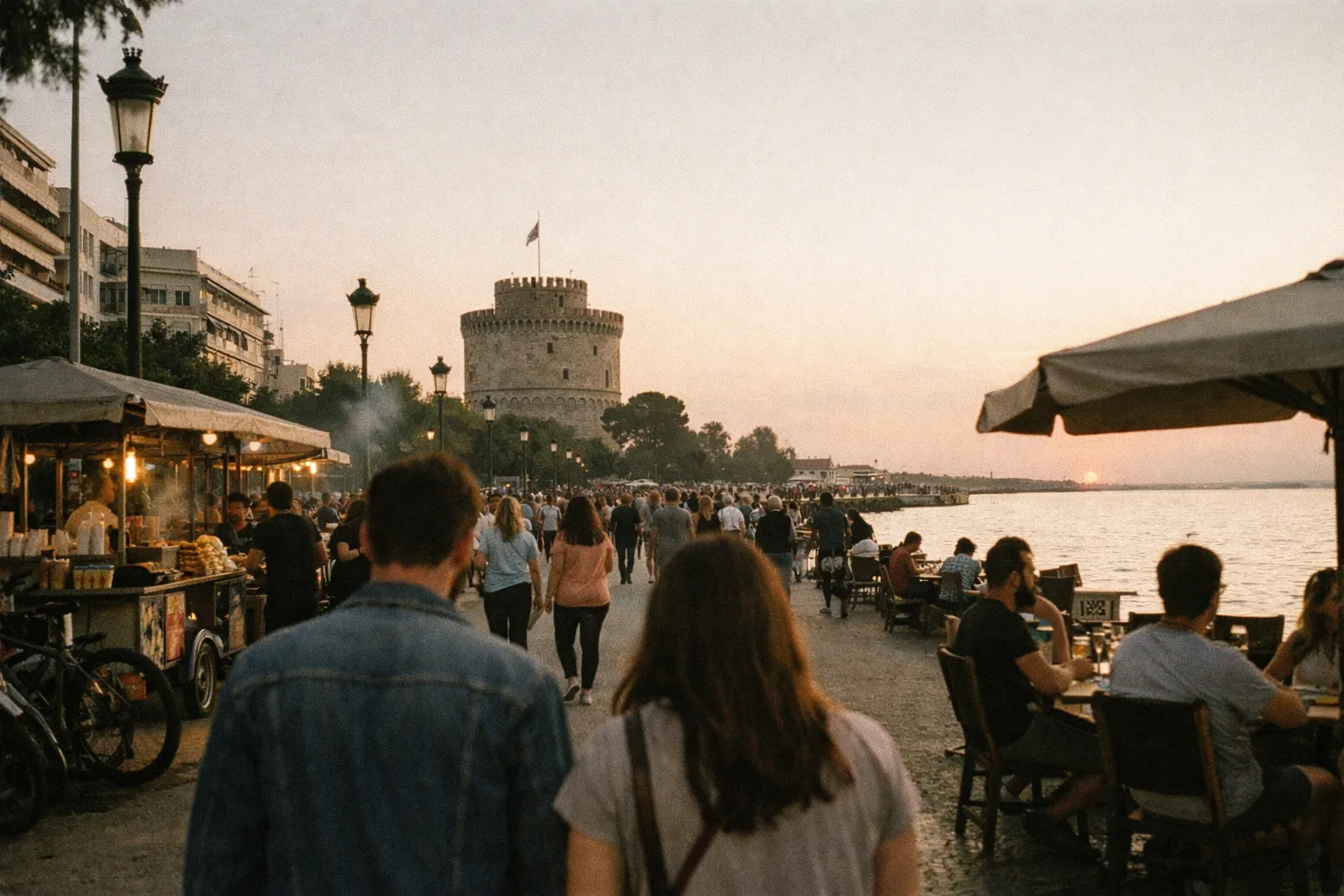
The city’s layers are different from Athens. Instead of classical ruins, you get a Byzantine and late-antique urban fabric: the Rotunda of Galerius (4th century), the White Tower on the waterfront, the Church of Hagios Demetrios, and Ano Poli (Upper Town), which survived the great fire of 1917 and reads Ottoman-Balkan rather than postcard-Greek.
The waterfront promenade - about 5 km from the White Tower to the concert hall - is where the city actually socializes. I walked it at sunset in October and understood immediately why people argue Thessaloniki is the most beautiful city in Greece.
Food in Thessaloniki
This is the part of Greece serious eaters come for. The city’s food identity traces back to refugees who arrived from Asia Minor in the 1920s, and it shows up in everything:
- Bougatsa (phyllo pastry with semolina cream or cheese) - eaten for breakfast standing up. Try Bougatsa Bantis in Ladadika.
- Koulouri (sesame bread rings) - sold from street carts for €0.50-€1, the standard Greek breakfast on the go.
- Mezze culture at places like Mourga or Sebriko in Valaoritou - small plates, natural wine, late hours.
Mid-range hotels in the center run €70-€140 (~$75-$155)/night in shoulder season. The airport (SKG) has direct flights from most European hubs, making Thessaloniki a clean 3-4 day standalone trip.
Patras, Greece: the western gateway
Patras, Greece is the country’s third-largest city - around 260,000 people - and the main port on the Ionian side. If you’re connecting from Italy by ferry (the Bari and Ancona routes both land here) or driving the Peloponnese, you’ll pass through. It’s also worth a deliberate stop, not just a transit point.
The city’s identity centers on Patras Carnival, which runs from mid-January through Clean Monday (the start of Orthodox Lent, usually February or March). It’s the largest carnival in Europe by some counts, with parades, a city-wide treasure hunt that runs for weeks, and a final-weekend night parade that genuinely doesn’t stop until sunrise. I was there for the last two days one February and the energy was unlike anything else I’ve seen in Greece. If you’re in the country in late winter, this alone is worth the detour.
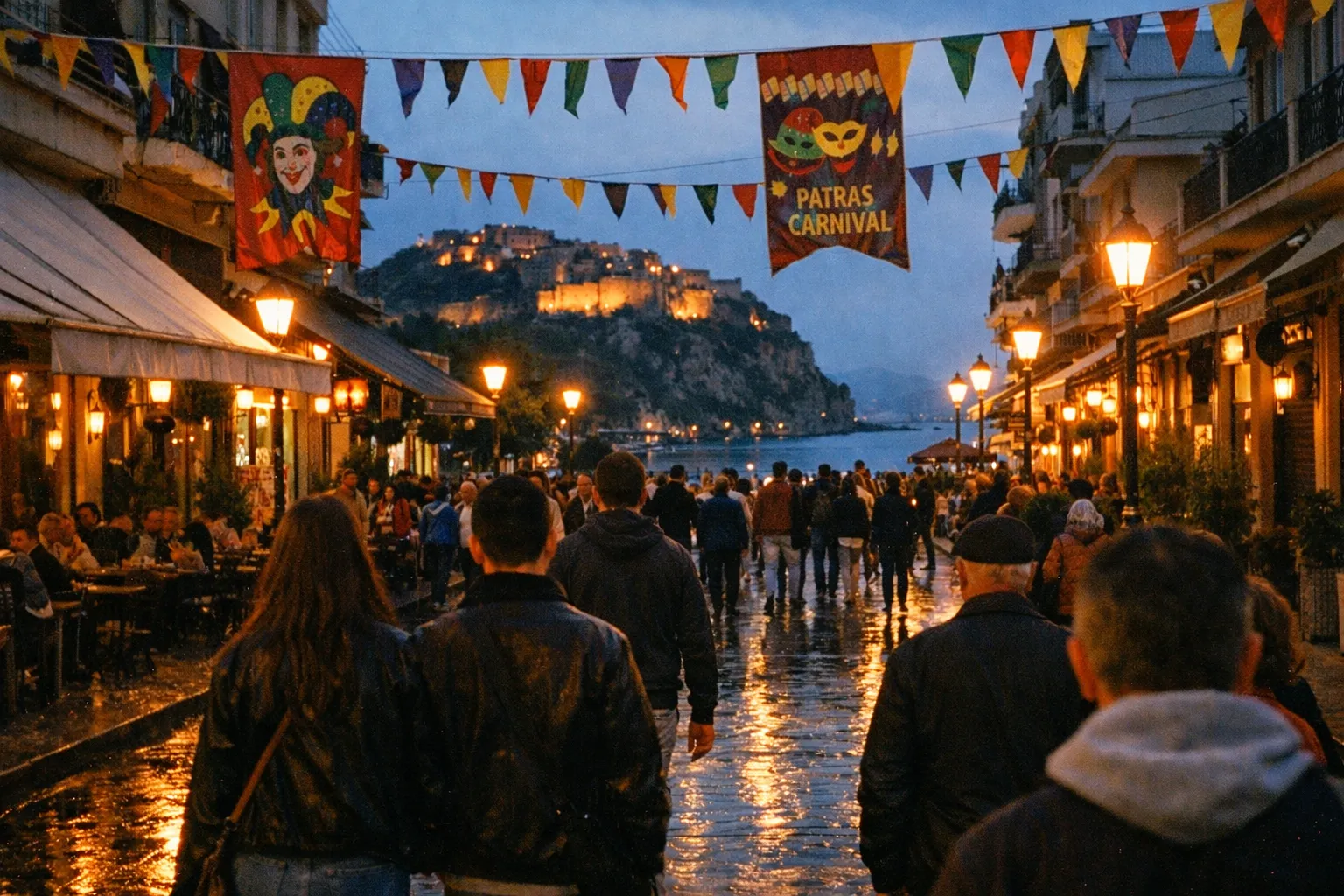
Outside carnival season, Patras is a working port city with a long pedestrian shopping street (Rigas Feraiou), a medieval castle on the hill above town, and easy access to wine country in Achaia. The Achaia Clauss winery, about 20 minutes inland, runs tours for €5 and has been making wine since 1861.
Hotels run cheaper than Athens or Thessaloniki - €55-€120 (~$60-$130)/night for solid mid-range. The KTEL bus from Athens takes about 3 hours; the new suburban rail is faster when it’s running.
Larissa, Greece: inland Thessaly’s transport hub
Larissa, Greece is the pick for travelers who want a Greek city that hasn’t been polished for tourists. If your main things to do in Greece include Meteora, Mount Olympus, or the Pelion peninsula, Larissa is the most practical - and most affordable - base for all three. Capital of Thessaly, sitting on the Pineios River, functioning mostly as an agricultural and transport center. Hotel prices typically run 15-30% below Athens for comparable quality.
The reason to base here isn’t Larissa itself - it’s what’s around it. Larissa is the practical staging point for:
- Meteora - the monasteries on rock pillars at Kalambaka, about an hour west by car. One of Greece’s most photographed sites and a legitimate UNESCO entry.
- Mount Olympus - about 90 minutes north, with trailheads at Litochoro.
- Pelion peninsula - old stone villages and beaches, 90 minutes east.
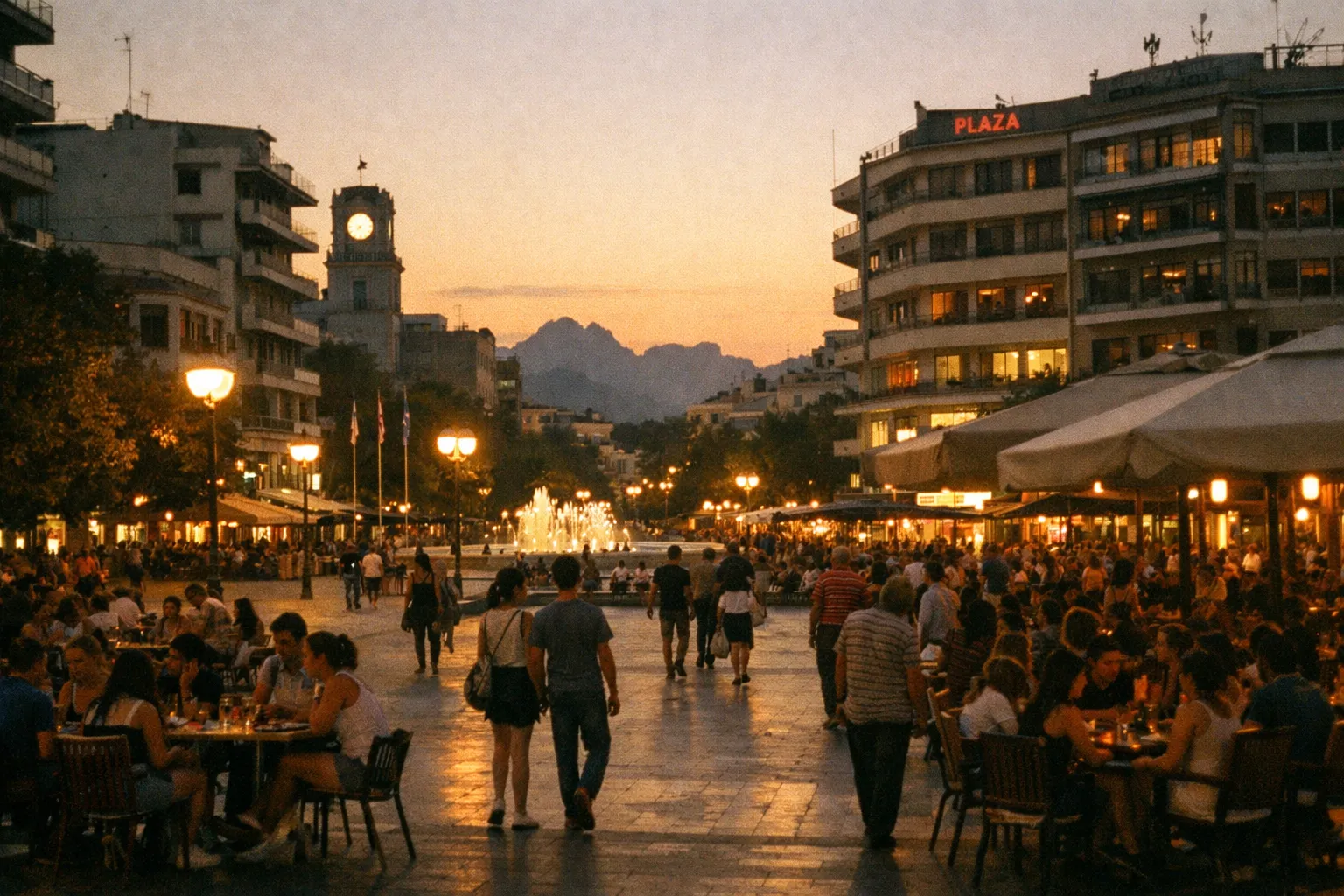
The city itself has a pleasant pedestrian center around Central Square, a 1st-century AD ancient theater still being excavated in the middle of downtown, and a café culture that runs late because of the large University of Thessaly student population. When I based here for four days to visit Meteora, I paid €65/night for a perfectly decent hotel room that would’ve cost €110 in Kalambaka.
Climate is genuinely different from coastal Greece - Larissa sits in a basin and gets cold wet winters (sometimes snow) and hot dry summers with thunderstorms. Pack accordingly.
Heraklion: Crete’s urban anchor
Worth adding to any urban Greece itinerary: Heraklion, the largest city on Crete with about 180,000 residents. It solves a specific traveler need - pairing a real city with one of Greece’s most important archaeological sites.
Knossos (the Minoan palace complex) sits 5 km from the city center and is reachable by local bus #2 for around €1.50-€2.00. Pair it with the Heraklion Archaeological Museum, which houses the actual frescoes and artifacts from the site. The museum and the ruins together are the experience - neither works alone, and most people who skip the museum leave Knossos confused.
Heraklion also has a working Venetian-era harbor, a strong food scene built on Cretan ingredients - sheep cheese, raki (grape pomace spirit), wild greens - and direct flights from most of Europe in summer. Most travelers stay 1-2 nights before moving on to Chania, Rethymno, or the south coast.
Quick Comparison: Top Cities in Greece
| Athens | Thessaloniki | Heraklion | Patras | Larissa | |
|---|---|---|---|---|---|
| Population (metro) | ~3.6 million | ~1 million | ~210,000 metro | ~260,000 | ~230,000 |
| Best For | First-timers, ancient history, day trips | Food, nightlife, Byzantine sites | Minoan archaeology + Crete base | Carnival, Italy ferry, Peloponnese gateway | Meteora base, lower prices, inland Greece |
| Typical Hotel (Shoulder Season) | €100-€180 | €70-€140 | €80-€150 | €55-€120 | €50-€100 |
What to eat for breakfast in Greek cities
Greek breakfast isn’t a hot buffet. In cafés and bakeries it’s usually one of these, paired with a Greek coffee or a freddo espresso (iced espresso shaken with sugar):
- Koulouri (sesame bread ring) - from a street cart, €0.50-€1
- Spanakopita (spinach and feta in phyllo)
- Tyropita (cheese pie in phyllo)
- Bougatsa (sweet semolina cream or savory cheese phyllo) - especially in Thessaloniki
- Greek yogurt with honey and walnuts - sit-down version
- Paximadi (Cretan barley rusk with tomato, olive oil, and feta) - mostly in Crete
Hotels catering to international visitors often add eggs, bacon, and pastries, but if you want what locals actually eat, head to a neighborhood bakery before 10 a.m. and order at the counter.
What can you not bring into Greece?
Greece follows standard EU customs rules, which catch travelers off guard more often than you’d expect. The main restricted or prohibited categories:
- Fresh meat, dairy, and most animal products from non-EU countries - this includes vacuum-sealed jamón bought on layover in Madrid if you’re arriving from outside the EU
- Fresh fruit, vegetables, and plants from non-EU countries without a phytosanitary certificate
- Counterfeit goods - Greek customs does check
- Antiquities - this matters on the way out, not in. You cannot legally export anything classified as a Greek antiquity without an export permit from the Ministry of Culture. Buying “ancient” coins or pottery from beach vendors is illegal to take home.
- Cash over €10,000 must be declared on entry from outside the EU
- Certain medications - bring a doctor’s note for controlled substances (ADHD meds, strong painkillers); codeine-based medications sold over the counter elsewhere are restricted here
Pets need an EU pet passport or equivalent health certificate plus a rabies vaccination at least 21 days before entry.
Which is the most beautiful city in Greece?
No honest single answer exists, but there are honest answers by category.
- Most dramatic urban setting: Athens. Nothing else in Europe looks like the Acropolis lit up at night from a rooftop bar in Monastiraki.
- Most beautiful waterfront: Thessaloniki. The 5-km promenade at sunset, with the Thermaic Gulf catching the light, makes the strongest case for any “most beautiful city” claim.
- Most beautiful historic core: Nafplio - technically a town, not a city, but if you want well-preserved without the scale of Athens or Thessaloniki, this is it.
- Most beautiful island city: Chania on Crete, for the Venetian harbor.
If forced to pick one urban center, Thessaloniki wins on ambiance and Athens wins on monumental impact. Pick based on what kind of beautiful you’re after.
Greek mainland trips beyond the cities
A lot of travel coverage lumps Greece’s mainland and islands together, which buries the mainland’s actual highlights. If you’re using one of the cities above as a base, these are the mainland day trips and overnight detours worth building in:
- Delphi - from Athens, 3 hours. The most important oracle site in the ancient world, set on the slopes of Mount Parnassus.
- Meteora - from Larissa, 1 hour. Active monasteries on rock pillars, six of which you can visit.
- Nafplio and Mycenae - from Athens, 2 hours. Greece’s first modern capital plus the Bronze Age citadel of Agamemnon.
- Mystras - from Athens or Patras, a Byzantine ruined city in the Peloponnese.
- Mount Olympus - from Larissa or Thessaloniki, serious hiking on Greece’s highest peak.
- Vergina - from Thessaloniki, the royal Macedonian tombs including Philip II’s burial.
Tips for families visiting Greek cities
Greek cities work better for families than their reputation suggests, but the logistics need thought:
- Strollers are difficult in older quarters of Athens, Thessaloniki, and Patras - uneven stone, narrow sidewalks, parked scooters. A baby carrier works better for kids under 2.
- Cap museum days at two major sights. The Acropolis plus the Acropolis Museum is enough for one morning; add a long lunch and a park afterward.
- Greeks eat late. Dinner at 9-10 p.m. is normal. Most restaurants happily serve families with kids at that hour, but factor it into nap schedules.
- Metro and bus are kid-friendly in Athens and Thessaloniki. Athens metro is air-conditioned and step-free at most stations built after 2000.
- Best family base in Athens: Pangrati or Koukaki, both with parks and pedestrian streets.
- Best family city pairing: Athens for 3 nights, then Heraklion for 2-3 nights with a Knossos visit. Short flight, easy logistics, two completely different historical layers.
Plan your trip around the cities, not the other way around
The honest version of a top cities in Greece ranking comes down to use case, not popularity. Athens for a first trip and the headline sights. Thessaloniki if you have a week and care about food. Patras if you’re coming from Italy or chasing carnival. Larissa if you want Meteora without paying tourist-town prices. Heraklion if Crete is already on the itinerary.
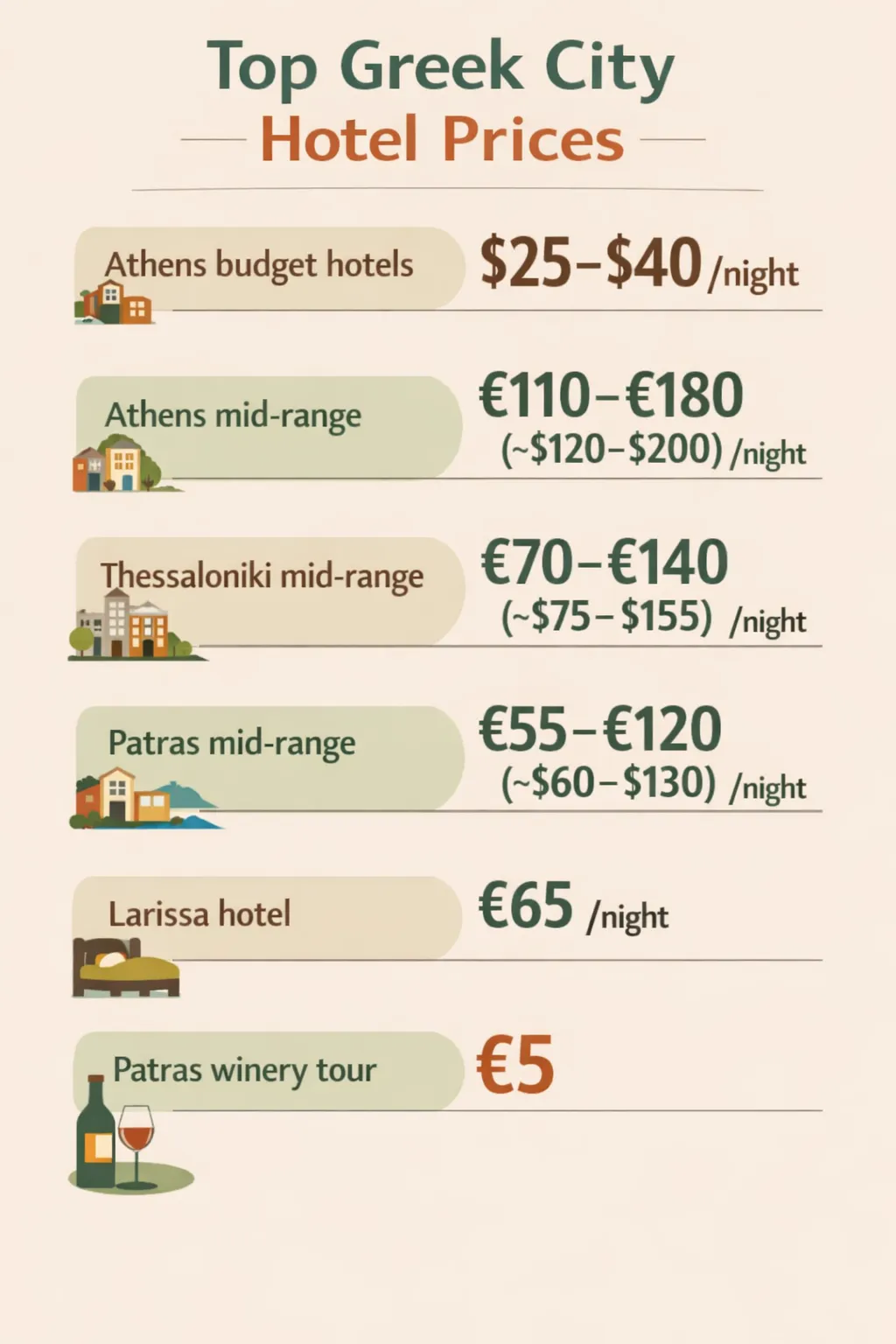 Shoulder-season hotel price ranges across Athens, Thessaloniki, Patras, and Larissa, plus a Patras winery tour: Athens budget hotels $25-$40/night; Athens mid-range €110-€180 (~$120-$200)/night; Thessaloniki mid-range €70-€140 (~$75-$155)/night; Patras mid-range €55-€120 (~$60-$130)/night; Larissa hotel €65/night; Patras winery tour €5.
What every one of these cities shares: walkable centers, late dinners, coffee culture that runs from 9 a.m. to 1 a.m., and enough layered history that a freddo espresso at a sidewalk café feels different here than it does anywhere else in Europe. Build the trip around the cities, treat the islands as add-ons, and you’ll see a Greece most beach-first travelers miss entirely.
✓ Pros
- Dense concentration of UNESCO sites within walkable city centers
- Good value city breaks outside peak summer months
- Diverse food scenes reflecting regional histories
- Strong public transport and infrastructure improvements
- Family-friendly options with thoughtful planning
✗ Cons
- Summer months can be oppressively hot and crowded in cities
- Some neighborhoods remain rough or less safe at night
- Older city quarters can be difficult for strollers or mobility issues
- Winter weather can be cold and wet inland
- Limited direct flights to some cities outside peak season
Frequently Asked Questions
- Are there direct flights to all these Greek cities year-round?
- Direct flights are more common to Athens, Thessaloniki, and Heraklion, especially in summer. Smaller cities like Larissa and Patras rely more on bus or train connections, and flight options can be seasonal.
- Is it safe to walk around Athens neighborhoods like Koukaki and Plaka at night?
- Koukaki and Plaka are generally safe and popular with tourists and locals alike. However, neighborhoods like Omonia are still improving and can feel less secure after dark, so it's best to avoid them at night if possible.
- Can I visit Meteora as a day trip from Larissa?
- Yes, Meteora is about an hour west of Larissa by car, making it a practical day trip. As of October 2026, no trains run to Kalambaka while the line damaged in the 2023 storms is restored. Staying overnight near the monasteries is also an option if you want more time to explore.
- What is the tipping culture like in Greek tavernas?
- Tipping is optional and modest. Rounding up the bill or leaving 5-10% for good service is appreciated but not expected. Locals often leave loose change rather than a percentage.
- Are Greek breakfasts similar across the mainland and islands?
- While many staples like koulouri and spanakopita are common, island breakfasts such as in Crete often include regional specialties like paximadi (barley rusk). Mainland cities tend to have more standardized options.
- Is public transport in Greek cities accessible for families with young children?
- Athens and Thessaloniki have modern metro and bus systems that are mostly accessible and air-conditioned. However, older city areas may have uneven sidewalks, so a baby carrier is often more practical than a stroller.