The gate at the 5th Station closes at 2:00 p.m. Unless you hold a mountain-hut reservation, that single fact reshapes everything about climbing Mount Fuji in 2026. This is a logistics exercise with a mountain attached, not a spontaneous hike. The official season runs a narrow window - July 1 to September 10 on the Yoshida Trail - and every climber now pays a ¥4,000 trail fee (roughly US$27 at current exchange rates - confirm the conversion before you travel). If you learned about Fuji from a pre-2026 guide, most of what you read is out of date.
I checked the Yoshida gate timing firsthand in August 2024 - the 2:00 p.m. cutoff is enforced without exceptions for walk-ups, and the staff at the checkpoint are not interested in negotiation. Plan your transport to arrive well before noon if you’re doing a same-day start.
By the end of this guide you’ll know which route to take, whether to go overnight or attempt a day trip, and exactly what to book before you ever reach the trailhead.
Climbing Mount Fuji in 2026: What You Need to Know About the Season, Rules, and Routes
The case for climbing Mount Fuji: it’s a genuine landmark summit at 3,776 m, achievable for fit non-technical hikers with no ropes or climbing gear, and unusually well supported - on the Yoshida Trail, huts sit roughly every 60 to 90 minutes, and a clear-sky sunrise from the crater rim is hard to top. If you’re choosing between July and August, early-to-mid July gives you lighter crowds and cooler temperatures; August is peak season with the 4,000-climber daily cap under real pressure most weekends. September is the underrated option - crowds thin noticeably after mid-August, weather is often more stable, and the season closes September 10, so you still have a window. Most guides push August without explaining the trade-off. That’s the thing they consistently get wrong: the best climbing conditions and the most popular month are not the same thing.
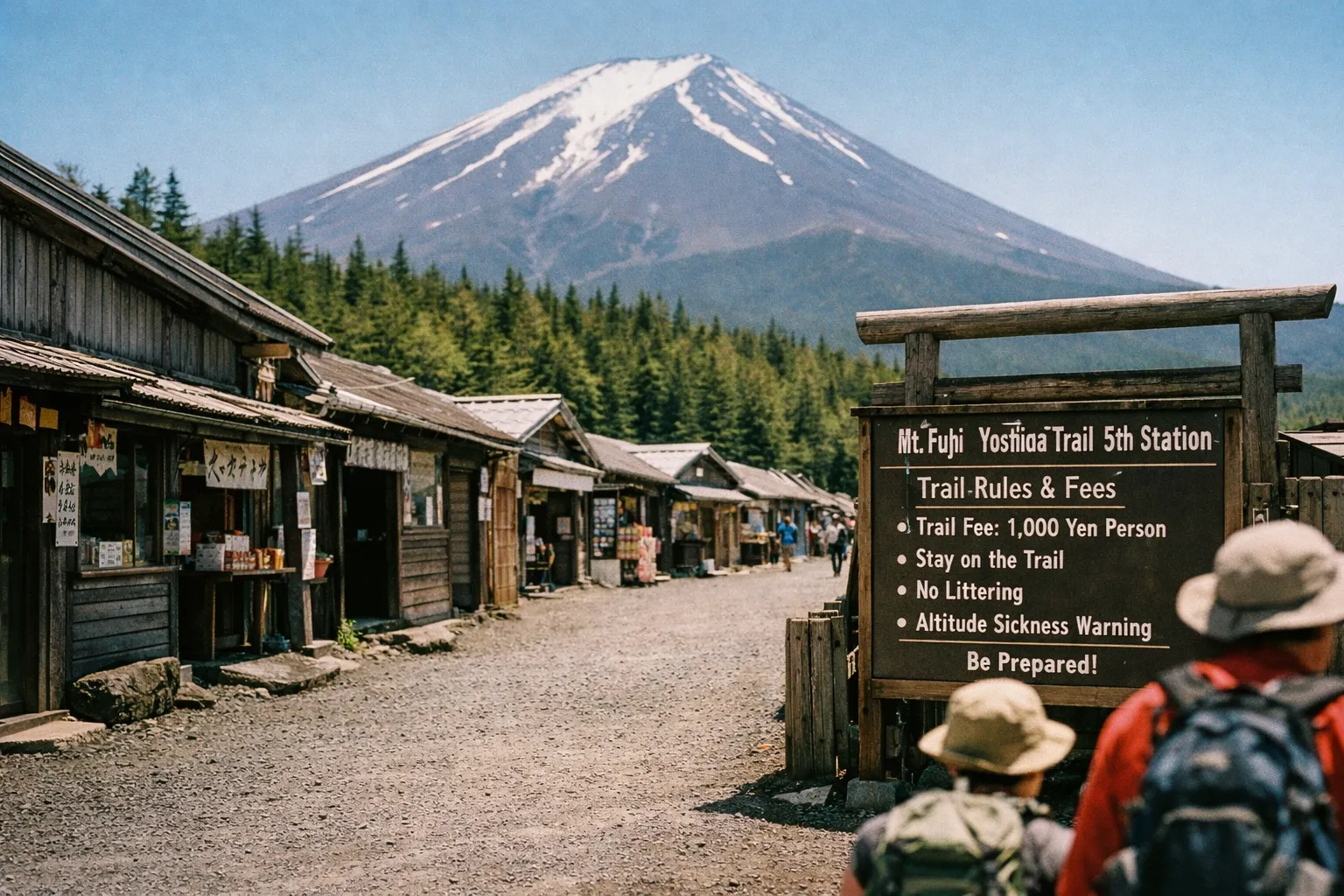
The case against: the season is short, the regulation is heavy, and a same-day round trip runs 10 to 12+ hours. Add altitude risk, peak-season congestion, near-freezing summit temperatures even in August, and the fact that trail entry, hut lodging, and transport are three separate bookings, and this becomes a trip you plan weeks ahead - not a weekend whim.
✓ Pros
- Iconic summit achievable for fit non-technical hikers
- Well-supported infrastructure with huts every 60-90 minutes on Yoshida
- Sunrise views on clear days from the crater rim
✗ Cons
- Short climbing season (July 1-September 10)
- Heavy regulation and multiple separate bookings required
- Long duration (10-12+ hours) with altitude risk
- Congestion at peak times
- Near-freezing summit temperatures even in summer
What the 2026 Rules Actually Mean for Your Climb
Three rules override everything older guides told you: advance registration is required, the ¥4,000 trail fee applies to all four routes, and on the Yoshida Trail, anyone on the mountain during the 2:00 p.m. to 3:00 a.m. gate-closure window must hold a confirmed mountain-hut reservation to pass through. This gate-and-reservation rule is specific to the Yoshida Trail - the Shizuoka-side routes (Subashiri, Gotemba, Fujinomiya) have their own access rules, and you should check the official requirements for each before assuming the same restriction applies identically.
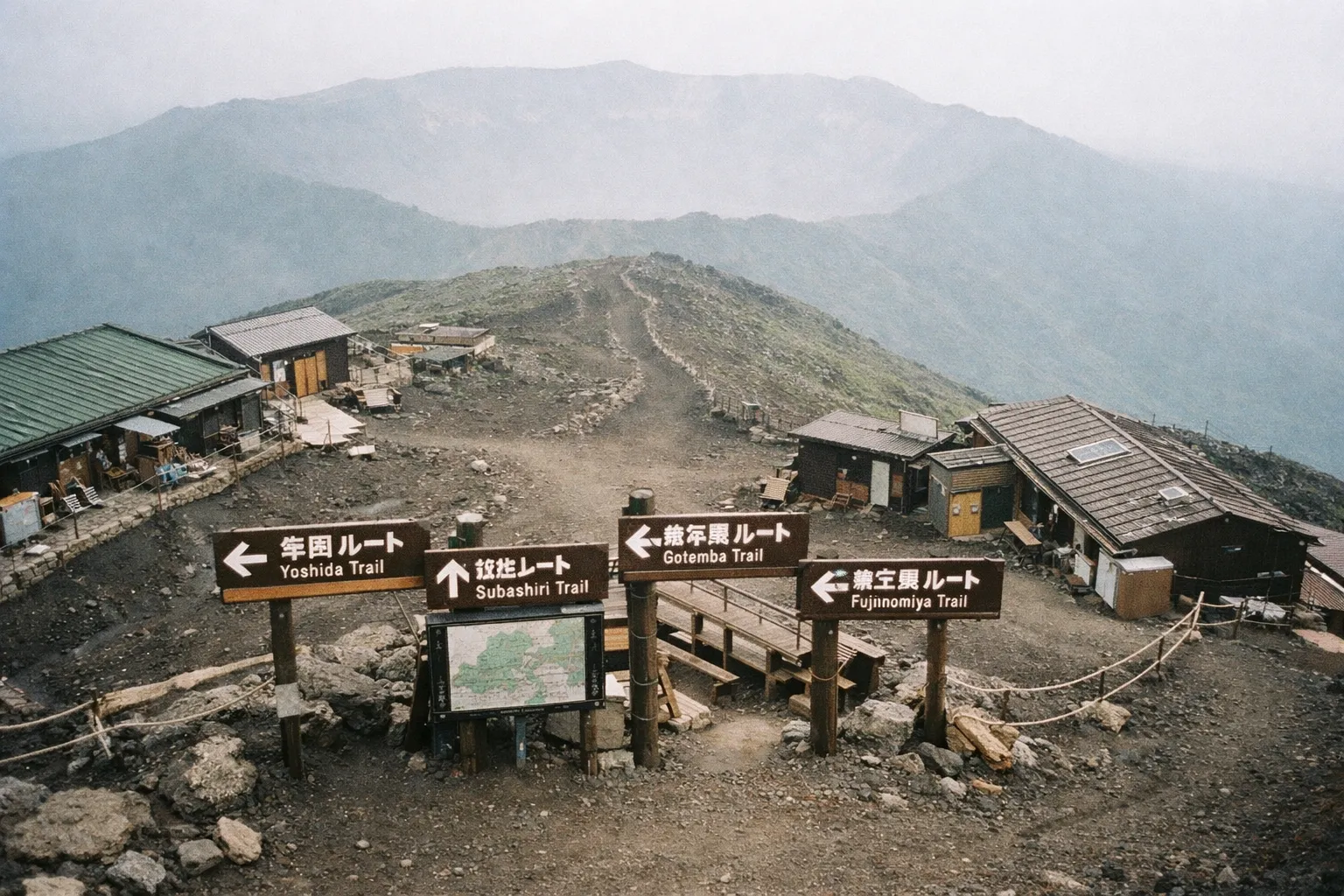
According to NHK World’s July 1, 2026 report on the season opening, each climber pays a ¥4,000 hiking fee and the gate at the 5th Station is closed from 2:00 p.m. to 3:00 a.m. for general entry (9). The ¥4,000 fee is mandatory on all four official trails, charged per person per climb, with no family or group discounts and no refunds even if you turn back early (3). A 2026 explainer on Hiddenjapan-gems.com stresses the point most readers miss: the ¥4,000 trail fee is separate from hut costs (6). Paying the fee gets you through the gate. It does not book you a bed.
The gate closure exists to stop “bullet climbing” - the overnight push straight to the summit without rest. LIVE JAPAN’s 2026 rules article explains the 2:00 p.m. to 3:00 a.m. closure was introduced specifically to curb these non-stop attempts, which authorities link to higher accident and rescue rates (5). Only climbers holding a mountain-hut reservation may pass through during the closure.
Yoshida Trail registration process
For the Yoshida Trail, you complete an online reservation and pay the ¥4,000 fee before you arrive. According to travelinjapan.net, reservations for the 2026 Yoshida season opened April 24, 2026 (2). You book a slot, pay online, and carry your confirmation to the trailhead, where it’s checked at the gate (4). The Yoshida route also runs a 4,000-climber daily cap, so on peak dates the online slot is not a formality - it’s your access.
FUJI NAVI and the Shizuoka-side process
The three Shizuoka-side routes - Subashiri, Gotemba, and Fujinomiya - add a step. Registration runs through the FUJI NAVI system, and beyond payment you must complete an e-learning course on safety and mountain manners (2)(7). This takes time. Don’t leave it for the night before your climb. The fee is the same ¥4,000, but the process is not identical to Yoshida, and treating the two as interchangeable is a common planning error.
The Four Official Routes to the Summit of Mount Fuji
Mount Fuji has four official climbing routes to the 3,776 m summit - Yoshida, Subashiri, Gotemba, and Fujinomiya - each starting from a different 5th Station and each charging the same ¥4,000 fee in 2026 (1). Choosing between them is the first real decision when planning your climb, and it drives everything from your transport plan to your odds of finding a hut bed.
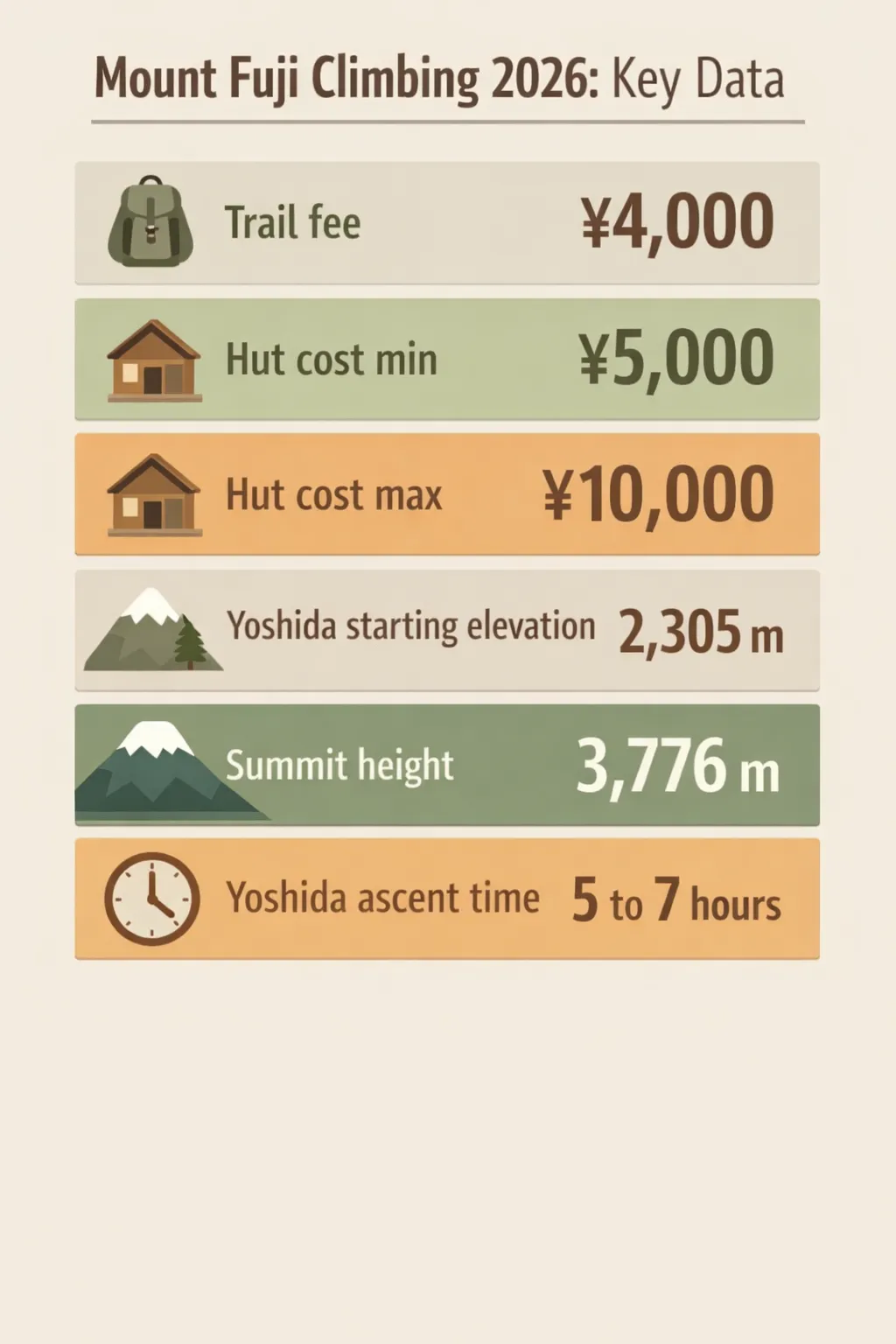 Climbing Mount Fuji in 2026 involves a ¥4,000 trail fee, hut beds costing ¥5,000-¥10,000 per night, Yoshida starting at 2,305 m, and a summit of 3,776 m, with a typical Yoshida ascent time of 5 to 7 hours.
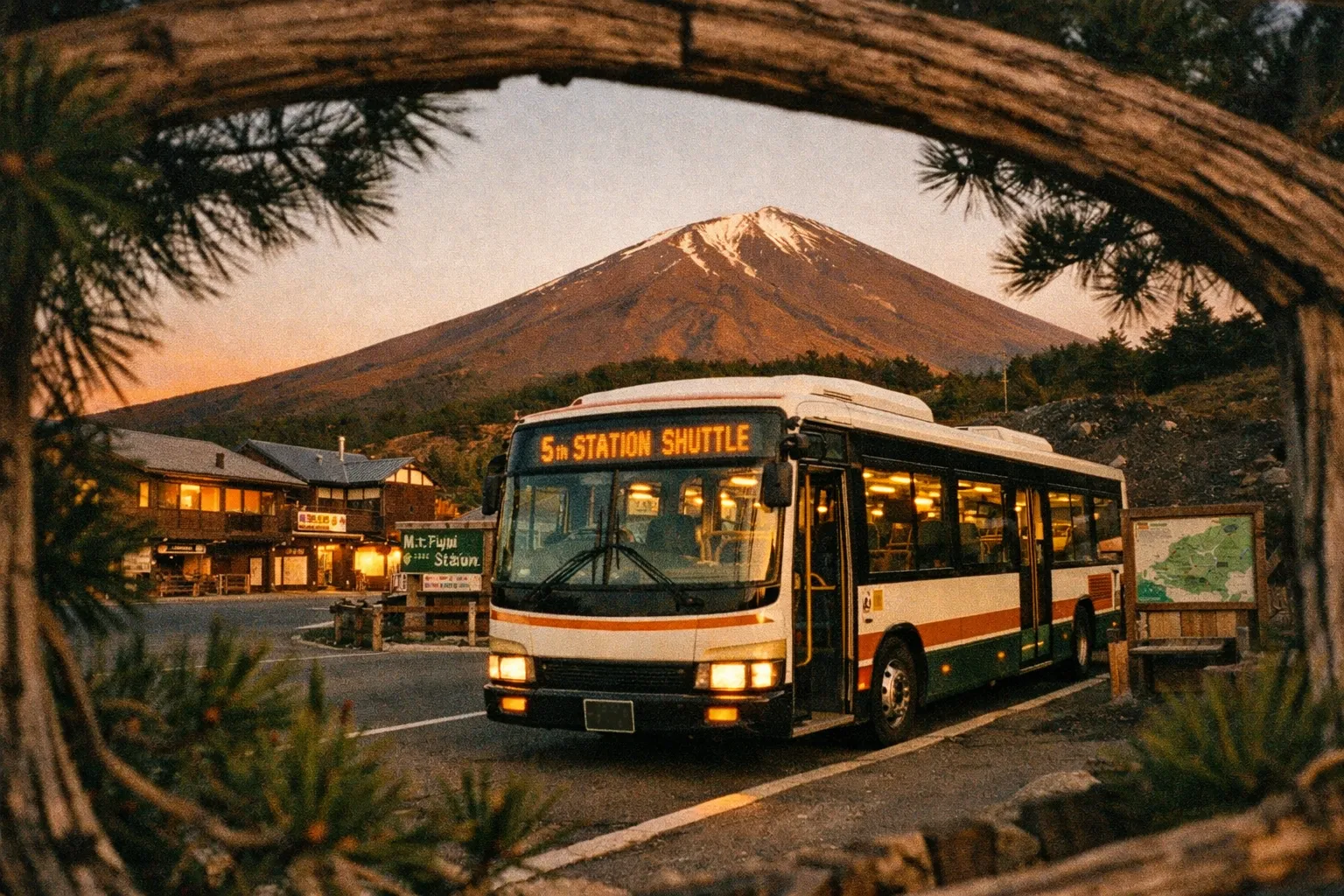
Yoshida is the default for good reason. The Yoshida 5th Station on the Fuji Subaru Line sits at 2,305 m, operates with the 4,000-climber daily cap, and has mountain huts roughly every 60 to 90 minutes of hiking from the 6th Station upward. It’s the most trafficked, best-signed, and easiest to reach from Tokyo - the sensible first-timer choice.
Subashiri starts lower, around 2,000 m, and stays quieter on its forested lower slopes. It merges with the Yoshida trail above the 8th Station, so the solitude ends before the summit, but the early sections have a noticeably different, greener character and far fewer people.
Gotemba is the outlier. Gotemba starts at about 1,440 m, making it the lowest and longest of the four. It’s known for the fast “osunabashiri” sand-run descent that shortens the way down relative to its long grind up. This is not a beginner route.
Fujinomiya is the shortest route by distance and starts highest on the Shizuoka side at about 2,400 m, which makes it popular with climbers coming from Nagoya and western Japan. Shorter does not mean easier - it’s steeper, with fewer huts than Yoshida.
On season dates, Yoshida and Subashiri open July 1, while Fujinomiya and Gotemba open July 10, and all routes close September 10 - a window of about 10 weeks (8). Private vehicles are restricted to most trail access points during the season; shuttle buses serve the 5th Stations. Both the daily cap and the vehicle restrictions are crowd controls rather than logistics: Fuji sits with Kyoto and Tokyo among the most pressure-sensitive destinations in the country, and capped access is one of the levers Japan’s sustainable tourism policy uses to spread visitors out. Expect the rules to tighten rather than lapse.
Route comparison at a glance
Mount Fuji Climbing Routes Comparison
| Most Popular Yoshida | Subashiri | Gotemba | Fujinomiya | |
|---|---|---|---|---|
| Starting Elevation | 2,305 m | about 2,000 m | about 1,440 m | about 2,400 m |
| Ascent Time | about 6 hrs | about 6-7 hrs | about 8-9 hrs | about 5-6 hrs |
| Descent Time | about 4 hrs | about 3-4 hrs | about 3 hrs | about 3 hrs |
| Difficulty | Moderate | Moderate | Hard | Moderate |
| Crowds | High | Medium | Low | Medium |
| Daily Cap | 4,000/day | None | None | None |
| Best For | First-timers | Second climb | Experienced hikers | Western Japan access |
Getting to the 5th Station
Yoshida is the most accessible from Tokyo: a bus to Kawaguchiko, then a local bus up the Fuji Subaru Line to the 5th Station. The Shizuoka-side trailheads require different access planning and are more naturally reached from Shizuoka, Nagoya, or western Japan. Because private vehicles are restricted during the season, you’ll rely on seasonal shuttle buses for all four routes. No current fares were sourced for 2026 - check the official route operators for shuttle schedules and prices before you travel, since they change year to year.
How Hard Is the Climb: and Can Most People Do It?
Climbing Mount Fuji is non-technical but genuinely demanding: the challenge is altitude and duration, not terrain, and a reasonably fit adult with regular cardio can complete it with proper preparation. There are no ropes, no scrambling on the standard routes, and no specialized skills required.
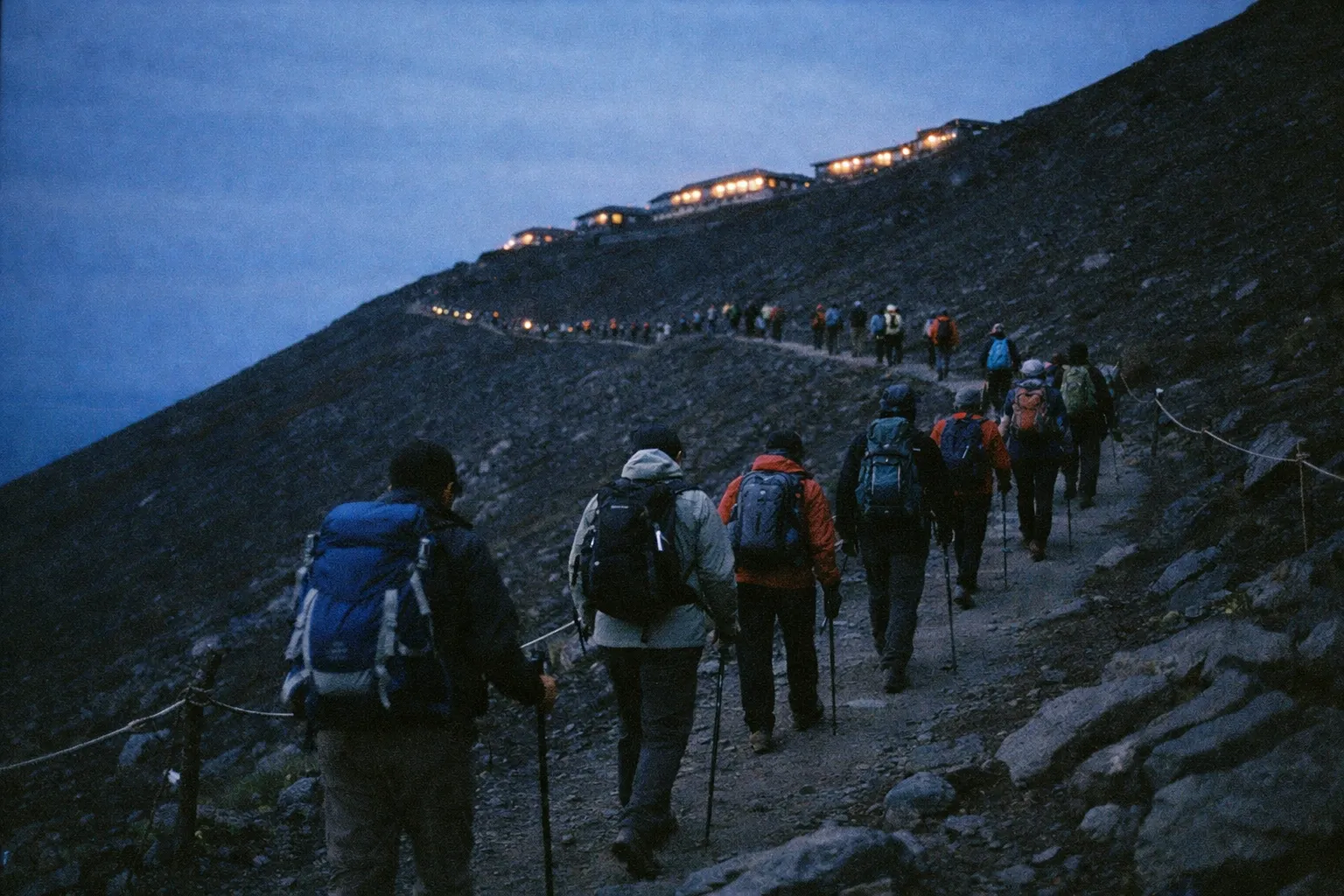
The physical scope is real, though. The official Mt. Fuji Climbing site lists the Yoshida ascent at 6.8 km from the 5th Station at 2,305 m (10), which is about 1,470 m of climbing to the 3,776 m summit: a sustained high-altitude hike, not a short walk. The same source times a Yoshida ascent at about 6 hours 10 minutes and the descent at about 3 hours 35 minutes, so most hikers spend around 8 to 11 hours on the trail excluding long breaks.
Who can realistically do it: fit adults who exercise regularly and have done multi-hour hikes before. Not recommended for young children, elderly climbers with health conditions, or anyone who’s never spent a full day on their feet on a trail.
Altitude sickness: what to watch for and what to do
Altitude sickness is the main risk for first-timers, not the terrain. The UK’s NHS puts the usual onset of altitude sickness above 2,500 m, with headache, nausea, and fatigue among the common symptoms (11), which lines up exactly with Fuji’s upper stations and summit. The 5th Station is already above 2,000 m, so some climbers feel the effects before taking a single uphill step.
Two moves reduce the risk meaningfully. First, acclimatize at the 5th Station for 30 to 60 minutes before you start climbing. Second - and higher value - overnight at a 7th or 8th Station hut so your body adjusts gradually. If symptoms worsen as you climb, slow down, rest, and if they don’t ease, descend. Altitude sickness gets better going down and worse going up. There’s no toughing it out.
What to pack for the climb
Summit temperatures on Mount Fuji can fall near 0°C (32°F) even in July and August, and Hiddenjapan-gems.com is blunt that cold-weather layers and waterproof outerwear are non-negotiable despite summer heat at the base (6). Afternoon thunderstorms are common. Pack a layering system - a moisture-wicking base layer, an insulating mid-layer, and a waterproof shell - plus a headlamp (mandatory for any pre-dawn or after-dark section), enough water, and a cashless payment backup for huts and gate checks. Trekking poles are optional but genuinely help on the long descent.
How Long It Takes to Reach the Summit and Descend Mount Fuji
Most first-timers doing a same-day round trip should plan for 10 to 12+ hours of walking, and the honest figure sits at the top of that range once you include breaks. The official Mt. Fuji Climbing site puts the Yoshida Trail at about 6 hours 10 minutes up and 3 hours 35 minutes down (10). Allow 5 to 7 hours up and 3 to 4 hours down once pace and breaks vary, giving a standard round-trip walking time of about 8 to 11 hours before you factor in hut stops, which are common and recommended.
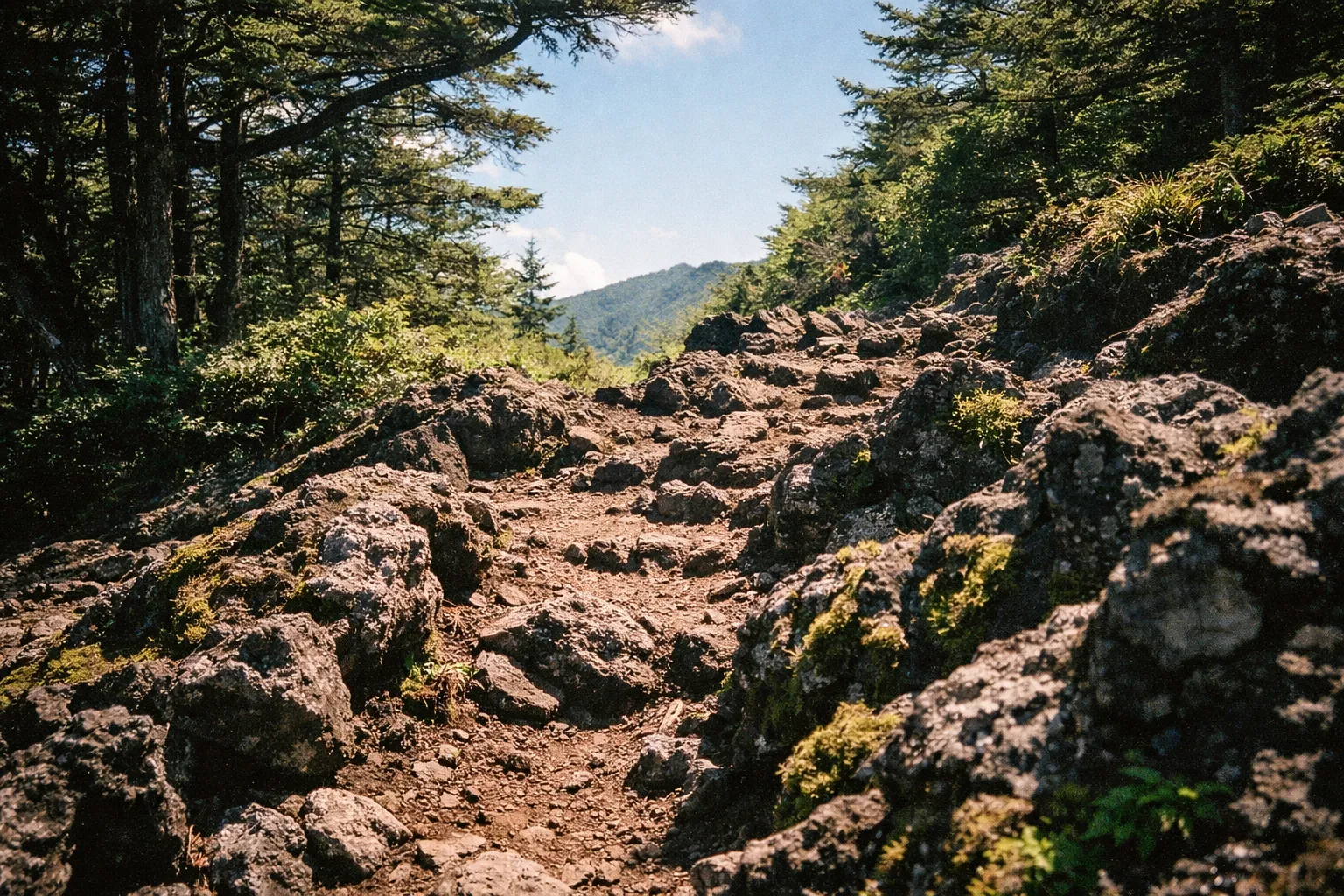
Route changes the math. The Gotemba Trail, starting lowest, is timed at about 8 hours 40 minutes of ascent on the official route comparison (10), though the sand-run descent brings the way down to about 3 hours 30 minutes. Fujinomiya’s shorter distance trims the ascent to about 5 to 6 hours, but it’s steeper for the trade.
The gate window forces your hand on timing. Trailhead gates reopen at 3:00 a.m. and close at 2:00 p.m., so any same-day climber without a hut reservation must start between 3:00 a.m. and 2:00 p.m. and plan a long day accordingly. A 10 to 12 hour round trip that begins near the 2:00 p.m. cutoff finishes deep into the night - which is exactly why a headlamp is mandatory rather than optional.
If sunrise is the goal, timing points toward an overnight stay. Summit sunrise in July and August falls roughly between 4:30 and 5:00 a.m. Reaching the crater rim by then from the 5th Station in a single push means either bullet climbing (now restricted) or an uncomfortable pre-dawn start. Staying at a hut and making a short summit push before dawn is the cleaner approach - and the one the rules are built around.
Overnight vs. Day Trip: Which Strategy Actually Works
For most first-timers, an overnight hut stay beats a day trip. It reduces altitude stress, aligns with the gate rules, and puts you on the summit for sunrise. A day trip is physically feasible for strong, well-acclimatized hikers, but it fights the clock the whole way.
The day-trip constraint is structural, not just physical. The gates are closed from 2:00 p.m. to 3:00 a.m., and climbers without hut reservations cannot enter during that window. So a day-tripper must start between 3:00 a.m. and 2:00 p.m., complete a 10 to 12 hour round trip, and accept that starting anywhere near the cutoff means finishing well after dark. JapanGuide.com’s 2026 rules summary confirms the ¥4,000 fee, advance online reservation, and 4,000-per-day limit (12) all apply to day-trippers too - so choosing a day trip avoids hut fees but not the mandatory trail costs.
The overnight strategy solves several problems at once. You climb to a 7th or 8th Station hut, sleep a few hours, and make a short summit push before dawn. The hut reservation is what legally lets you be on the mountain during the 2:00 p.m. to 3:00 a.m. closure - which is why hut selection is a route-access decision, not just a lodging choice. Hiddenjapan-gems.com frames a realistic first-timer climb as roughly 10 to 12+ hours of walking spread over two days, budgeting around ¥25,000 to ¥40,000 from Tokyo including transport, trail fee, and hut stay (6).
Day-trip checklist: timing and conditions required
Attempt a day trip only if all of these are true:
- You have strong cardio fitness and prior experience with 10+ hour hiking days.
- You can be at the 5th Station well before 2:00 p.m. - earlier is better.
- The weather forecast is clear, with no afternoon storm risk.
- You’re carrying a headlamp and cold-weather layers regardless of base temperature.
- You’ve already registered and paid the ¥4,000 fee online.
If any of those is shaky, go overnight.
Planning an overnight climb: what to book and when
How to Book an Overnight Mount Fuji Climb (Step by Step)
About 1 hourFollow these steps to secure your route registration, hut reservation, and transport for an overnight climb.
- 1
Choose your route
Select Yoshida for first-timers or a Shizuoka-side trail (Subashiri, Gotemba, Fujinomiya) based on your location and preferences.
- 2
Complete route-specific registration
For Yoshida, book online and pay the ¥4,000 fee. For Shizuoka-side, register via FUJI NAVI, complete the e-learning course, and pay the fee.
- 3
Book your mountain hut separately
Reserve your sleeping spot through the official hut booking system; this is not included in the trail fee.
- 4
Arrange transport to the 5th Station
Use seasonal shuttle buses as private vehicles are restricted during the climbing season.
- 5
Plan your ascent timing
Arrive at the 5th Station early, acclimatize for 30-60 minutes, then climb to reach your hut before dark.
- 6
Make your summit push
Depart the hut in the early hours to reach the summit before dawn, timing depends on hut elevation and sunrise.
Mountain Huts: What They Are and How to Book One
Mountain huts on Fuji are staffed rest stops with bunk-style sleeping areas, hot meals, and toilets. Basic shelters, not hotels, but warm and functional. For an overnight climb, they’re the difference between a manageable summit day and a brutal one.
The Yoshida Trail has the densest hut network, with huts spaced at roughly 60 to 90 minute walking intervals from the 6th Station upward, giving climbers several options to overnight around the 7th and 8th Stations. For first-timers, a 7th or 8th Station hut is the standard recommendation - high enough to aid acclimatization, low enough to leave a manageable pre-dawn push.
Here’s the confusion worth clearing up: the ¥4,000 trail fee does not include hut lodging. Hut reservations are booked and paid separately through route-specific systems or hut operators. Paying the trail fee secures your gate access, not a bed. Hut accommodation runs around ¥5,000 to ¥10,000 per person per night on top of the non-refundable ¥4,000 entrance fee, which makes the overnight stay a significant share of total climb cost.
Booking timing is the trap. Peak-season inventory - late July through mid-August - fills weeks or months in advance. A hut night typically buys you a shared bunk-style sleeping space with dinner and breakfast available for purchase, no private rooms. Bring earplugs; you’ll be sleeping shoulder to shoulder with strangers who are also getting up at 1 a.m.
Choosing the Right Route: Beginner, Intermediate, and Logistics-First
The right route depends on your experience and where you’re starting from: Yoshida for first-timers, Fujinomiya for western Japan access, Subashiri for slightly fewer crowds, and Gotemba only for experienced hikers.
Yoshida for first-timers. It’s best for beginners, thanks to the daily cap, dense hut network, and clear signage, and remains the primary recommendation for those starting from Tokyo. The crowds are a feature as much as a bug - more climbers means more support and easier morale on a hard day. The 4,000-person daily cap sounds alarming, but it functions as a ceiling, not a typical day’s traffic.
Fujinomiya for climbers from western Japan or Nagoya. It’s the shortest route by distance, starting at about 2,400 m, which suits climbers coming from Nagoya and western Japan who want a shorter approach. The trade-off is steeper sections and fewer huts than Yoshida - a solid second choice, not the easiest one.
Subashiri for slightly fewer crowds. It shares the upper trail with Yoshida, so the quiet doesn’t last to the summit, but the lower forested sections are notably less trafficked. Good if you want some solitude without committing to a hard route.
Gotemba for experienced hikers who want a real challenge. It’s the longest, lowest, and most demanding route, its about 1,440 m start and exposure making it better suited to hikers with experience on Japan’s mountains than to first-time summit attempts. The osunabashiri sand-run descent is a genuine draw - but this is not a first Fuji climb.
Route choice also shapes logistics. Yoshida is the most accessible from Tokyo (bus to Kawaguchiko, then local bus to the 5th Station); the Shizuoka-side routes demand different access planning.
Do You Need a Guide for Your Mount Fuji Climb?
No. The trail is well-marked, staffed, and supported by huts, and independent climbing is the norm during the official season. The 2026 rules and infrastructure are built around independent climbers, and most people don’t hire guides, relying instead on the hut network and clear signage.
That said, a guide adds real value in specific cases. First-timers with no hiking experience, groups with mixed fitness levels, or anyone who wants active pacing and altitude-symptom management benefit from having a professional along. LIVE JAPAN’s practical guide makes the same point: guides are most useful for first-time hikers with limited mountain experience or mixed-ability groups because they handle pacing, altitude symptoms, and reservations - but reiterates they’re optional, not required (5). Guided tours also absorb the booking burden, which matters if the multi-step registration process feels overwhelming.
On cost, guided climb pricing varies and changes seasonally - check current offerings directly with operators like Mtfuji.tours or through the official tourism resources, since no reliable 2026 figure was available at time of writing. The honest trade-off: a guide costs money and locks you into a group pace, while going independent gives you flexibility but puts every logistical step on you.
Common Mistakes That Derail a Mount Fuji Climb
Most failed Fuji climbs come down to logistics, not fitness. Here are the pitfalls that turn people back most often:
- Assuming the ¥4,000 fee covers lodging. It doesn’t. Many visitors make exactly this mistake; hut stays are booked and paid separately, often adding ¥5,000 to ¥10,000 per night.
- Arriving after 2:00 p.m. without a hut reservation. NHK World confirms the 5th Station gate is closed from 2:00 p.m. to 3:00 a.m., and climbers without a hut booking who arrive after 2:00 p.m. are turned back until the gate reopens. That’s your whole climb gone.
- Treating the Shizuoka-side registration like Yoshida. The FUJI NAVI e-learning step takes time. Don’t leave it for the day before.
- Underestimating altitude. The 5th Station is already above 2,000 m, so some climbers feel the effects before they start uphill - which is why the 30 to 60 minute acclimatization stop matters.
- Booking huts late for peak dates. Late hut booking is one of the most common reasons planned climbs fail, since late-July-to-mid-August inventory books out weeks or months ahead.
- Packing for base weather and ignoring the summit. A light jacket isn’t enough when the summit sits near freezing. Bring the full layering system.
- Skipping the 5th Station acclimatization stop. Thirty to sixty minutes at the trailhead costs almost nothing and meaningfully cuts altitude risk.
Frequently Asked Questions
- How difficult is the climb up Mount Fuji?
- Non-technical but strenuous. Altitude above 2,500 m and 10-12 hour duration are the main challenges. Fit adults with cardio fitness can manage with preparation.
- Can the average person climb Mount Fuji?
- Yes, with adequate fitness, cold-weather gear, and a realistic plan. Yoshida Trail is most forgiving. Not recommended for young children or those sensitive to altitude.
- How long does it take to climb Mount Fuji?
- Ascent from Yoshida 5th Station takes 5-7 hours; descent 3-4 hours. Full round trip is 10-12+ hours including breaks. Overnight climbers split this over two days.
- Do I need a guide to climb Mount Fuji?
- No. Trails are well-marked and staffed. Guides help first-timers with logistics and pacing but are optional. Independent climbing is standard.
- What is the Mount Fuji climbing fee in 2026?
- ¥4,000 per person on all four main routes. This covers trail entry only; hut accommodation is booked and paid separately.
- Can I climb Mount Fuji as a day trip from Tokyo?
- Technically yes, but it's a long, demanding day requiring early start and strong fitness. Most first-timers benefit from an overnight hut stay.
- What happens if I arrive at the trailhead after 2:00 p.m.?
- Without a mountain-hut reservation, you won't be allowed through the gate during 2:00 p.m.-3:00 a.m. closure. Hut booking grants access during this time.
Before You Go: The Booking Sequence That Determines Everything
The mountain is the same for everyone. What separates a good climb from a wasted trip is almost always logistics.
Three things must be in place before you reach the trailhead: trail registration completed and the ¥4,000 fee paid online, hut reservation confirmed if you’re going overnight, and shuttle transport to the 5th Station arranged. Get the order right - register and pay, book the hut separately, then sort transport - and confirm each one is actually done, not just intended.
The season runs a narrow 10 weeks, and peak-date hut inventory in late July and August books out weeks ahead. Start planning early and you’re choosing between routes. Leave it late and you’re taking whatever’s left, if anything is. If Fuji is one stop on a longer trip, a 10 Day Japan Itinerary can help you build the rest of your schedule around the climb without losing time in Tokyo or Kyoto.