A Bali itinerary lives or dies on how you split your bases, not just how many days you have. Seven days covers two bases and one day trip, but it forces you to skip Nusa Penida, the island most people wish they had built in. Fourteen days unlocks it as a proper three-night stop, plus the quiet Sidemen valley, for around 560 to 990 dollars on the ground. Here is how each trip length actually plays out.
Your Bali Itinerary: How Many Days Are Actually Enough?
Planning a bali itinerary can be tricky, but the short answer is that seven days is the practical minimum, and ten to fourteen days is the sweet spot for first-timers. This timeframe allows you to experience the island’s highlights without feeling rushed.

Five days gets eaten by jet lag, the airport transfer from Denpasar (DPS), and one cultural day in Ubud - you’ll see almost nothing else. A week lets you split between two bases (typically Ubud plus one beach town) and squeeze in one big day trip. Two weeks is when Nusa Penida, Sidemen, or Uluwatu stop being tradeoffs and start being natural stops on the route (2)(4)(5).
A useful rule from the route-planning side: every move between bases costs roughly half a day once you factor in checkout, the drive, and settling into the new place. Three bases in a week is the upper limit before transit overwhelms the trip.
One-week plan for first-timers
This is the bali travel itinerary I’d hand a friend with seven nights, one international flight, and no patience for daily hotel changes. Two bases, one island day trip, no backtracking.

Days 1-4: Ubud (4 nights)
Land at DPS, prebook a transfer to Ubud (roughly 1.5 hours, 350,000-450,000 IDR / ~$22-28 USD). Use day one to recover. I’d book a massage on Jalan Hanoman (150,000-250,000 IDR / ~$10-16 USD), eat at a warung near the market, and sleep early.
- Day 2: Sacred Monkey Forest in the morning, Campuhan Ridge Walk before lunch, then the Ubud Palace and market in the afternoon. Catch a Kecak dance performance at sunset.
- Day 3: Hire a driver for a north Ubud loop - Tegalalang rice terraces at sunrise (before the tour buses), then a coffee plantation, Tirta Empul water temple, and Tegenungan or Tibumana waterfall. A driver for the day runs 700,000-900,000 IDR (~$45-58 USD).
- Day 4: Either the Mount Batur sunrise hike (pickup at 2 AM, around 500,000-700,000 IDR / ~$32-45 USD with guide and breakfast) or a slower day with a yoga class and the Tegallalang swings.
Days 5-7: Canggu or Uluwatu (3 nights)
Move south. Canggu is better for cafes, surf lessons, and beach clubs; Uluwatu wins on cliff scenery and the temple at sunset. Pick one - splitting three nights between both is the classic first-timer mistake (1)(4).
- One day for the beach and learning to surf (group lessons run 350,000-500,000 IDR / ~$22-32 USD).
- One day for a Nusa Penida snorkel trip - Manta Point, Kelingking Beach viewpoint, Crystal Bay. Day tours from south Bali run 1,200,000-1,800,000 IDR (~$77-115 USD) including the speedboat and lunch.
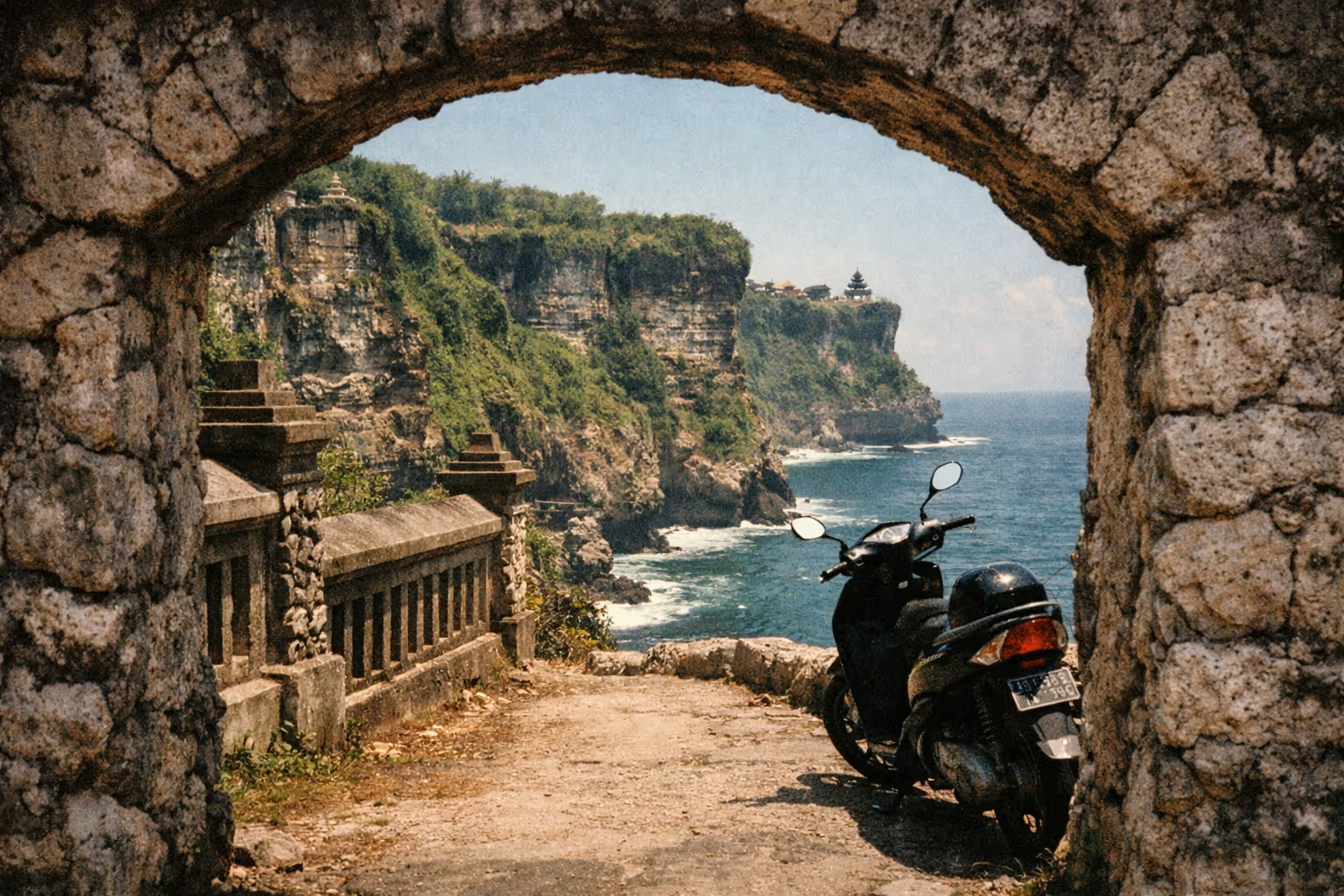
- One day for Uluwatu Temple at sunset (whether you sleep there or not - it’s worth the drive), plus dinner at the cliffside warungs or Sundays Beach Club.
Fly out from DPS on day 8.
This Ubud-plus-southern-coast combo covers the headline experiences without the route doubling back on itself.
Two-week route: the deeper version
Fourteen nights lets you slow down, add Nusa Penida properly (not as a rushed day trip), and fit in either Sidemen or the Gilis. Here’s the breakdown most route-planners settle on (2)(4)(5):
Canggu (3 nights) → Ubud (4 nights) → Sidemen (2 nights) → Nusa Penida (3 nights) → Uluwatu (2 nights)
Days 1-3: Canggu
Start with the easier landing - Canggu is 45 minutes from the airport versus Ubud’s 1.5 hours. Mornings for surf at Echo Beach or Batu Bolong, afternoons for the cafes around Jalan Pantai Batu Bolong and Jalan Pantai Berawa. The coffee scene here genuinely competes with Melbourne. Sunset at La Brisa or Old Man’s.
Days 4-7: Ubud
Same Ubud base as the one-week version but with breathing room. Add a cooking class (Paon Bali, around 450,000 IDR / ~$29 USD including market visit), a half-day on the Ayung River for white-water rafting, and at least one slow morning at a cafe with rice-field views - Karsa and Pomegranate are both worth it.
Days 8-9: Sidemen
Skipped by most first-timers, which is exactly why it works. Sidemen is what Ubud was twenty years ago - terraced rice fields, no tourist buses, family-run lodges with pools facing Mount Agung. Drive time from Ubud is around 90 minutes. I’d use it as a decompression stop before the Nusa Penida segment; it earns that role.
This is also the easiest base for visiting Lempuyang Temple (the “Gates of Heaven”) at sunrise without a 4 AM start from Ubud.
Days 10-12: Nusa Penida itinerary
Ferries leave from Sanur multiple times daily; the fast boat runs 30-45 minutes and costs 200,000-300,000 IDR (~$13-19 USD) each way. Book through Maruti, Angkal, or Idola - not from beach touts.
A workable nusa penida itinerary across three nights:
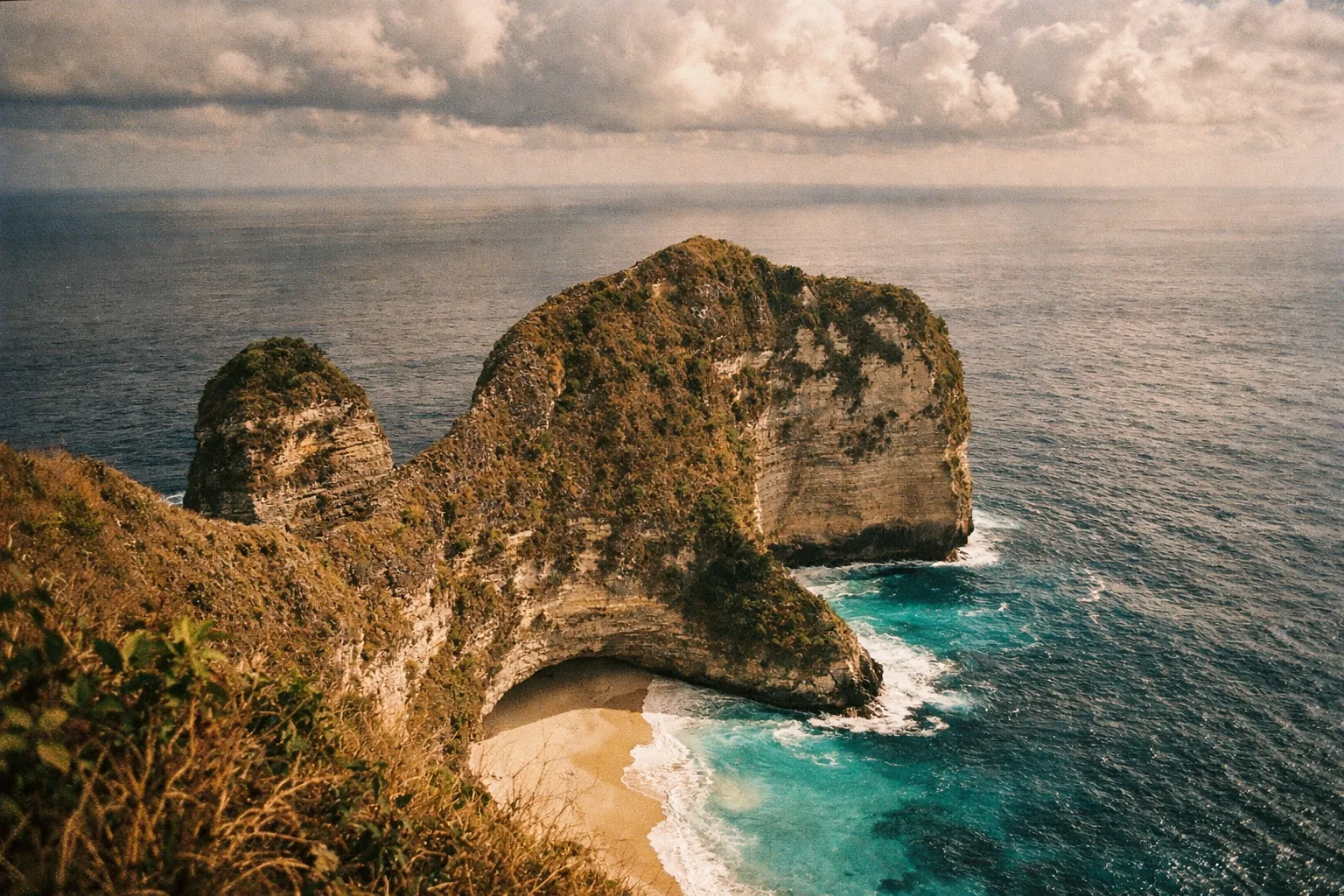
- Day 10 (West Coast): Kelingking Beach (the T-Rex viewpoint), Angel’s Billabong, Broken Beach, Crystal Bay for sunset. A scooter rental is 80,000-100,000 IDR/day, but the west coast roads are rough - many travelers hire a driver instead (600,000-800,000 IDR / ~$38-52 USD for the day).
- Day 11 (East Coast): Diamond Beach, Atuh Beach, Rumah Pohon treehouse. Less crowded than the west, and the descents to the sand are serious staircases - bring real shoes, not sandals.
- Day 12 (Snorkel day): Manta Point and Crystal Bay snorkel tours run from Toya Pakeh harbor, around 450,000-650,000 IDR (~$29-42 USD). Manta sightings are most reliable April through October.
A common mistake: treating Penida as a chilled beach island. It’s a working trip with long drives between viewpoints, and three nights is the minimum to do it without rushing (1)(4).
Days 13-14: Uluwatu
Ferry back to Sanur, then 90 minutes south to Uluwatu. Use these last two nights for the temple at sunset (with the Kecak fire dance - 150,000 IDR / ~$10 USD), Padang Padang Beach, and one beach club afternoon at Karma or Sundays. Fly out from DPS, which is only 30-40 minutes from Uluwatu.
What to do in Bali beyond the obvious
The headline list - things to do in bali that show up in every guide - covers Tegalalang, Mount Batur, Uluwatu Temple, Tanah Lot, the Monkey Forest, and Kelingking Beach. They’re popular because they deliver. But a few additions worth working into the itinerary:
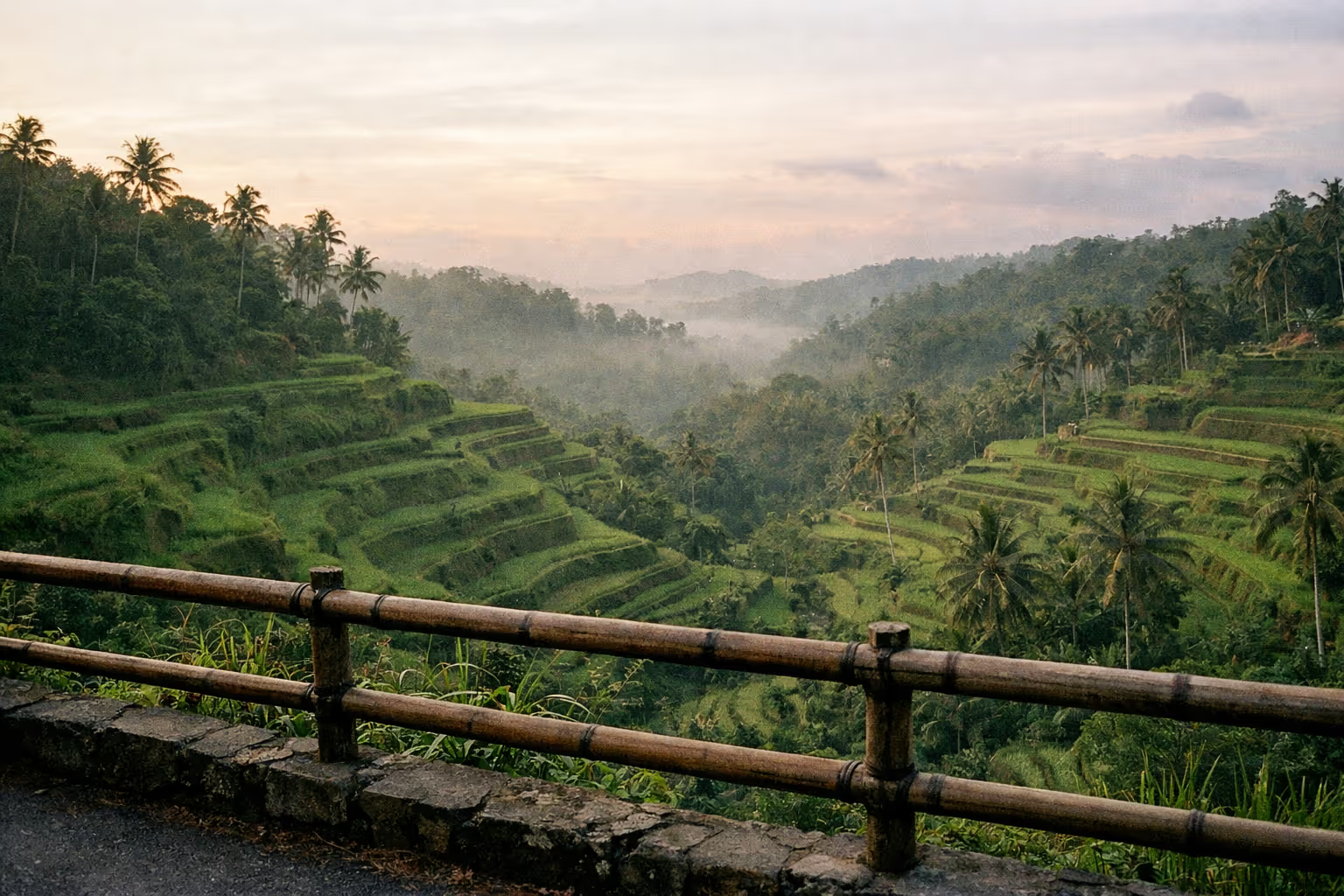
- Jatiluwih rice terraces - bigger and less crowded than Tegalalang, UNESCO-listed, about 90 minutes from Ubud.
- Tukad Cepung waterfall - the one with the light beam through the cave ceiling. Best between 10 AM and noon in dry season.
- Sekumpul waterfalls in the north - a real trek, but the most dramatic falls on the island.
- Munduk - cooler highland village with two scenic lakes (Tamblingan and Buyan) and almost no nightlife. Good for one quiet night if you’re not adding Sidemen.
- A traditional ceremony - if you’re invited to a local temple ceremony, dress in a sarong and sash (often loaned by hosts), and bring a small offering. Photographing is generally fine; standing higher than the priest is not.
One etiquette note that catches travelers out: at temples, menstruating women are traditionally asked not to enter inner courtyards. Most sites post this rule at the entrance. It’s not enforced, but it’s expected to be respected.
Is $1000 enough for a week in Bali?
Yes, comfortably - for on-the-ground costs only. International flights are separate.
Here’s a realistic breakdown for one person over seven days, mid-range style (private room in a guesthouse with pool, mix of warungs and Western cafes, one driver day, one big activity):
- Accommodation: $25-45/night × 7 = $175-315
- Food: $15-25/day × 7 = $105-175 (warung meals run 30,000-50,000 IDR / ~$2-3.20; cafe meals 80,000-150,000 IDR / ~$5-10)
- Transport (drivers, scooters, ferries): $80-150
- Activities (one big tour + entrance fees + a massage or two): $150-250
- Buffer: $50-100
Total: roughly $560-990 for a comfortable week, which means $1,000 is workable if you avoid daily beach club tabs and luxury villas. Drop to $600-700 by staying in homestays at $12-18/night, eating at warungs, and renting a scooter instead of hiring drivers. Push past $1,500/week the moment you book a villa with a private pool, eat at Locavore or Mason, or do multiple private day tours(3)(4).
What $1,000 does NOT cover: international airfare (typically $700-1,400 round trip from the US West Coast, $900-1,500 from Europe), travel insurance (World Nomads or SafetyWing - $30-60/week), or a visa extension if you stay past 30 days.
What is the typical food in Bali?
Balinese food is distinct from broader Indonesian cooking - heavier on coconut, lemongrass, turmeric, and base genep (a foundational spice paste). The dishes worth tracking down:
- Nasi campur (mixed rice plate) - the universal warung order. Rice surrounded by small portions of vegetables, tempeh, tofu, chicken or fish, and sambal (chili sauce). 25,000-45,000 IDR (~$1.60-3) at a local warung.
- Babi guling (suckling pig) - Balinese roast pork, served with rice and crispy skin. Ibu Oka in Ubud is famous but touristy; Warung Babi Guling Pak Malen in Seminyak is the local pick. Skip if you don’t eat pork - most Balinese are Hindu and pork is central here, unlike in Muslim-majority Java.
- Bebek betutu (slow-cooked duck) - wrapped in banana leaves with spice paste and roasted for hours. Order ahead at traditional places.
- Lawar - a mix of vegetables, grated coconut, and minced meat with spices. Often served as part of nasi campur.
- Sate lilit - minced fish or chicken satay wrapped around lemongrass skewers. Coastal villages do it best.
- Mie goreng (fried noodles) and nasi goreng (fried rice) - the everyday Indonesian standbys. Good everywhere, 20,000-40,000 IDR.
- Pisang goreng (fried banana) and dadar gulung (green coconut pancake) - the street snacks to hunt down at markets.
For drinks: kopi Bali (traditional ground coffee, brewed directly in the cup) is the local breakfast order; arak is the rice liquor, but only buy from established bars - there have been bootleg arak poisoning incidents over the years. That’s not a scare story, it’s a real pattern.
Vegetarians and vegans do well here. Ubud especially is loaded with plant-based cafes, and the Hindu festival food tradition means meat-free options are normal, not an afterthought.
What is the 6 month rule in Bali?
This is a passport rule, not a Bali-specific one: your passport must be valid for at least six months beyond your arrival date in Indonesia. If it expires sooner, you’ll be denied boarding at your departure airport, not at Indonesian immigration. Airlines check this before you fly.
A second six-month rule worth knowing: most travelers enter on the Visa on Arrival (VoA), which costs 500,000 IDR (~$35 USD) and is valid for 30 days, extendable once for another 30 days. If you’re trying to stay longer than 60 days within a six-month period, you need a different visa class (B211A or the newer digital nomad options). Repeatedly bouncing in and out on tourist visas raises flags with Indonesian immigration - not banned outright, but not unlimited either.
Bring printed proof of onward travel. Immigration occasionally asks for it, and some airlines require it at check-in.
How to get around Bali
Bali has no operating metro or train system (a metro project has been announced for around 2028, but nothing runs yet). Your options:
- Private driver for the day - the most efficient way to cover multi-stop days. 600,000-900,000 IDR (~$38-58 USD) for 8-10 hours, often including fuel. Negotiate at your hotel rather than through touts.
- Grab and Gojek - the local rideshare apps. Cars from the airport to Ubud run around 350,000 IDR; short hops in Canggu are 30,000-60,000 IDR. Some areas (Ubud center, Canggu beach roads) have local taxi operators who block app pickups - walk a few hundred meters from your hotel before booking.
- Scooter rental - the price depends on the model and how many days you book. An Uluwatu rental catalog lists 110-125 cc scooters from 59,000 to 135,000 IDR a day on a three-day minimum (9), while a local guide quotes 130,000-200,000 IDR a day for a standard automatic (10). Only rent if you’ve ridden before. An international driving permit with motorcycle endorsement is required by law; police checkpoints in Canggu and Uluwatu have been targeting foreigners more aggressively in 2024-2025, and fines for no permit run 250,000-500,000 IDR.
- Fast boats - for Nusa Penida, Nusa Lembongan, and the Gilis. Book through Maruti, Idola, Angkal, or Scoot. Crossings are choppy in January-February.
Driving yourself in a rental car is legal but not recommended for first-timers - Bali traffic is dense, signage is inconsistent, and parking is a real problem in tourist zones.
Best time to visit Bali
Dry season runs April to October, with the best weather in May, June, and September - sunny, less humid, and before the August peak crowds. July and August are the busiest months and the most expensive for hotels (expect a 30-50% markup over shoulder months).

Wet season is November to March, with January and February the wettest. Rain usually comes as afternoon downpours rather than all-day washouts, so the wet season isn’t a write-off - fewer crowds, greener rice terraces, cheaper rooms. The tradeoff is rougher seas (ferries to Nusa Penida occasionally cancel) and more mosquitoes.
Nyepi, the Balinese Day of Silence, typically falls in March. The entire island shuts down for 24 hours - no flights in or out of DPS, no leaving your hotel, no lights at night. It’s a remarkable experience if you’re prepared for it and a logistical disaster if you’re not. Check the date before booking.
Where to stay: matching neighborhoods to trip style
- Ubud center (around Monkey Forest Road and Jalan Hanoman) - walkable to cafes, dance performances, and the market. Trades quiet for convenience.
- Penestanan and Sayan (west Ubud) - quieter, rice-field views, slightly cheaper. You’ll need a scooter or driver for nightly dinners.
- Canggu (Berawa, Batu Bolong, Pererenan) - surf, cafes, coworking, beach clubs. Traffic is bad and getting worse; Pererenan is the calmer pick.
- Seminyak - boutique shopping, beach clubs, restaurants. More polished, less distinctly Balinese.
- Uluwatu (Bingin, Padang Padang) - cliffs, surf, sunset. Quieter at night, harder to get around without a scooter.
- Sidemen - rice terraces and mountain views. Bring a book.
- Nusa Penida (Toya Pakeh or Ped) - base for the island. Most accommodations are simple guesthouses; don’t expect luxury.
Budget tiers: homestays $12-25/night, mid-range guesthouses with pools $30-60/night, boutique hotels and small villas $80-150/night, luxury villas $200+/night.
Practical things to lock in before you go
A short checklist that saves trouble:
- Travel insurance - World Nomads or SafetyWing cover scooter accidents and theft, both of which are real risks in Bali (3).
- Cash and cards - ATMs are everywhere but skimming has been an issue; use machines attached to bank branches. Most cafes take card; warungs and small drivers take cash only.
- eSIM or local SIM - Telkomsel has the best coverage. An eSIM from Airalo or Holafly works the moment you land.
- Two pairs of decent walking shoes - Bali’s steps (especially on Nusa Penida) destroy flip-flops.
- Reef-safe sunscreen - and a refillable water bottle; tap water is not drinkable, but most hotels and cafes have refill stations.
- A sarong - required for temple visits. Most temples loan them, but having your own (50,000 IDR at any market) saves the queue.
The smartest bali travel itinerary isn’t the one with the most stops. It’s the one that gives each place enough time to actually register. Whether you’re working through a bali itinerary 2 weeks long or a tighter seven-day window, the principle holds: pick three anchor zones, build around them, and let the unplanned hours fill themselves in. A focused ubud itinerary alone - four nights, a cooking class, a driver day, one sunrise hike - can outperform a ten-stop sprint. That’s when the trip stops feeling like a checklist.
Frequently Asked Questions
- Can I rent a scooter in Bali without an international driving permit?
- Legally, you need an international driving permit with a motorcycle endorsement to ride a scooter in Bali. Police checkpoints have become stricter in recent years, and fines for riding without a permit can be steep.
- Is it safe to photograph Balinese temple ceremonies?
- Generally yes, but be respectful: do not stand higher than the priest or disrupt the ceremony. Always ask permission if unsure.
- How early should I book a Mount Batur sunrise hike?
- Booking at least a day in advance is recommended, especially in high season, since pickups start around 2 AM and guides can fill up quickly.
- What should I do if my passport expires within six months of travel?
- You will likely be denied boarding by your airline. Renew your passport before booking flights to Indonesia to avoid issues.
- Are there quiet alternatives to Ubud for rice terrace views?
- Yes, Sidemen offers terraced rice fields with far fewer tourists and a more relaxed atmosphere, about 90 minutes from Ubud.
- How do I avoid tourist touts when booking fast boats to Nusa Penida?
- Book directly through reputable operators like Maruti, Angkal, or Idola online or at official counters in Sanur, rather than from beachside touts.
- What is the best way to travel between Bali's main bases?
- Hiring a private driver for the day is the most efficient and comfortable option, especially for multi-stop days.