Bali adventure activities are easy to over-schedule, and that is the mistake that turns a great week into an exhausting one. A Batur sunrise trek means a 3:30 a.m. start, Ayung rafting eats a half day near Ubud, and the best North Bali waterfalls sit a two to three hour drive from anywhere you are sleeping. Stack them wrong and you spend the trip in a car. Here is how to pace the trek, the rafting, the surf, and the falls across one week.
The best Bali adventure activities worth your time in 2026
If you’re planning a trip filled with excitement, the best bali adventure activities offer a perfect mix of thrill and natural beauty. Before getting into specifics, here’s the shortlist most experienced visitors converge on:
- Mount Batur sunrise trek - easy volcano summit, 2-hour ascent, the most popular dawn hike on the island
- Ayung River rafting near Ubud - Class II-III, beginner-friendly, roughly 2 hours on the water
- Surf lessons in Kuta, Legian, or Canggu’s Batu Bolong
- Waterfall circuits in North Bali - Sekumpul, Banyumala, Gitgit
- Nusa Penida day trips - manta-ray snorkeling and cliff viewpoints
- ATV jungle tours around Payangan and Ubud
- Canyoning in the Gitgit and Sambangan gorges
- Diving at Tulamben (USS Liberty wreck), Amed, and Crystal Bay
Most travelers slot 4-6 of these into a week. Trying to do all of them is how people end up sick by day five.
Whitewater rafting on the Ayung River
The Ayung River near Ubud is where most first-time rafters in Bali end up, and for good reason. It runs Class II-III - enough current to feel like an adventure, gentle enough that families with kids as young as 7 do it routinely (5). Expect roughly 2 hours on the water; most operators have standardized around the shorter run because it pairs well with a buffet lunch and hotel transfer.
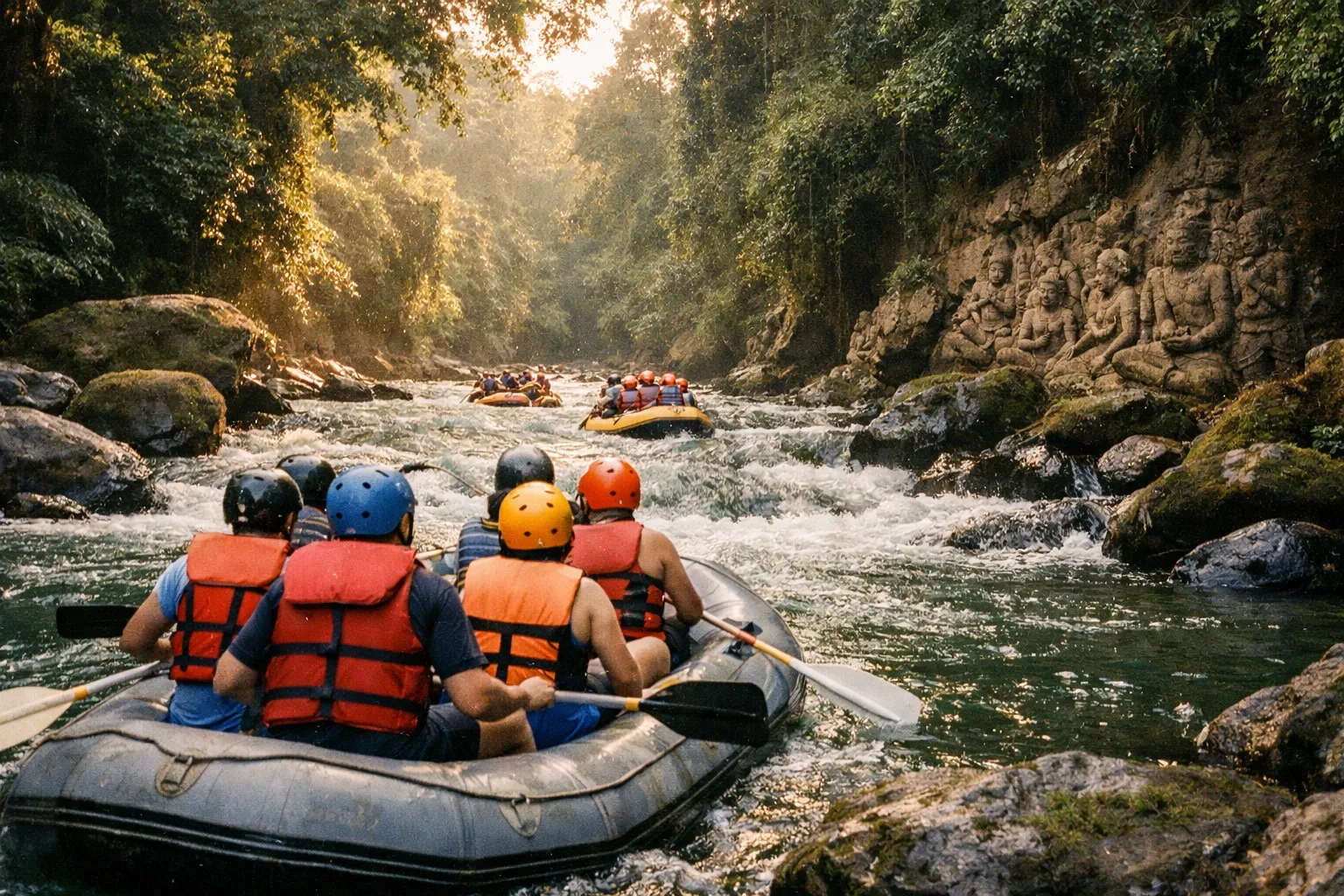
Between rapids, you drift past intricate rock carvings cut into the gorge walls - Ramayana scenes commissioned by one of the rafting companies decades ago - and the kind of dense jungle that makes you forget you’re 30 minutes from a town with three Starbucks.
Current pricing:
- Group trips with transfers and lunch: USD 25-50 per person (3)
- Premium small-group operators (4-6 guests per raft, upgraded gear): USD 70-100
If you want something punchier, the Telaga Waja River in East Bali runs slightly bigger rapids and is marketed as the adrenaline option (5). For something genuinely mellow, the Siap River near Payangan offers canyon tubing - individual tubes, small drops, more giggling than gasping.
Practical notes:
- The put-in is reached via 300-600 steps down the valley, and you climb the same stairs back up at the end. Worth knowing if you have knee issues.
- Bring quick-dry clothes, a dry bag, and sandals with straps - not flip-flops.
- Lockers, showers, and changing rooms are standard at reputable operators.
- Tip your guide IDR 50,000-100,000 (~USD 3-7) per person - generous by local standards.
I did the Ayung run in March 2025 with a mid-range operator and the stairs back up were genuinely the hardest part. The rapids themselves are fun but not scary. If you’re on the fence about whether it’s worth the drive from Ubud, it is.
Mount Batur sunrise trek
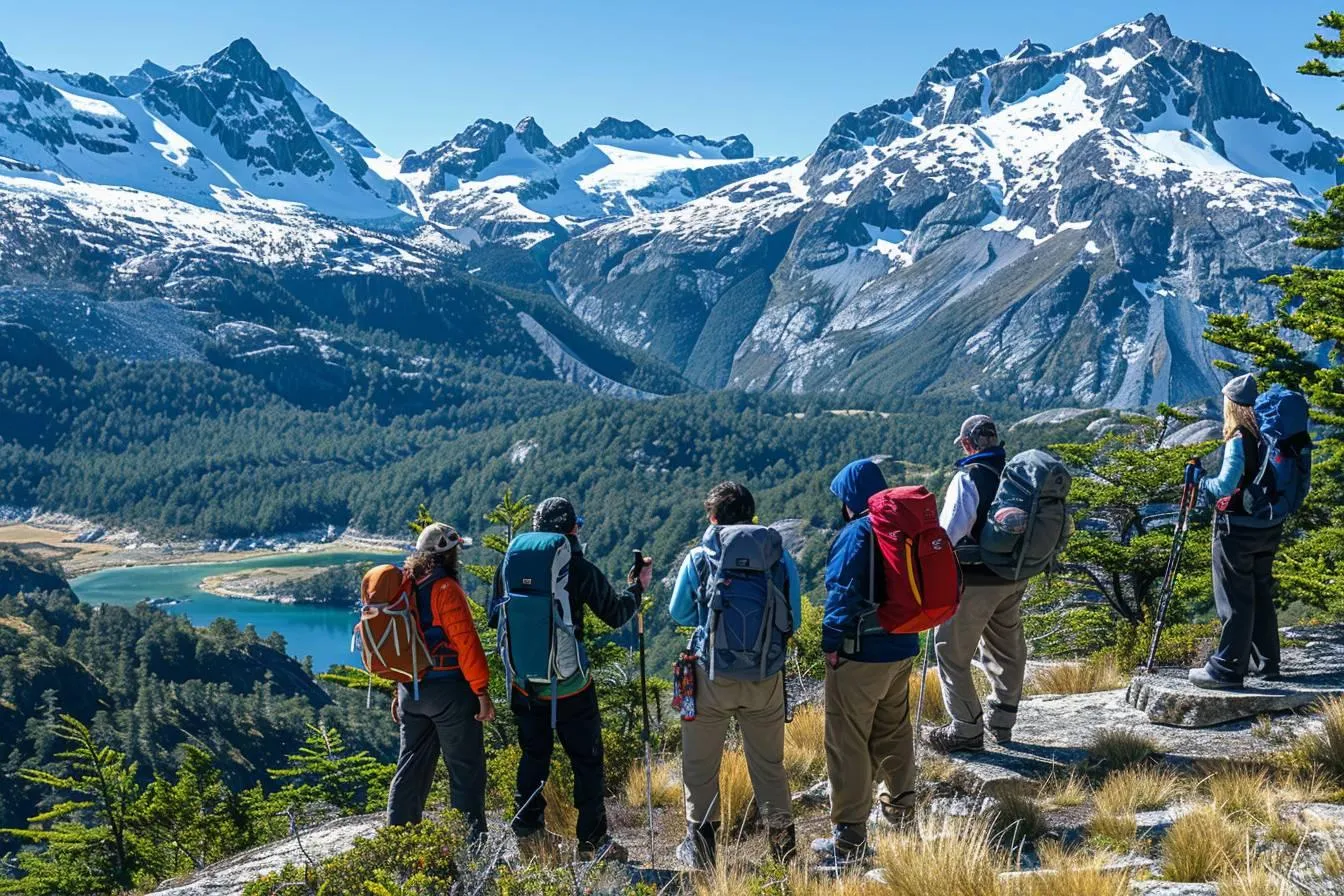
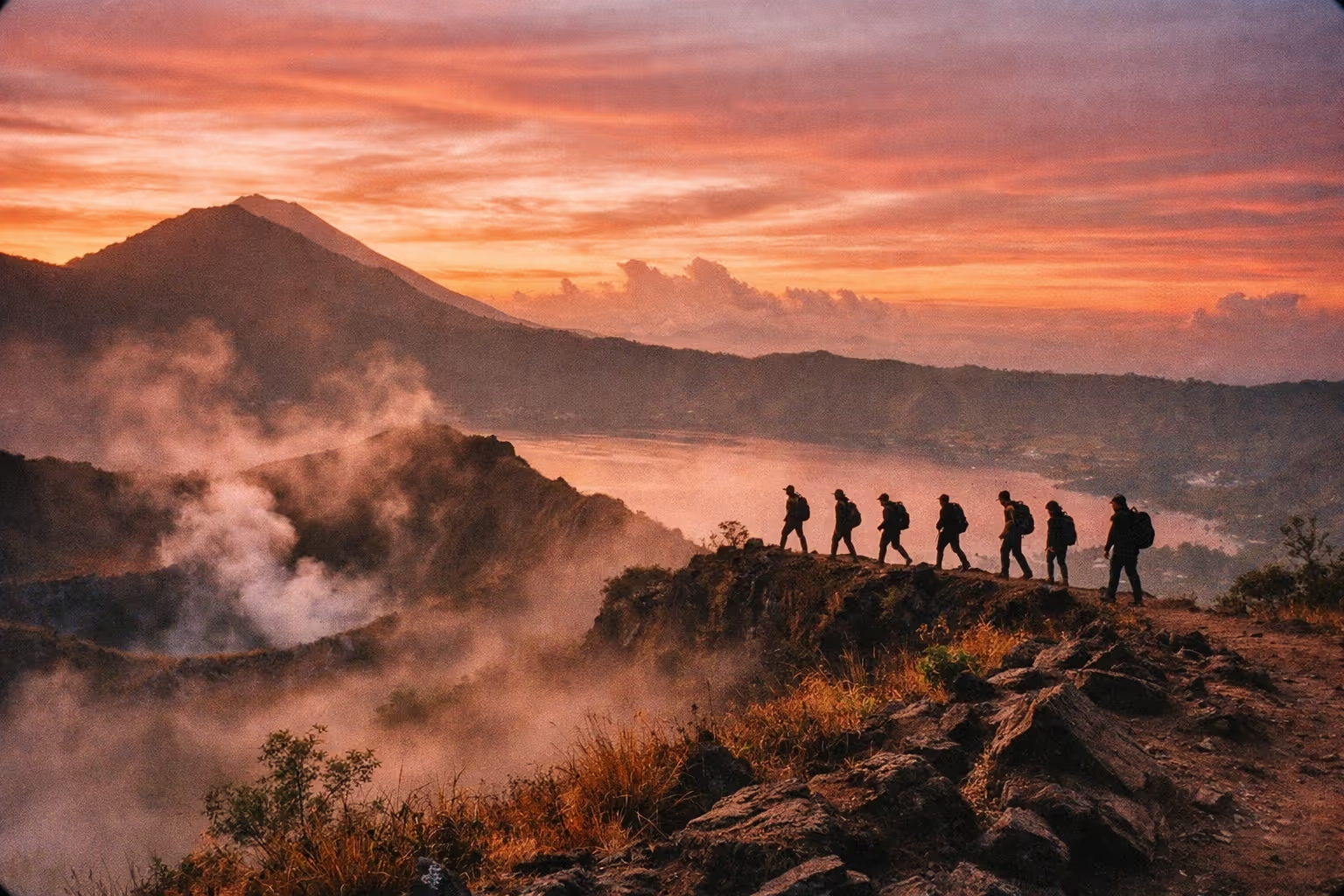
The mount batur sunrise trek is the single most-booked adventure on the island, and the math behind it is straightforward: a 1,717 m active volcano, a relatively easy 2-hour ascent in the dark, and a summit view across the caldera to Lake Batur and the silhouette of Mount Agung as the sky goes orange (3)(4).
What the day looks like:
- Pickup from Kuta/Canggu/Seminyak around 1:30-2:00 am
- Pickup from Ubud around 2:00-2:30 am
- Trailhead start by 3:30-4:00 am
- Summit by 5:30-6:00 am for sunrise around 6:15
- Back at your hotel by mid-to-late morning
You cannot summit Batur without a licensed local guide - the village cooperative enforces this, and rogue attempts get turned back at the trailhead. Group tours run USD 30-60 including transport, guide, headlamp, and a simple breakfast cooked using volcanic steam at the summit (3). Private treks run USD 70-120+ and are worth it if you want a slower pace, photography stops, or no one in your sunrise photo.
What to bring:
- Closed hiking shoes with grip - the upper section is loose volcanic scree
- A light jacket or fleece (summit temperatures sit around 10-15°C before sunrise)
- 1-1.5 liters of water
- Cash for tips and snacks at the summit warung (small roadside stall)
The first time I did Batur, I wore trail runners and was fine. The second time, someone in our group wore canvas sneakers and was sliding around the scree section. Closed shoes with actual grip matter on that upper stretch.
Worth knowing: if you’ve already done Batur, or you want to skip the crowd, ask operators about Pinggan village or Lahangan Sweet viewpoints - both offer Batur-and-Agung sunrise views with a fraction of the foot traffic (4)(6). You drive up rather than hike, which makes them a softer option that still earns you the photo.
Bali waterfalls: the North Bali circuit
The most photographed bali waterfalls - Tegenungan, Kanto Lampo - are close to Ubud and easy to reach, which is why they’re packed by 9 am. The waterfalls genuinely worth a long drive are clustered in North Bali, about 2-3 hours from Ubud or the south coast (6)(7).
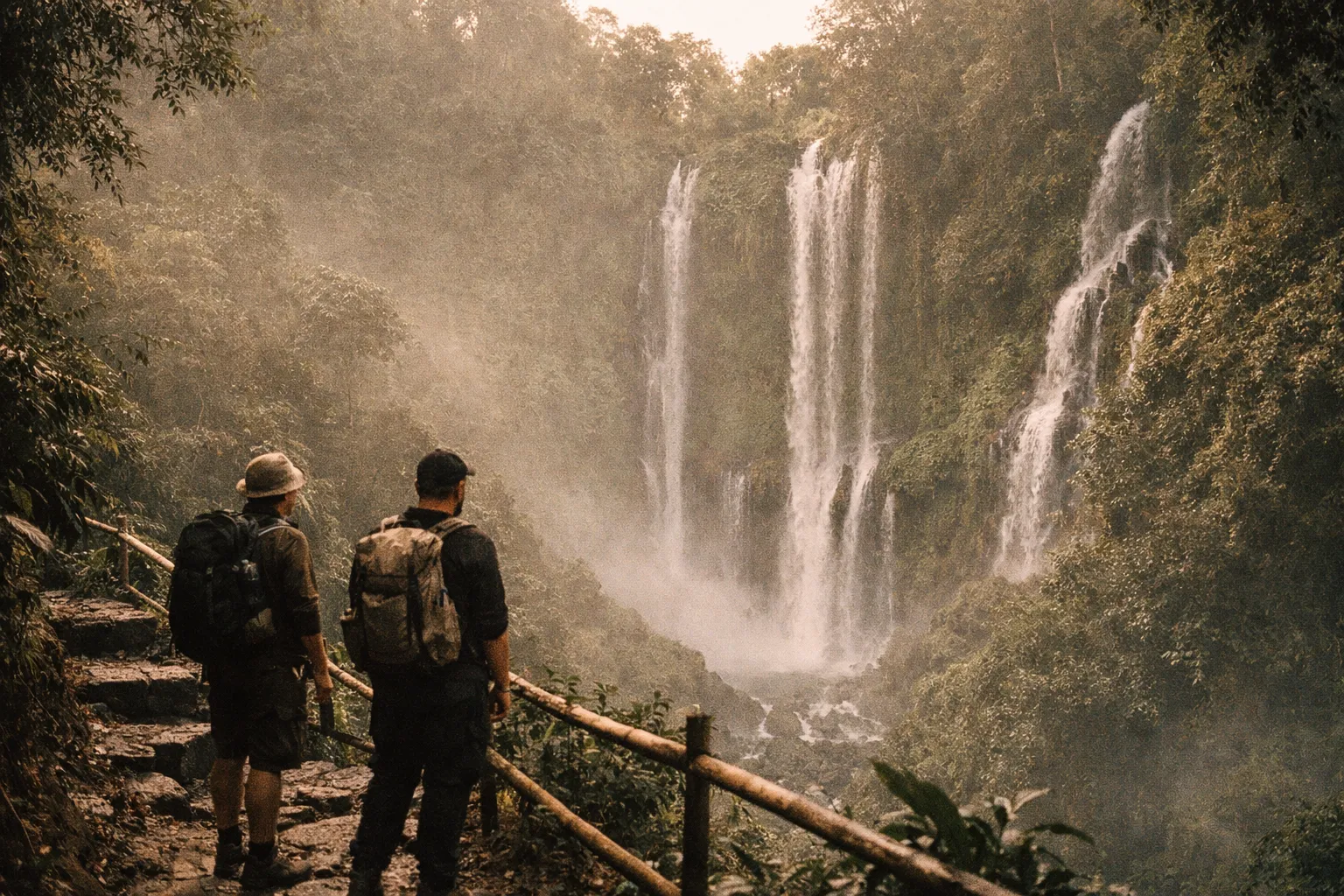
The three worth prioritizing:
- Sekumpul - a cluster of seven falls reached via a 30-45 minute hike with stairs and a small river crossing. Entrance fees and “guide fees” total around IDR 125,000-175,000 (USD 8-11) depending on the route.
- Banyumala Twin Waterfalls - quieter, with a swimmable pool at the base. About a 15-minute walk down (and back up).
- Gitgit - the easiest access of the three; good if you’re combining several falls in one day.
Entrance fees at most waterfall sites run IDR 20,000-75,000 (~USD 2-5) (6). Bring small bills - card readers don’t exist at the parking lots.
Start before 7 am. The first falls on a North Bali circuit are essentially empty until 9, and you’ll have clean photos and swimming space. Tour buses and the influencer contingent arrive between 10 and 12.
For more adrenaline, the Sambangan and Gitgit canyons run guided canyoning trips - rappels, jumps, and natural slides - typically USD 70-150 for a half-day depending on route length. Bring water shoes. Bare feet on wet basalt is a bad idea.
Bali surf lessons: where to learn and where not to
Bali surf lessons are an industry on this island, and most beginners default to Kuta or Legian, where the beach is wide, the wave is forgiving, and instructors outnumber tourists at low tide. Batu Bolong in Canggu is the other main beginner spot - slightly more crowded, slightly cooler scene afterwards.
What lessons cost in 2026:
- Group 2-hour lessons with board and rash guard: USD 20-35
- Private 1-on-1 coaching: USD 40-70 per session
- Multi-day surf camps with lodging in Canggu: USD 500-1,000+ per week
Book 2 or 3 lessons on consecutive days, not one. Muscle memory is the whole game. People who take a single lesson stand up once and don’t surf again; people who take three sessions in a row are catching unbroken waves by the end. I’ve watched this play out enough times that I’d call it reliable.
Best beginner season: roughly April through October on the west coast - dry season swells are consistent and morning winds are usually lighter. November to March, the west coast goes choppy and the east coast (Sanur, Keramas) becomes the better learning option.
Where NOT to take your first lesson:
Uluwatu, Padang Padang, Bingin - these are advanced reef breaks. Shallow coral, powerful waves, strong rips. Watch from the cliff bar, surf there in year three(6). Anywhere without an instructor on a soft-top board is also a hard no. The ocean here is not a swimming pool.
Etiquette note: on crowded breaks, don’t paddle for waves more experienced surfers are already on. Local surfers in Bali are generally relaxed compared to, say, North Shore Oahu, but dropping in is the universal way to make enemies.
Nusa Penida and manta-ray snorkeling
Nusa Penida sits 30-45 minutes by fast boat from Sanur and has become the single most popular day trip from Bali (3). The draw is twofold: the Kelingking cliff viewpoint (the T-Rex shaped headland you’ve seen everywhere) and manta-ray snorkeling at Manta Point.
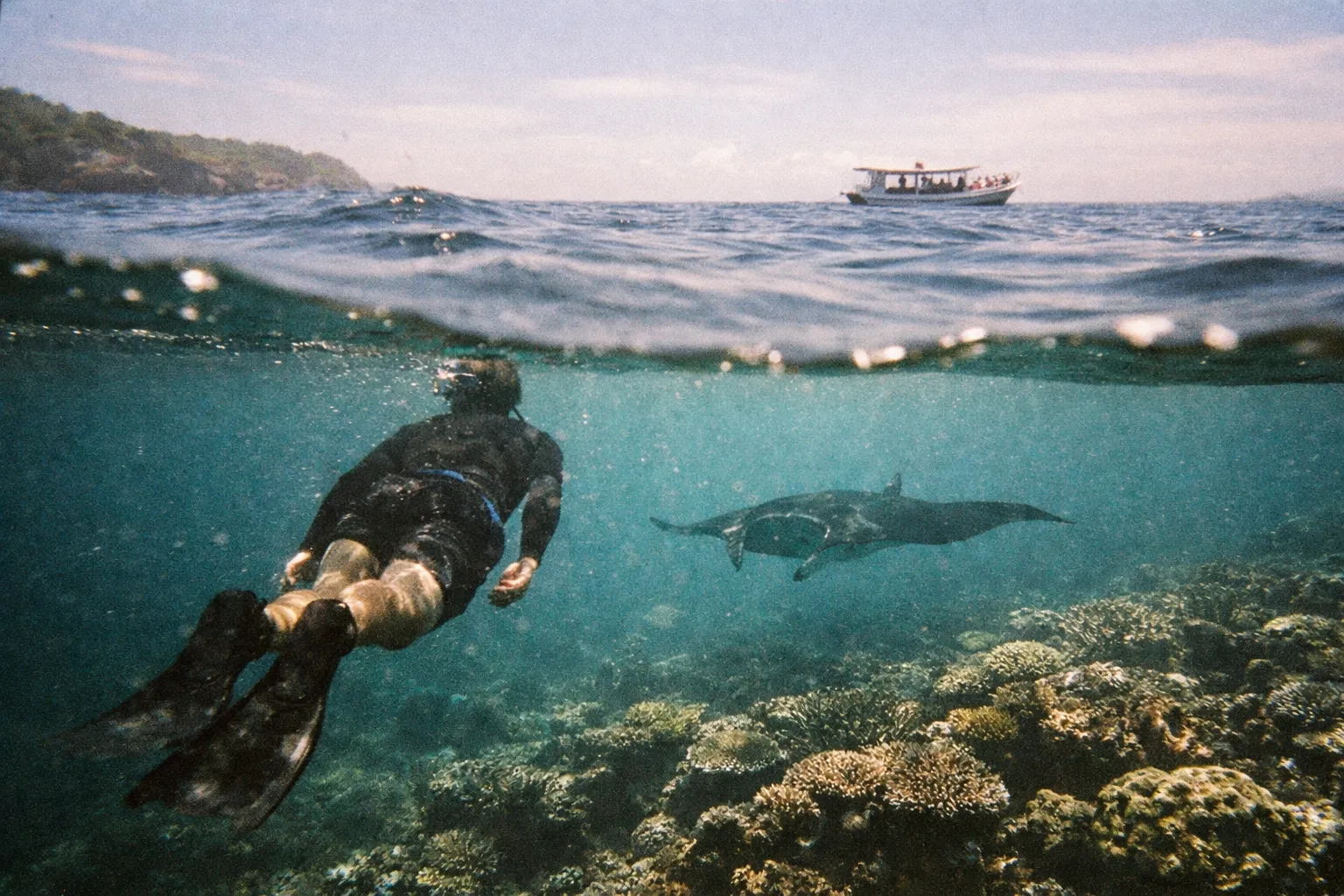
Pricing in 2026:
- Group day tours (snorkeling + 3 land viewpoints + GoPro): USD 50-90
- Private boat charters: USD 150-300+ per boat
The water at Manta Point can be choppy, and currents are strong. If you get seasick, take medication an hour before boarding - not on the boat when you’re already green. If you’re not a confident swimmer, stay close to the boat. Strong surge runs through the site even on calm days.
Penida’s roads are steep, potholed, and not made for scooters with inexperienced riders. Hire a car-and-driver as part of your tour. The local hospital sees foreigners with broken collarbones every week, and that’s not an exaggeration.
ATV tours, mountain biking, and off-road
ATV quad-bike tours through Ubud-area jungle, rice terraces, river crossings, and the much-photographed “Gorilla Caves” near Payangan are among the most-booked outdoor experiences on the island according to TripAdvisor’s 2026 listings (7).
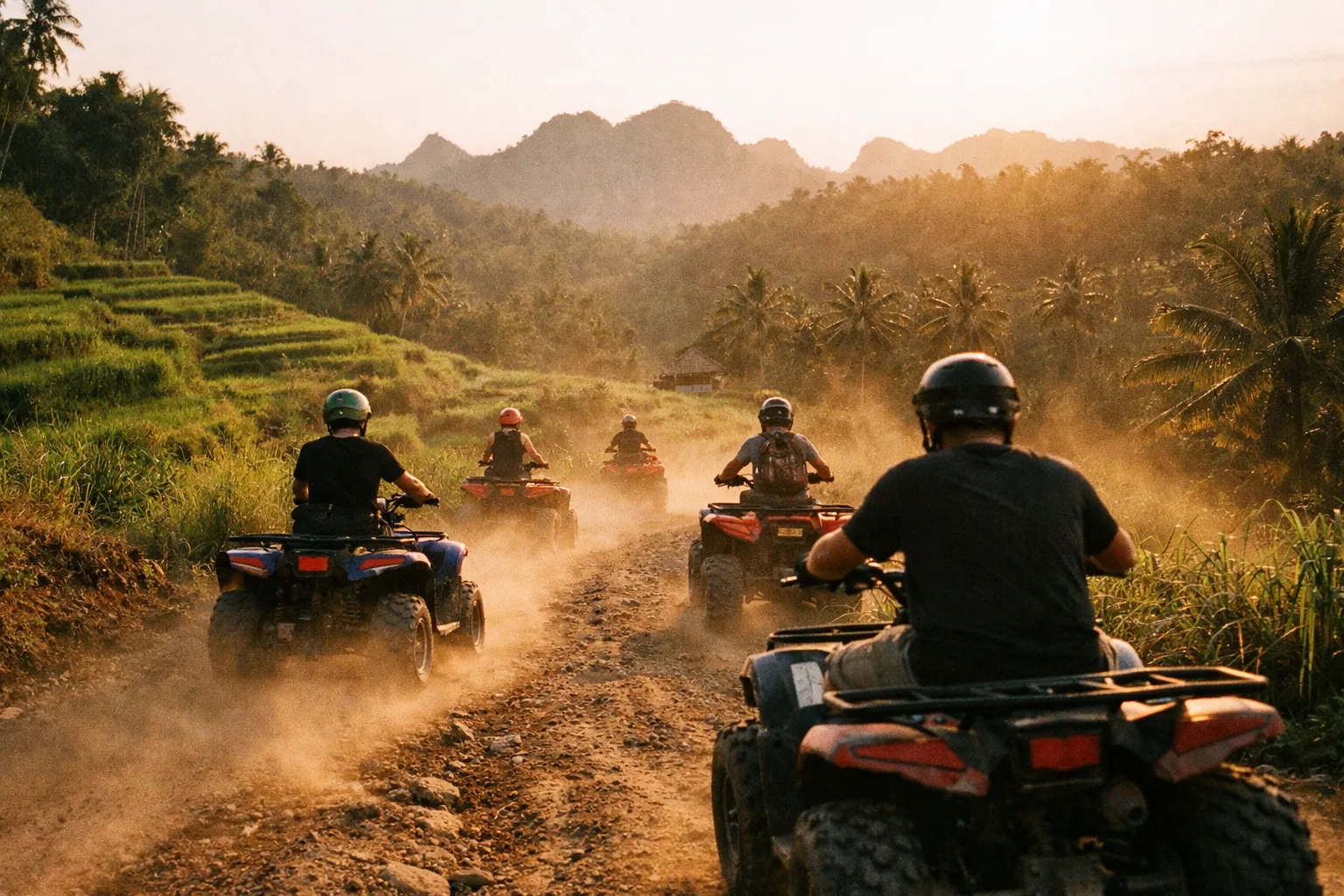
- Group ATV tours, 1.5-2 hours riding: USD 30-60 including gear, insurance, and sometimes lunch (7)
- Premium operators with newer machines and better safety briefings: USD 80-120
- Combo days (e.g., ATV + Ayung rafting in one booking): around USD 70-100 via platforms like GetYourGuide (3)
Mountain biking down the slopes of Batur and through rice-paddy villages is one of the most underrated things to do in Bali - 20-30 km of mostly downhill riding through landscapes that are genuinely quiet, typically USD 40-90 with bike, guide, and transfers (5)(8). Most people skip it in favor of the ATV. Their loss.
For diving, Tulamben’s USS Liberty wreck is reachable from shore and suitable for divers of all levels; Crystal Bay at Nusa Penida is famous for mola-mola (ocean sunfish) sightings during the cooler months around July-October (1).
Cultural breaks between adventures
Stacking hard activity days back-to-back is how trips end with food poisoning and a fever. Between bigger adventure days, slot in lower-impact things to do in Bali that still feel like part of the trip:
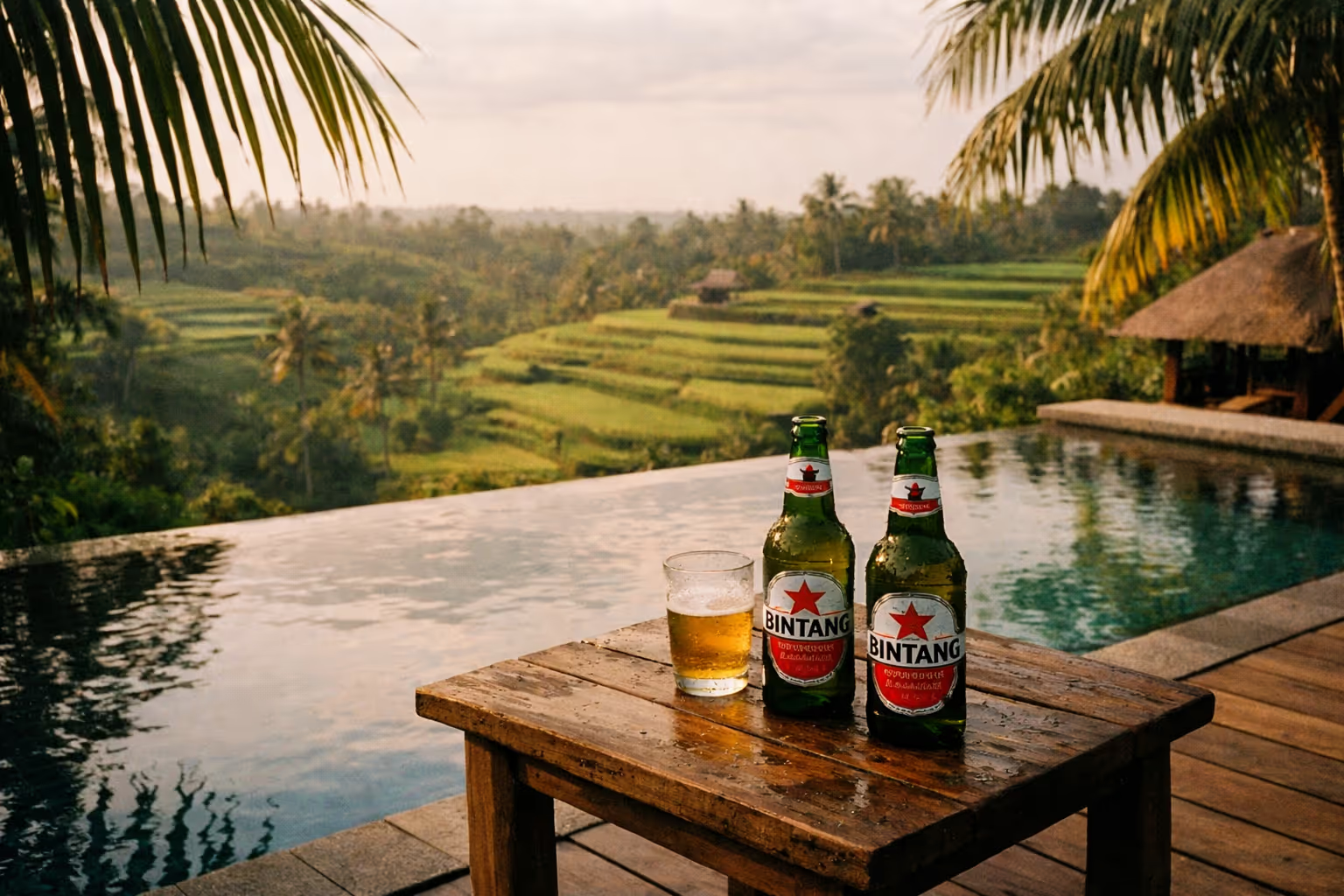
- A morning at the Tegalalang or Jatiluwih rice terraces (Jatiluwih is UNESCO-listed and noticeably quieter) (1)
- A Balinese cooking class in Ubud - most include a morning market visit
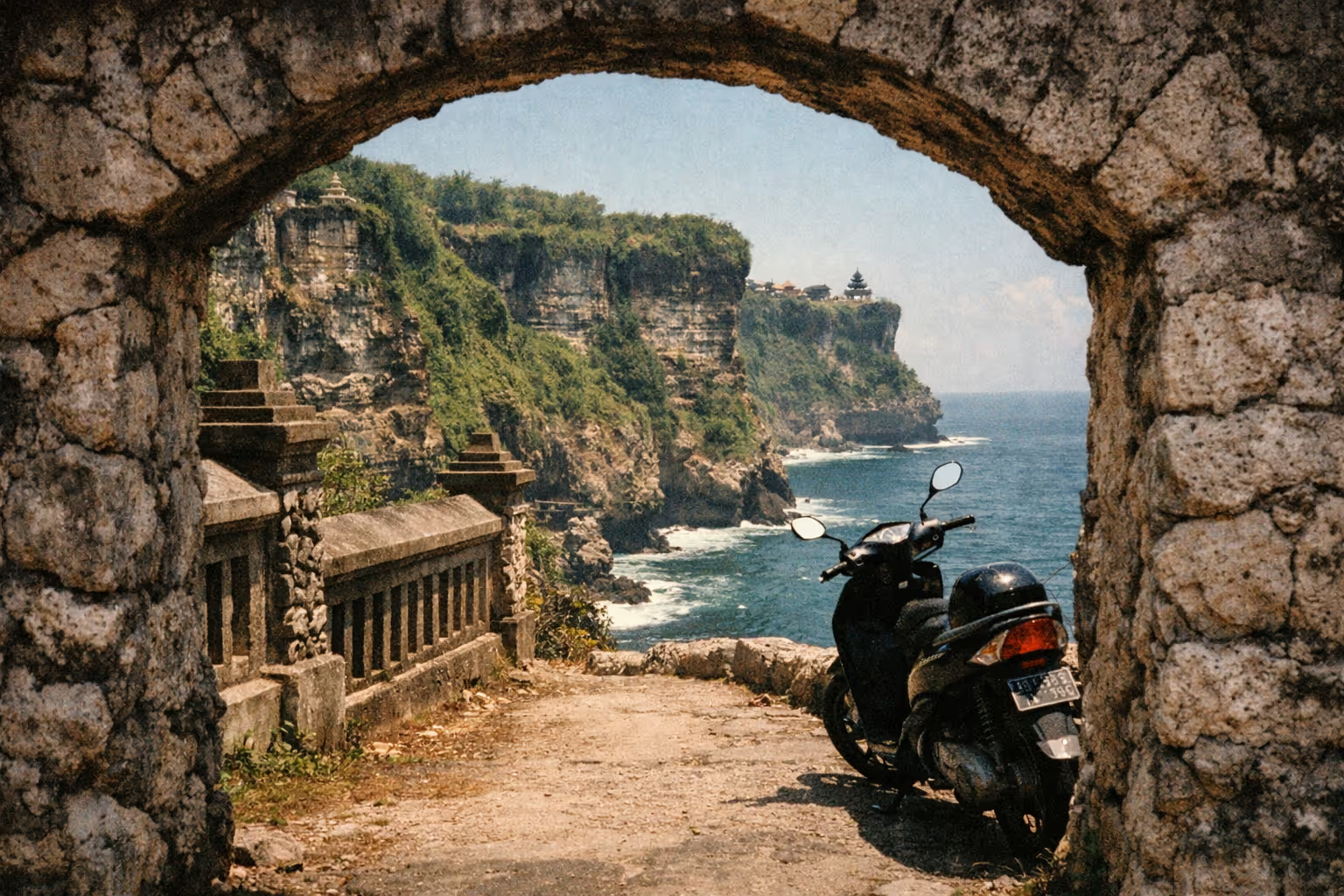
- A kecak fire dance at Uluwatu temple at sunset
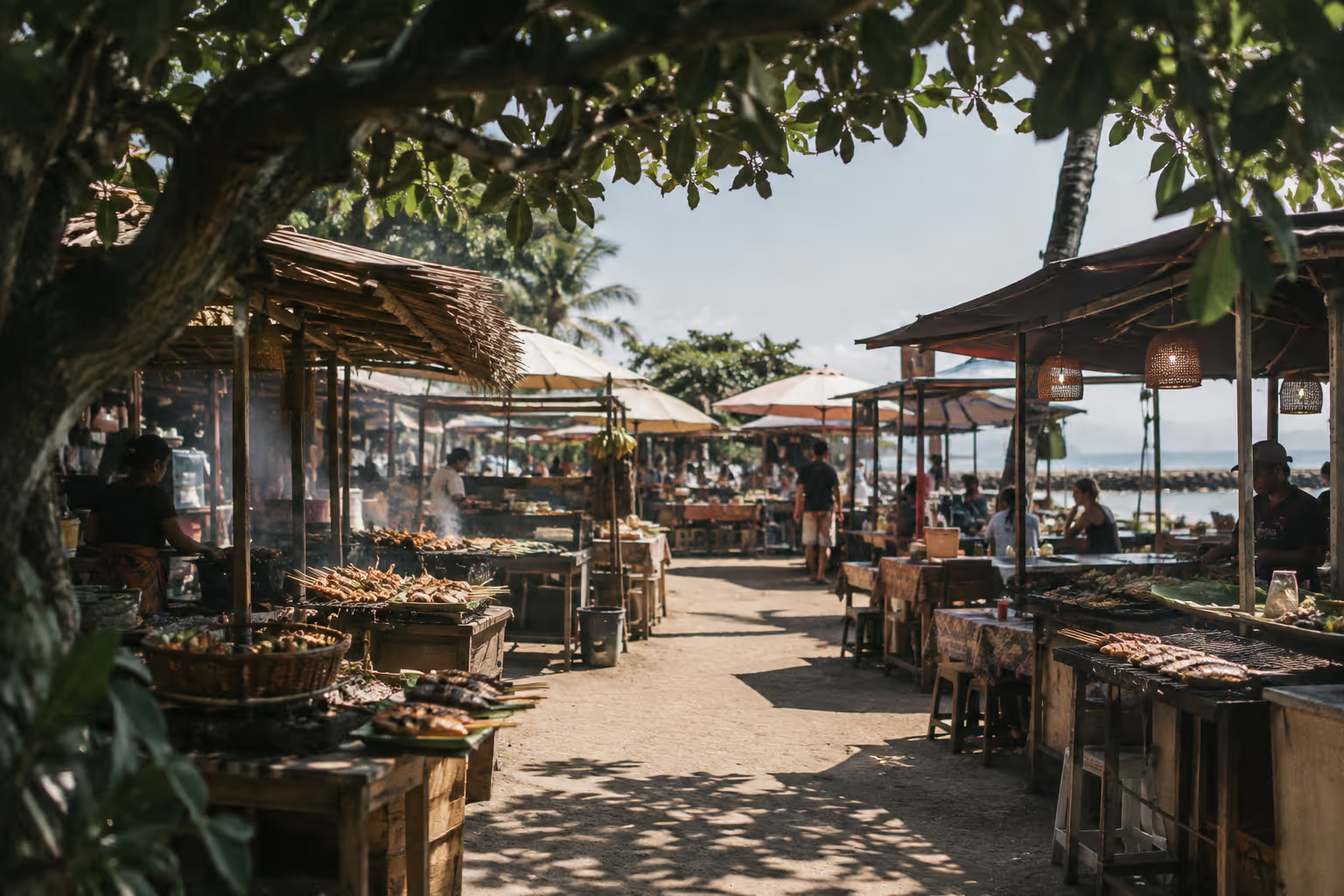
- An afternoon at a warung (small family-run restaurant) for nasi campur (mixed-rice plate with sides) - typically IDR 25,000-45,000 (USD 2-3)
- A traditional frangipani oil massage, USD 8-20 for an hour in Ubud (1)
Etiquette note: at temples, you must wear a sarong covering your knees, and shoulders must be covered. Most temples loan sarongs at the entrance for a small donation. Don’t enter inner courtyards during ceremonies unless invited, and don’t stand higher than a priest who is seated. This applies everywhere, not just the famous ones.
Is $1,000 enough for 1 week in Bali?
For a mid-range solo adventure traveler, yes - comfortably. For a luxury traveler or a couple splitting a villa, no.
Here’s the realistic breakdown for one person over 7 nights, doing 4-6 paid adventures:
- Lodging, mid-range guesthouse or small hotel at USD 30-80/night: USD 210-560
- Food, mixing warungs (USD 2-4 per meal) and mid-range restaurants (USD 6-12): USD 105-210
- Adventures (Batur trek $50 + Ayung rafting $40 + Penida day trip $70 + two surf lessons $60 + ATV $50): USD 270-350
- Transport (scooter rental USD 5-8/day, occasional Grab rides, airport transfer): USD 60-120
- Entrance fees, tips, massages, miscellaneous: USD 80-150
Total: roughly USD 725-1,390 per week, with USD 1,000 sitting right in the middle.
Where USD 1,000 stops working:
- Booking a private villa with pool (USD 150-400+/night)
- Drinking heavily at beach clubs (cocktails run USD 8-15 each at Seminyak/Canggu)
- Daily private driver instead of scooter (USD 50-70/day)
- High-end experiences - private boats, private Batur treks, fine dining
If you’re traveling as a couple, USD 1,000 each for a week is generous. You’ll split lodging and a driver, which stretches the budget meaningfully.
Tipping in Bali: what’s actually appropriate
To address this directly: no, tipping USD 20,000 in Bali is not appropriate - it would be wildly out of proportion to local wages and create more confusion than gratitude. Bali’s average monthly wage sits in the low hundreds of USD; USD 20,000 represents several years of pay for many workers in the tourism industry. That kind of tip doesn’t read as generous. It reads as a misunderstanding.
Realistic tipping in 2026:
- Restaurants: round up the bill, or add 5-10% at sit-down places. Many mid-range restaurants now add a 10% service charge automatically - check the receipt.
- Tour guides (Batur, rafting, Penida): IDR 50,000-100,000 (~USD 3-7) per person per tour
- Drivers for full-day private hire: IDR 50,000-100,000 for a good day
- Hotel housekeeping: IDR 10,000-20,000 per day if you want to
- Spa massages: 10% is generous
Tipping in Bali is appreciated, not expected the way it is in the United States. Don’t feel obligated, but if someone took care of you, IDR 50,000 in their hand at the end of the day means something.
Premium and small-group adventures: the “elite” tier
Several high-end operators shifted hard into private and small-group products in 2025-2026, responding to traveler fatigue with crowded buses and mass tours (2). This isn’t snobbery - it’s a different way to use the island.
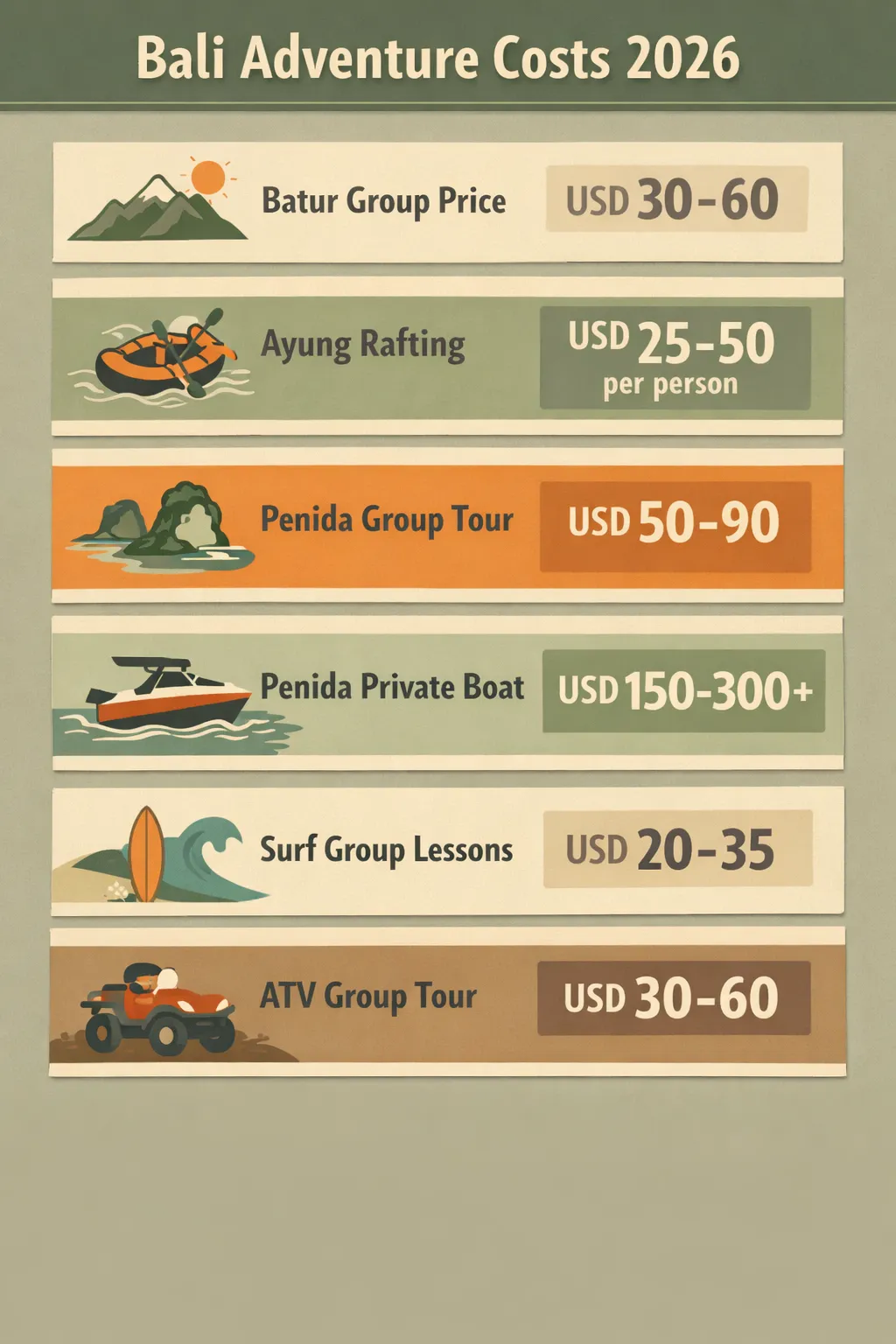 Cost snapshot of Bali adventure activities: Batur USD 30-60, Ayung USD 25-50 per person, Penida group USD 50-90, Penida private boat USD 150-300+, Surf USD 20-35, ATV USD 30-60.
What the premium tier actually looks like:
- Private Mount Batur sunrise treks with a single guide for your group, post-hike access to natural hot springs, and a sit-down breakfast at a caldera-view restaurant - typically USD 80-150 per person
- Premium rafting with smaller boats (4-6 guests), upgraded safety gear, and gourmet lunches at riverside restaurants - roughly 2-3x the budget price
- Private surf coaching in Canggu with video analysis and tailored spot selection - USD 500-1,000+ for a 3-5 day camp
- Curated island-hopping to Nusa Penida or Menjangan on a private boat with small groups, snorkel gear, and a chef on board - USD 300-700+ per boat for the day (2)
Operators like Mason Adventures market international-standard safety equipment, higher guide-to-guest ratios, and proper insurance - worth paying for if you’re doing higher-risk activities like canyoning or technical rafting (8).
Anything involving water (rafting, diving, boat trips) or heights (canyoning, paragliding) is where I’d spend extra. ATVs and basic waterfall tours, the budget version is fine.
Common mistakes to avoid
A few patterns I’ve watched travelers fall into repeatedly:
- Stacking 8-10 hour adventure days back-to-back. Batur on Monday, Penida on Tuesday, rafting on Wednesday - you’ll be sick or injured by Thursday. Space them out with rest days.
- Underestimating traffic. A 30 km transfer can take 1.5-2 hours during peak times. Don’t book three far-flung activities on the same day.
- Choosing the cheapest rafting or ATV operator on the booking platform. The price difference between budget and reputable is often USD 10-20. Not worth saving on safety gear and guide ratios.
- Rainy season blindness. From roughly November through March, some waterfalls become dangerous, canyoning routes close, and rafting rivers can rise fast. Operators cancel last-minute. Check forecasts and have backup plans.
- Paddling out at advanced reef breaks too early. Uluwatu and Padang Padang are not where you learn. Coral cuts get infected fast in tropical water.
- Riding scooters in Penida or in rain without experience. Bali’s hospitals see foreign road-accident patients every single day. If you haven’t ridden a scooter before, take a half-day lesson on a quiet road first, or use Grab and drivers.
What to pack for an adventure-heavy week
Keep it simple:
- Closed hiking shoes with grip (for Batur and slippery waterfall trails)
- Water sandals with straps (for rafting, canyoning, boat trips)
- Quick-dry clothing - at least two sets
- Light rain jacket or windbreaker (Batur summit, North Bali waterfalls, rainy season)
- Reef-safe sunscreen (SPF 30-50) - required at most marine reserves, available locally but expensive
- Dry bag (10-20L) for rafting and boat days
- Phone lanyard or floating case - you will drop your phone in water otherwise
- Quick-dry towel
- Headlamp - optional, since most Batur operators provide one
- Cash - IDR equivalent of USD 50-100 in small notes for entrance fees, tips, parking, and warungs
Frequently Asked Questions
- What are the adventure activities in Bali?
- Core activities include volcano trekking, river rafting, surfing lessons, waterfall hikes, snorkeling at Nusa Penida, ATV rides, canyoning, diving, and paragliding.
- Is $1,000 enough for 1 week in Bali?
- It's sufficient for a mid-range solo traveler doing multiple adventures and staying in guesthouses, but tight for luxury travelers or those wanting private villas and drivers.
- What are some fun activities to do in Bali beyond the adventure stuff?
- Consider Balinese cooking classes, kecak fire dances at Uluwatu, frangipani oil massages, coffee farm visits, warung dinners, and walks through rice terraces.
- Is $20,000 a good tip in Bali?
- No, such a tip is disproportionate to local wages and can cause confusion; realistic tipping is modest and appreciated but not expected.
- Do I need travel insurance for Bali adventure activities?
- Yes, especially policies covering adventure sports like rafting, canyoning, and motorbike accidents, as standard insurance often excludes these.
- When is the best time of year for adventure activities in Bali?
- The dry season from April to October offers safer trails, better surfing conditions, and clearer summit views; the wet season brings more closures and cancellations.
- Are premium adventure tours worth the extra cost?
- Premium tours offer smaller groups, better safety gear, and added comforts like hot springs access or gourmet meals, which can enhance safety and experience.
- What should I avoid when planning adventure days in Bali?
- Avoid scheduling long, consecutive adventure days without rest, underestimating travel times, choosing the cheapest operators for risky activities, and riding scooters without experience.