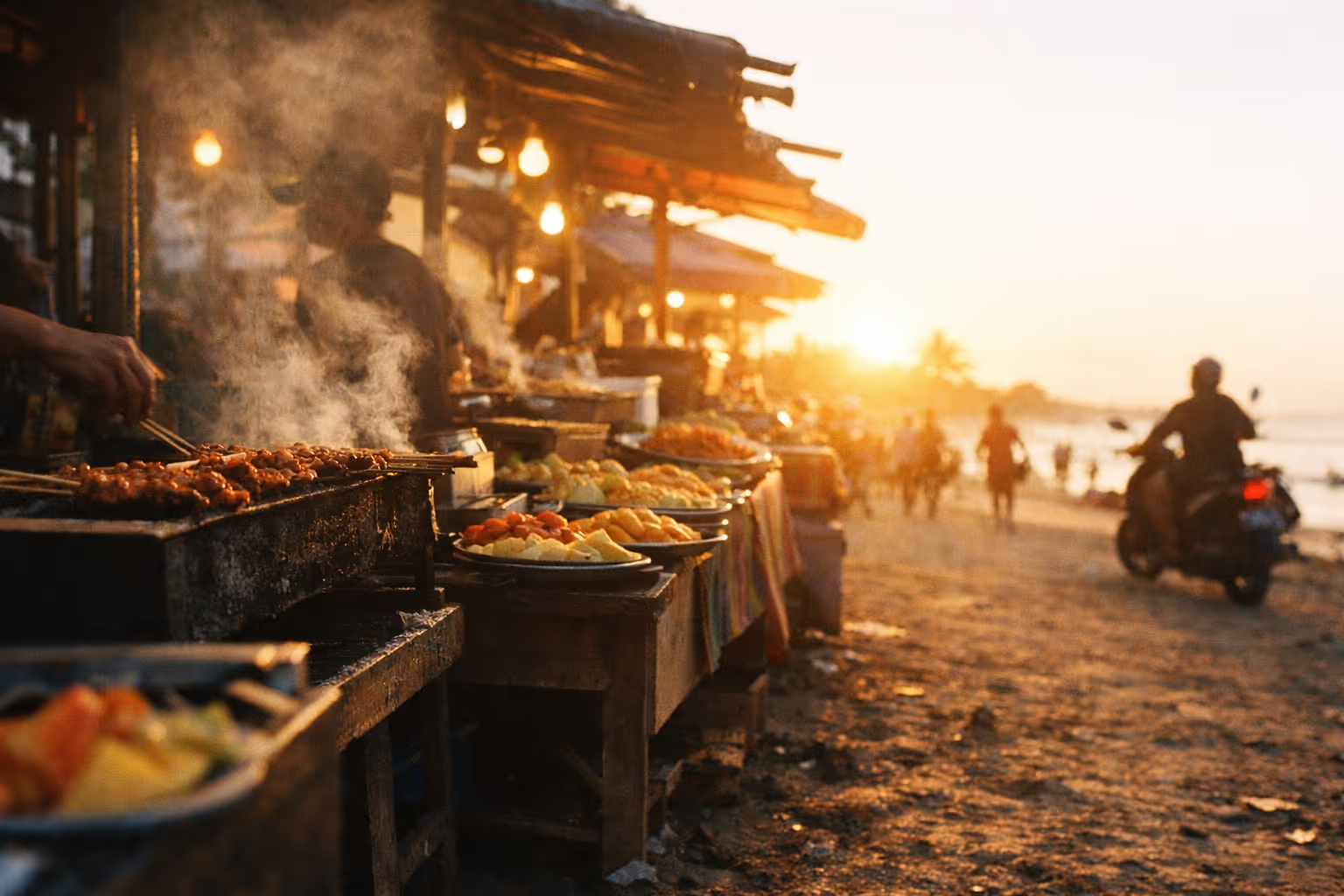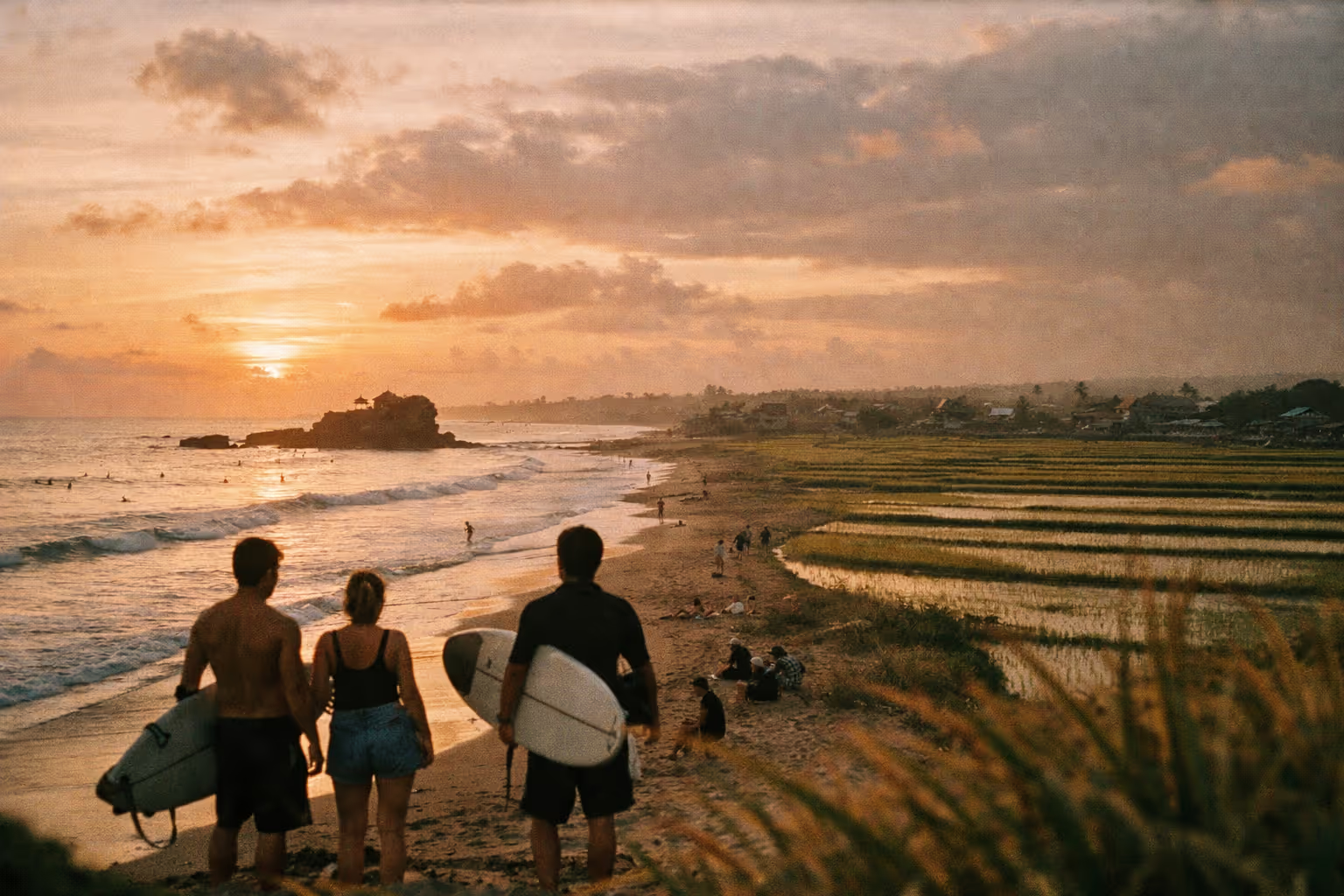
The best things to do in Canggu, Bali happen at the edges of the day, not the middle. Dawn belongs to the beginner surf break at Batu Bolong, midday to the twenty-odd specialty cafes packed within a kilometer, and the last light to a warung on quiet Pererenan beach where the rice paddies run almost to the sand. Cram it all into the hot afternoon and you miss the point. Here is how to shape a day here, surf to sunset.
Things to Do in Canggu, Bali: What the Place Is Actually Known For
When considering things to do in Canggu Bali, most visitors focus on three main attractions: surfing, enjoying the vibrant food scene, and embracing the remote-work lifestyle that has drawn long-term visitors from around the world. Canggu strings together five main beaches - Batu Bolong, Echo (officially Batu Mejan), Berawa, Pererenan, and Nelayan - all volcanic black or grey sand, all with surf breaks (4). Batu Bolong is the beginner-friendly spot with mellow longboard waves. Echo and Pererenan step it up with steeper, faster waves for intermediate surfers (5).
Beyond surfing, Canggu is famous for its café density - you can walk a 1 km radius around Batu Bolong and hit 20-plus specialty coffee spots - and its yoga studios. One local guide counted around 68 yoga venues in the wider area (4). Then there are the sunset beach bars, where surfers, nomads, and weekend visitors from Ubud converge around 5:30 p.m. for a Bintang.
It’s also Bali’s main base for digital nomads. Co-working spaces like bWork and Tribal have stepped in after the pandemic closed older venues. Nomeo runs curated meetups that keep the remote work crowd connected.
Is Canggu worth visiting?
If you’re after surf, café culture, and a social, youthful vibe, yes. Tripadvisor lists over 15 top attractions in Canggu, many with ratings between 4.5 and 5.0, including Mai Main Playground (4.9/5, 320+ reviews), G Swing (5.0/5), and The Wheel Bali (5.0/5) (7).
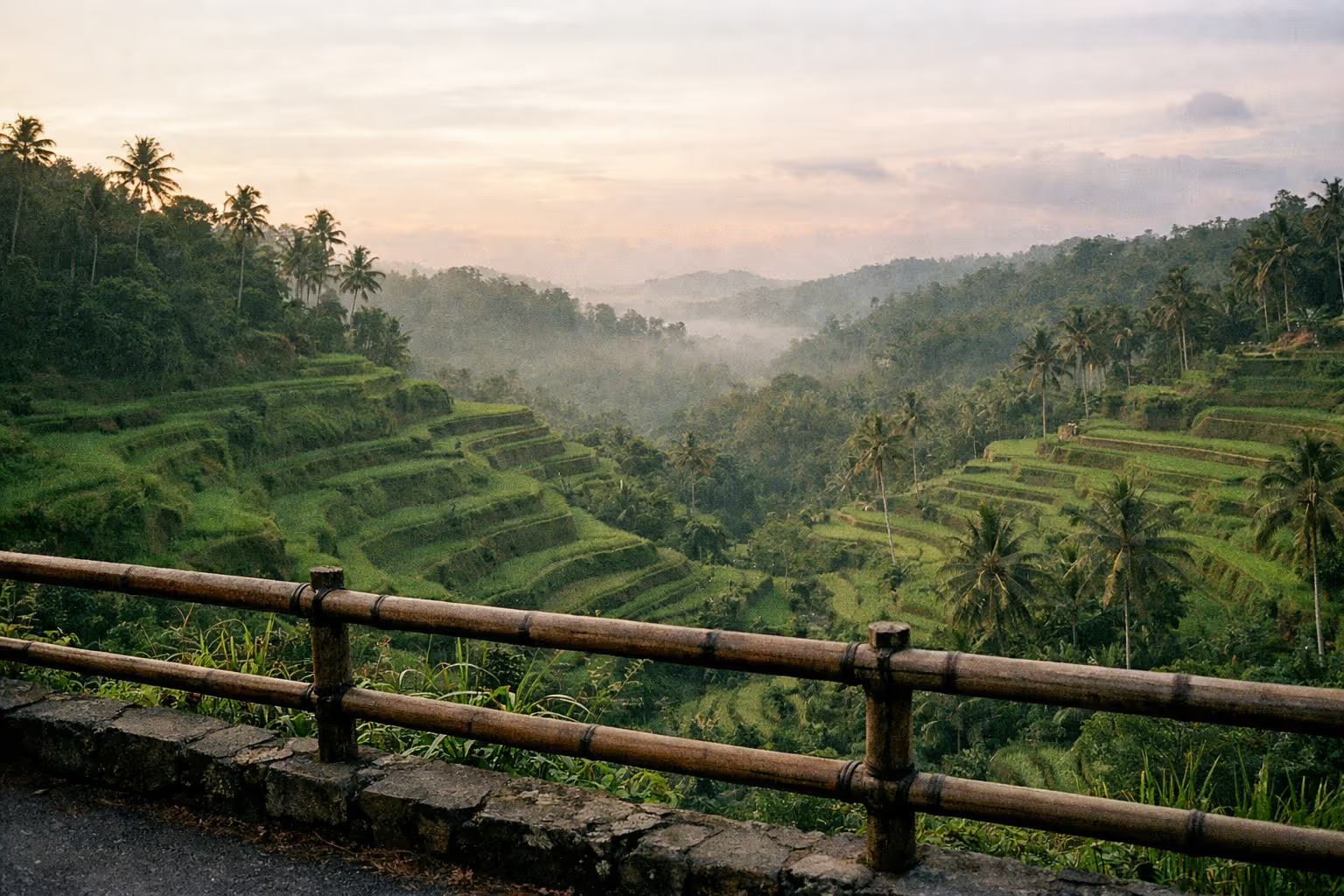
If you came to Bali chasing quiet temples, terraced rice fields straight from postcards, or calm swimming beaches, Canggu isn’t the place. Head to Ubud for temples and inland culture, or Tegallalang and Jatiluwih for dramatic terraces (both doable as day trips from Canggu). For calmer swimming, Sanur or the Nusa islands are better bets.
Canggu’s appeal lies in a certain rhythm: surf at dawn, brunch or work midday, yoga or massage late afternoon, then sunset drinks and dinner. If that sounds like your pace for 5-10 days, it’s worth fitting in (3).
Canggu surf: where to paddle out
Batu Bolong is the go-to for beginners. The waves are forgiving, the bottom is sandy, and at least a dozen surf schools run lessons off the beach. Expect to pay IDR 350,000-500,000 (USD 23-33) for a two-hour group lesson, which includes board, rashguard, and instructor. Boards rent for IDR 50,000-80,000 per hour or day.
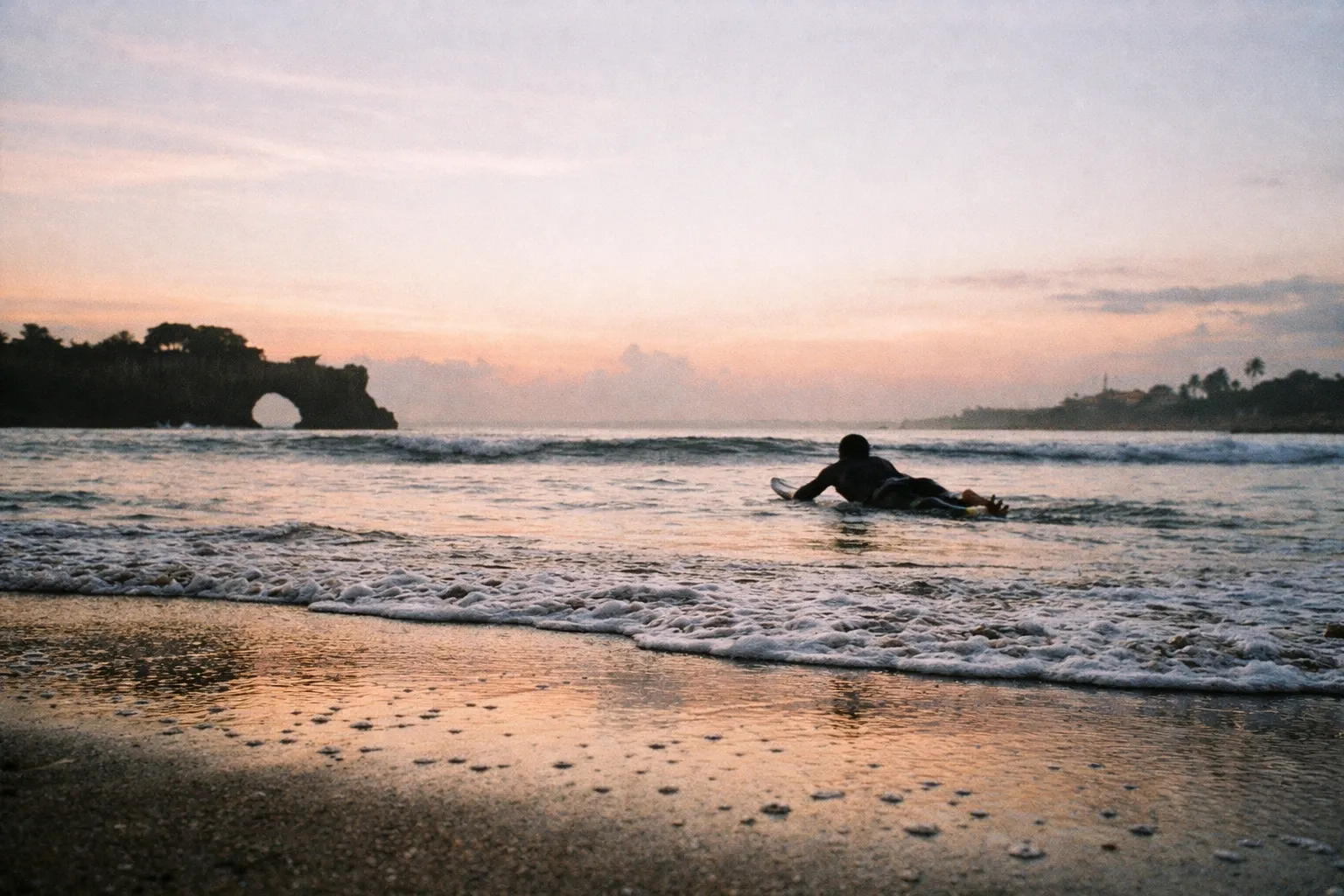
Echo Beach gets more swell and faster waves - better for surfers who can pop up and turn. The crowd thins early, around dawn.
Pererenan, just west of Echo, offers similar waves with fewer people. It’s also where the rice paddies come closest to the sand.
Berawa feels more like a beach club zone (think Finns, La Brisa) than a serious surf spot, though waves do break there.
A few practical notes on canggu surf:
- Tide matters more than swell here - check Magicseaweed or Surfline before you paddle out
- Dawn sessions (5:30-7:00 a.m.) are quieter and cleaner; afternoons get crowded with onshore winds
- Many beaches have strong rips and shorebreaks. Red flags mean no swimming, including wading past your knees
- Board storage at beachfront shacks costs IDR 20,000-30,000 per day if you don’t want to scooter your board home
Canggu beach guide and sunset spots
Canggu beach isn’t one beach but a string of breaks, each with its own vibe:
- Batu Bolong: surf school central, home to Old Man’s bar, busiest foot traffic
- Echo Beach: rougher, less developed, with La Brisa anchoring the sunset crowd
- Berawa: the beach club zone with Finns and The Lawn
- Pererenan: quieter, locals fishing, and simple beach shacks selling fresh coconuts for IDR 20,000-25,000 (USD 1.5-2)
- Nelayan: the smallest, mostly used as a walk-through between Batu Bolong and Berawa
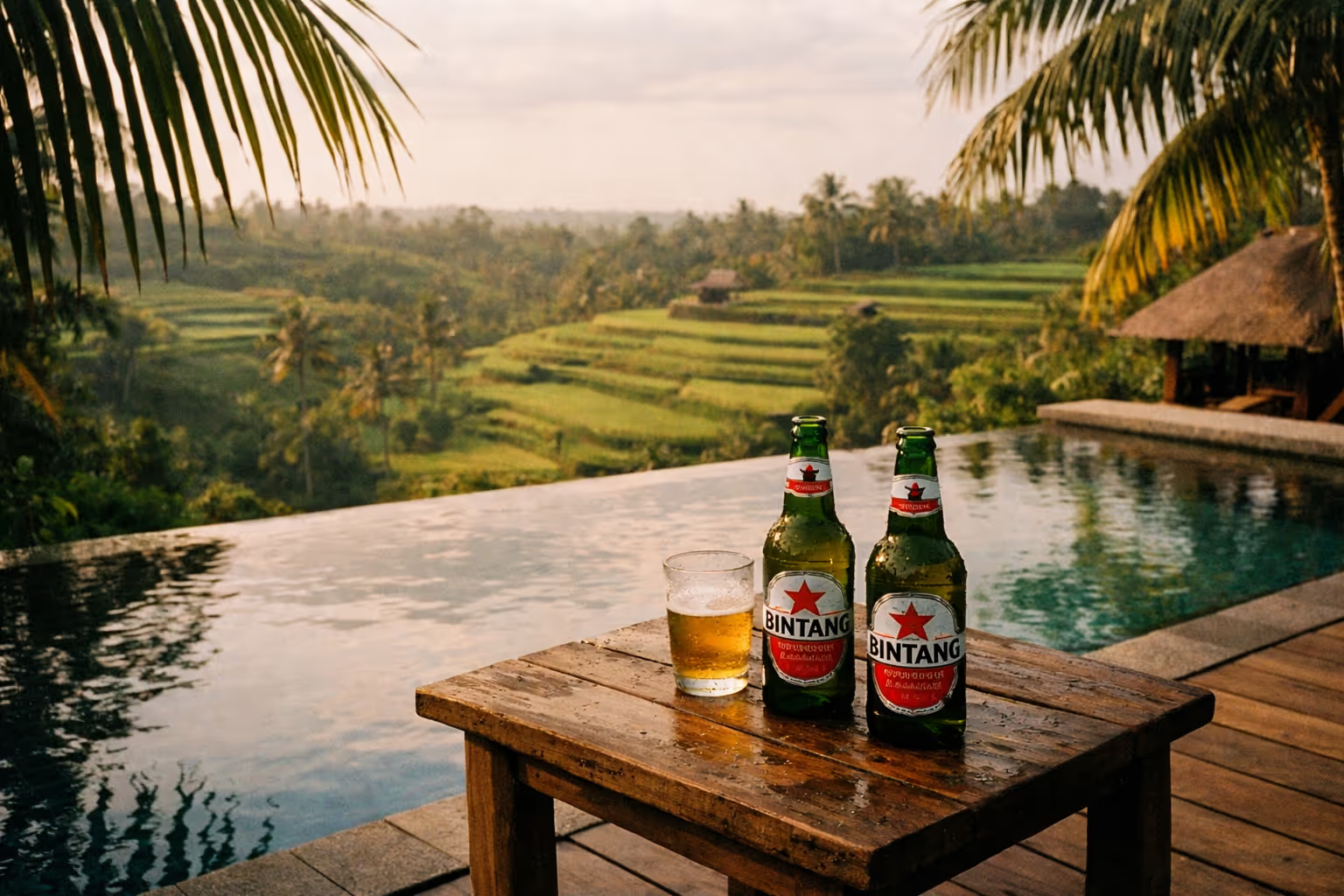
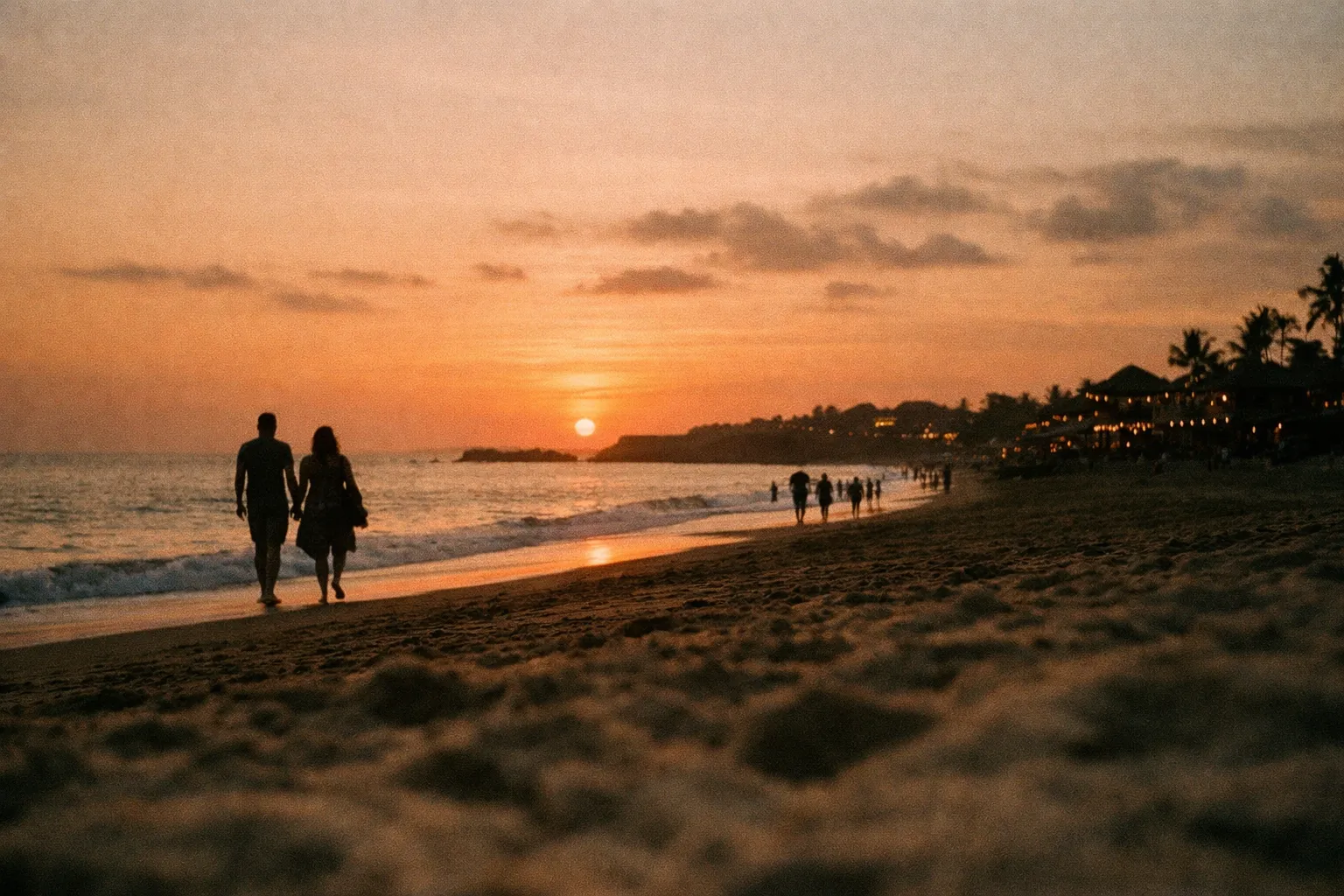
Sunset is a ritual here. The free option: grab a Bintang from a warung, sit on the sand at Batu Bolong or Pererenan, and watch the surfers darken against the orange sky. The paid option: reserve a daybed at Finns Beach Club, The Lawn, or La Brisa. On busy days, expect minimum spends of IDR 300,000-750,000 (USD 20-50) per person. Bar stools have no minimum but drinks cost more.
For something more low-key, Times Beach Warung and Hippie Fish at Pererenan offer beanbags on the sand with lower minimums.
Canggu cafes: where to eat and work
The canggu cafes scene is the daily backbone here. A few places stand out:

- Crate Café (Batu Bolong) - the original brunch spot. Açaí bowls, eggs, strong coffee. Expect a queue between 9 and 11 a.m. Mains cost IDR 80,000-140,000 (USD 5-9)
- Betelnut Café - relaxed two-floor spot with healthy bowls and reliable Wi-Fi
- Café Organic - vegan-friendly, heavy on smoothie bowls
- Milu by Nook - quieter sit-down brunch
- Moana - beachy interior, good for solo work sessions
- Vida Café - newer with consistent Wi-Fi and seating
- Penny Lane - British-leaning menu, good for a proper sit-down meal
- BGS (Bali Gunung Surf) - coffee plus surf gear, smaller scene
Specialty coffee runs IDR 30,000-45,000 (USD 2-3). For Indonesian food at local prices, warungs serve nasi campur (mixed rice plate with vegetables, fish, and meat) for IDR 25,000-40,000 (USD 1.50-3).
For coffee plus actual work, bWork and Tribal are the two co-working spaces most digital nomads use in 2025-2026, with day passes around USD 8-15.
Canggu rice fields and scooter routes
The canggu rice fields aren’t the dramatic terraces you’ll find at Tegallalang - they’re flatter, fragmented by villas under construction, but still photogenic early in the morning. The best stretch lies behind Batu Bolong and around Pererenan, where narrow lanes cut through paddies wide enough to scooter through.
I recommend a sunrise loop (5:30-7:00 a.m.). It skips the heat, traffic, and most construction noise (5). A few tips:
- Download Google Maps offline (grab the Bali region before you go)
- Save pins for “rice field viewpoints,” parking near Batu Bolong, and the Canggu shortcut - a small road locals use to avoid the main strip between Berawa and Batu Bolong
- Watch out for cows, dogs, and unmarked drops along the lanes
- Don’t ride through actual paddies - these are working farms tied to Bali’s centuries-old Subak irrigation system
For more dramatic terraces, consider a day trip inland to Tegallalang (1.5 hours by car) or Jatiluwih (2 hours).
Where to stay in Canggu
Where to stay in canggu depends on what you want from the trip. The area breaks into four main zones, each with a different feel:
Batu Bolong - the heart of the action. Good for first-timers, surfers who want to walk to the break, café hoppers, and short stays. Expect the loudest traffic and most construction.
Berawa - a bit more polished, home to Finns Beach Club and newer restaurants. Better for families, older travelers, and longer stays. Quieter at night than Batu Bolong.
Pererenan - quieter still, with rice paddies close to the beach. Good for wellness retreats, writers, or anyone who finds Batu Bolong overwhelming.
Echo Beach - more spread out, surf-focused, midrange to luxury villas with ocean views.
Price bands per night in 2026:
- Budget hostels and guesthouses: USD 10-25 (dorms or basic private rooms)
- Midrange boutique hotels and guesthouses: USD 40-90
- Private villas with pool: USD 100-250+ depending on size and location (Batu Bolong and Berawa tend to cost more than Pererenan)
For monthly stays, expect 20-35% off nightly rates if you book directly with guesthouses. Co-living spaces aimed at nomads run USD 600-1,200 per month including utilities and Wi-Fi.
What not to miss in Canggu
If you have 3-5 days, here’s a practical checklist:
- One dawn surf session at Batu Bolong, even if it’s your first lesson
- One sunrise scooter ride through the Pererenan rice paddies
- One Sunday market: Samadi or La Brisa, both run roughly 9 a.m. to 2 p.m., with organic groceries, prepared food, and crafts (4)
- One sunset with feet in the sand and a Bintang - Pererenan or Batu Bolong
- One Tanah Lot day trip - the offshore sea temple is 30 minutes west, best at late afternoon for sunset against the rock
- One Balinese massage - 60 minutes at Mello Spa, Beach House by Tonic, or Maja Spa runs IDR 150,000-300,000 (USD 10-20)
- One warung dinner for proper nasi campur or mie goreng at local prices
- One yoga class at The Practice, Desa Seni, Udara, or The Path - drop-ins cost IDR 150,000-180,000 (USD 10-12) (4)
Etiquette note: when entering temples (including Tanah Lot), cover your shoulders and knees. Sarongs are usually provided at the entrance for a small donation. Don’t step on offerings - the small woven trays of flowers and rice you’ll see on sidewalks - walk around them.
Day trips from Canggu
Tanah Lot Temple (30 minutes west) - iconic sea temple. Go for sunset and expect crowds. Entry costs around IDR 60,000 (USD 4).
Ubud (1.5 hours northeast) - temples, the Monkey Forest, art, and inland culture. Doable as a long day or better as an overnight.
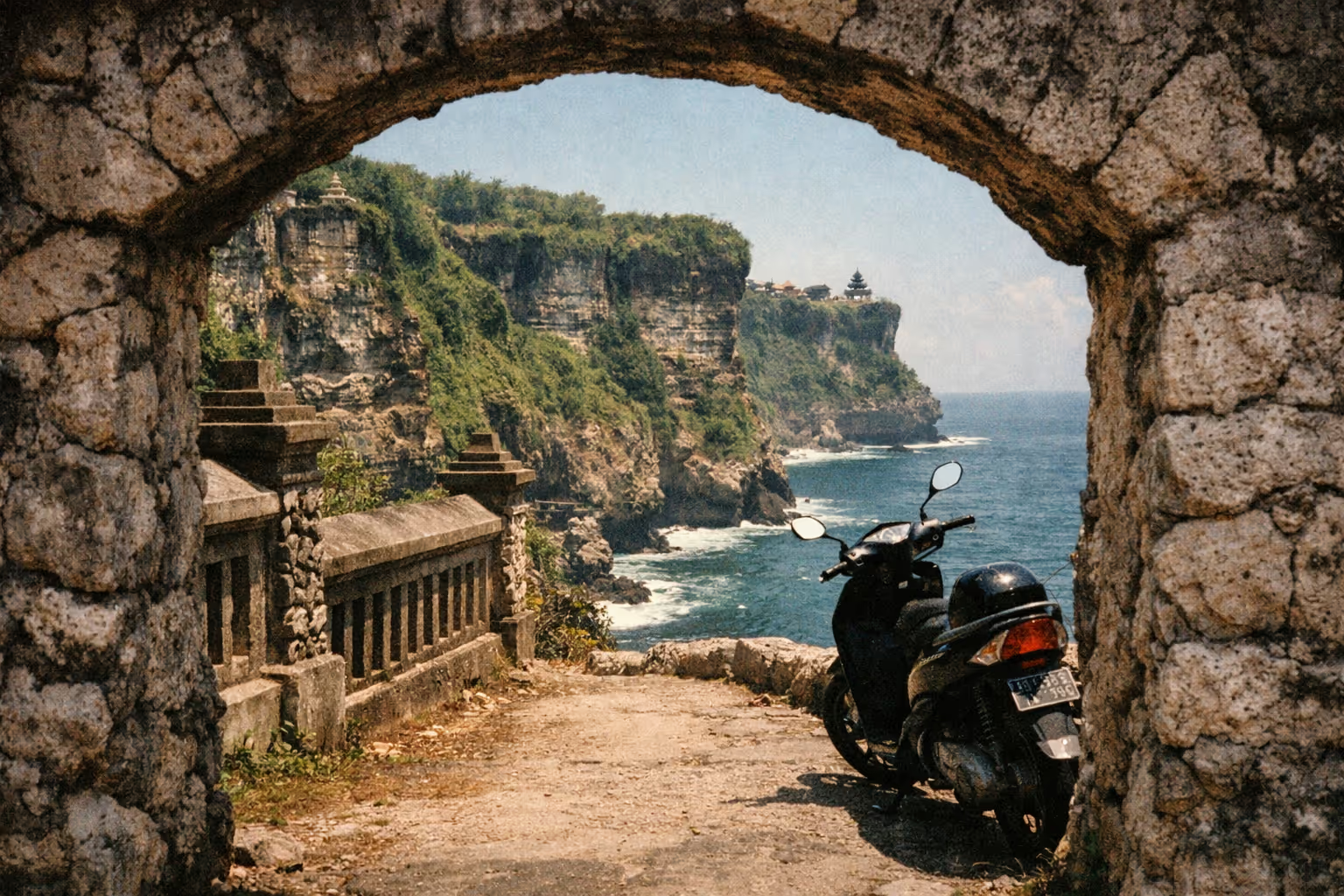
Uluwatu (1.5 hours south) - clifftop temples, the Kecak fire dance at sunset, and white-sand beaches on the Bukit Peninsula (a contrast to Canggu’s black sand).
Tegallalang Rice Terraces (1.5 hours northeast) - the postcard terraces, plus the G Swing photo spots (rated 5.0/5 on Tripadvisor with 220+ reviews) (7).
Nusa Penida (boat from Sanur, full day) - for Kelingking Beach and dramatic cliffs. It’s a long day with a rough boat ride.
A private driver for a full day runs USD 50-70. Split between two or three people, it’s the easiest way to get around.
Day Trips from Canggu
| Tanah Lot Temple | Ubud | Uluwatu | Tegallalang Rice Terraces | Nusa Penida | |
|---|---|---|---|---|---|
| Distance from Canggu | 30 minutes west | 1.5 hours northeast | 1.5 hours south | 1.5 hours northeast | Boat from Sanur, full day |
| Highlights | Iconic sea temple, sunset views | Temples, Monkey Forest, art, culture | Clifftop temples, Kecak fire dance, white-sand beaches | Postcard terraces, G Swing photo spots | Kelingking Beach, dramatic cliffs |
| Entry Fee | IDR 60,000 (USD 4) | Varies | Varies | Varies | Varies |
| Typical Visit Duration | 2-3 hours | Day trip or overnight | Half to full day | 2-3 hours | Full day |
When’s the worst time to go to Bali?
The wettest months are December through February - humidity over 80%, heavy downpours, occasional flooding on shortcut roads, and murkier water at Canggu’s beaches. Sunset bar plans and rice-field rides often get washed out. Mosquitoes are worse too.
Peak season runs June through September - driest weather but the busiest crowds, highest prices, and Batu Bolong’s traffic at its worst.
The sweet spots are the shoulder months: April-May and October to early November. Surf is still good, rain is occasional, and accommodation costs run 10-20% below August rates.
If you must visit in the rainy season, base yourself in Berawa or Pererenan (less flooding than Batu Bolong’s shortcut), plan more café and spa days, and accept that some beach days will turn into brunch days.
Practical logistics: visas, scooters, money
Visa: most nationalities get a 30-day Visa on Arrival (VOA) for about IDR 500,000 (USD 33), extendable to 60 days. Rules change - check your country’s current eligibility before flying.
Airport transfer to Canggu: private cars or Grab/GoJek run IDR 250,000-350,000 (USD 17-23) one way, 45-90 minutes depending on traffic. Pre-book through your accommodation for a fixed price.
Scooter rental: IDR 80,000-120,000 (USD 5-8) per day, USD 60-100 per month. Helmets are mandatory by law. Police checkpoints on main roads fine unlicensed riders IDR 250,000-500,000 - carry an International Driving Permit with a motorcycle endorsement if you want to ride legally.
Cash: most cafés, beach clubs, and villas take cards, but warungs, markets, parking attendants, and beach shacks need cash - often in small bills (IDR 2,000-5,000) (5). Keep some tucked in your scooter compartment.
Wi-Fi: cafés generally offer 20-50 Mbps, co-working spaces hit 100+. Telkomsel SIM cards from the airport are the most reliable nationwide. A tourist data SIM costs about IDR 150,000 (USD 10) for 25 GB over 30 days.
Common mistakes to avoid
- Underestimating evening traffic - Batu Bolong’s main strip jams from 4 to 8 p.m. A 15-minute scooter ride can turn into 40 minutes. Plan dinner and airport transfers accordingly (4)
- Treating Canggu beaches as swimming beaches - rips and shorebreak are serious. Red flags mean no entry
- Riding a scooter with zero experience - Bali isn’t the place to learn. Practice somewhere quiet first or use Grab
- Booking accommodation too far from a main strip - walking infrastructure is poor, sidewalks narrow or missing, and you’ll rack up expensive short Grab rides
- Arriving without a backup plan for rain - December to February rain can wash out outdoor plans. Have indoor café and spa options ready
- Showing up at empty bars - Old Man’s, Deus, The Lawn, and Sand Bar each have their busy nights. Check Instagram or ask at your hostel before trekking 25 minutes for a quiet floor
Daily budget guide for Canggu
What you’ll actually spend per day in 2026, USD:
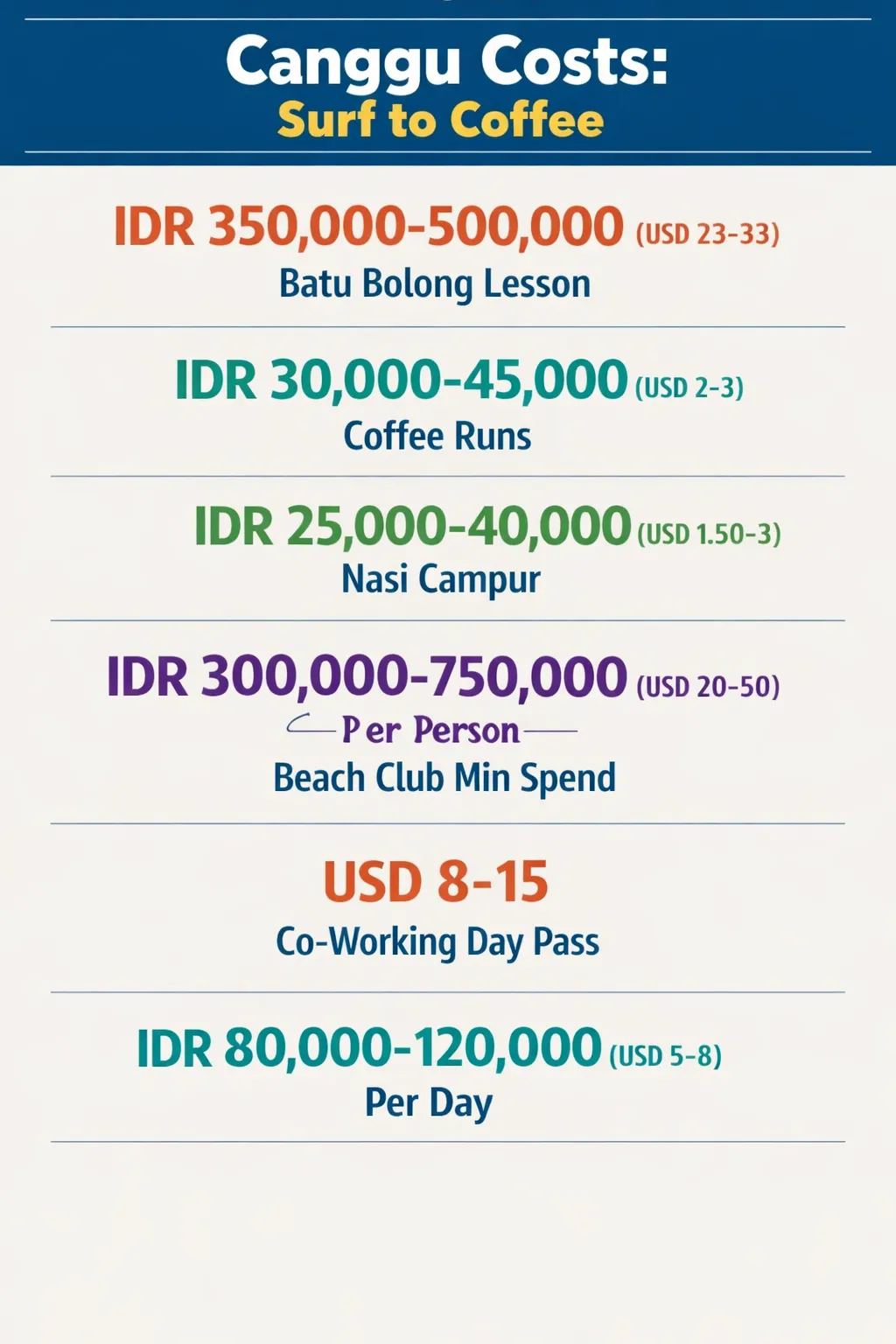 Prices in Canggu include Batu Bolong surf lesson IDR 350,000-500,000 (USD 23-33); coffee IDR 30,000-45,000 (USD 2-3); nasi campur IDR 25,000-40,000 (USD 1.50-3); beach club minimum spend IDR 300,000-750,000 (USD 20-50) per person; coworking day passes USD 8-15; scooter rental IDR 80,000-120,000 (USD 5-8) per day.
- Shoestring (USD 25-40/day): hostel dorm, warung meals, scooter, free sunsets, one paid activity per week
- Midrange (USD 50-120/day): guesthouse private room, café brunches, scooter, one or two paid activities per day (yoga, surf, massage)
- Comfortable (USD 150-300/day): boutique hotel or shared villa, café meals, daily activities, occasional beach club beds
- Luxury (USD 400+/day): private villa with pool, driver, daily spa, VIP daybeds at Finns or The Lawn, private surf guide
Flights aren’t included. Drinks and beach club minimums push budgets up fast - a single afternoon at Finns can easily hit USD 50.
Frequently Asked Questions
- Can I rent surfboards directly at the beaches, or should I bring my own?
- Surfboards are widely available for rent at Batu Bolong and Echo beaches, with hourly and daily rates. Bringing your own board is optional but can save rental costs if you plan to surf extensively.
- Are scooters the best way to get around Canggu?
- Scooters are the most common and convenient transport in Canggu, but only recommended if you have prior experience due to local traffic and road conditions. Alternatives like Grab rides are safer for beginners.
- Is it necessary to book beach club daybeds in advance?
- During peak season and weekends, booking daybeds at popular beach clubs like Finns and La Brisa is advisable to secure a spot and avoid minimum spend surprises.
- What are the typical Wi-Fi speeds in cafés and co-working spaces?
- Cafés generally offer 20-50 Mbps, sufficient for casual work, while co-working spaces like bWork and Tribal provide faster connections around 100+ Mbps for more demanding remote work.
- Are there any local customs I should be aware of when visiting temples?
- Yes, cover shoulders and knees when entering temples, use sarongs provided at entrances, and avoid stepping on offerings placed on sidewalks to show respect.
- How crowded does Canggu get during peak season?
- June through September sees the highest visitor numbers, especially on Batu Bolong's main strip and popular beaches, leading to traffic jams and busy cafés.
- Can I find quiet spots within Canggu for wellness or writing retreats?
- Pererenan offers a quieter atmosphere with rice paddies nearby, making it a preferred zone for wellness retreats and focused work away from Batu Bolong's bustle.