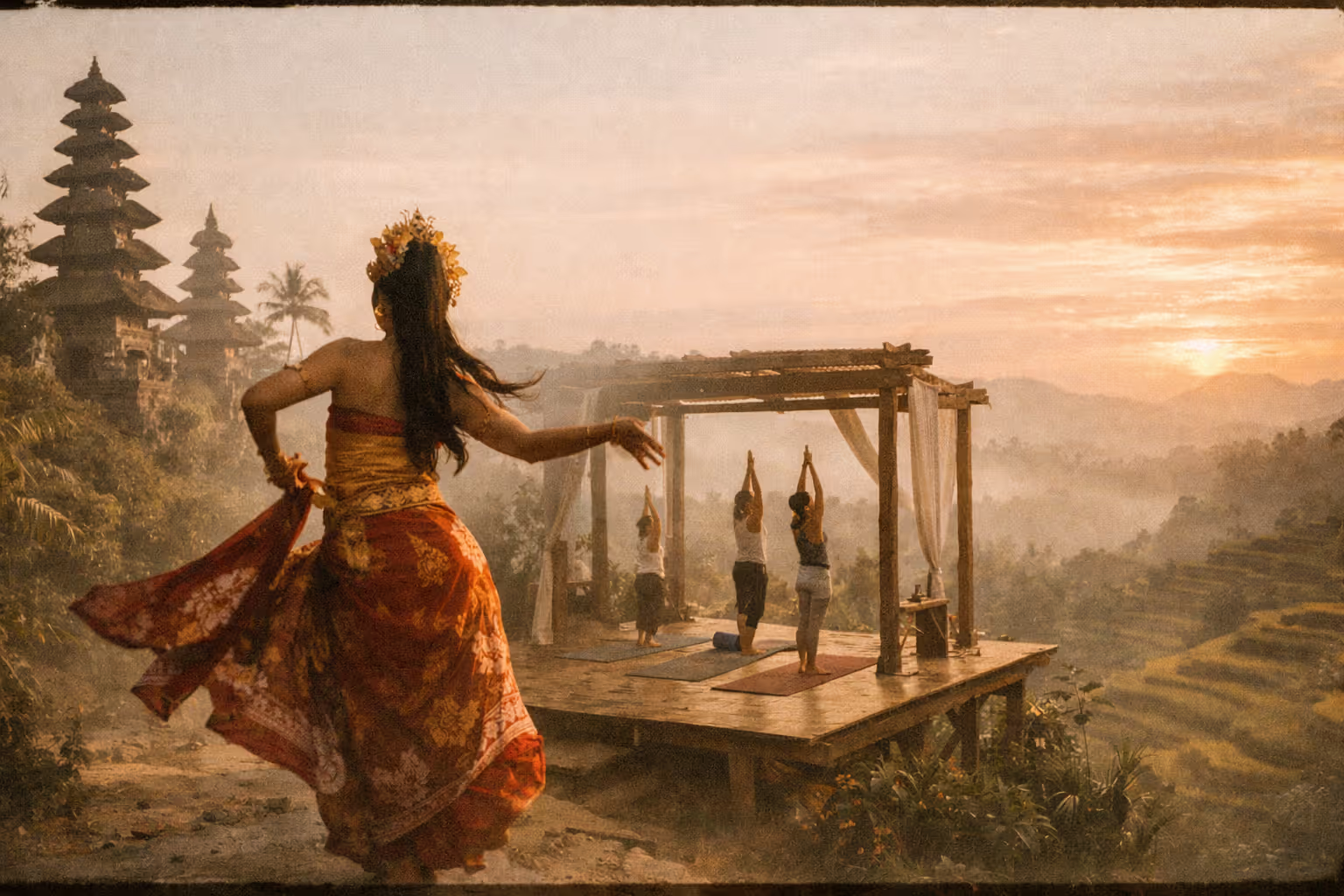
Visiting temples in Bali now comes with enforced rules: a 2025 order fines climbing on shrines, drones, and disrespectful poses, so cover shoulders and knees and behave. Start with Besakih, the Mother Temple on Mount Agung, arriving by 9 a.m. with a guide so you do not miss the shrines. For ritual, Tirta Empul offers the melukat purification in spring-fed pools, so pack a quick-dry sarong. And end a day at Uluwatu with the Kecak fire dance at sunset, where tickets can sell out in peak season.
Are there Hindu Temples in Bali?
Yes - and almost every major temple you’ll visit is a Balinese Hindu temple. While Indonesia is the world’s most populous Muslim-majority country, Bali is the exception: roughly 87% of the island practices Balinese Hinduism, a distinct branch that blends Hindu deities with animist and ancestral traditions.
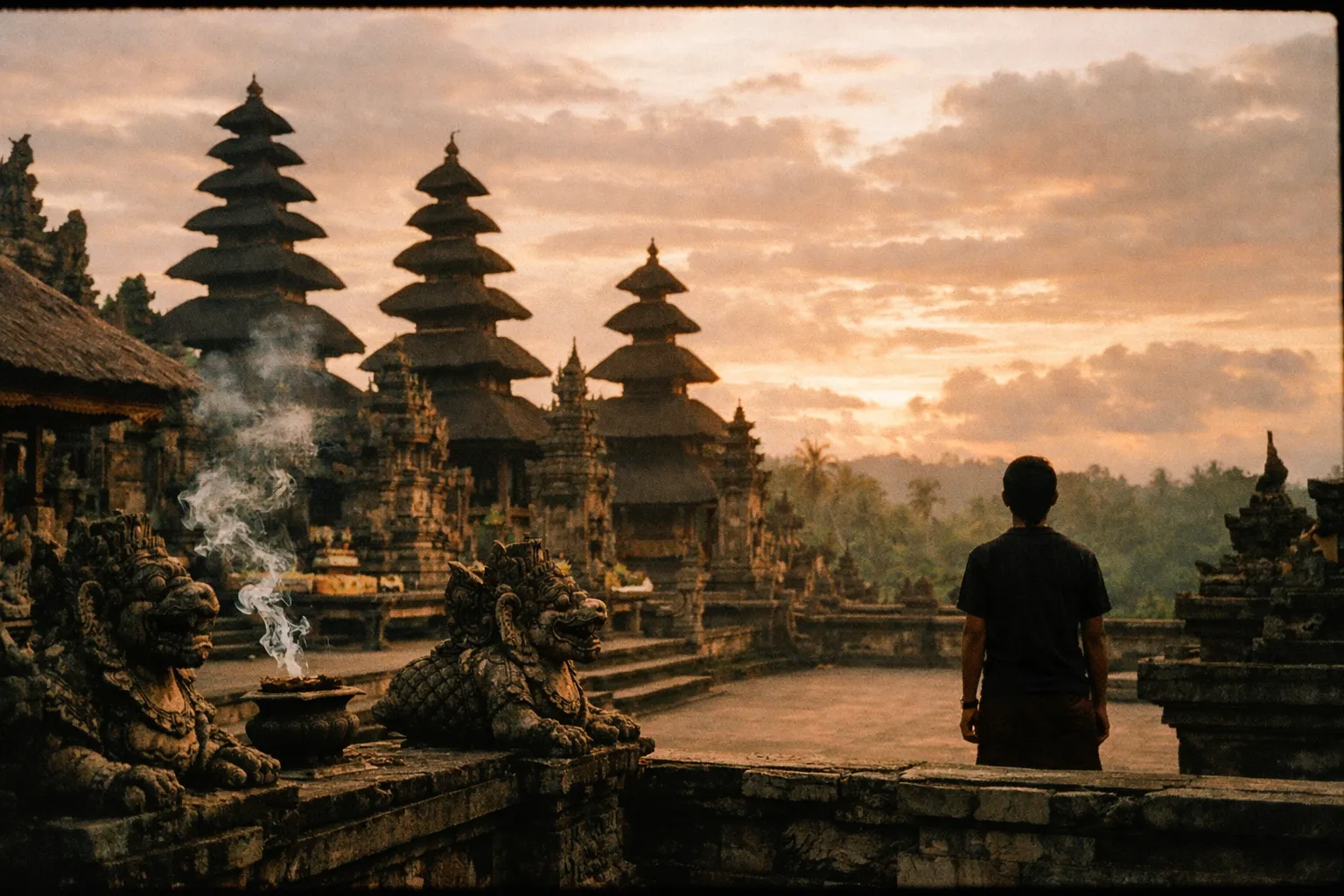
The local word for temple is pura, an open-air walled complex rather than a roofed building. Besakih, Uluwatu, Tanah Lot, Tirta Empul, and Ulun Danu Beratan are all Balinese Hindu temples (1)(9). Everywhere you walk, you’ll see daily offerings - small palm-leaf trays called canang sari (flower-and-rice offerings) left on shrines, sidewalks, and shop doorsteps. That constant ritual is the thread connecting every temple on this list.
Which is the most famous temple in Bali?
The most famous and holiest is Pura Besakih, known as the “Mother Temple” (1)(9). It sits on the southwestern slopes of Mount Agung, Bali’s highest and most sacred volcano, and is actually a complex of more than 20 separate temples spread across the hillside.
Besakih is the spiritual anchor of the island. When Balinese Hindus speak of the temple, they mean this one. The terraced layout climbs the mountain in tiers, with the central Pura Penataran Agung as the focal point. Plan 3-4 hours here; the complex is large and the terrain is steep (1)(9).
A few practical notes from my visit:
- Arrive 08:00-09:00. By late morning, fog rolls down Mount Agung and hides the upper shrines, and the tour buses fill the lower courtyards.
- Licensed guides at the entrance charge roughly USD 10-20. Without one, it’s easy to get turned around in the multi-temple layout and miss the key shrines - I’d take the guide here even if you skip them everywhere else.
- A modern visitor center now manages access via shuttle, so budget extra time for the walk up.
What are the 9 temples in Bali? The directional temples
Bali’s nine directional temples - Pura Kahyangan Jagat (the island’s cosmic guardian temples) - are positioned around the island to protect it from evil spirits, each aligned with a compass point and a Hindu deity (2)(10). They form the island’s spiritual perimeter, and working through several of them is a satisfying way to structure a temple trip.
The Nine Directional Temples of Bali
| Pura Besakih | Pura Lempuyang Luhur | Pura Goa Lawah | Pura Luhur Uluwatu | Pura Ulun Danu Beratan | Pura Pucak Mangu | Pura Andakasa | Pura Batukau | Pura Pusering Jagat / Pura Sakenan | |
|---|---|---|---|---|---|---|---|---|---|
| Location | Karangasem, center/northeast | East Bali | Southeast Bali | South, Bukit Peninsula | Bedugul, northwest | Near Lake Buyan, north | South Bali | West, slopes of Mount Batukaru | Varies by tradition |
| Key Feature | Mother Temple on Mount Agung | Gates of Heaven split gate | Bat Cave temple | Cliff-top temple 70 m above sea | Lakeside water temple | Mountain temple | Protective temple | Forest temple | Varied temple in network |
| Elevation | 800-1,000 m | 1,175 m | Sea level | 70 m | 1,200 m | 1,100 m | Lowland | 1,500 m | Varies |
If you want to see several in one go, the east Bali cluster makes the most sense: Besakih + Lempuyang + Goa Lawah can be linked over 1-2 days with a private driver (≈ USD 40-60/day, roughly IDR 600,000-900,000) and combined temple fees of around USD 10-15 (approximately IDR 150,000-225,000 at current rates) (10). Tirta Empul charges around IDR 50,000 (≈ USD 3) per person for entry, and Pura Lempuyang Luhur runs approximately IDR 100,000 (≈ USD 6-7) including the split-gate photo area (4).
Temple tours: a journey through sacred sites
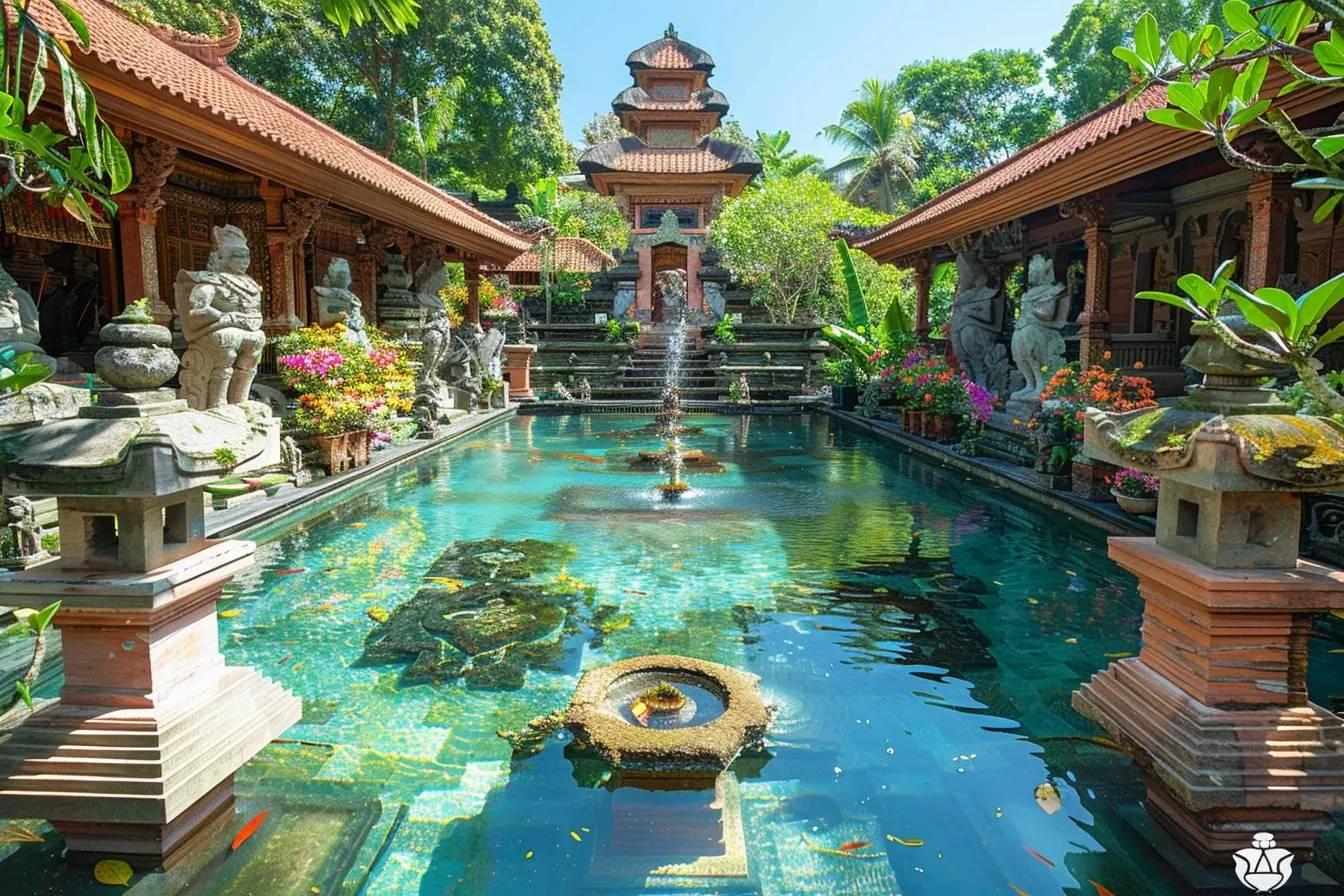
Besakih, covered above, anchors the east. But two other temples draw the biggest crowds for good reason.
Tanah Lot is a sea temple set on a rock formation against the surf - one of the most photographed sunset spots on the island and a fixture on every top-10 list (1)(3). Time your visit for 2-3 hours, arriving about two hours before sunset so you can walk the complex at lower tide, see the inland shrines, and then position for the silhouette as the sun drops (3). Entrance runs roughly USD 2-4 per person (3). One warning I’d underline: traffic and parking near Tanah Lot can add 30-60 minutes of delay, so don’t cut it close to sunset.
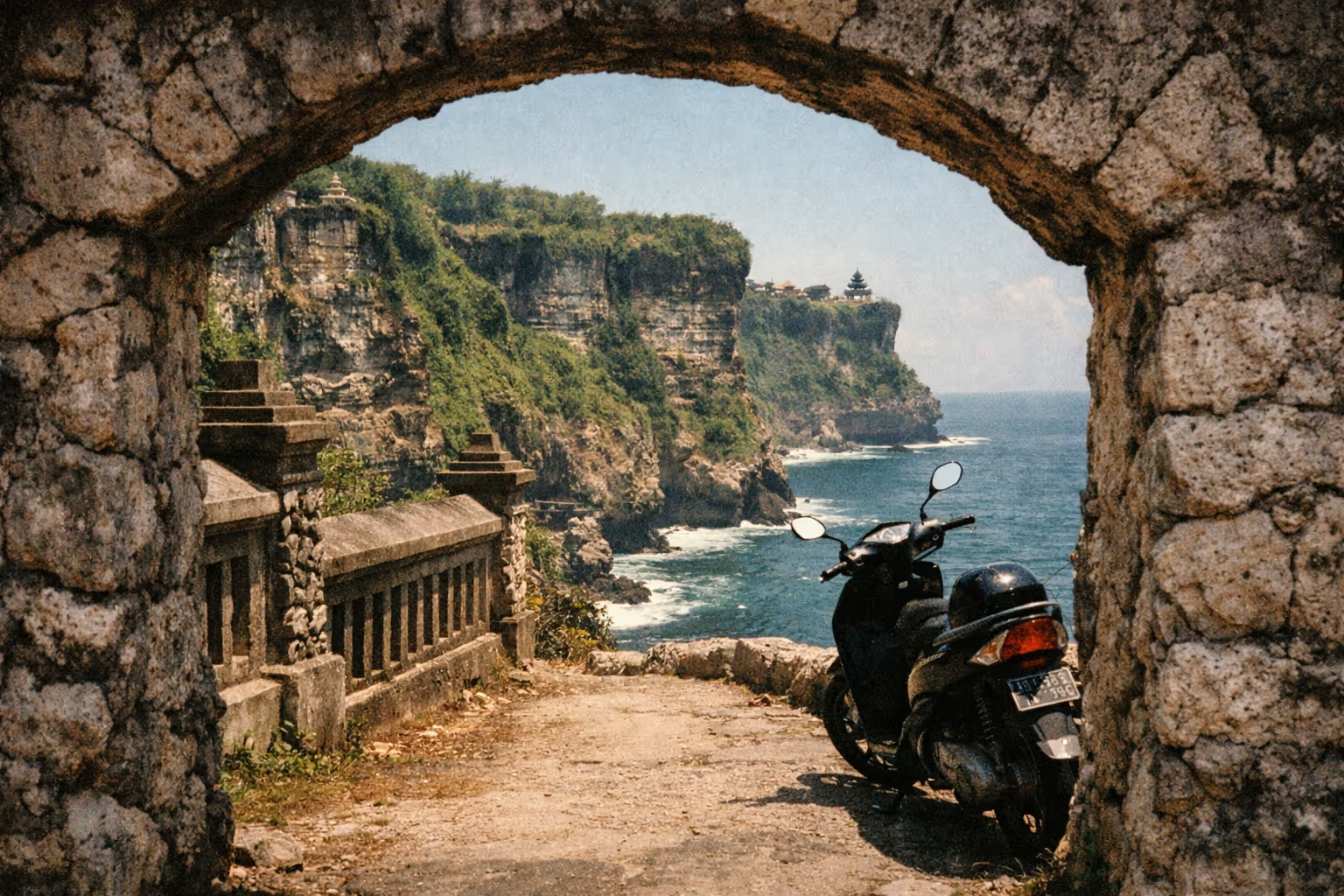
Pura Luhur Uluwatu is the south’s other showpiece - a temple perched on a cliff 70 m above the Indian Ocean, and one of the nine directional temples (10). The monkeys here are notorious thieves. Keep sunglasses and phones zipped away; I watched someone lose a pair of Ray-Bans within thirty seconds of arriving. Most people pair Uluwatu with its evening fire dance, which I’ll get to below.
My travels also led me to Tirta Empul, the holy spring temple near Tampaksiring, where the water itself is the attraction.
Sacred Water Temples: Tirta Empul and Ulun Danu Beratan
The water temples Bali is famous for tie directly into the Subak irrigation system - the UNESCO-listed network of canals and rituals that has watered the island’s rice for over a thousand years, according to UNESCO’s 2012 inscription of the Subak landscape (9).
Tirta Empul was built in 962 AD and centers on a petirtaan (bathing complex) with two main pools fed by a natural spring - the source of the Pakerisan River (4). Visitors can take part in melukat, a purification ritual where you move along a row of water spouts, dipping your head under each in turn. Immersing myself in that cold, clear water, queueing fountain to fountain, was one of the more grounding things I did on the island. Allow 2-3 hours, including the wait for the pools.
Bring your own quick-drying sarong and a towel. Rental sarongs turn heavy and cold once soaked, and your own gear saves a couple of dollars and a lot of discomfort over the 2-3 hour ritual (4). A sarong-and-locker combo on-site runs about USD 3-5.
Pura Ulun Danu Beratan sits on Lake Beratan at 1,200 m elevation, its multi-tiered meru (pagoda-style shrine) towers appearing to float on the water when the lake is high. It’s also one of the nine directional temples and central to irrigation rituals for the surrounding highlands (10). This is more of a scenic half-day - you can rent a boat on the lake and linger in the cooler mountain air. Many travelers cite this and Tanah Lot at sunset as the two prettiest temple settings on the island, and I wouldn’t argue with either pick.
Balinese dance: Kecak, Legong, and the fire dance
These performances are not tourist entertainment bolted onto a temple visit. They’re a spiritual offering, each movement telling a story from the Ramayana, and they’re worth treating that way.
The Kecak fire dance at Uluwatu
The Balinese fire dance - properly the Kecak Fire Dance - is performed by a chanting circle of 50-100 men against the cliffside backdrop of Uluwatu at sunset. There’s no Gamelan orchestra; the men’s interlocking “cak-cak-cak” chant is the music. The climax involves fire-walking scenes as the Ramayana story builds. It’s the most striking cultural show on the island, and I say that having seen Legong, Barong, and a handful of smaller village performances.
Practical details, updated for 2026:
- One show nightly, 18:00 to 19:00, every day; the gates open at 16:00 (11).
- Adult tickets are IDR 150,000 (IDR 75,000 for children aged 2 to 9), roughly USD 9-10, and payment is generally cash only (11).
- Tickets can sell out quickly in peak season, and the operator advises arriving at least an hour early for a good seat (11). Bring the exact amount in cash.
- Arrive by 16:30-17:00 if you want to walk the temple grounds before the show.
Legong and Barong in Ubud
Legong dance is a different register entirely - intricate, precise, with detailed footwork, darting eyes, and gold-threaded costumes. Performances run 60-90 minutes, scheduled 3-5 nights a week at venues like Ubud Palace, with tickets around USD 7-12 - typically cheaper than the Kecak show (7). The Barong dance, depicting the eternal battle between the lion-like Barong and the witch Rangda, is another Ubud staple. Don’t treat these as optional filler. They’re the clearest window into the Hindu mythology that shapes everything else you’ll see on the island.
Yoga Retreats Around Ubud’s Rice Terraces
Ubud is Bali’s wellness center, and a Bali Yoga retreat here is more than a week of morning stretches - it’s a slower pace built around the rice terraces and the rituals around you.

Starting my day with sunrise yoga overlooking the Tegallalang rice terraces is something that stays with me. The silence, broken only by roosters and water moving through the subak (traditional irrigation) channels, is a genuinely good backdrop for it. What you’ll pay:
Bali Yoga Retreat Options in Ubud
| Budget/Locally Run Retreats | Premium Packages (e.g., Escape Haven) | Drop-in Classes | |
|---|---|---|---|
| Price Range | USD 100-125/day | USD 2,295-2,595 per week | USD 10-20 per class |
| Typical Duration | 3-4 weeks | 7 nights | Single sessions |
| What's Included | Yoga, lodging, food, some temple outings | Yoga, spa, curated temple excursions | Yoga class only |
Two things worth checking before you book: deposits are typically 20-30% upfront (USD 450-780 on a premium package), and some budget retreats don’t include airport transfers or temple excursions, leaving you to cover a private driver at USD 40-60/day (6). My approach is to use a mid-week temple excursion as an “active rest” day - it breaks up the physical intensity and gives the cultural context of the practice somewhere to land (6).
What is the prettiest place in Bali?
A few spots consistently come up, and most of them are temples or rice terraces.
- Ulun Danu Beratan at high water, with its meru shrines mirrored on Lake Beratan against the highland mist.
- Tanah Lot at sunset, when the temple becomes a black silhouette against an orange sky and low tide opens the rock base (3).
- Pura Lempuyang’s split gate, framing Mount Agung - one of the most photographed compositions on the island.
- Tegallalang and Jatiluwih rice terraces (below), for green rather than stone.
If you want one frame that says “Bali,” it’s Ulun Danu Beratan or Tanah Lot at sunset. Both are worth prioritizing.
Bali’s rice terraces: Tegallalang and Jatiluwih
Bali’s landscapes are stitched with terraced rice paddies, and these two are the ones to know.
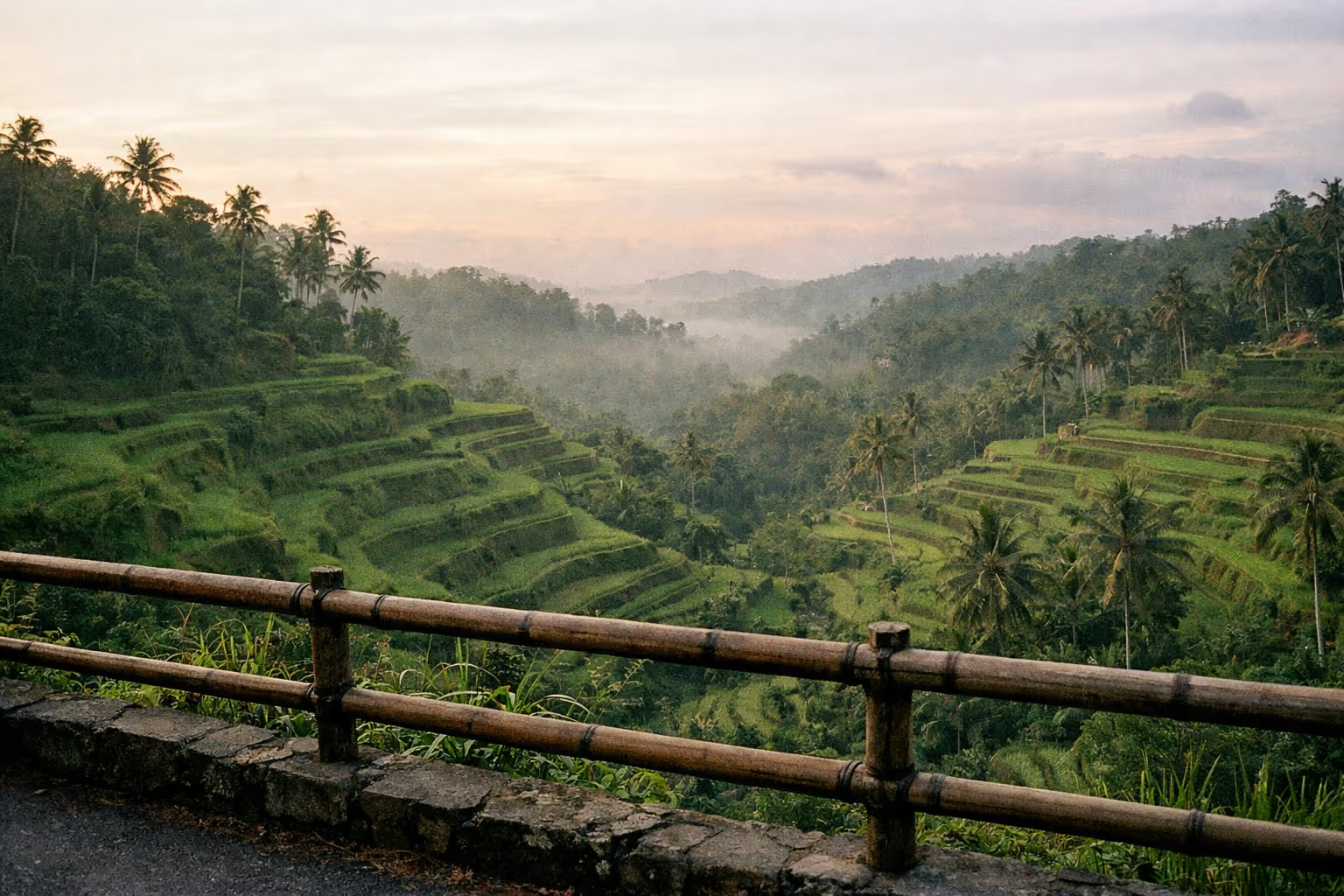
Tegallalang, just north of Ubud along Jalan Raya Tegallalang, shows off the subak irrigation system - the same UNESCO-listed practice that feeds the water temples. It’s the more dramatic and accessible of the two, with carved-out viewing platforms and the now-famous “Bali Swing” setups. Entry to the terrace viewing areas typically costs IDR 10,000-20,000 (≈ USD 0.70-1.30), collected informally at the path entrances. Go early - before 08:30 - to beat both the crowds and the heat; by 10:00 the tour vans are stacked along the road and the swing queues stretch past the warungs.
Jatiluwih, on the slopes of Mount Batukaru in the west, is the larger and quieter panorama - vast contour-following terraces with far fewer tour buses. Time slows down here. Pair it with Pura Ulun Danu Beratan, which is on the way up to the highlands, for a full day of green and water.
Temple etiquette: what to wear and how to behave (2025 rules)
Bali tightened its temple rules in 2025, and enforcement is real. Read this before you go.
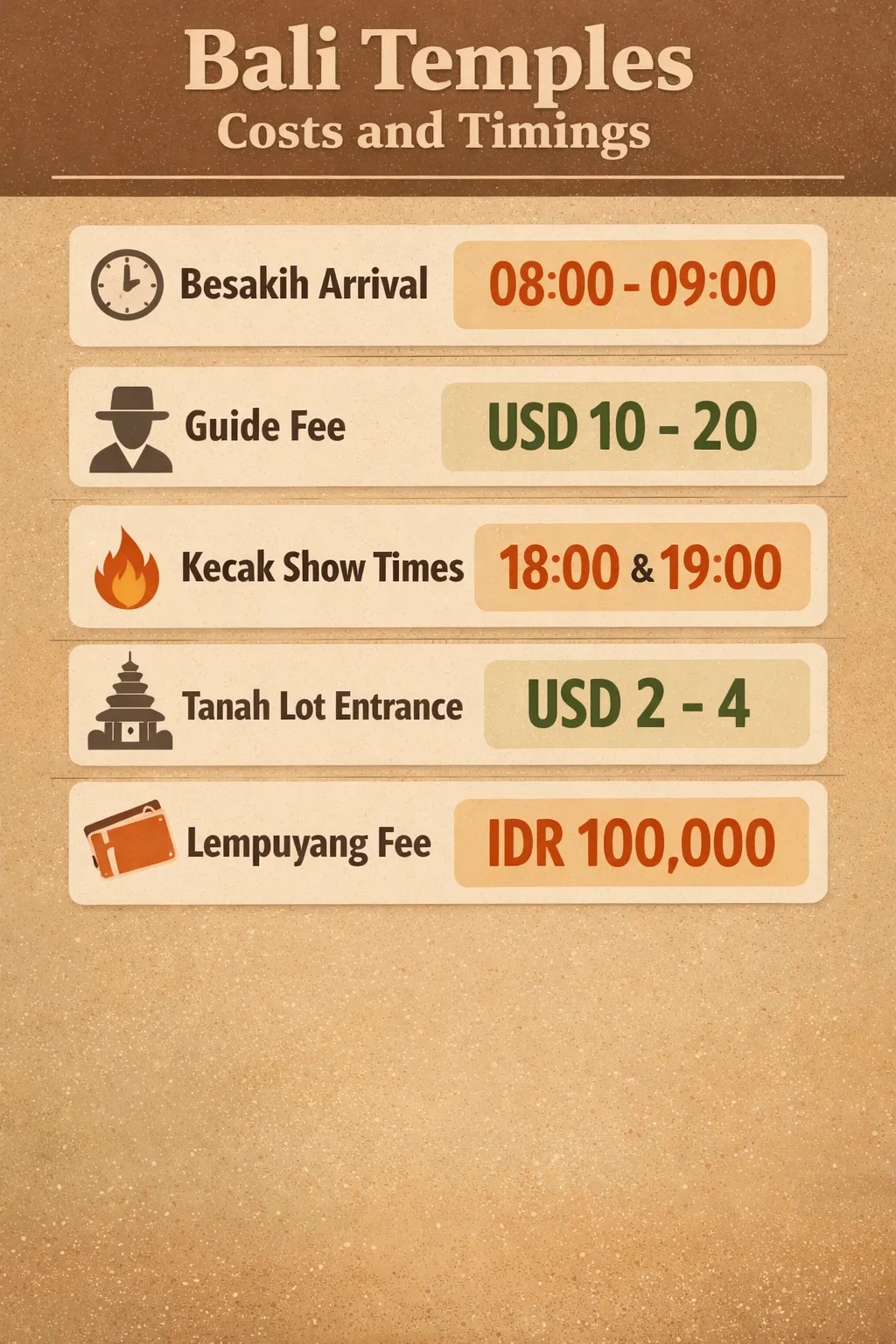 Key Bali temple costs and timings: Besakih arrival 08:00-09:00, guide fee USD 10-20, Kecak show 18:00-19:00, Tanah Lot USD 2-4, Lempuyang Luhur IDR 100,000.
- Dress code: shoulders and knees must be covered at every Hindu temple. A sarong and sash are usually required and can be rented on-site for IDR 10,000-25,000 (≈ USD 0.70-1.70). Arriving in shorts or a sleeveless top means a forced rental at best, refused entry at worst - and the cost adds up across a multi-temple trip.
- New behavior rules: In March 2025, Governor Wayan Koster issued Circular Letter No. 7 of 2025, which explicitly bans climbing or posing on temple structures, flying drones, and disrespectful photo poses. Violators face fines (locally quoted at USD 30-100) and removal from the site (7).
- Menstruation rule: by tradition, women who are menstruating are asked not to enter temple inner courtyards. It’s posted at many entrances.
- Offerings: don’t step on or over the canang sari offerings on the ground. Walk around them.
- Cash: smaller and remote temples (Lempuyang, for one) have no ATMs and take only IDR cash, so carry small bills.
For a broader look at respectful exploring across the island, including dress codes, photography norms, and village etiquette beyond the temple gates, it’s worth reading up before you arrive.
Sample temple itineraries
Two routes I’d actually recommend:
East Bali culture route (1-2 days): Besakih + Tirta Empul + Goa Lawah + Lempuyang, with a private driver at ≈ USD 40-60/day and combined temple fees around USD 10-15 (4). Start at Besakih early before the fog, then drop to Tirta Empul for the purification ritual.
South Bali sunset route: Uluwatu Temple + Kecak Fire Dance one evening (USD 9-10 show fee), Tanah Lot another evening (USD 2-4 entrance), with each visit needing a 2-3 hour window (3)(5). Don’t try to do both temples in one evening - the sunsets and the traffic won’t allow it. If you’re still building out your wider schedule, a Bali itinerary that sequences temples alongside beaches and highlands can help you avoid backtracking and make the most of each region.
Frequently Asked Questions
- Can I visit Bali temples without a guide?
- Yes, but guides are recommended at complex sites like Besakih to avoid missing key shrines and understand rituals.
- Are sarongs mandatory for all temple visits in Bali?
- Yes, sarongs and sashes covering shoulders and knees are required at all Hindu temples, with rentals available on-site.
- How early should I arrive for the Kecak Fire Dance at Uluwatu?
- Arrive by 16:30-17:00 to explore the temple before the single 18:00 show; the gates open at 16:00 and tickets can sell out in peak season.
- Is it safe to take photos inside Bali temples?
- Photography is allowed but avoid disrespectful poses or climbing temple structures to comply with 2025 regulations.
- What is the best way to travel between multiple temples in East Bali?
- Hiring a private driver for USD 40-60 per day is the most efficient way to visit multiple temples in East Bali.
- Do all temples accept credit cards for entrance fees?
- No, many smaller or remote temples only accept Indonesian Rupiah cash, so carry small bills.
- Can women visit temple inner courtyards during menstruation?
- Traditional rules ask menstruating women to avoid inner temple courtyards; signs are posted at many entrances.