Bali customs and etiquette are no longer just polite suggestions; since 2024, climbing sacred shrines has gotten tourists deported. At any temple, cover your shoulders and knees and wear a sarong, rentable on-site for pocket change. Pass money and gifts with your right hand only, since the left is considered unclean, and greet elders with the sembah, palms together at your chest. One more before you fly: pay the 150,000-rupiah tourist levy online through Love Bali and keep the digital proof.
Bali Customs and Etiquette: Navigating Temple, Dining, Greeting, Tipping, and Spa Norms

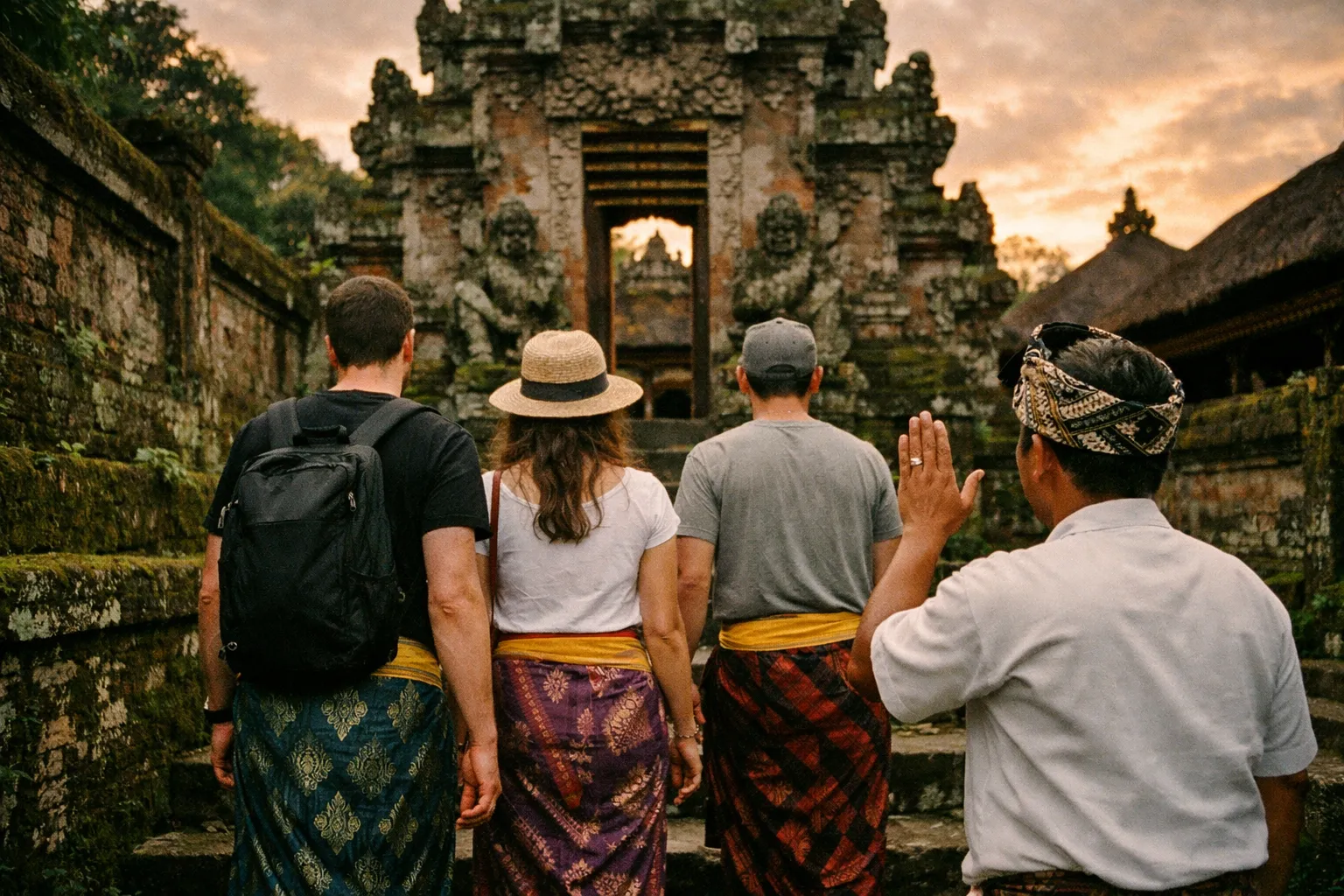
Understanding Bali customs and etiquette is essential for a respectful and enjoyable visit. The first time I visited Pura Taman Ayun, I borrowed a sarong from the temple entrance and wrapped it the way the attendant showed me - twice around, tucked at the hip. It felt slightly awkward for about five minutes. Then I forgot I was wearing it.
That’s roughly how dress code works here. At temples (pura, sacred Hindu worship sites), covering your shoulders and knees and wearing a sarong is non-negotiable. Not a suggestion, not a preference - it’s the condition of entry. The same sensitivity applies in villages and during ceremonies, where showing up in a crop top and short shorts reads as indifference rather than ignorance, which is worse.
Here’s what to know about appropriate attire:
- Temples: Sarong and waist sash required, shoulders covered. Most major temples rent sarongs and sashes on-site for 10,000-30,000 IDR (approximately USD 0.70-2) if you haven’t brought your own.
- Villages: Modest clothing covering shoulders and knees.
- Ceremonies: Follow the lead of people around you. When in doubt, go more covered, not less.
A tank top alone won’t pass at a temple. You’ll need a cover, which you can buy locally for 50,000-100,000 IDR (USD 3.30-6.70). Hats and sunglasses come off in prayer areas. Women are asked not to enter temples during menstruation (1).
The practical move: keep a sarong or light scarf in your bag. It weighs nothing, takes up no space, and saves you from being turned away at the gate.
Temple behavior: what’s changed and why it matters
Temple behavior is where the 2025 rules bite hardest. Balinese authorities issued a formal letter of do’s and don’ts, and enforcement has tightened considerably. Since 2024, there have been more frequent deportations and fines for disrespectful conduct at sacred sites - often triggered by the offender’s own social media posts. The irony writes itself.
The core rules at any pura:
- Wear the full kit: sarong, waist sash, covered shoulders. Remove hats and sunglasses in prayer areas.
- Don’t climb structures or shrines for photos. This single act is behind a large share of recent deportations.
- Step around offerings, never over them. Small woven trays of flowers and rice - canang sari (daily offerings placed to honor the gods) - sit on doorways, sidewalks, and shrine steps. Stepping over one is read as a direct insult.
- Don’t enter inner sanctums unless invited, and don’t touch sacred objects or sacred trees.
- Keep your voice down and skip the drone during prayers. Pointing at shrines with a single finger reads as rude - gesture with an open hand instead.
- Ask before filming priests or worshippers. Temple guides consistently advise getting consent before close-up shots (1).
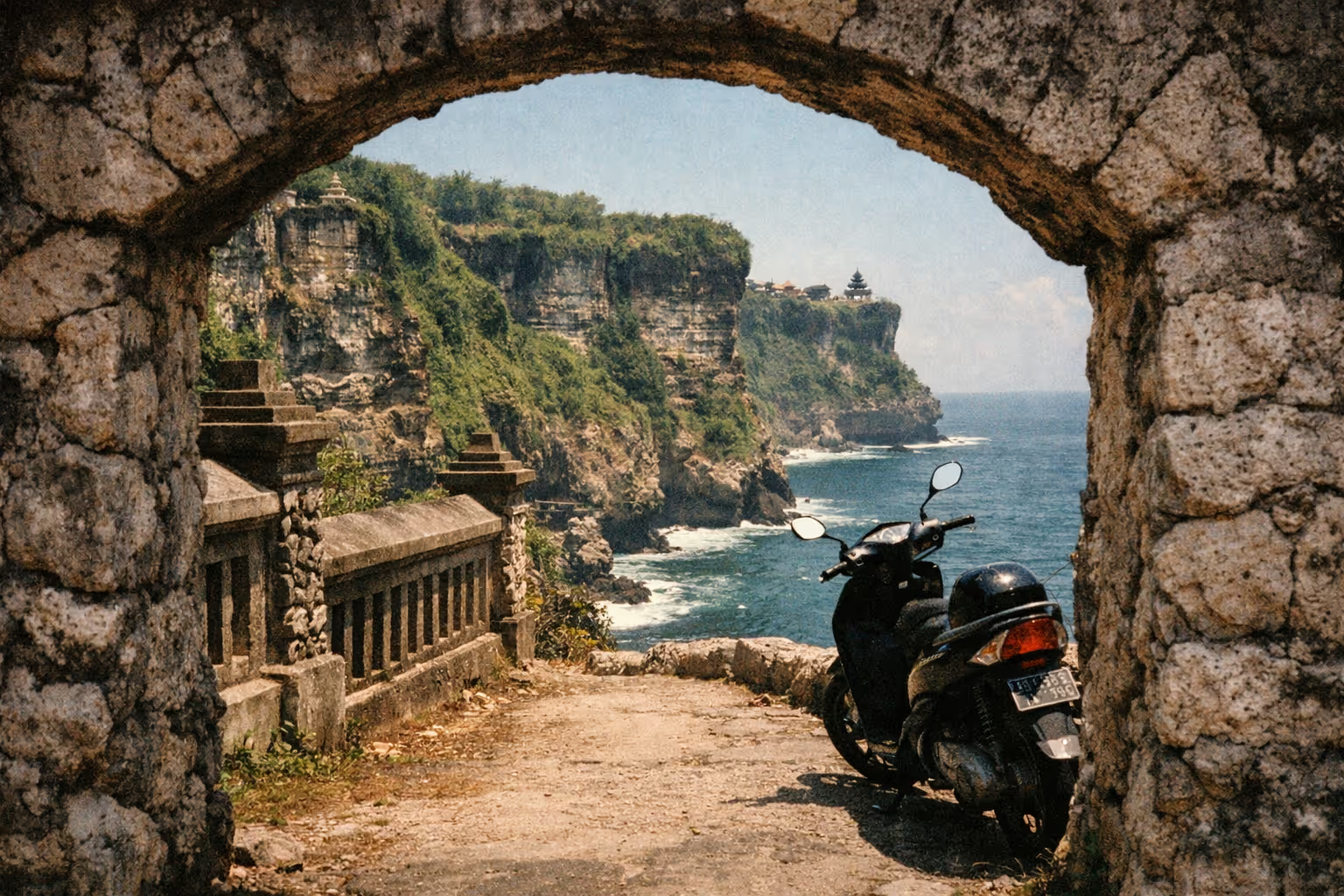
On timing: I’ve visited Tanah Lot and Uluwatu both early (before 10:00) and during the sunset rush. Early is better in every way - fewer people, quieter ceremonies, easier to move respectfully. The sunset crowd at Uluwatu is dense and fast-paced, and it’s genuinely harder to be thoughtful about where you’re stepping. Budget half a day to a full day for a temple circuit including dress, offerings, and any ritual you’re allowed to watch. Ceremonies often run one to three hours.
The right-hand rule and how greetings actually work
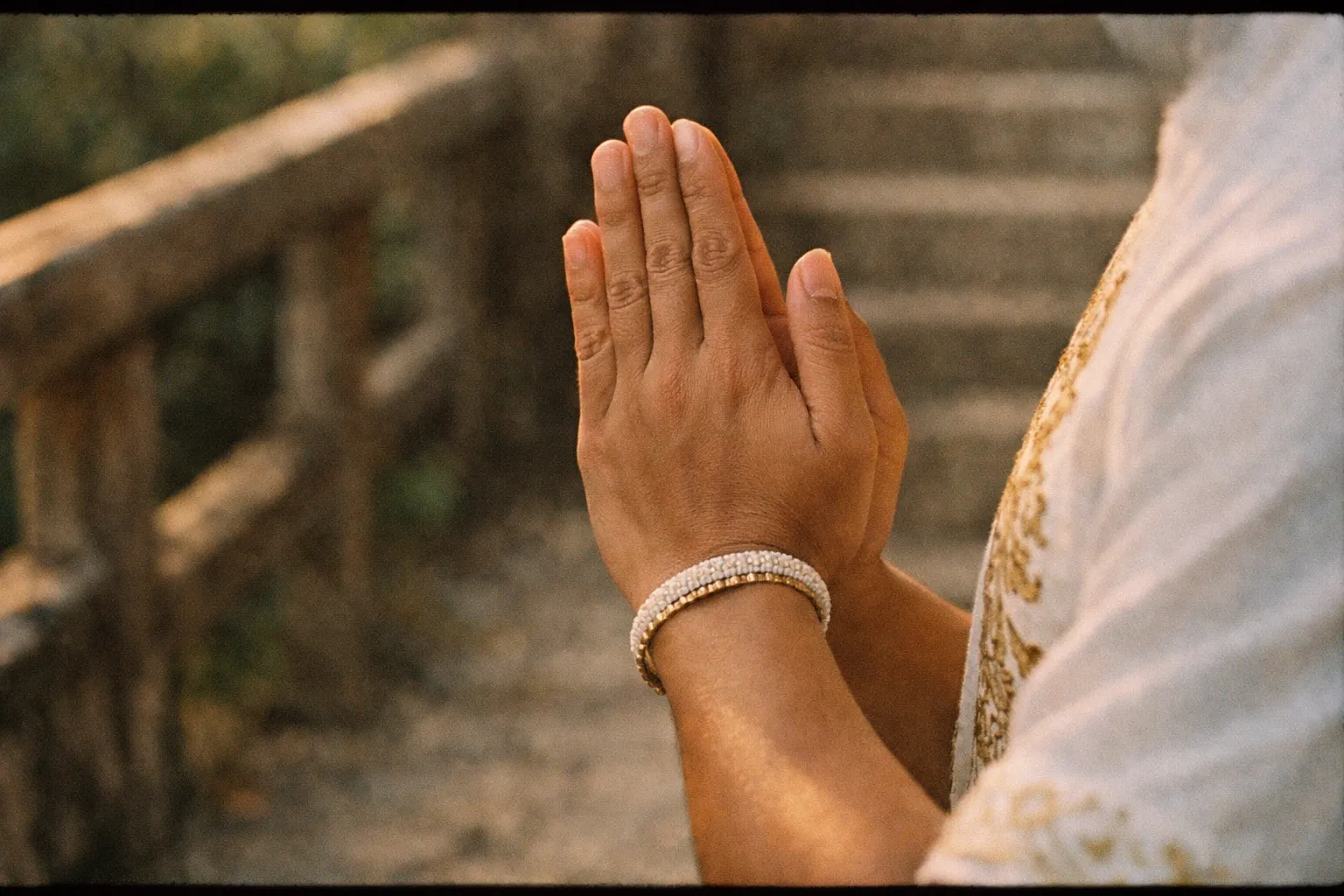
The traditional greeting is the sembah - palms pressed together at chest height with a slight bow, used especially with elders or in formal settings (2). Handshakes are common too, but always with the right hand.
That right-hand preference runs through almost everything here. The left hand is traditionally considered unclean - associated with bathroom hygiene - so you pass money, food, business cards, and gifts with your right hand, or with both hands together. Handing someone something with your left hand alone is a small but noticeable rudeness (2)(8). According to Bali’s provincial tourism guidelines and widely cited etiquette resources including Lonely Planet’s Bali coverage, this convention holds across both rural villages and urban Seminyak or Canggu settings equally.
A few more gestures worth knowing:
- Heads are sacred. Don’t pat or touch anyone’s head, including children’s.
- Feet are the lowest part of the body. Don’t point them at people, shrines, or offerings, and don’t prop them on furniture in someone’s home.
- Even with QR payments, pass the card or cash with your right hand. Bali has pushed hard toward QRIS digital payments and licensed money changers, but the right-hand courtesy still applies to the physical handoff.
Three phrases cover most daily situations: “Permisi” (excuse me) when stepping past someone or interrupting a conversation, “Terima kasih” (thank you) paired with a smile, and “Maaf” (sorry) for the occasional bump. These aren’t transactional politeness - they signal that you’re paying attention, which matters more than pronunciation.
Bali greeting etiquette is less about performing the right gesture and more about slowing down enough to acknowledge the person in front of you.
Dining manners: what to watch for at Balinese tables
Traditional Balinese eating uses the right hand only - no left hand near the food (8). Younger Balinese often use a spoon and fork, with the fork in the left hand pushing food onto the spoon in the right, which is then used to eat. Knives don’t usually appear at casual meals.
Two things worth watching for:
- At a shared meal, diners often wait until the oldest man at the table begins eating before they start. When in doubt, hold off ten to twenty seconds and follow the room (8).
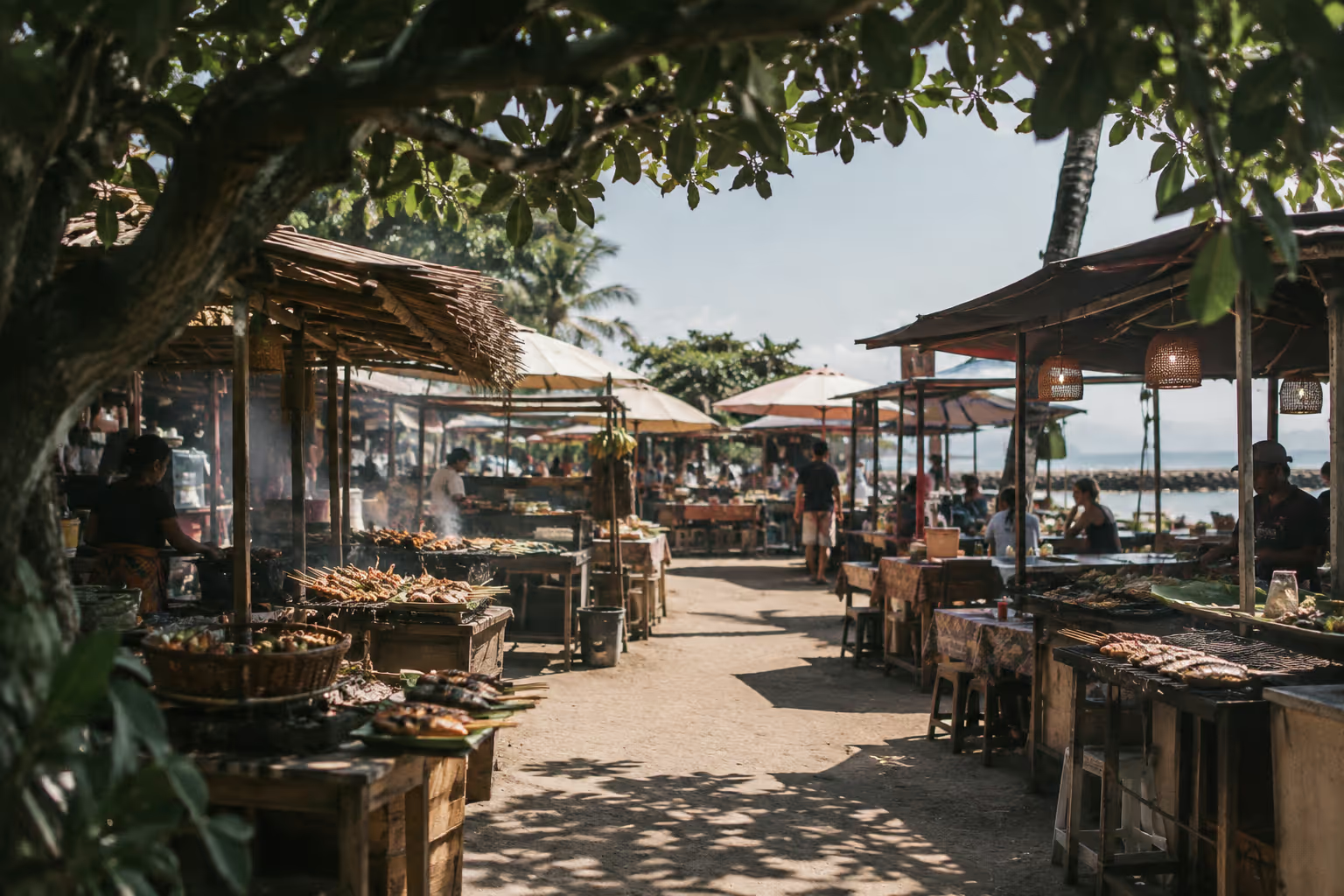
- At a warung (small local eatery or food stall), don’t over-formalize. Meals run 20,000-50,000 IDR (USD 1.30-3.30), and the atmosphere is relaxed. Matching that energy is part of the etiquette.
If you’re eating with your hand, keep it to the right, scoop with your fingers, and don’t make a production of it. It’s the norm, not a performance.
Bali dining etiquette is mostly about reading the room - formal settings call for more care, warungs call for less.
Tipping customs and guidelines: what to expect
Tipping in Bali is not mandatory. That trips up a lot of visitors who assume Western conventions apply everywhere. The general guidance is 5-10% of the bill at restaurants when no service charge has been added. If a service charge of 5-10% already appears on the bill, you don’t need to add more (3)(8).
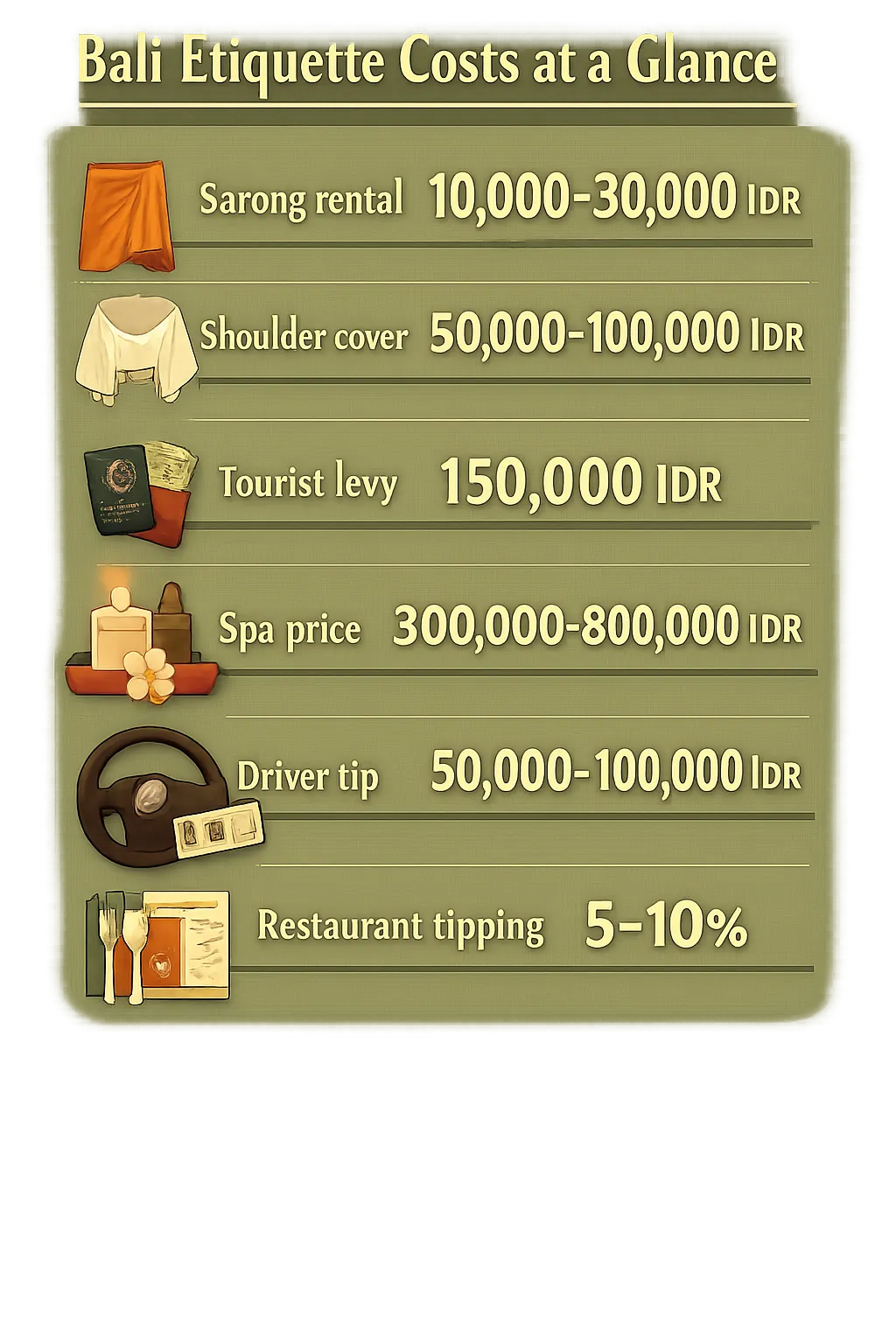 Budget snapshot: Bali etiquette costs include sarong rental (10,000-30,000 IDR), shoulder-covering purchase (50,000-100,000 IDR), a 150,000 IDR tourist levy, spa price (300,000-800,000 IDR), full-day driver tip (50,000-100,000 IDR), and restaurant tipping at 5-10%.
Here’s how tipping etiquette in Bali breaks down by service:
- Restaurants: 5-10% if no service charge; skip extra if one’s included. At warungs, round up by 5,000-10,000 IDR or leave the change.
- Hotel staff: 10,000-20,000 IDR (USD 0.70-1.30) per bag for bell staff; 20,000-50,000 IDR (USD 1.30-3.30) per night for housekeeping at mid-range hotels.
- Private drivers and guides: 50,000-100,000 IDR (USD 3.30-6.70) for a full day of good service. Around 100,000 IDR (approximately USD 6-7) is genuinely generous for a full-day private driver (3).
- Spa therapists: 50,000-100,000 IDR (USD 3.30-6.70) handed directly to the therapist, or roughly 10% (3).
Carry small notes - 10,000 and 20,000 IDR denominations. Coins feel like offloading spare change, and large notes leave you over-tipping by accident.
One thing people get wrong: over-tipping at local warungs. Leaving 20-30% on a 30,000 IDR meal can embarrass the staff and quietly distort local norms. Rounding up a few thousand rupiah is the right move(5).
Plan roughly USD 2-4 per day in small notes for casual tipping of hotel staff and drivers, plus USD 3-7 per spa session. These figures are based on mid-2024 through early 2025 pricing - worth checking if you’re reading this much later, as the IDR/USD rate shifts. For context, a full-day private driver tip of 100,000 IDR (USD 6-7) is roughly three times what you’d leave at a warung meal, and about one-fifth of what a resort spa session costs before tip - so the proportions stay consistent even as the base prices move.
Spa arrival, attire, and tipping: what to know before you book
A Balinese massage runs 300,000-800,000 IDR (USD 20-53) at a resort spa, and the experience is more ritualized than most Western spa formats.
The basics of Bali spa etiquette:
- Arrive 15-20 minutes early. Spas run on calm. Showing up flustered at the start time means rushing through the consultation and foot-wash ritual, which sets the wrong tone for both of you (3).
- Keep your voice low. These spaces are deliberately hushed - match it.
- Use the disposable underwear provided. Most spas hand you a set; wearing it is standard practice.
- Tip the therapist directly. A tip of 50,000-100,000 IDR or roughly 10% handed straight to the person who treated you is polite and appreciated (3).
If a treatment package includes flower baths or scrubs, the therapist will guide you through each stage. Follow their lead on timing rather than rushing to the next thing.
Can girls wear shorts in Bali?
Yes - but context decides everything. Women can wear shorts comfortably across most tourist areas, beaches, and nightlife zones. The line shifts at temples and in villages (6).
- At temples: Short shorts above the knee and tight or see-through leggings are explicitly not acceptable. You’ll need the sarong and covered shoulders regardless of what’s underneath (1).
- In villages and near religious sites: Very short or tight clothing is discouraged and can draw unwanted attention.
- Beach clubs and nightlife: Different setting, different rules.
For solo women, the practical move is keeping knee-length shorts or a skirt and a shoulder-covering top on hand for village and temple stops, and saving tighter clubwear for beach clubs and evenings out (6). A light sarong in your bag covers you for any unplanned temple stop - and there will be unplanned temple stops.
Quick reference: what to do and what to skip
If you remember nothing else from this guide, remember these.
Do:
- Pay the foreign tourist levy of 150,000 IDR (approximately USD 9-10) via the official “Love Bali” platform before or during your stay, and keep digital proof - some attractions ask to see it (4).
- Wear a sarong, sash, and covered shoulders at temples.
- Use your right hand (or both) for giving, receiving, and paying.
- Step around offerings on the ground.
- Learn “Terima kasih,” “Permisi,” and “Maaf.”
- Use official money changers and QRIS where possible (4).
- Bargain in markets with a smile - start around 40-60% of the opening price and walk away politely if needed.
Don’t:
- Climb temple structures, shrines, or sacred trees for photos.
- Touch anyone’s head or point your feet at people or shrines.
- Hand things over with your left hand alone.
- Wear short shorts or tank tops inside temples.
- Film priests or worshippers without asking (1).
- Use single-use plastics - Bali has introduced regulations targeting plastic waste, and visitors are encouraged to avoid single-use items as part of broader environmental rules now in effect (4).
Violations aren’t just frowned upon anymore. Climbing sacred structures, public nudity, and suggestive photos at temples have led to fines and deportations - frequently after the traveler posted the evidence themselves.
✓ Pros
- Clear dress codes ensure respectful access to temples and ceremonies
- Right-hand rule fosters polite daily interactions
- Tipping is flexible and culturally sensitive
- New legal rules help protect sacred sites from disrespect
- Simple phrases and gestures ease communication
✗ Cons
- Strict enforcement can lead to fines or deportation for unaware visitors
- Dress code restrictions may require carrying extra clothing
- Social media posts can inadvertently cause trouble
- Some customs may feel unfamiliar or restrictive to first-time visitors
Frequently asked questions
Frequently Asked Questions
- Is $100,000 a big tip in Bali?
- USD 100,000 is an enormous sum in Bali, far beyond customary tipping; typical generous tips are around 100,000 IDR (USD 6-7) for a full day driver.
- Is $1000 enough for 1 week in Bali?
- USD 1,000 can work comfortably for a budget-conscious solo traveler covering mid-range accommodation, food, transport, and tours (excluding flights), but it is not a reliable figure for a couple - two people sharing those costs should budget closer to USD 1,500-1,800 for a similar standard. Prices are based on mid-2024 through early 2025 rates.
- What are the main do's and don'ts in Bali?
- Pay the tourist levy, dress modestly at temples, use your right hand, step around offerings, and avoid climbing sacred sites or filming without consent.
- Can women wear shorts in Bali?
- Women can wear shorts in tourist and nightlife areas, but temples and villages require modest dress with covered shoulders and knees.
- What happens if I disrespect temple rules?
- Disrespecting temple rules can lead to fines or deportation, especially if documented on social media by the offender.
- Is tipping mandatory in Bali?
- Tipping is not mandatory; 5-10% at restaurants without service charge is customary, with small tips appreciated for other services.
- How should I behave during Balinese ceremonies?
- Dress modestly, follow locals' lead, keep quiet, and avoid taking photos without permission during ceremonies.
What actually matters before you go
Bali’s customs aren’t complicated - they’re just specific. The dress code, the right-hand rule, the offerings on the ground, the levy you pay before arrival. None of it requires much effort once you know what you’re doing.
Pack a sarong and a scarf for temple stops, carry small notes for tipping, lead with your right hand, and pay the levy before you arrive. Learn three phrases. Step around the offerings.
Do those things and you’ll spend less time worrying about getting it wrong and more time actually being there - which is the whole point. If you’re still planning your trip, a day-by-day Bali itinerary can help you structure your time around the cultural stops that matter most. And if you want to understand the deeper significance behind the temples and offerings you’ll encounter, the island’s history and temple traditions gives that context in full.