Puerto Rican pasteles are the island’s Christmas parcels, and the tamale comparison only goes so far: the masa is grated green bananas and roots like yautia and yuca, not corn. That gives them a dense, subtly sweet body, stained orange by achiote oil and steamed inside banana leaves. Making a family batch of 40 to 50 is a full day of work, so spread the masa, filling, and wrapping across three. Boil one test pastel before wrapping the rest; it is the single step that saves the batch.
What Are Puerto Rican Pasteles, and Why Do They Matter?
Puerto Rican pasteles are the island’s cherished holiday parcels: a grated masa of green bananas, plantains, and root vegetables, filled with seasoned pork, wrapped in banana leaves, tied with twine, and boiled (6)(9). Think of them as Puerto Rico’s answer to the tamale - but where a tamale uses corn masa, a pastel uses starchy roots and green bananas.
The masa is the defining element. It’s made from a blend of:
- Green bananas (guineos verdes)
- Green plantains
- Yautía (taro root)
- Yuca (cassava)
- Calabaza or pumpkin
- Sometimes potato
That combination creates a dense, subtly sweet dough colored deep orange by achiote (annatto) oil (6). The filling is traditionally pork shoulder seasoned with sofrito, achiote oil, garlic, onion, and oregano - stewed with olives, capers, and adobo (5)(6). Chicken and vegetarian versions using chickpeas or lentils exist, but pork remains the standard at Christmas.
What sets pasteles apart is the wrapping. Each one is folded into banana leaves and parchment paper, then tied with string. The leaf imparts a subtle flavor during boiling, and the packet keeps the masa cohesive as it cooks (6)(7).
What are Puerto Rican pasteles made of?
Short version: grated green bananas, plantain, and root vegetables (yautía, yuca, calabaza) form the masa; seasoned pork forms the filling; banana leaves and parchment form the wrap (6)(9). A typical batch of 40-50 pasteles uses roughly 6-8 lb of green bananas and plantains, 3-4 lb of yautía and/or yuca, 2-3 lb of calabaza, 1-2 cups of achiote oil, and 2-4 lb of pork shoulder. The masa runs about 60-70% starchy roots and bananas to 30-40% liquid and fat (broth and annatto oil) (4)(6).
What’s the difference between tamales and pasteles?
Both are wrapped, boiled or steamed parcels of masa and filling - but the base ingredients diverge completely. Tamales are built on corn masa and wrapped in dried corn husks (2)(7). Pasteles use grated green bananas, plantain, and root vegetables - no corn - and are wrapped in banana or plantain leaves (2)(4)(7). The texture follows: tamale masa is grainy and corn-forward; pastel masa is smoother, denser, and slightly sweet from the plantain. Tamales are Mesoamerican in origin; pasteles reflect a blend of Taíno, African, and Spanish influences that’s specific to the Caribbean.
The art of crafting pasteles the traditional way
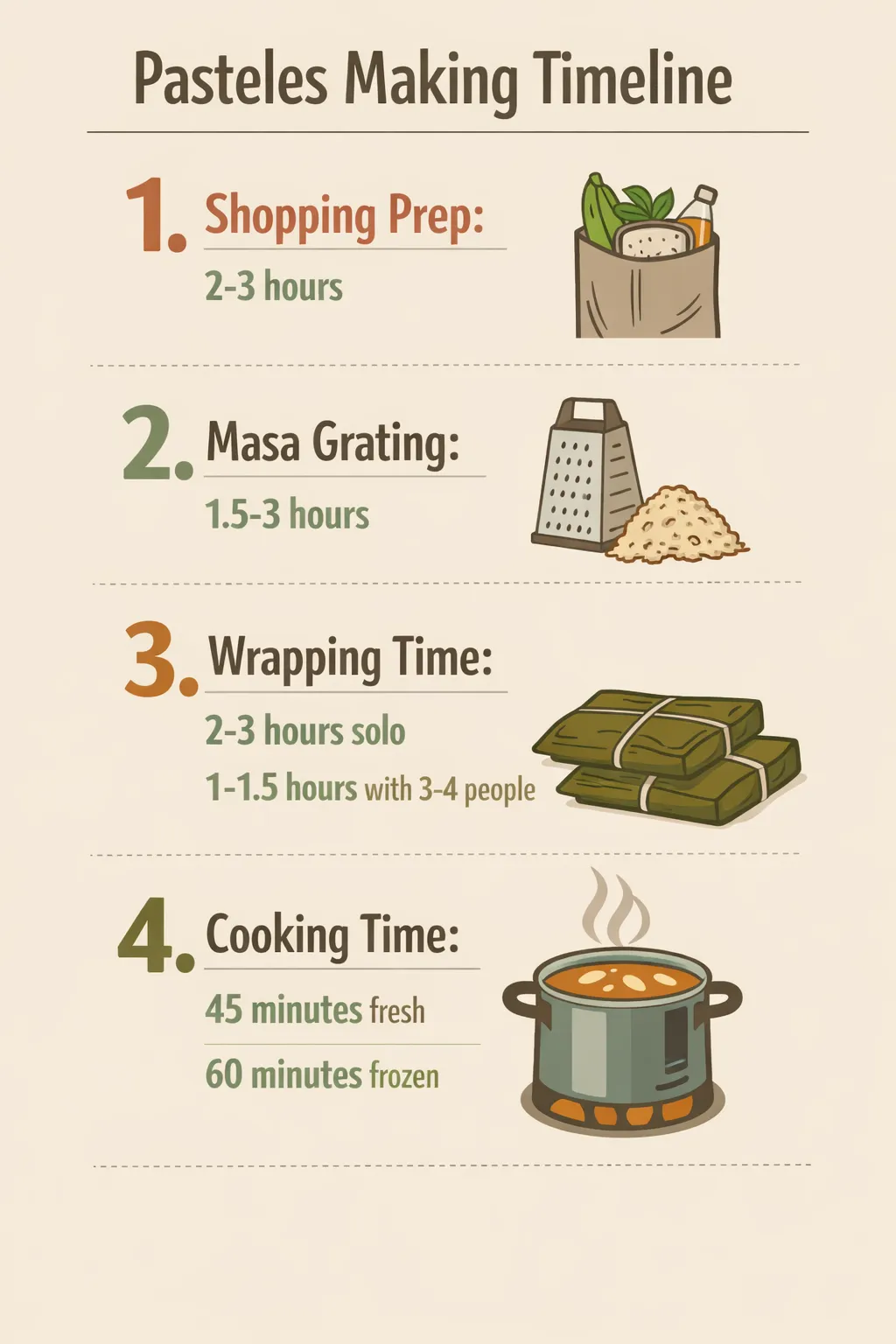 Pasteles making spans about a full day, with prep 2-3 hours, masa 1.5-3 hours, wrapping 2-3 hours, and cooking 45 minutes for fresh or 60 minutes for frozen.
I joined a family in San Juan for their annual pastel-making day a few years back. What struck me wasn’t the complexity of any single step - it was the sheer accumulation of time. Nothing is hard. Everything takes longer than you expect.
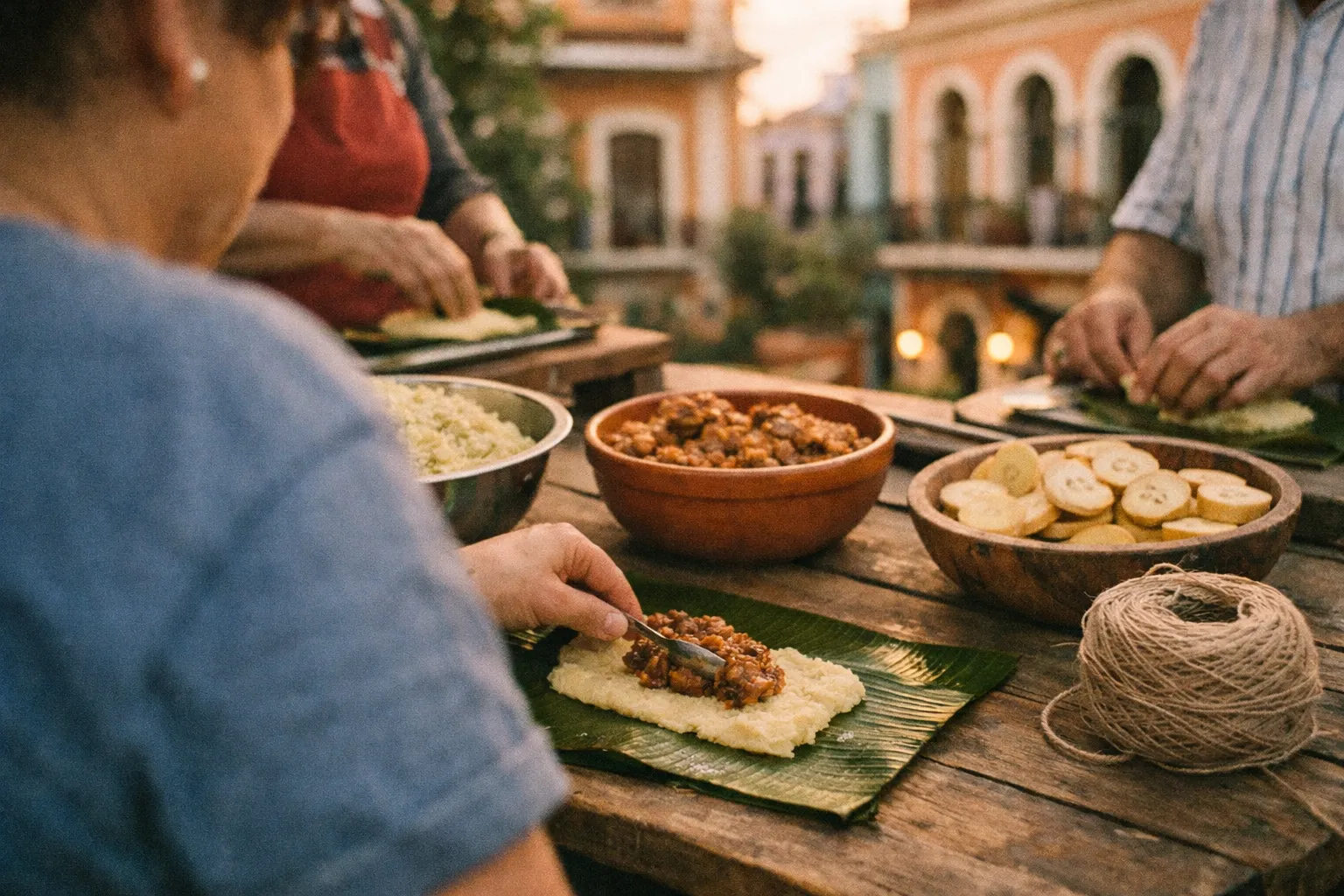
Making pasteles is labor-intensive, but it’s also a genuine expression of community. Families often turn it into a junta de pasteles - an assembly-line gathering that can produce 80-120 pasteles in a day with three or four people working (5)(10). Here’s the honest scope before you start:
- Shopping and prep: 2-3 hours (hunting down roots, green bananas, and leaves)
- Masa grating and mixing: 1.5-3 hours (a food processor cuts this dramatically versus hand-grating)
- Filling prep: 1-2 hours (a pressure cooker stew runs about 30 minutes, plus chopping) (6)
- Wrapping and tying: 2-3 hours solo, or 1-1.5 hours with 3-4 people(6)(10)
- Cooking: 45 minutes for fresh, 60 minutes for frozen, often across multiple pot loads (6)(7)
Plan on a full day, or spread it over 2-3 days to make it manageable. That staggered approach - masa one day, filling the next, wrapping the third - is how most families avoid burnout.
How to Make Puerto Rican Pasteles
About 8 hours totalStep-by-step process to prepare pasteles efficiently over multiple days.
- 1
Prepare the masa
Grate or process green bananas, plantains, and root vegetables; remove excess moisture.
- 2
Season and stew the filling
Cook pork shoulder with sofrito, achiote oil, garlic, onion, olives, and capers; cool completely.
- 3
Assemble the pasteles
Spread masa, add filling, fold and wrap in banana leaves and parchment paper.
- 4
Tie the packages
Secure each pastel with butcher's twine in a gift-box pattern to prevent leaks.
- 5
Cook the pasteles
Boil fresh pasteles for 45 minutes, frozen for 60 minutes, in multiple batches if needed.
Here’s a table summarizing the key components:
| Component | Main Ingredients | Preparation Method |
|---|---|---|
| Masa | Green bananas, plantains, root vegetables | Grated, processed, moisture removed |
| Filling | Pork, chicken, or vegetarian alternatives | Seasoned, stewed, cooled |
| Wrapper | Banana leaves, parchment paper | Softened, cleaned, cut to size |
What it costs and what you’ll need
For a family batch of 40-50 pasteles, budget roughly $80-$150 USD depending on meat and produce prices. A leaner batch - more green bananas, less yautía, 3 lb of pork - lands closer to $60-$80. A premium batch with 5+ lb of pork and imported banana leaves pushes toward $120-$150.
Tools that make the difference: a food processor with a fine shredder blade or a high-power blender (hand-grating the full batch takes 2-3 hours; a machine cuts it to 45-60 minutes) (6), two or three large mixing bowls, and plenty of butcher’s twine - at least 50-60 ties. Banana or plantain leaves usually come frozen in 1-2 lb packages for $4-$8 USD at Latin groceries (6).
How do I finish the masa?
This is where most first attempts go wrong, so it deserves its own section. Getting the masa right is entirely about hydration and texture.
After grating or processing the green bananas, plantains, and roots, let the mixture sit for 10-15 minutes, then drain the excess liquid before you add broth and achiote oil (6). Too much water and your pasteles turn to mush and split open in the pot. Too little and the masa cracks, refusing to seal around the filling.
Aim for a smooth but not watery paste. If you’re using a processor, work in small batches to avoid overheating - that makes the texture grainy and uneven (6). The finished masa should hold together when you spread a spoonful: soft enough to fold, firm enough to stay put.
Two things separate an authentic batch from a pale imitation:
- Achiote oil is non-negotiable. Skipping it leaves the masa flat and colorless. Most recipes call for enough annatto-infused oil to tint the whole batch a deep yellow-orange (6).
- Test before you commit. Wrap and boil a single pastel first. If it holds and tastes right, wrap the rest. If it falls apart, adjust with a little more broth or oil (6).
You can make the masa a day ahead and refrigerate it, or freeze it if you’re prepping well in advance (6).
How do I wrap pasteles?
Wrapping looks intimidating. After about five of them, it becomes muscle memory. Here’s the standard technique:
- Stack a sheet of pastel paper (or parchment) and a piece of banana leaf, leaf on top.
- Brush about 1 teaspoon of achiote oil onto the center of the leaf.
- Spread ½ cup of masa into a rectangle over the oil (6)(7).
- Spoon 2 tablespoons of filling down the center of the masa. Resist overfilling - more than this and the packet leaks or cooks unevenly.
- Use the leaf to fold the masa over the filling, bringing the long edges together so the masa encloses the meat.
- Fold the leaf ends in twice to seal, then tuck them under.
- Wrap the outer paper the same way and tie with twine in a gift-box pattern - firm, overlapping loops so no water seeps in (6).
A few things I picked up that first day in San Juan:
- Soften the leaves first. Cold, stiff banana leaves tear. Pass them briefly over an open flame or a hot burner until they turn glossy and flexible, then wipe them clean and trim the thick ribs (6).
- Cool the filling completely. Hot stew soaks through the paper and breaks the leaves. Let the meat come to room temperature before you wrap.
- Tie it like you mean it. Loose twine is the number one reason pasteles unravel in the boil. Firm tension, no shortcuts.
Assign roles if you have help - one person spreads masa, one fills, one folds, one ties. That’s how a family knocks out 100 pasteles before lunch(6)(10).
Savoring the flavors of Puerto Rico
The moment of truth comes when you unwrap one. Pasteles are usually served as part of a larger Christmas feast, alongside pernil (roast pork) and arroz con gandules (rice with pigeon peas) (5)(10).
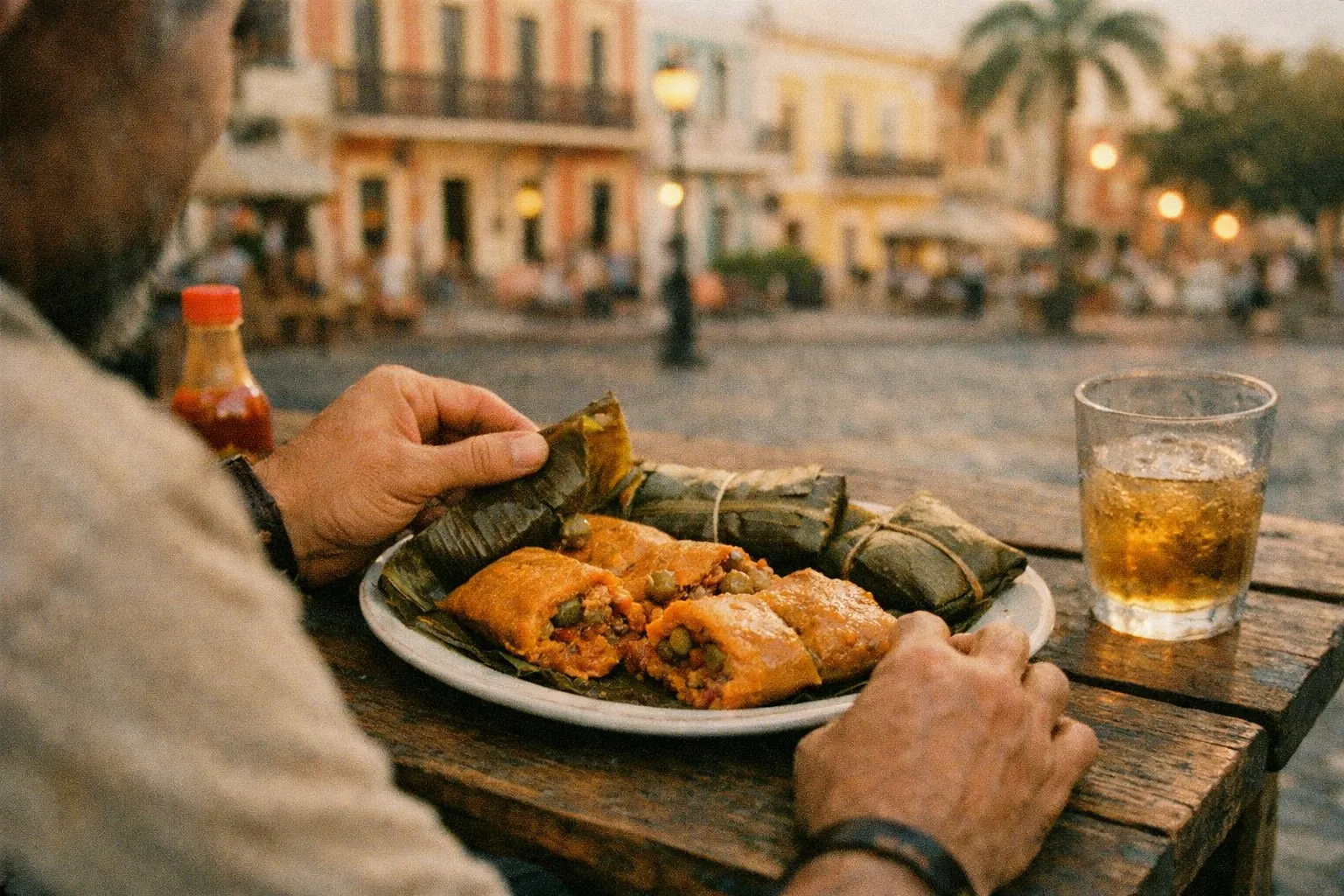
The masa has a subtle sweetness that plays against the savory, olive-flecked filling. Many locals add a dollop of ketchup or a dash of hot sauce - it sounds odd, but it cuts the richness in a way that works. The dish itself is edible history: a blend of African, Spanish, and Taíno influences that traces the island’s culinary story in a single bite.
If you can’t make it to Puerto Rico, wrapped uncooked pasteles freeze well for 3 to 6 months (6)(9). Most families prep in November and eat through the winter, dedicating a full freezer drawer to 50-plus units. Boil frozen pasteles straight from the freezer - no thawing - for about 60 minutes. A pressure cooker cuts fresh cooking to roughly 30 minutes with about a cup of water (6)(7).
Short on time? Frozen pasteles and pre-made masa now show up in diaspora bakeries and Latin grocery brands across US cities, often around $12-$18 USD per frozen dozen (based on 2023-2025 US market pricing). Small vendors and home cooks around Christmas typically sell them for $1.50-$3.00 USD per unit, with full trays of 25-30 running $40-$75 USD. Not the same as making them yourself, but a real option when December runs out of days.
Notes and substitutions
A few clarifications worth keeping straight before you shop or cook:
- Pasteles vs. pastelillos. These get confused constantly. A pastel is the boiled, leaf-wrapped root-vegetable parcel described here. A pastelillo (also called an empanadilla) is a completely different thing - a fried wheat-flour turnover, usually tinted orange with sazón and stuffed with ground beef or cheese (3)(8). If a recipe tells you to fry it, you’re making pastelillos, not pasteles.
- Yuca vs. yautía. Both work in the masa, but they behave differently. Yuca (cassava) yields a smoother, starchier batter and shows up in the pasteles de yuca variation (8)(10); yautía (taro) gives the traditional masa its earthiness. Many cooks use both.
- Banana leaf vs. parchment. Banana leaf adds flavor and is traditional; parchment alone works if you can’t source leaves, though you’ll lose that grassy note. A common compromise for beginners is a small piece of banana leaf inside the parchment - flavor without the full sourcing hassle (6).
- Beginner scale. Don’t start with 60. A half batch of 20-24 pasteles teaches you the wrapping technique without a day-long commitment (6).
- Cross-Caribbean cousins. The Dominican pasteles en hoja is a related plantain-and-beef version - similar concept, different seasoning and filling (4).
✓ Pros
- Rich cultural tradition tied to Puerto Rican Christmas celebrations
- Unique blend of root vegetables creates a distinct texture and flavor
- Community-oriented preparation fosters family and social bonding
- Freezable for months, allowing advance preparation
✗ Cons
- Labor-intensive and time-consuming to prepare
- Requires sourcing specific ingredients like banana leaves and yautía
- Wrapping technique has a steep learning curve for beginners
Frequently Asked Questions
- Can I substitute banana leaves if I can't find them?
- Parchment paper alone works but loses the subtle grassy flavor banana leaves impart.
- How long can I store frozen pasteles safely?
- Frozen pasteles keep well for 3 to 6 months when properly wrapped and stored.
- Is it possible to make pasteles without pork?
- Yes, chicken and vegetarian fillings using chickpeas or lentils are common alternatives.
- What's the best way to avoid masa cracking or falling apart?
- Drain excess liquid from the masa and test-cook one pastel before wrapping the full batch.
- Are pastelillos the same as pasteles?
- No, pastelillos are fried turnovers made with wheat flour, not boiled root-vegetable parcels.
- Can I make a smaller batch to practice?
- Yes, a half batch of 20-24 pasteles is recommended for beginners to learn wrapping without burnout.