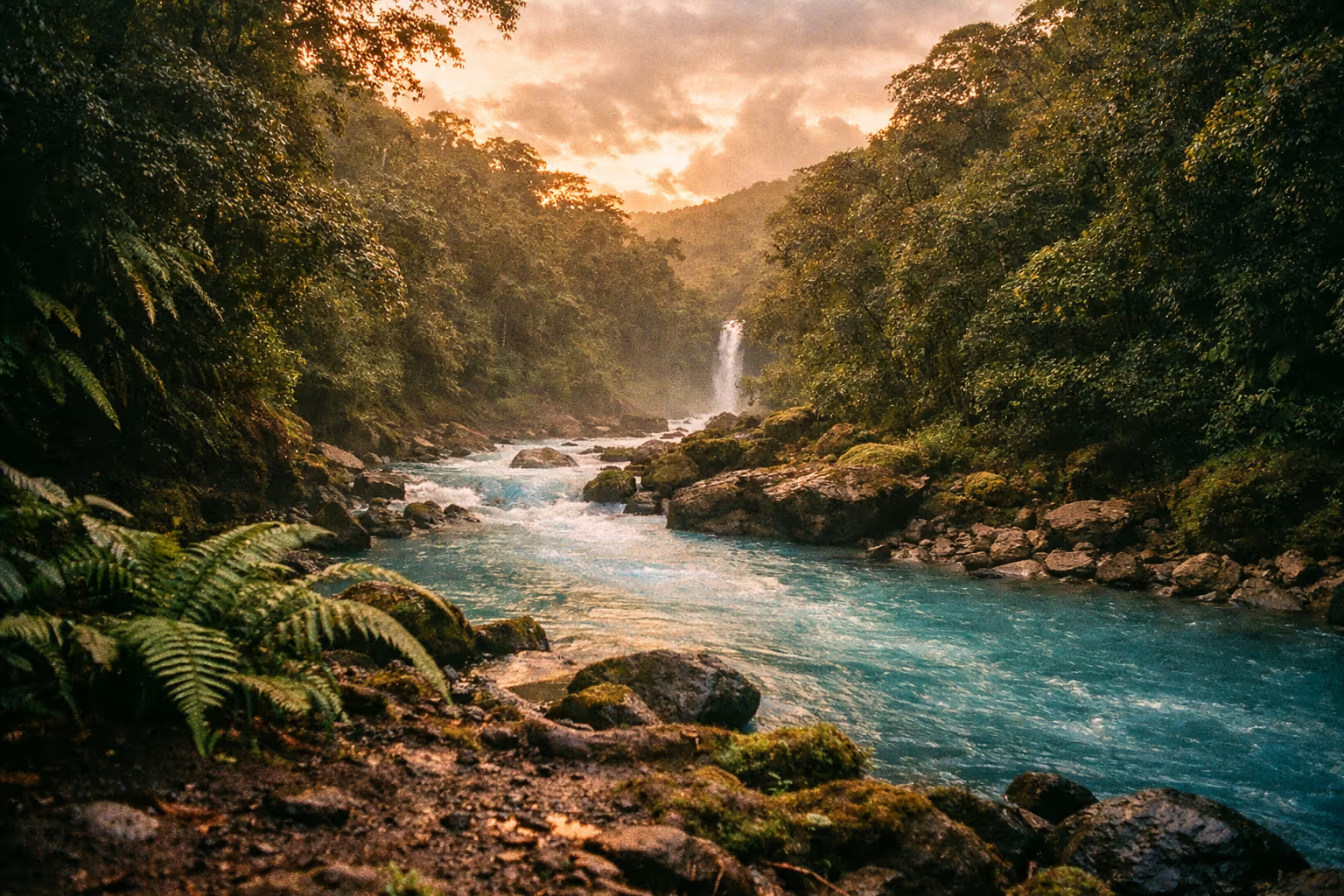
Rio Celeste Costa Rica delivers a genuinely strange payoff: a spot called the tenideros, where two clear rivers meet and the water visibly turns turquoise mid-current. Buy the $12 SINAC ticket online with your passport well ahead, since it sells out, and pick two or three rain-free days, because storms mute the blue. The trail is 7 kilometers with 253 steep stairs, so rent rubber boots at the gate in the wet season. One rule catches people out: swimming is banned everywhere inside Tenorio, waterfall pool included.
Is Rio Celeste Costa Rica Worth Visiting?
Short answer: yes, if you want a rainforest hike with a genuinely unusual payoff. Rio Celeste Costa Rica offers a unique experience with its strikingly blue waters and lush surroundings. Skip it if your idea of a waterfall day involves swimming or a 20-minute stroll.
What you actually get is a 7 km out-and-back trail through premontane rainforest, a 30 m waterfall (8), a lagoon (Laguna Azul), bubbling hot spots called borbollones, and the teñideros - the confluence where the Buenavista River meets Sour Creek and the water visibly turns blue mid-current. That last spot is, for most visitors, the actual highlight. The waterfall is the postcard; the teñideros is the moment you stand there trying to figure out how it’s real (2)(3).
It earns 4.5+ on most review platforms (9), and Tenorio is one of Costa Rica’s five most visited parks for a reason (4). But it’s not a casual outing. If you want a swim-friendly waterfall, La Fortuna Waterfall or Llanos de Cortés are better fits - swimming is banned everywhere inside Tenorio (3)(4)(8).
Worth the detour if: you’re already in La Fortuna or Guanacaste, you can handle 253 stairs and mud, and you can commit to an early start.
Skip if short on time: you’ve got one day and you’re choosing between this and Arenal - Arenal wins on logistics.
Tickets, Cost, and Entry Rules for Rio Celeste
The park now requires Rio Celeste tickets purchased online in advance through SINAC’s reservation system. You’ll enter your passport number at booking and present the same passport at the gate (3).
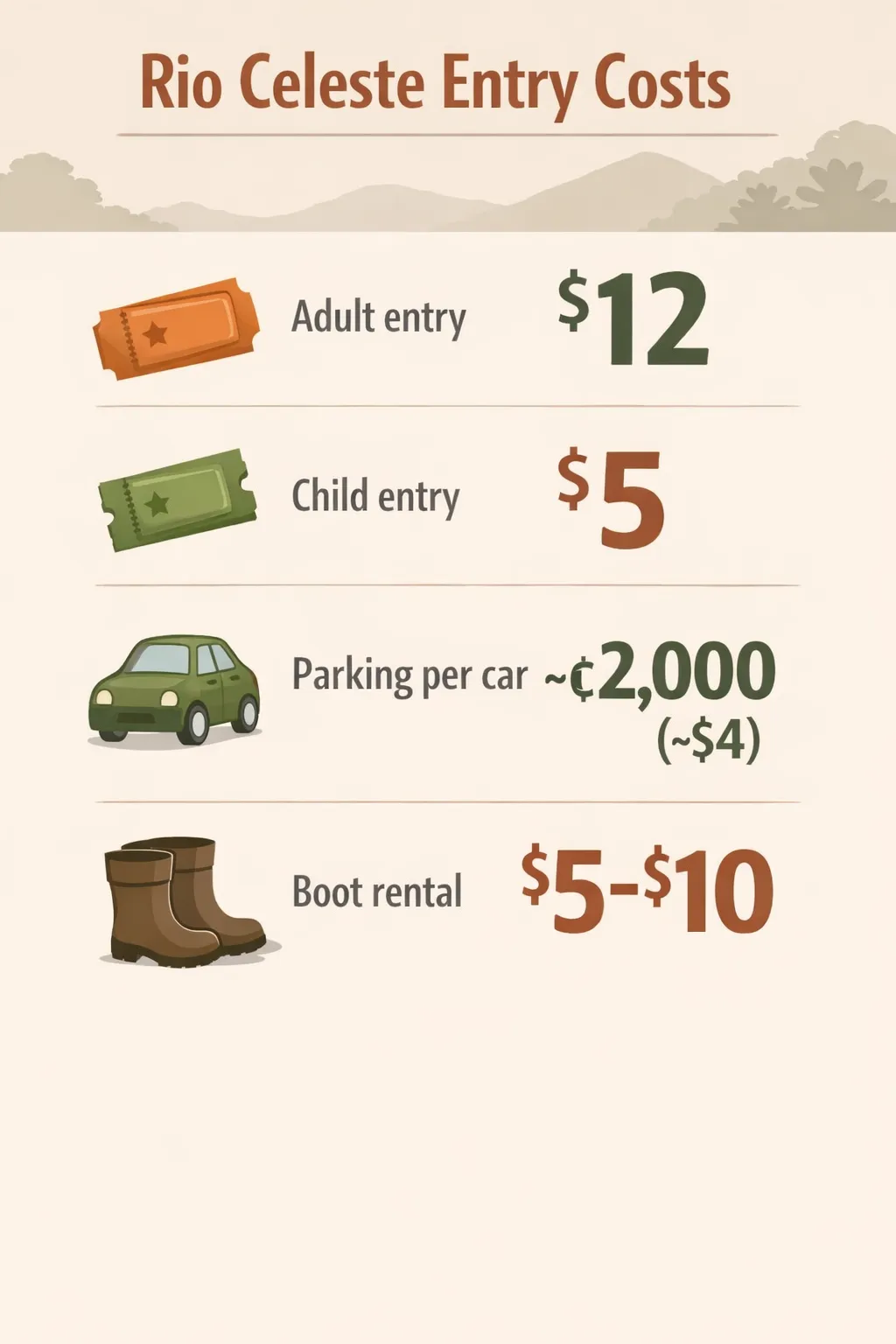 Rio Celeste park entry costs and parking details: adult $12, child $5, parking ~₡2,000 per car, boot rental $5-$10.
Current costs (per person, one-way day visit):
- Park entry, non-resident adult: $12
- Park entry, non-resident child (2-12): $5
- Costa Rican residents/citizens: ₡800 adults, ₡500 children (about $1.50-$2.00)
- Parking near the entrance: ~₡2,000 (~$4) per car
- Optional rubber boot rental near the gate: $5-$10 in wet season
Full day-trip budget estimates (per person, USD):
- Budget DIY (bus + hostel base in Bijagua): $40-$60 for the day - entry, local meals, bus/taxi
- Mid-range DIY (rental car, mid-tier lodge): $80-$130 for the day - entry, car share, fuel, casado lunch ($8-$12)
- Guided tour from La Fortuna or Guanacaste: $120-$200 including transport, bilingual guide, lunch, and usually a sloth stop (5)(9)
Park hours and the rule everyone misses:
Show up at 14:30 expecting to wing it and you’ll be turned away. In high season (Dec-Apr, Easter, weekends), mid-morning slots sell out days ahead. Book at least a week out if your dates are fixed.
Best Time to Visit Rio Celeste
The best time to visit Rio Celeste is mid-January through April - the back half of the dry season. Rainfall has tapered, sediment has settled, and the blue is at its most saturated.
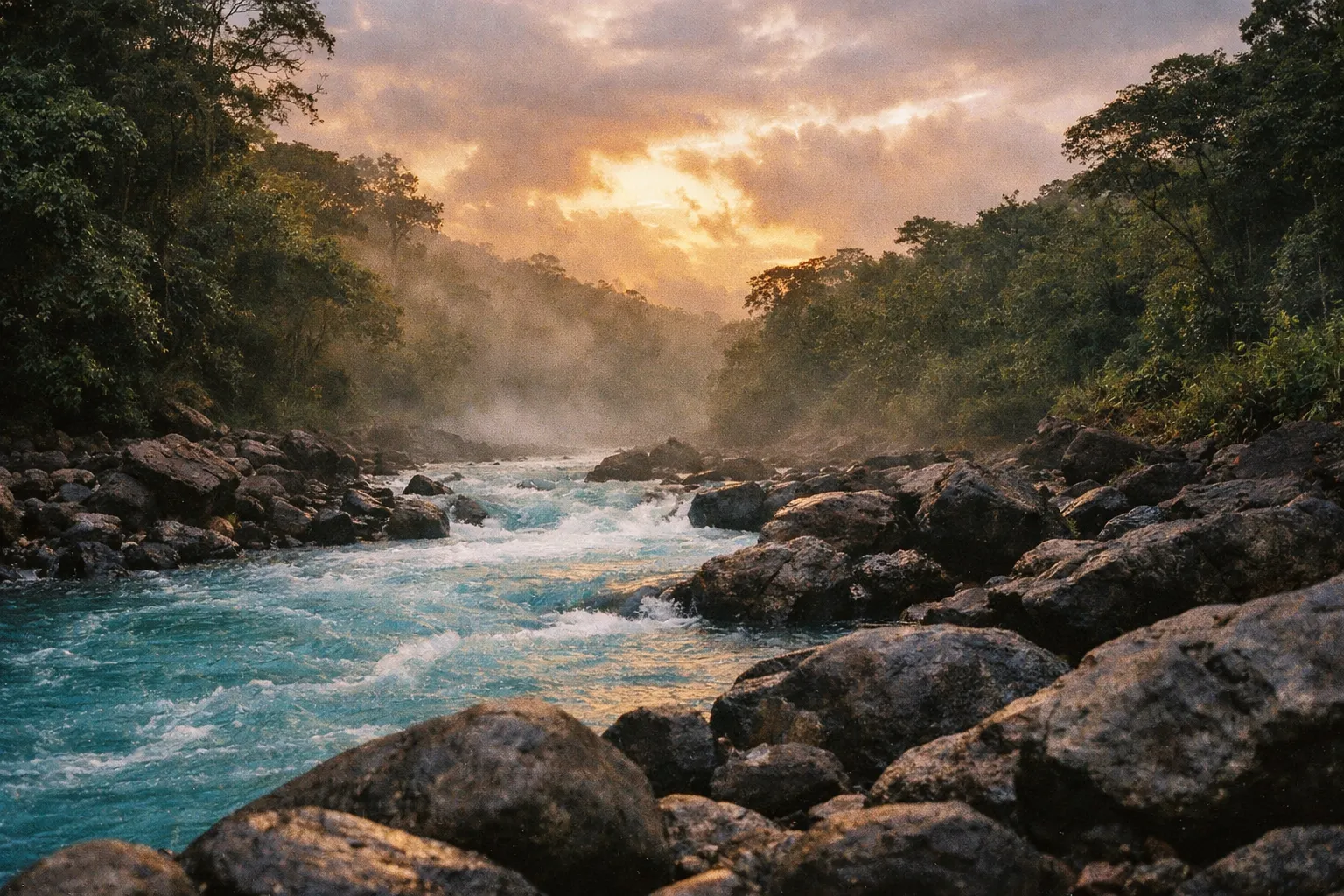
Here’s the nuance most guides skip: “dry season is better” is technically true, but the actual variable is how many rain-free days have passed. After a heavy storm, the river can run brown or dull for 2-3 days regardless of the calendar month. Conversely, if you hit a dry stretch in late November, the color can be perfect.
Month-by-month read:
- December-April (dry): highest probability of vivid color, biggest crowds, most reliable trail conditions. Best window overall.
- May-July (early wet): afternoon showers, fewer crowds, color is hit-or-miss. Mornings often still good.
- August-November (heavy wet): river frequently brownish, trails extremely muddy, occasional closures after storms (1). Lowest prices on lodging, lowest tourist density.
Rainy-season strategy: stay 2 nights in Bijagua instead of day-tripping. That gives you a second shot if day one’s water is muddy. Lodges in town usually have current intel on river conditions - ask before you commit to a hike day.
Daytime temps hover 26-28°C (low-to-mid 80s°F) year-round with high humidity (4). Mornings at the trailhead can feel cool; afternoons are sticky.
Time of day: target an 8:00 entry. Cooler air, softer light at the waterfall, fewer people on the stairs, and you’ll be back at your car before the afternoon rain rolls in.
Difficulty of the Waterfall Trail at Rio Celeste
Rated moderate. Not a stroll, not an expedition. Most reasonably fit adults handle it fine; people in flip-flops or with knee issues regret showing up unprepared.
The Rio Celeste waterfall trail breakdown:
- Entrance to waterfall junction: ~1.8 km / 1.1 mi each way, mostly flat-to-rolling on a wide dirt trail
- Waterfall stairs: ~253 steep steps down (and the same 253 back up) to the viewpoint deck (4)
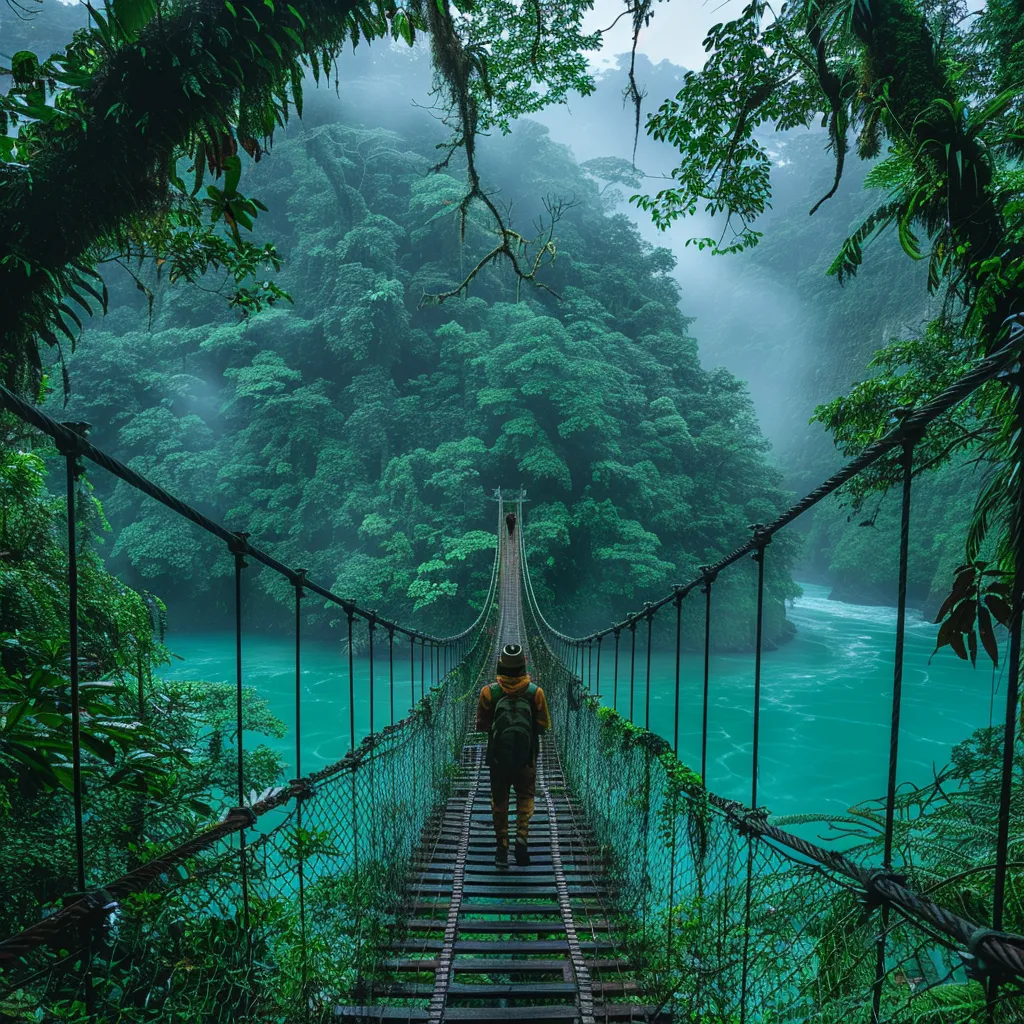
- Junction to teñideros (color-change point): another ~1.7 km past the waterfall, passing Laguna Azul, the borbollones hot spots, and hanging bridges
- Full out-and-back: ~7 km / 4.3 mi, allow 3-4 hours at a relaxed pace including stops
- Waterfall-only version: ~3.6 km round trip, 1.5-2 hours
The honest difficulty assessment:
The stairs are the hardest part. They’re steep, often wet, and the climb back up is where unfit visitors hit a wall. The trail beyond the waterfall is where mud gets serious - in wet season it’s ankle-deep in spots, which is exactly why locals rent boots at the gate. Elevation gain is modest, but humidity makes everything feel harder than the numbers suggest.
No drinking water or food on the trail. Pack 1.5-2 L per person.
Who should skip the full loop:
- Anyone with knee problems should consider stopping at the waterfall viewpoint and turning around - the 253 stairs are non-negotiable to see it, but you can skip the second half.
- Small kids under 6 will struggle with the full distance; the waterfall-only option works.
- Visitors with mobility limitations: there’s no accessible route to the waterfall. The first kilometer is manageable, but the stairs end the trip.
I hiked it in late October a couple of years back - the trail past the bridges was a continuous mud slick, and I watched at least four people in sneakers slide on the way down. Rented boots at a soda near the gate the next morning and it changed the entire day.
What to Wear Rio Celeste for Comfort and Safety
The single biggest comfort upgrade is footwear. Everything else is secondary.
What to wear Rio Celeste - by season:
Dry season (December-April):
- Closed-toe hiking shoes or trail runners with grippy soles
- Lightweight quick-dry shorts or hiking pants
- Moisture-wicking T-shirt
- Light rain shell (afternoon showers happen even in “dry” months)
- Hat, sunglasses
- Insect repellent (use sparingly, never near the river edge)
Wet season (May-November):
- Rent rubber boots at the gate for $5-$10. This is the move. Your hiking shoes will not survive.
- Quick-dry long pants (mud splatter, mosquito coverage)
- Synthetic T-shirt plus a spare in your pack
- Real rain jacket, not a plastic poncho - you’ll be in it for hours
- Microfibre towel and dry socks for the drive back
In your daypack regardless of season:
- 1.5-2 L water per person
- Snacks (no food sold on the trail)
- Dry bag or zip-top for your phone/camera
- Reef-safe sunscreen (you won’t swim, but the exposed stretches near the entrance get sun)
- Passport or a clear photo of it for ticket validation at the gate (4)
- Small first-aid basics - blister tape especially
What not to wear: jeans (they soak through and stay wet for hours), flip-flops, white anything, cotton shirts, any shoe you’d be sad to ruin.
Spotting Wildlife and Sloths Near Rio Celeste
Maybe. Not on the main waterfall trail, usually.
The Rio Celeste hike Tenorio Volcano National Park trail runs through dense forest with a closed canopy. Sloths exist in the area but are hard to spot when you’re moving fast and the leaves are thick overhead. What you’ll more reliably see on the trail itself:
- Howler monkeys (heard more than seen)
- Capuchin monkeys near the entrance and parking
- Toucans, especially keel-billed
- Red-eyed tree frogs and poison dart frogs in wetter spots
- Lizards, including basilisks near the river
Where sloths actually show up: the road approaches near Bijagua, lodge grounds, and dedicated sloth-spotting sites along Route 6. Several combo tours from La Fortuna and Guanacaste now bundle Rio Celeste with a dedicated sloth encounter stop at a private reserve - this is the reliable way to see one and costs $150-$200 per person total (5)(9).
If sloths are a priority, don’t expect the park trail to deliver. Book a combo tour, or stay at a lodge in Bijagua and ask staff where they’ve been spotting them - most properties know which trees are currently active. For more ideas on family fun with wildlife in the region, there are excellent options worth exploring alongside a Rio Celeste visit.
How to Get to Rio Celeste from La Fortuna and Liberia
How to Get to Rio Celeste
About 2.5 hoursStep-by-step directions from Liberia Airport and La Fortuna
- 1
From Liberia Airport (LIR)
Drive about 70-80 km east on Route 1, then north on Route 6 toward Upala. Take the signed turnoff for Bijagua and the park. The road is paved but narrow near the park. Drive time is approximately 90 minutes.
- 2
From La Fortuna / Arenal
Drive about 60-80 km via Route 142 and Route 4, then turn toward Tenorio. The road is mostly paved but can flood in heavy rain. Drive time ranges from 1.5 to 2.5 hours depending on conditions.
- 3
Vehicle Recommendations
A regular sedan is fine in dry season. For May-November wet season, a high-clearance SUV is recommended to handle potholes and mud puddles. 4WD is rarely needed but adds margin.
- 4
Without a Car
Take public bus to Bijagua from San José or via La Fortuna with a transfer, then taxi (~$15-$25 each way) from Bijagua to the park entrance. Shared shuttles from La Fortuna cost about $60-$80 round trip. Guided day tours from La Fortuna or Guanacaste resorts run $120-$200.
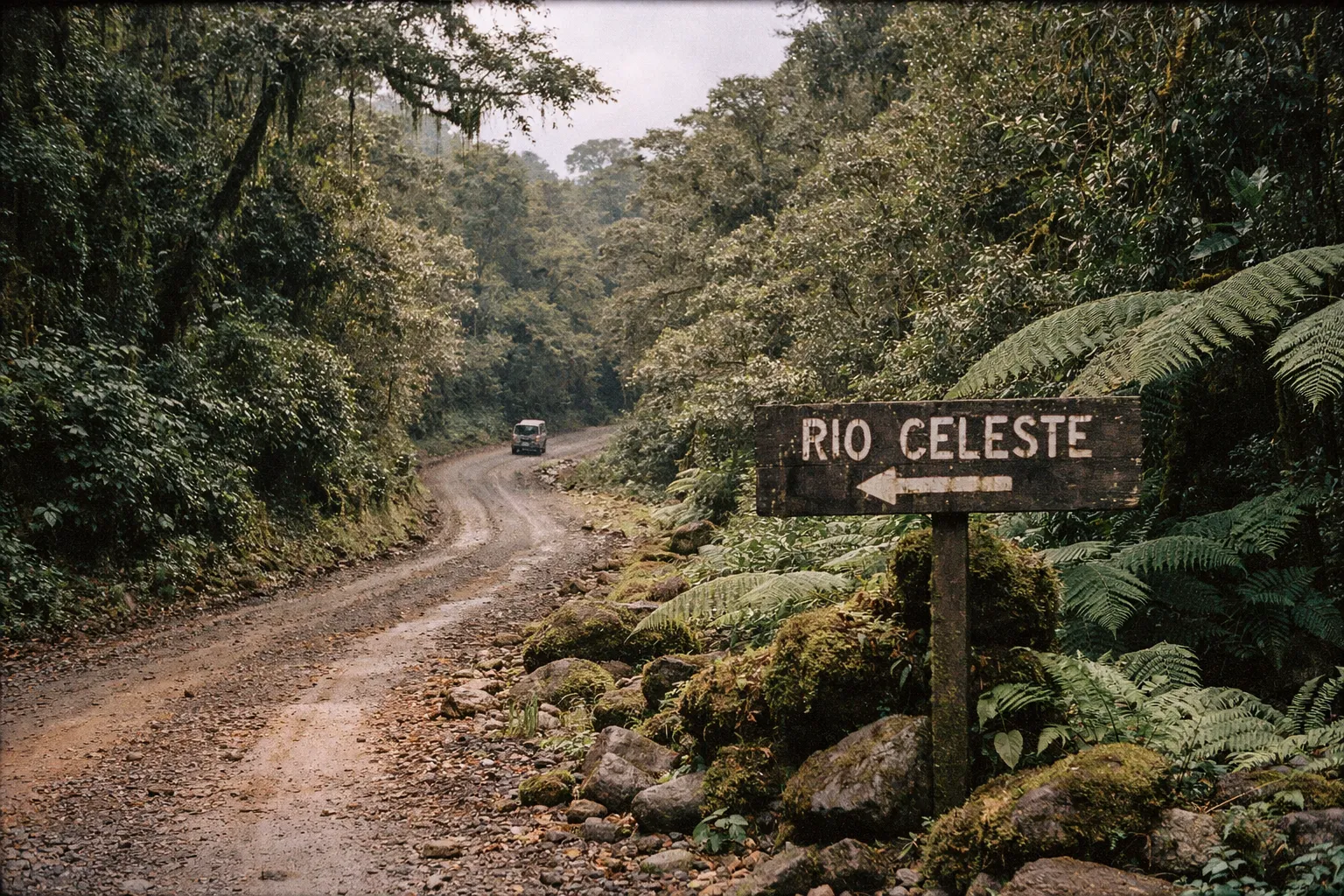
Closest base town: Bijagua de Upala. Rural, quiet, and about 22 km from Route 6. Accommodation runs from $15-$30 hostels to $70-$150 mid-range eco-lodges. The luxury option is Hideaway Rio Celeste, a boutique property on an 80-acre private reserve directly on the river, typically $250-$400+ per night in high season (7).
Inside the Park: What You’ll Actually See
The trail isn’t just the waterfall. In order, from the entrance:
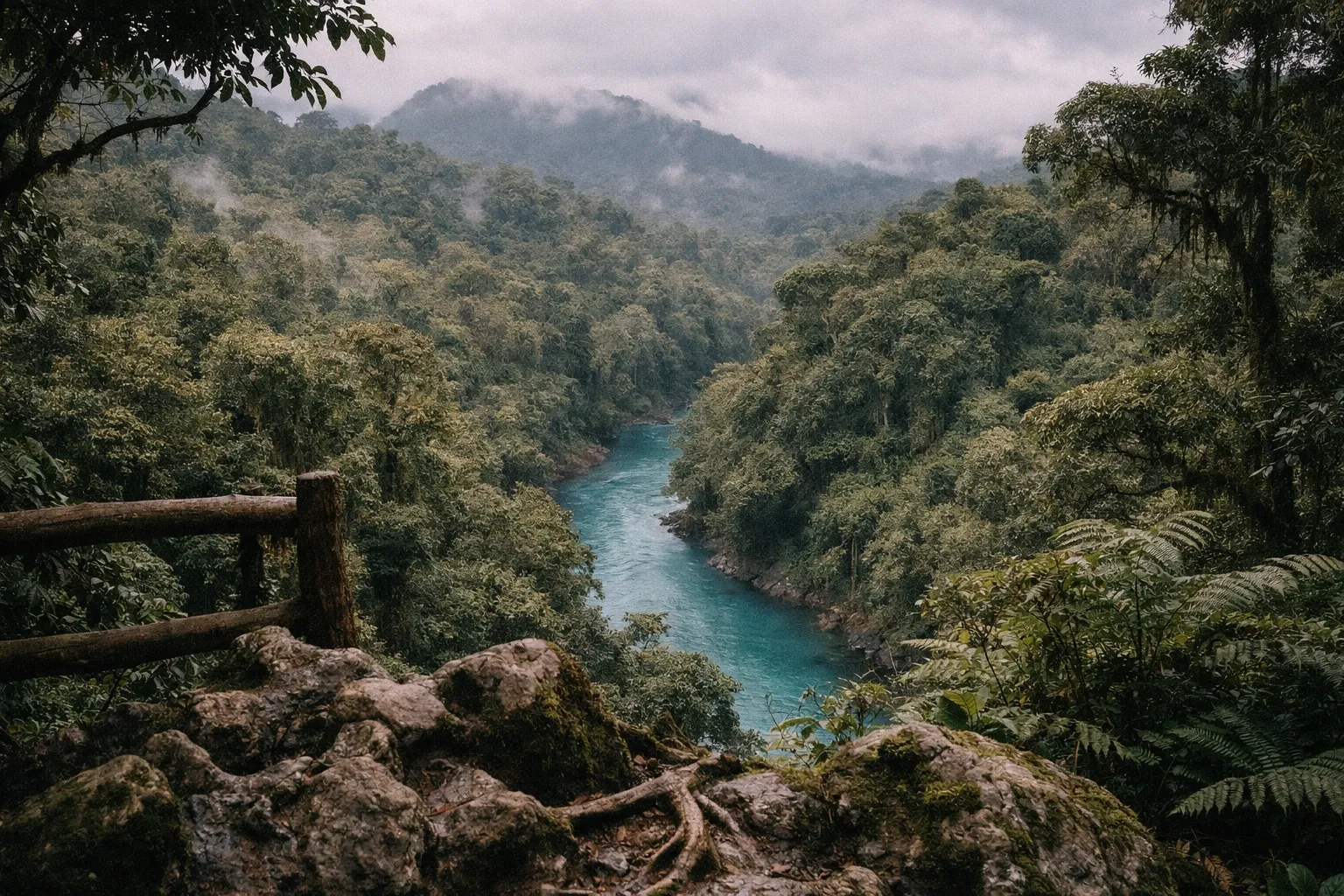
- Ranger station and trailhead - show your ticket, pick up a basic map
- The main forest trail (~1.8 km) - wide, rolling, well-maintained
- Waterfall junction and the 253 stairs - the iconic shot
- Laguna Azul - a turquoise pool past the falls, viewing platform only
- Borbollones - bubbling hot spots where geothermal gases vent through the riverbed (no entry, viewing only)
- Hanging bridges over the river
- Teñideros - the confluence where Buenavista River and Sour Creek meet and the water turns blue in real time (2)(3)
The science, briefly: at the confluence, a pH shift causes fine aluminosilicate particles in the water to aggregate to approximately 566 nanometers in diameter. That size scatters blue light through Mie scattering, the same optical phenomenon that gives the sky its color. Recent research from Universidad de Costa Rica and Universidad Nacional confirmed this mechanism, overturning the older “chemical reaction between minerals” explanation that still circulates (2)(3).
Most guides get one thing wrong about Rio Celeste: they describe it as a chemical reaction. It’s not. It’s an optical effect. The water that “turns blue” is colorless if you scoop it into a glass.
Common Mistakes to Avoid at Rio Celeste
- Showing up after 14:00. Last admission is 13:45-14:00 and rangers enforce it (1).
- Expecting blue water after a storm. Two to three rainy days will dull the color. Check with your lodge before you go.
- Wearing the wrong shoes. The stairs and the mud past the waterfall destroy unsuitable footwear.
- Skipping the teñideros. The waterfall is more dramatic, but the confluence is the more memorable visual.
- Assuming you can swim. You can’t - anywhere inside the park (3)(4)(8). If swimming matters, build a hot springs evening into your itinerary at one of the Bijagua lodges.
- Not booking ahead in high season. Tickets sell out for mid-morning slots in dry season, Easter week, and weekends.
- Skipping lunch planning. No food sold on the trail. Sodas near the gate serve $8-$12 casado plates and $2-$3 fresh juices - budget 45-60 minutes after the hike.
Where to Stay Near Rio Celeste
Bijagua de Upala is the base. It’s a small agricultural town with growing eco-tourism infrastructure and zero nightlife - which is the point.
Budget ($15-$40/night): Hostels and family-run guesthouses in town. Casa Rural Aroma de Campo and similar properties run breakfast-included rates in this range.
Mid-range ($70-$180/night): Eco-lodges scattered on the road between Bijagua and the park entrance. Heliconias Lodge, Tenorio Lodge, and Celeste Mountain Lodge are the common picks. Most include private trails, breakfast, and onsite sloth-spotting opportunities. If you’re weighing your accommodation options more broadly, Costa Rica all-inclusive resorts can be a convenient base for multi-day itineraries that include day trips to Tenorio.
Luxury ($250-$400+/night): Hideaway Rio Celeste is the only property directly on the river inside its own reserve, with private hiking trails, a spa, and on-site naturalist guides (7).
Day-trippers from La Fortuna or Guanacaste skip lodging in Bijagua entirely - that’s the most common pattern. You won’t lose much by doing it as a day trip if you start early.
Sample Itinerary for a Rio Celeste Day
Duration: 1 full day. Estimated cost: $80-$130 per person DIY, $150-$200 on a guided tour.
- 6:00 - Leave La Fortuna or your Guanacaste base
- 7:30-8:00 - Arrive at park, park the car, eat a quick breakfast at a soda near the gate
- 8:00 - Enter the park (first slot)
- 8:15-10:30 - Hike to waterfall, take photos, continue to Laguna Azul and teñideros
- 10:30-12:00 - Hike back, slower pace, more wildlife spotting
- 12:00-13:00 - Lunch at a soda near the entrance (casado, juice)
- 13:00 - Drive back, optional stop at a sloth sanctuary or Bijagua chocolate/coffee tour
- 16:00-17:00 - Back at base
If you’re staying overnight in Bijagua, swap the late drive for an early dinner and a soak at your lodge’s hot tub.
Frequently Asked Questions
- Can I buy tickets at the park entrance?
- No, tickets must be purchased online in advance through SINAC's system with your passport number. This helps control visitor numbers and avoid overcrowding.
- Are there any accessible trail options for visitors with mobility issues?
- The trail to the waterfall includes 253 steep stairs and is not wheelchair accessible. The first kilometer is manageable for some mobility limitations, but the full loop is not recommended.
- Is it possible to see the blue color year-round?
- The blue color depends on recent rainfall and sediment levels. Even in dry months, heavy storms can dull the color for 2-3 days. Checking local conditions before your hike improves your chances.
- What should I do if I want to see sloths during my visit?
- Sloths are rarely seen on the main trail. Booking a combo tour with a dedicated sloth encounter or staying at a lodge with naturalist guides in Bijagua increases your chances.
- Can I swim anywhere in Tenorio Volcano National Park?
- Swimming is prohibited throughout the park, including the waterfall, Laguna Azul, and river. For swimming options, consider La Fortuna Waterfall or hot springs near Bijagua.