Bali history has one turning point that explains almost everything you will see: when Islam swept Java, the Hindu Majapahit court, priests and artists and all, fled east to Bali and stayed. That is why a single small island remains close to ninety percent Hindu, its temples still working rather than preserved. Some of what feels ancient is not, though; the famous Kecak chant was actually staged in the 1930s. The layers run from million-year-old stone tools to the offerings left on your doorstep each morning.
Bali History: From Volcanic Origins to Living Tradition
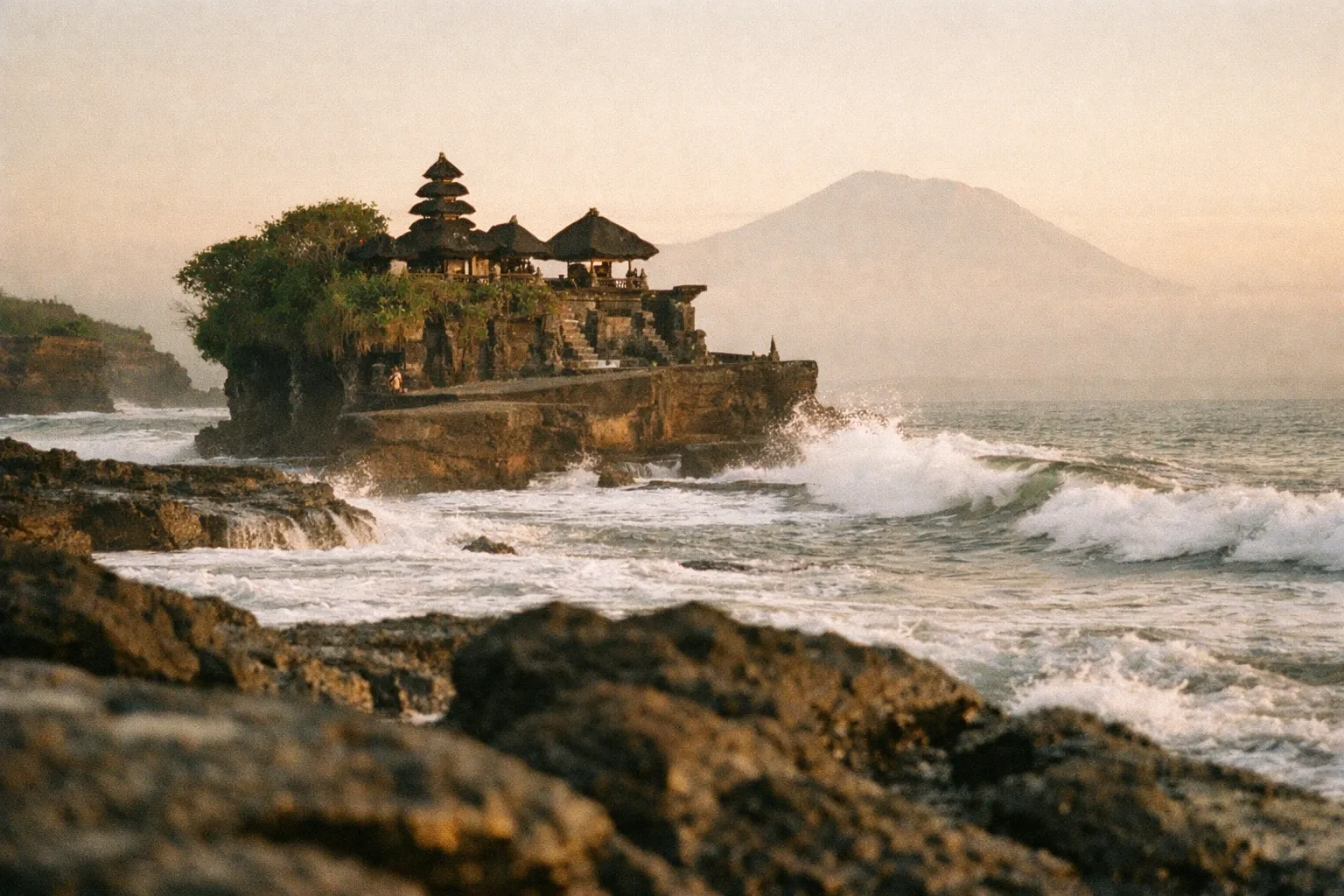
Bali history is deeply intertwined with its unique geological setting, as the island sits at the crossroads of the Indo-Australian and Eurasian tectonic plates. The island’s central mountain range - with Mount Agung at its highest point - is a direct product of that subduction. The whole island is geologically young and restless.
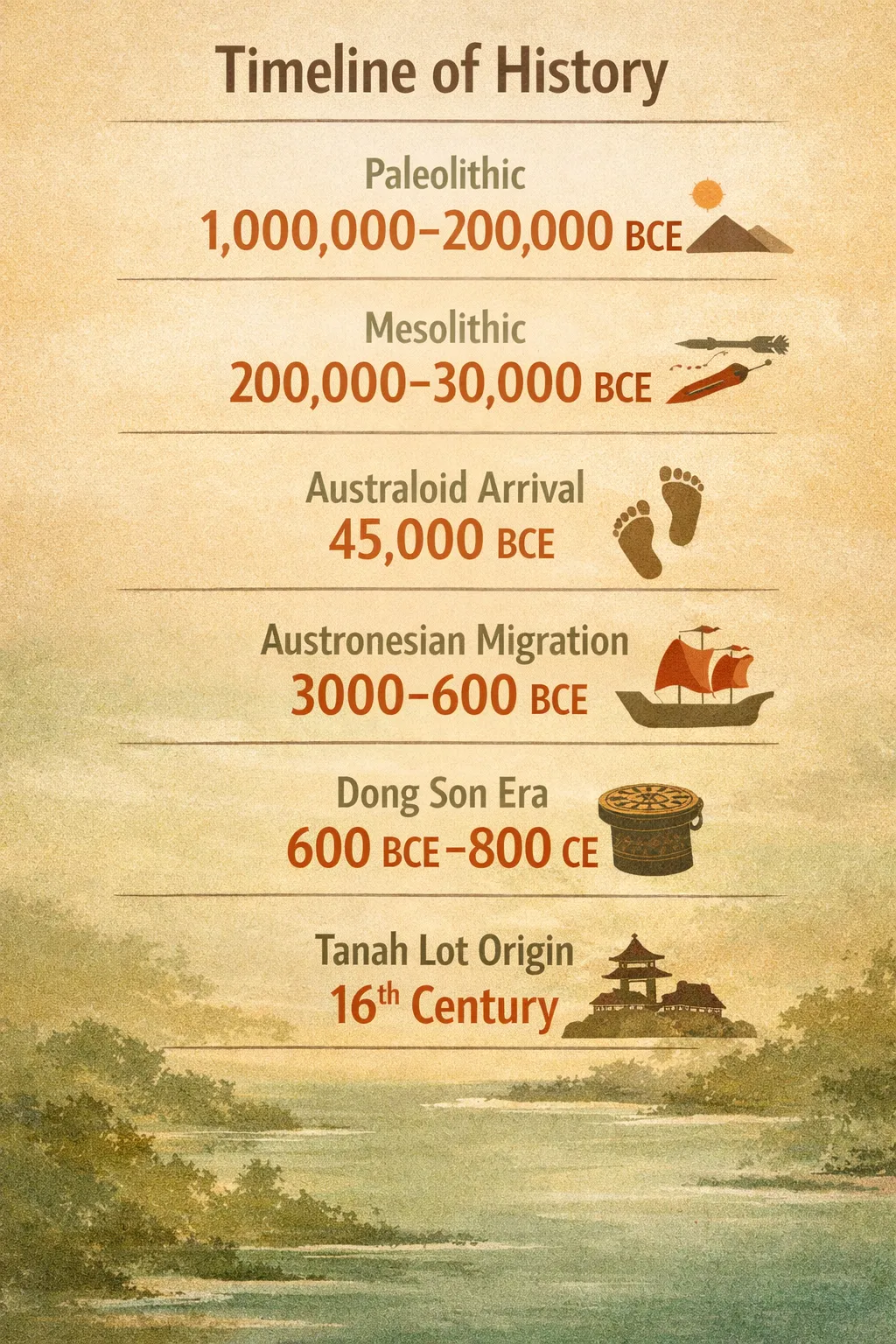 A concise Bali history timeline showing major epochs from 1,000,000-200,000 BCE to 16th-century Tanah Lot origins.
I did a sunrise trek up Mount Batur on my first visit, and standing at the summit watching the sky go orange over the caldera lake, the forces that built this place felt less abstract. The terraced rice paddies flanking the slopes below are a direct response to that volcanic geology - fertile, well-drained soil that fed the island’s earliest settlers and still feeds it today.
Paleolithic and Mesolithic occupation
Humans lived on Bali far earlier than most visitors imagine. Stone hand axes found near the villages of Sembiran and Trunyan point to Paleolithic occupation dating roughly 1,000,000-200,000 BCE (1). These were the tools of Homo erectus, working the land long before any temple stood.
By the Mesolithic - roughly 200,000-30,000 BCE - toolmaking grew more refined, with arrow points and bone implements turning up in cave sites like Selanding and Karang Boma in the Pecatu hills, used as temporary shelters (1)(5). Modern humans of Australoid stock arrived around 45,000 BCE, gradually replacing the earlier population (1).
You can’t tour these caves on a typical day trip, but knowing they exist reframes the Bukit Peninsula. The same Pecatu cliffs where you’ll watch a sunset performance sheltered people tens of thousands of years ago.
Neolithic: Austronesian migrations (3000-600 BCE)
The Bali that began to resemble the island we know took shape with the Austronesian migrations. Between roughly 3000 and 600 BCE, farmers speaking Austronesian languages arrived from South China, moving down through the Philippines and Sulawesi (1)(5). They brought rice cultivation - the agricultural foundation that still defines Bali’s terraced valleys.
Their toolkit included rectangular adzes and red-slipped pottery, and archaeological layers show evidence of pork consumption and betel chewing (1)(3). Socially, these communities practiced mountain worship and buried their elites in oval stone sarcophagi carved with human and animal heads (1)(5).
That mountain reverence never disappeared. When Balinese Hindus today orient their temples toward Mount Agung and treat the highlands as sacred, they’re carrying forward a belief older than Hinduism itself.
Bronze Age: arrival of Dong Son culture (600 BCE-800 CE)
Bali’s Bronze Age, roughly 600 BCE-800 CE, arrived with metallurgical knowledge from the Dong Son culture of Northern Vietnam, spreading south between the 8th and 3rd centuries BCE (1)(3). Local smiths produced cast bronze items decorated with spiral and anthropomorphic motifs, working with copper and tin that had to be imported.
The standout artifact is the Moon of Pejeng, a ceremonial bronze drum from the late Bronze Age (around the first millennium BCE) - the largest single-cast bronze kettle drum in the world (3)(7). You can see it at the Pura Penataran Sasih temple in Pejeng, near Ubud. It’s worth the detour. Standing before something 2,300 years old, still housed in an active temple, collapses the distance between Bali’s prehistory and its living religion in a way that museum displays rarely do.
Indianized kingdoms (800-1343 CE)
From around 800 CE, Bali was drawn into the broader Indic cultural sphere that swept across maritime Southeast Asia. This era seeded Balinese Hinduism and the earliest forms of Balinese temple architecture (1)(3). It also produced subak (the cooperative irrigation system that channels water through the rice terraces) - now recognized by UNESCO and still managed by farmer collectives today.
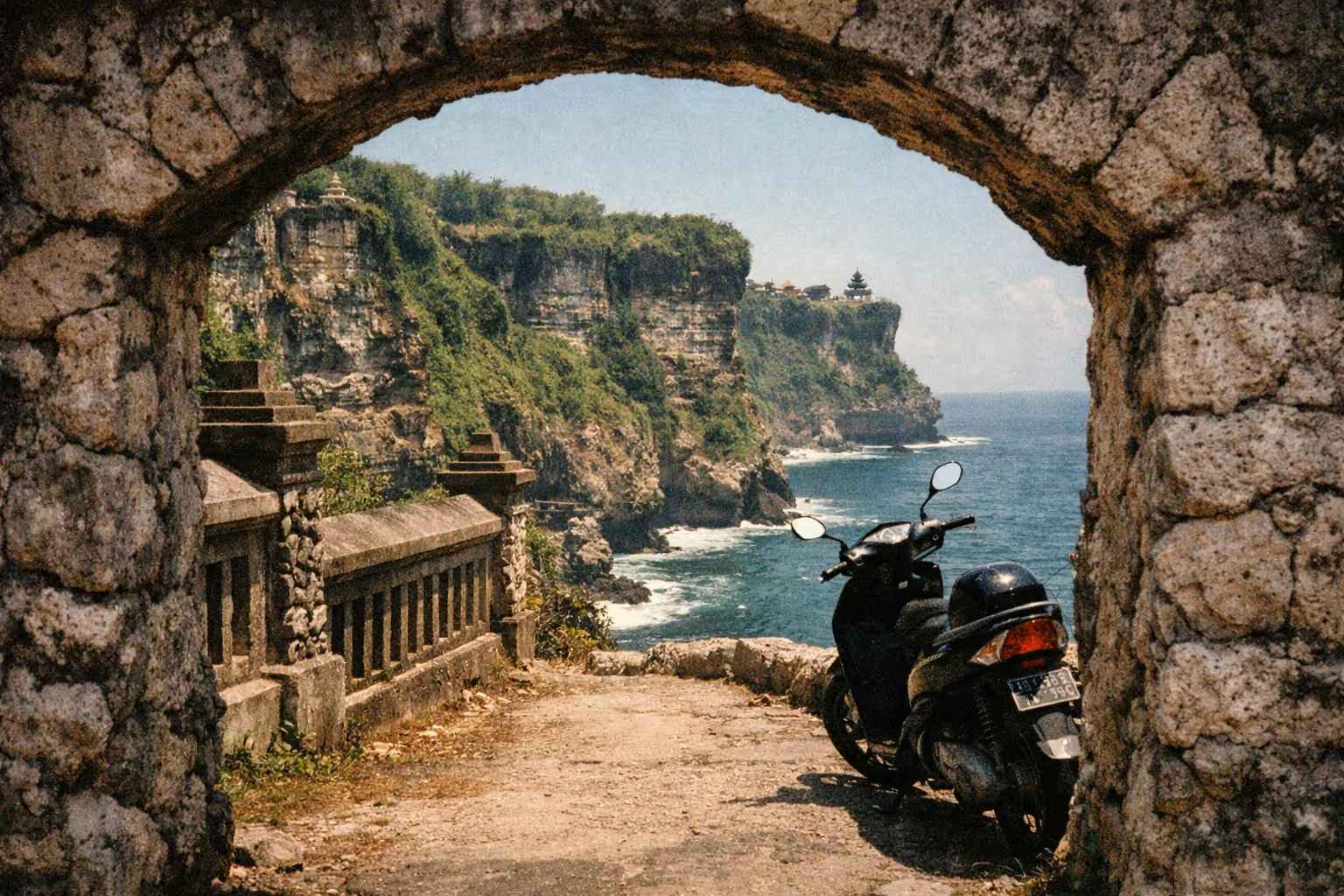
The earliest temples in places like Uluwatu and central Bali likely date to around the 11th century CE (6). When you stand at a clifftop temple watching the surf below, you’re looking at architecture whose roots reach back a thousand years - and whose religious logic was already centuries old when the stones were laid.
Majapahit dynastic rule (1343-1846)
The chapter most often told as the start of “real” Bali history begins in 1343 CE, when the East Javanese Majapahit empire asserted control over the island (1). Majapahit brought court culture - refined arts, literature, the caste system, and elaborate ritual - that fused with existing Balinese traditions to produce the classical age.
I spent a morning at Taman Ayun Temple in Mengwi - about 18 km northwest of Kuta, easy to combine with a Tanah Lot visit - specifically because of this period. The tiered shrines (meru) and water moats there give you a concrete sense of what post-Majapahit architecture looked like when it was meant to impress. Entry is around IDR 20,000 (USD 1.25), and the grounds are quiet enough in the morning that you can actually look at the stonework without navigating crowds.
When Majapahit collapsed in Java in the late 15th and early 16th centuries, its priests, nobles, artists, and scholars fled east to Bali, concentrating Javanese Hindu-Buddhist culture on the island just as Islam spread across the rest of the archipelago. This is why Bali became - and remains - a Hindu island in a majority-Muslim nation. Shadow puppetry, court dance, and classical literature crystallized under this influence (1)(7).
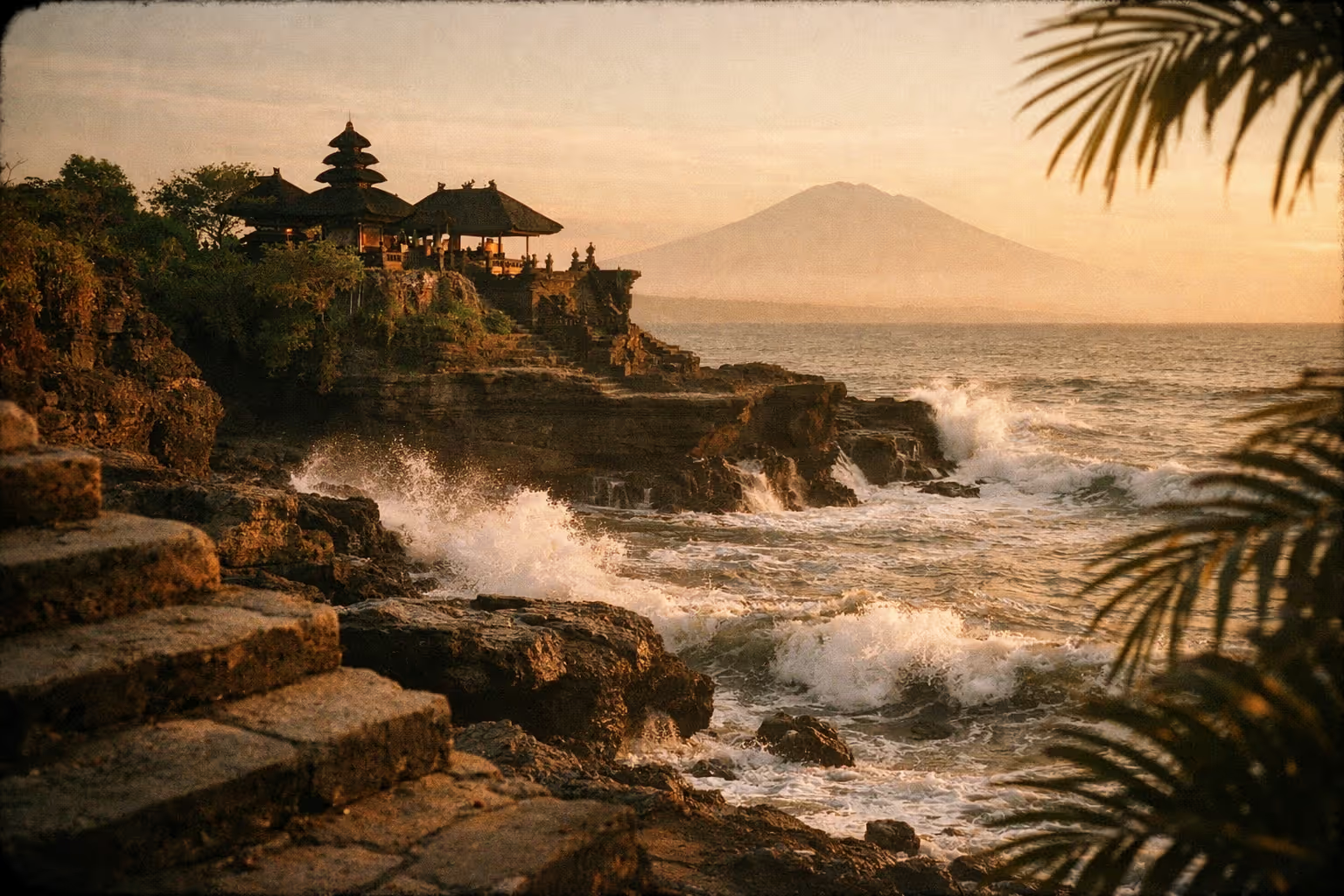
It’s also the era that produced Tanah Lot temple, whose origins are tied to the 16th-century itinerant Brahmin priest Dang Hyang Nirartha. Built on a tidal rock formation off the southwest coast, Tanah Lot is one of the Sad Kahyangan, the six principal sea temples said to guard the island. At low tide you can walk out to its base; at high tide it sits marooned and dramatic, which is exactly when most visitors photograph it at sunset.
Modern historical period (1846-present)
Dutch colonial conquest began in the mid-19th century, and Bali was gradually absorbed into the Dutch East Indies (1). The resistance was fierce. Puputan Square in central Denpasar - where the Balinese royals made their last stand in 1906 in a ritual fight-to-the-death rather than surrender - is calm now, just a public square with a monument and a few food carts on the perimeter. But if you know what happened there, it doesn’t feel calm. The Bali Museum on the eastern edge of the square fills in the colonial-era story with artifacts and photographs; entry runs around IDR 50,000 (USD 3).
Japanese occupation followed during World War II (1942-1945), and Indonesian independence came in 1945 (5). The independence period brought its own upheaval - the 1965 anti-communist purges hit Bali hard, killing an estimated 80,000 people, a chapter that rarely surfaces in heritage tourism but shaped the island’s modern social fabric. Tourism arrived slowly in the early 20th century, then accelerated sharply from the 1970s onward, when the government designated Nusa Dua in the south as a planned resort zone to concentrate development away from cultural centers. Bali now receives millions of visitors a year, with culture-based tours - temples, dance, rituals - among the most popular, typically priced USD 30-80 per person including transport (6).
The recent expansion of Ngurah Rai International Airport and improved road infrastructure around the Ngurah Rai bypass and the Bali Mandara toll road are the most visible signs of Bali’s adaptation to that growth - alongside the ongoing question of how much change the island can absorb before something essential shifts.
✓ Pros
- Deep historical layers visible in temples, rituals, and daily life
- Rich cultural fusion from Austronesian to Majapahit influences
- Living traditions like subak irrigation and Hindu festivals still active
- Accessible heritage sites spanning prehistoric to modern eras
✗ Cons
- Rapid tourism growth risks diluting cultural authenticity
- Some historical sites are difficult to access (e.g., ancient caves)
- Traffic congestion in popular areas reduces travel ease
- Strict customs and dress codes can confuse first-time visitors
How Hinduism Took Root and Transformed in Bali
The history of Hinduism in Bali is really a story of layering rather than replacement. The animist mountain worship of the Neolithic, the bronze ritual culture of the Dong Son period, the Indianized temple traditions of the 9th-13th centuries, and the Majapahit court religion of the 14th-16th centuries all fused into what’s now called Balinese Hinduism - distinct from Indian Hinduism in its emphasis on maintaining balance between the human world, the divine, and the spirits (4).
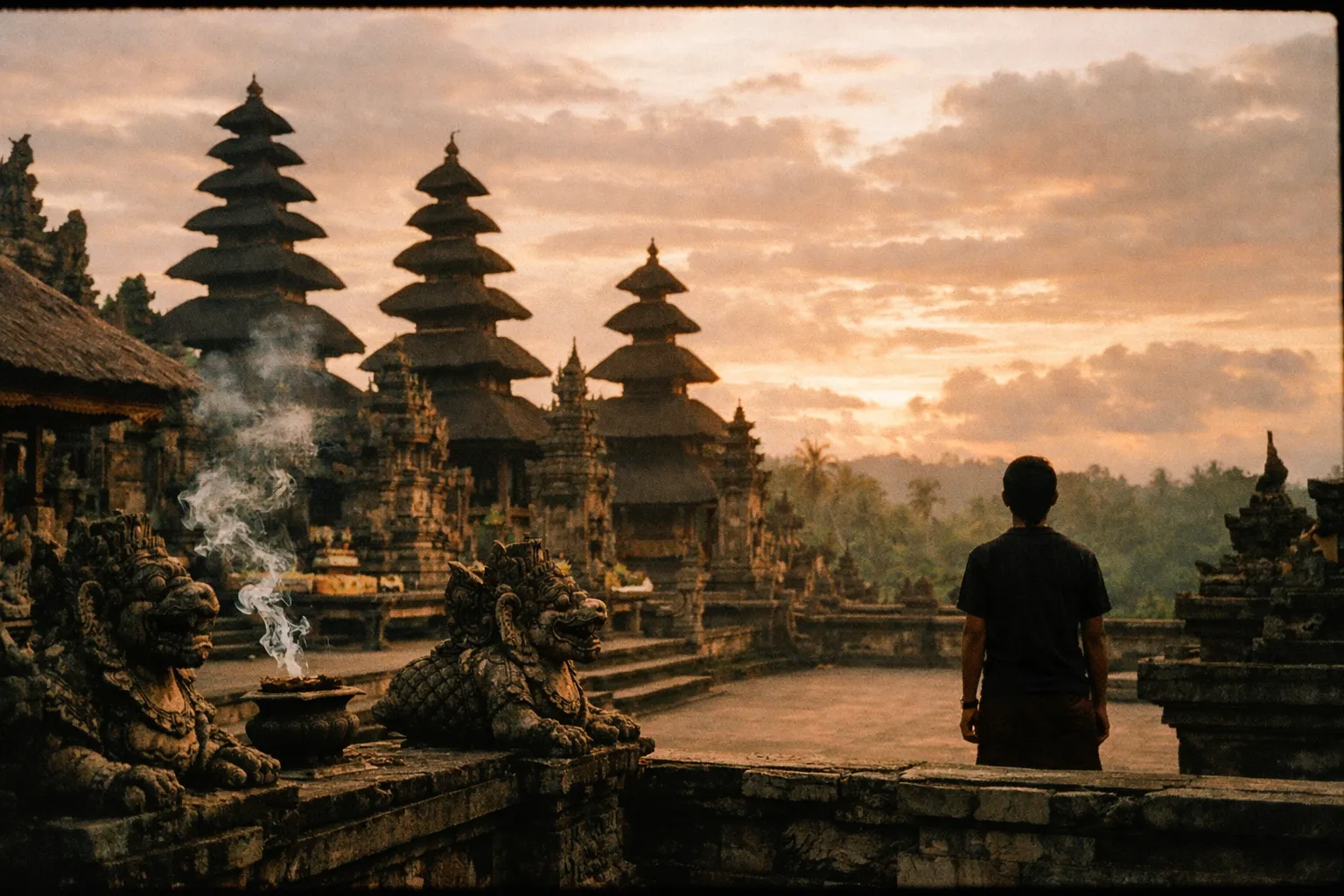
Today, roughly 87% of Bali’s 4.3 million residents are Balinese Hindu. You see the religion most clearly not in temples but on the ground, literally. Canang sari - small woven palm-leaf trays holding flowers, rice, and incense - are laid out daily at doorways, shops, and street corners. A set costs locals about USD 0.10-0.50 depending on materials. Watch your step on sidewalks. Those offerings are placed deliberately, and walking over them carelessly reads as disrespect.
The Nyepi festival, Bali’s day of silence, is the most striking expression of this spirituality. For 24 hours the island shuts down - no traffic, no flights, no lights, no work - in a collective act of introspection that genuinely has no equivalent anywhere else I’ve traveled.
The Kecak Dance: Origins, Ritual Roots, and What You’re Actually Watching
The Kecak dance Bali history surprises people who assume it’s an ancient temple rite. It isn’t, at least not in its current form. Kecak grew out of the Sanghyang (a trance ritual traditionally performed to protect a village’s health and ward off illness) (4). In the 1930s, the chanting chorus of the Sanghyang was paired with scenes from the Ramayana epic to create the theatrical “monkey chant” performed for audiences today (2)(4). The choreography was developed in collaboration with German artist Walter Spies, who was living in Ubud at the time - a detail that complicates the “purely Balinese” framing you’ll sometimes hear from guides.
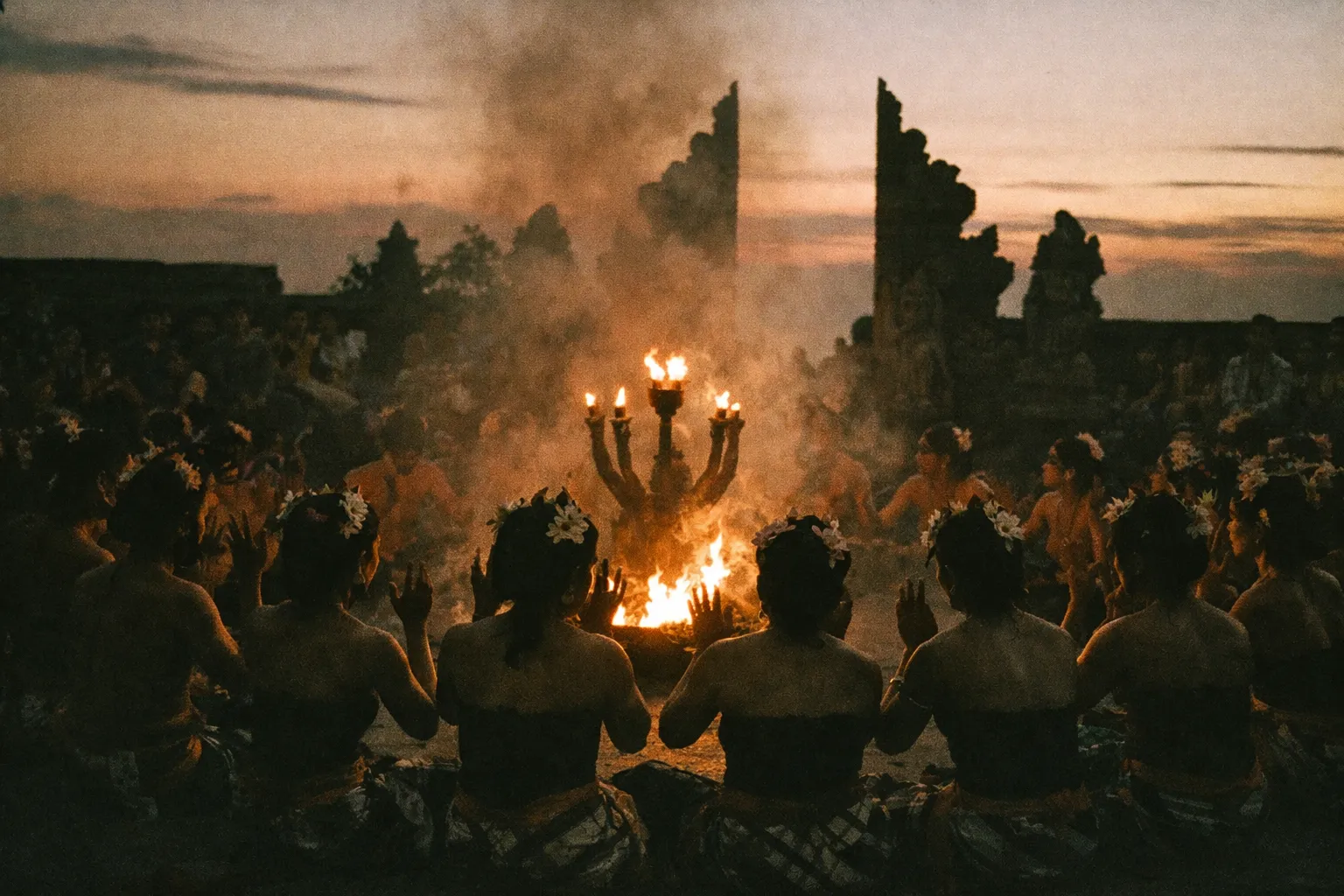
There’s no orchestra. Instead, 50 to 100 men sit in concentric circles chanting “cak-cak-cak” in interlocking rhythm while dancers act out Rama’s rescue of Sita, often ending with a fire scene. Shows run 45-60 minutes and are timed for sunset (6). The Uluwatu version is staged in the outer courtyard of Pura Luhur Uluwatu, perched on a cliff above the Indian Ocean - the setting does a lot of the work.
The best place to see it is Uluwatu, specifically the open-air stage on the western terrace of Pura Luhur Uluwatu in the Bukit Peninsula, where the clifftop temple and ocean backdrop give the performance real context. If you’re staying in Seminyak or Canggu, the drive south takes about 45 minutes without traffic - budget more in the late afternoon. Tickets for the show alone typically run IDR 130,000-320,000 (USD 8-20); bundled sunset packages with transport and a guide from south Bali average IDR 480,000-960,000 (USD 30-60) (6). For driver-guide hire, expect to pay around IDR 640,000-960,000 (USD 40-60 per day).
One etiquette note: treat it as the descendant of a sacred ritual, not a tourist spectacle. Phones down, voices off during the performance. This is the one I see people get wrong most often.
Bali traditions, religion and culture
Beyond the headline performances, Bali traditions run through daily life in ways visitors brush against constantly. Bali religion and culture are inseparable - nearly every craft, dance, and ceremony traces back to Hindu cosmology or the older animist beliefs beneath it.
The island’s craft villages specialize by trade: Celuk for silverwork, Mas for wood carving, Ubud - particularly the streets around Jalan Hanoman and Jalan Dewi Sita - for painting and contemporary galleries. I wandered into a silversmith’s workshop on the main strip in Celuk, about 6 km south of Ubud, and watched techniques passed down through generations - skills that crystallized under the Majapahit-era flourishing of court arts and haven’t changed much since. The workshop owners are used to visitors; just ask before photographing the craftspeople at work. In Mas, the wood-carving studios along Jalan Raya Mas range from tourist-facing souvenir shops to serious ateliers producing ceremonial masks still used in temple rituals.
A few notes on Bali culture and customs that matter at temples and ceremonies:
- Dress code: Temples require a sarong and sash; shoulders should be covered. If you arrive without one, sites usually rent them for around IDR 15,000-50,000 (USD 1-3).
- Photography: Fine in most temple courtyards, but never photograph people praying without asking, and stay out of inner sanctums where signs indicate.
- Offerings: Don’t step on or over canang sari on the ground.
- Ceremonies: If a procession crosses your path, wait - don’t cut through it. Menstruating women are traditionally asked not to enter temples; this is locally observed, not optional in many places.
To connect history to today, build a loose “time-travel” itinerary: start at Pejeng for the Bronze Age drum, move to Uluwatu or Tanah Lot for the Indianized and Majapahit temple traditions, and finish in Ubud’s museums for the colonial and modern story (6). For a deeper look at temples in Bali - including ticket prices, dress codes, and the 2025 rules - it’s worth reading up before you go.
Ecology
Bali’s biodiversity mirrors its geological youth. West Bali National Park is a sanctuary for the endangered Bali Starling and the clearest example of the island’s conservation work in practice.
The coral reefs around Bali are biodiversity hotspots. On a diving trip to Menjangan Island, part of the national park, I spent an afternoon underwater that I’d rank among the best dives I’ve done in Southeast Asia. The same waters that carried Bali’s first Austronesian settlers millennia ago are still worth protecting - and the park’s existence is evidence that at least some people here understand that. For a broader look at nature’s treasures in Bali, the island’s landscapes reward exploration well beyond the temple circuit.
Transportation
Getting around Bali involves a mix of options that range from practical to genuinely enjoyable. The island has a network of bemos (shared minivans) and traditional jukungs (outrigger canoes) for coastal routes. I rented a scooter around Ubud on my second visit - picking it up from a rental shop on Jalan Raya Ubud for around IDR 80,000-120,000 (USD 5-7.50) per day - and found it the best way to cover ground between villages like Pejeng, Mas, and Celuk. The traffic around Kuta and Seminyak has gotten bad enough that I wouldn’t bother there; the Sunset Road and Bypass Ngurah Rai corridors are genuinely unpleasant on two wheels during peak hours.
Ride-hailing apps like Gojek and Grab now cover most of south and central Bali and are the easiest way for first-timers to get around without haggling. For history-focused days, hiring a driver-guide - roughly USD 40-60 per day - makes far more sense than self-driving between temples. You’ll get context at each stop and skip the parking chaos. If you’d rather handle your own wheels, custom gear rentals - from scooters to hiking equipment - are widely available and easy to arrange in advance.
Frequently Asked Questions
- Can I wear red in Bali?
- Red is fine for everyday wear, but muted tones or white are preferred at funerary or somber ceremonies to avoid disrespect.
- What is the 6-month rule in Bali?
- Your passport must be valid for at least 6 months beyond arrival or exit; airlines enforce this strictly to avoid denied boarding.
- Are there any local customs I should know for temple visits?
- Wear a sarong and sash, cover shoulders, avoid stepping on offerings, and wait for processions to pass before crossing.
- Is the Kecak dance an ancient tradition?
- Kecak dance was created in the 1930s from the Sanghyang trance ritual, combining chanting with Ramayana scenes for performance.
- What transportation options are best for visiting historical sites?
- Hiring a driver-guide at USD 40-60/day offers context and convenience, better than self-driving or public transport for temples.
- Can I visit the ancient caves where early humans lived?
- These caves are not open for typical tours; specialized guides and permits are needed for access.
- How much do cultural tours typically cost?
- Culture-based tours including temples and dance run about USD 30-80 per person with transport included.