Cross from Dublin to Belfast and the euros in your pocket stop working. That single fact catches out more visitors than anything else about money in Ireland: one island, two currencies. The Republic of Ireland runs on the euro (EUR, €); Northern Ireland uses pound sterling (GBP, £), the same as the rest of the UK. Cards handle most of the heavy lifting on either side of the border, but cash still matters in specific spots, and the gap between those two currency zones is where most money mistakes happen.
This guide covers the practical stuff: which currency applies where, when to use a card versus cash, how to dodge ATM fees and Dynamic Currency Conversion traps, what tipping actually looks like in Ireland, and how to claim your VAT refund on the way out. Not the tourist-board version, but the version that saves you money.
✓ Pros
- Cards and contactless are accepted almost everywhere in cities and towns; no need to carry large amounts of cash
- Mobile wallets are exempt from the €50 contactless cap on physical cards
- VAT refunds are available for non-EU shoppers
- Tipping expectations are modest compared to North America
✗ Cons
- A combined Republic + Northern Ireland trip requires two currencies
- Euros aren't reliably accepted in Northern Ireland
- Independent ATMs carry extra fees
- Dynamic Currency Conversion (DCC) traps are common at terminals and ATMs
- Some rural businesses and markets remain cash-only
Which Currency Ireland Uses, and Where Each One Applies
The Republic of Ireland uses the euro (EUR, €), subdivided into 100 cent. Northern Ireland uses pound sterling (GBP, £), subdivided into 100 pence (1). Euro notes and coins replaced the Irish pound in the Republic on 1 January 2002 (2). The border between the two is real, and the currencies don’t cross it reliably in either direction.
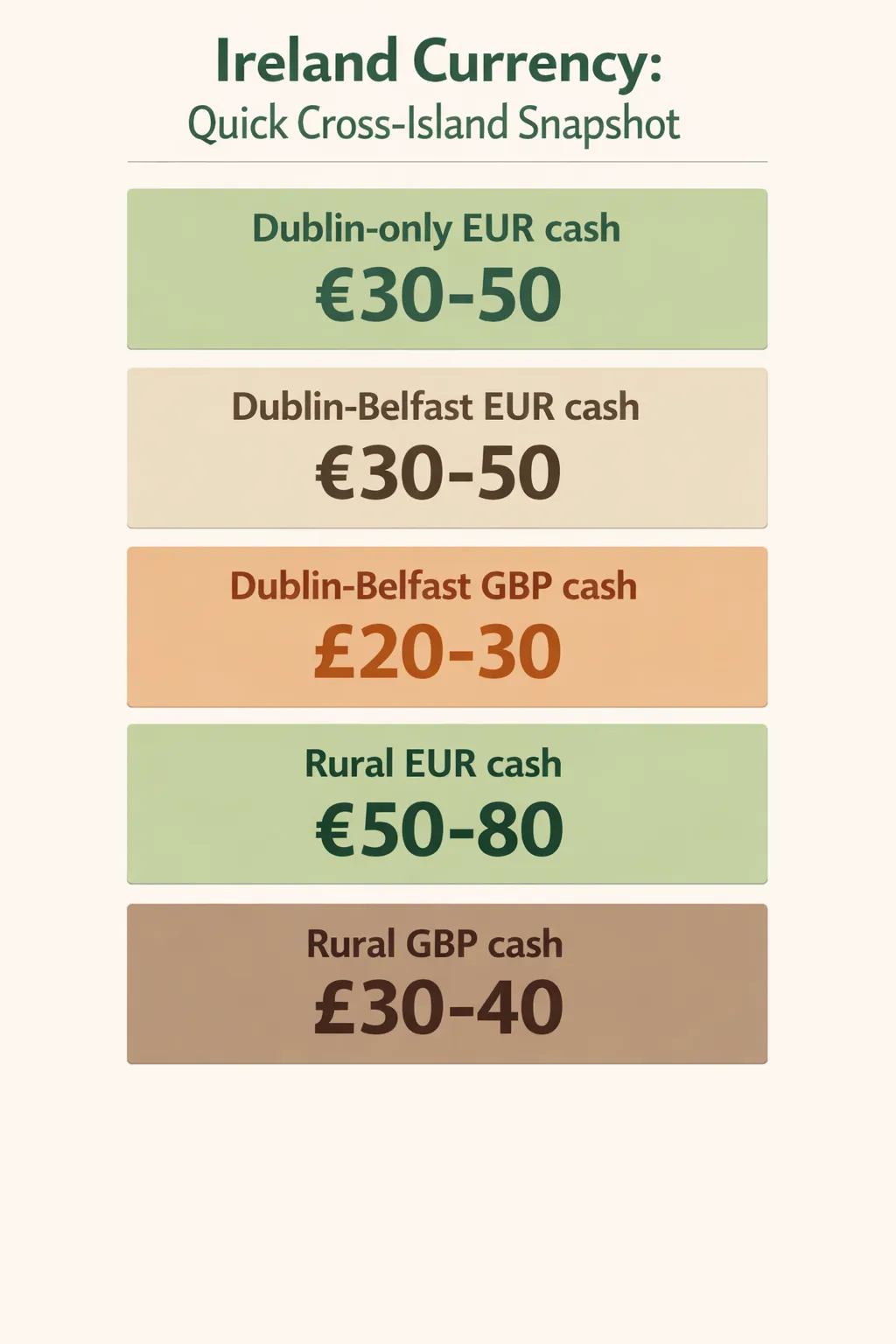 The island uses EUR in the Republic and GBP in Northern Ireland; the cash worth carrying runs from €30-50 on a Dublin-only trip to €50-80 on a rural border trip, plus £20-40 for the northern leg.

This matters the moment your trip covers both jurisdictions. A Dublin-and-Belfast itinerary, or a Donegal-to-Derry drive, means you need both currencies on hand, or a card strategy that handles the switch for you. I’ve met visitors in Belfast who showed up with leftover Irish pounds from a trip decades earlier, which brings up the old currency question.
The Irish punt, or Irish pound (IEP), was the Republic’s currency before the euro replaced it in 2002 (2). It’s no longer legal tender and won’t be accepted at any shop or till, but the Central Bank of Ireland still exchanges old Irish pound notes and coins for euro, with no deadline (2), so old punts at home are redeemable rather than worthless. In everyday Irish slang you’ll hear “quid” used informally for money, borrowed from British usage, far more often than “punt.” That word now comes up mostly in conversation about pre-euro prices, not at a till.
Euro denominations: notes and coins in circulation
Euro banknotes come in €5, €10, €20, €50, €100, €200 and €500, though the €200 and €500 notes are unusual in everyday transactions (2), and some places won’t accept a €500 note if they don’t have change (4). Coins come in 1, 2, 5, 10, 20 and 50 cent, plus €1 and €2, but you’ll rarely handle 1c and 2c coins: Irish shops round cash totals to the nearest five cent (4). Irish euro coins carry a Celtic harp, the historic symbol of Ireland, on the national side alongside the word “Éire” (2). Coins from any eurozone country are equally valid, so a German or Spanish coin in your change is perfectly normal.
Pound sterling denominations used in Northern Ireland
Pound sterling notes in Northern Ireland come in £5, £10, £20 and £50, and coins run from 1p to £2 (1). One quirk worth knowing: local banks in Northern Ireland issue their own banknotes. Three are authorised to do so, Bank of Ireland (UK), Danske Bank and Ulster Bank, and First Trust Bank’s notes stopped being issued on 30 June 2020, so exchange any you’re handed with AIB (16). Northern Irish notes are fully valid in Northern Ireland but are sometimes refused by shops elsewhere in the UK, so spend them before you leave or swap them at a bank.
Can You Use US Dollars, or Euros, Across the Whole Island?
US dollars are not accepted for everyday purchases anywhere in Ireland: not in the Republic, not in Northern Ireland. You’ll need euros in the Republic and pounds in Northern Ireland, and there’s no shortcut around that. Trying to pay in dollars at a shop or restaurant simply won’t work; you’d have to exchange them first, at a rate that rarely favors you.
Euros don’t travel well across the border either. Some large stores near the border in Northern Ireland may accept euros, but when they do, the exchange rate is set by the merchant, not by any regulation, and it’s usually worse than a card or bank rate. Pounds, meanwhile, are not accepted in the Republic. Treat each jurisdiction as needing its own currency.
As for the common question “how much is $1 in Ireland?”, there’s no fixed answer. The EUR/USD rate moves daily. Check a live mid-market rate before you travel using a currency app or your bank’s tool; the European Central Bank publishes daily reference rates. When you withdraw at an ATM with a low-fee card and decline any currency conversion, the rate you get lands a little below mid-market (12). Airport exchange desks are significantly worse. The simplest approach: arrive with the right currency for each side of the island, or lean on cards and withdraw local currency once you land.
Cards vs Cash in Ireland: What Actually Works Where
Visa and Mastercard are widely accepted throughout the island of Ireland (1), at hotels, restaurants, supermarkets, petrol stations and transit operators in both jurisdictions. Contactless works almost everywhere, with a €50 per-transaction cap on physical cards in the Republic (17). Cash still has its place, but it’s a supporting role, not the lead.
Payment Methods in Ireland
| Visa/Mastercard debit | Credit card (Visa/MC) | Mobile wallet (Apple/Google Pay) | Prepaid travel card (multi-currency) | |
|---|---|---|---|---|
| Accepted Where | Near-universal | Near-universal | Most modern terminals | Mastercard/Visa network |
| Contactless Limit | €50 per tap | €50 per tap | Exempt from the €50 card cap | Varies |
| Foreign Transaction Fee | Varies by home bank (0-3%) | Varies (0-3%) | Same as linked card | Often 0% if pre-loaded |
| Best For | Daily spending, ATM withdrawals | Hotels, car rental, security deposits | Higher-value contactless purchases | Cross-border EUR + GBP trips |
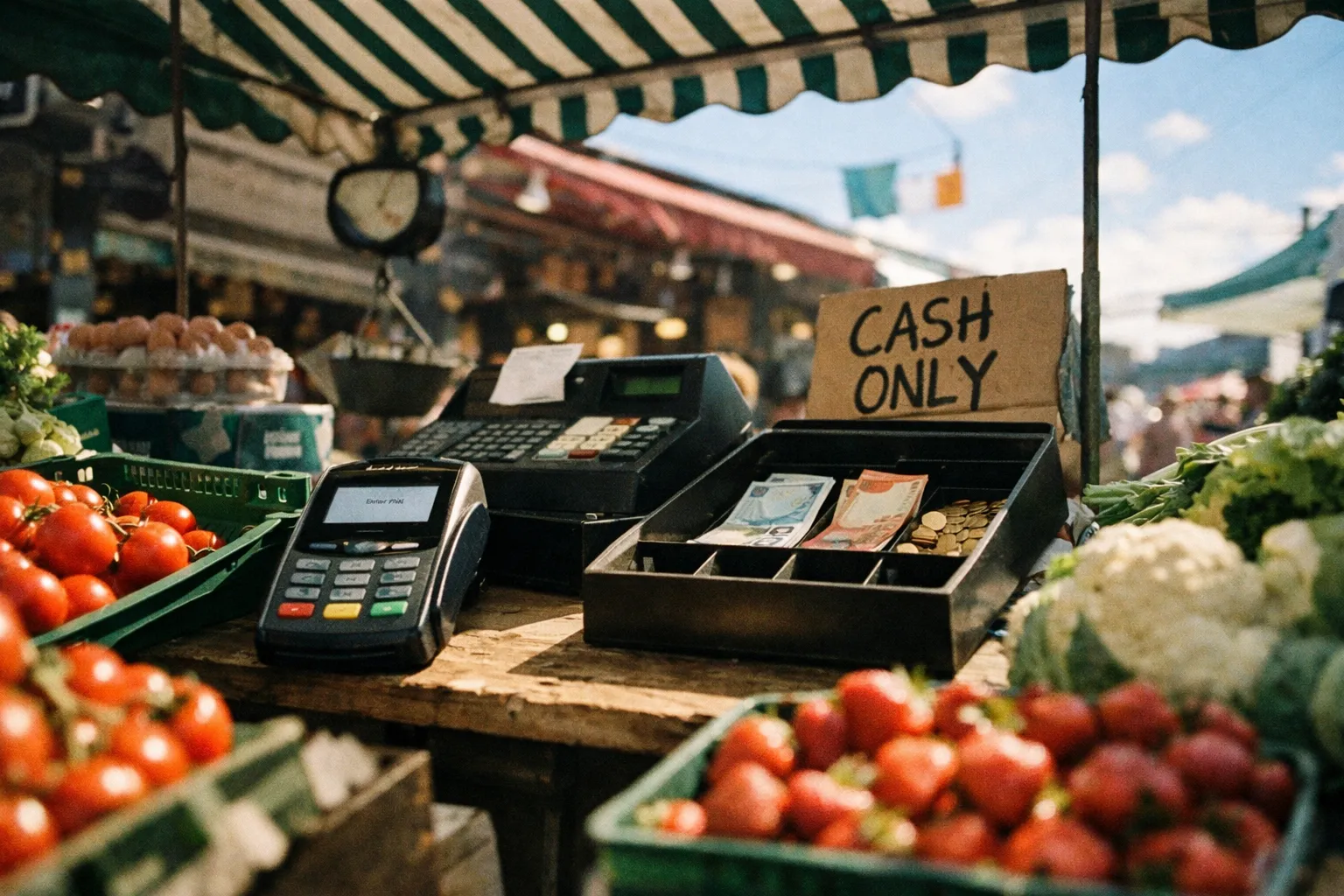
Cash is still worth carrying for small market stalls, rural B&Bs, some taxis, pub tip jars, occasional parking meters and rural pubs whose card machine loses signal. True Trip Costs puts the need at about €100-150 in small notes for a whole week (12), so a €30-50 buffer topped up from bank ATMs covers it. The practical rule: carry enough for a day or two of small expenses and top up via ATM rather than arriving with a thick wad.
One card to watch: American Express is accepted in some places but not all (1). Plenty of smaller merchants don’t take Amex, so don’t make it your only card.
Mobile wallets and the contactless cap workaround
The €50 contactless cap applies to physical cards only, not to Apple Pay or Google Pay. Ireland’s Competition and Consumer Protection Commission states it plainly: card payments have a €50 limit per transaction, but the limit does not apply when you pay with a digital wallet (17). In practice, that means you can tap your phone for a large restaurant bill without being kicked to a chip-and-PIN terminal, provided your underlying card has the balance or credit. Loading your cards into a mobile wallet before you travel is one of the easiest wins available.
ATM Fees in Ireland: Which Machines to Use and What They Cost
Use bank-branded ATMs (AIB, Bank of Ireland, Permanent TSB) and avoid the stand-alone machines in shops, bars and tourist zones that add a few euro on top of whatever your home bank charges (12). That single choice is where most ATM fees in Ireland get made or avoided.
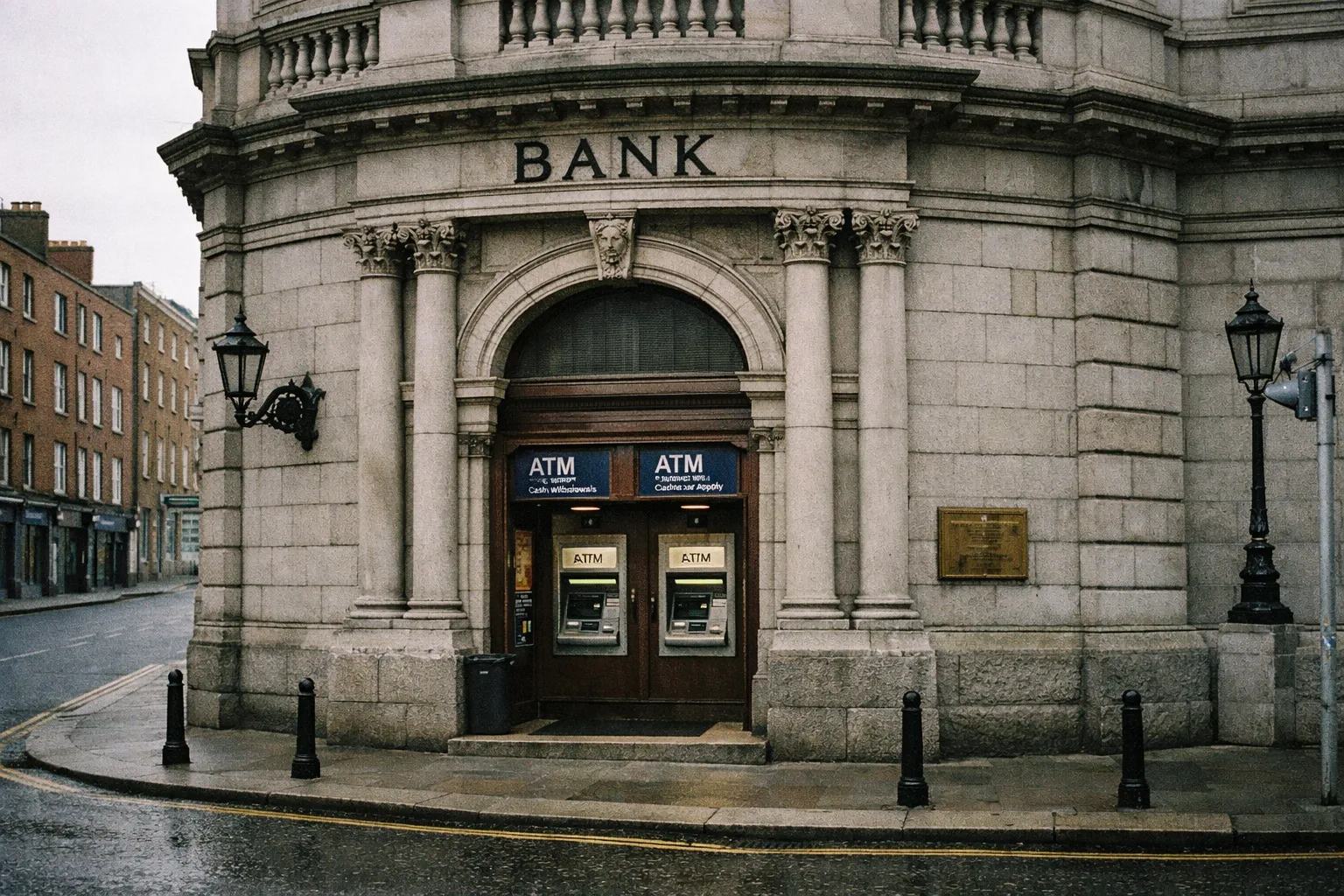
Bank ATMs generally charge foreign cards no access fee (12), though your home bank may still charge a foreign transaction or withdrawal fee separately. Independent ATMs stack a convenience fee on top, making them meaningfully more expensive for the same withdrawal.
For a concrete sense of scale, look at what an Irish bank charges its own customers on foreign-currency transactions. Bank of Ireland’s schedule of fees, effective from 1 August 2025, charges a cross-border handling fee of 3.5% on debit card cash withdrawals in a foreign currency, with a minimum of €3.17 and a maximum of €11.43 per transaction (14). That’s what an Irish cardholder pays abroad; your home bank’s fee structure may differ, but it illustrates how small, frequent withdrawals get punished: the minimum fee hits hardest when you take out small amounts.
Worth noting: the same schedule waives that handling fee when Bank of Ireland customers withdraw sterling at Bank of Ireland ATMs in Northern Ireland, although a margin on the currency conversion still applies (14). It’s a useful detail if you’re crossing the border and happen to bank with them. Withdrawing sterling at other ATMs in Northern Ireland triggers the 3.5% fee.
A few practical points on limits and timing:
- Your home bank’s daily withdrawal limit is the one that applies, so check it before you fly and plan fewer, larger withdrawals.
- Irish residents pay a government stamp duty of €0.12 per ATM withdrawal, capped at €2.50 a year for a cash-only card or €5 for a combined debit card (6). It’s a domestic charge, not something a foreign visitor pays.
- Use bank ATMs during branch opening hours where you can, so staff are on hand if your card is ever retained.
Dynamic Currency Conversion (DCC): always decline it
Dynamic Currency Conversion is a service that offers to charge you in your home currency (dollars, say) instead of the local euro or pound, at a terminal or ATM. It sounds convenient. It isn’t. Choosing your home currency quietly adds a few percent to the transaction (12), and it’s consistently worse than letting your own bank handle the conversion.
The rule is simple and applies at both card terminals and ATMs: when the screen asks whether you want to pay in EUR/GBP or your home currency, always choose the local currency. Never select dollars.
Euro vs Pound Sterling on a Combined Republic-Northern Ireland Trip
On a cross-border day, carry small amounts of both euro and pound sterling and lean on cards for everything else. The goal is to have enough cash for a meal, a taxi and a tip in each currency, not a full day’s budget in cash, so you’re not stuck with a pile of leftover notes you can’t easily spend.
Here’s how the cash-and-card mix shifts by trip type:
Cash and Card Strategy by Trip Type
| Dublin only | Dublin + Belfast | Rural road trip crossing border | |
|---|---|---|---|
| EUR Cash Needed | €30-50 buffer | €30-50 | €50-80 |
| GBP Cash Needed | None | £20-30 | £30-40 |
| Card Strategy | Card for most spending | Card-first; ATM on each side | Card where accepted; more cash for rural stops |
Favoring cards on cross-border days keeps leftover cash to a minimum. If you do end up with spare notes, spend them down before you cross back or hold them for a return visit: airport and bureau-de-change desks offer poor rates on small amounts, so exchanging €15 of leftover coins is rarely worth it. The Bank of Ireland detail from the ATM section is relevant here too: for sterling withdrawals, its own ATMs in Northern Ireland skip the cross-border handling fee, which makes them a cost-effective way for its customers to pick up pounds for the Northern leg.
Using a multi-currency card or travel account
A multi-currency travel card or account that holds both euro and pound balances can simplify cross-border days considerably. You pre-load each currency and spend from the matching balance with no extra FX fee, which removes the “wrong currency in my pocket” problem entirely. The trade-off is setup time (you need to open the account and load it before you travel), and it only pays off if your trip genuinely straddles the border. For a Dublin-only trip, a single low-fee card is simpler.
VAT Refunds for Tourists: How to Claim Back Tax on Shopping
Visitors resident outside the EU can reclaim the VAT on qualifying shopping in the Republic of Ireland under the Retail Export Scheme; residents of Northern Ireland are excluded, visitors from Great Britain are not (19). The standard Irish VAT rate on most goods is 23% (12), but you don’t get all of it back: the retailer or refund agent deducts a processing or administration fee, and must tell you how much it is (19). Each export voucher must be worth at least €75 (18), so a single small souvenir won’t qualify on its own.
Which purchases qualify: physical goods you carry home in your luggage, such as clothing, jewelry, wool goods and designer items. Services such as hotel accommodation, meals and car hire don’t (19). The goods must leave the EU by the last day of the third month after the month you bought them (18).
When is it worth the effort? For high-ticket purchases like jewelry, quality wool or luxury fashion, the VAT back is real money. For a purchase that barely clears the €75 threshold, the paperwork and airport queue rarely justify the return once the agent’s fee is taken off. Customs certifies the voucher at your last point of departure from the EU: Dublin or Shannon if you fly straight home, but the next country’s customs if you continue to another EU country first (19).
Step-by-step VAT refund process
30 minutesHow to claim your VAT refund on qualifying purchases in the Republic of Ireland
- 1
Shop at a participating retailer
Confirm before you buy that the shop operates the Retail Export Scheme, directly or through a refund agent.
- 2
Meet the minimum
Each export voucher must be worth at least €75 including VAT.
- 3
Request the tax-free form at the till
Show proof that you live outside the EU and sign the declaration when you pay; the form is issued with the purchase.
- 4
Keep documents and goods accessible
Keep the form, receipt and goods in hand; don't pack them in checked luggage before the voucher is certified.
- 5
Get the voucher certified by Customs
At your last EU departure point, follow the refund agent's instructions; items of €2,000 or more must be shown to a Customs officer.
- 6
Receive your refund
Refunds go to your card, in cash at the airport or by post, depending on the agent; the retailer or agent must pay within 25 working days of receiving your documents.
Tipping in Ireland: What’s Expected and What’s Excessive
Tipping in Ireland is expected in fewer situations than in the US, and at lower percentages. Importing 20%-plus norms isn’t necessary and isn’t expected. The Irish approach sits somewhere between American habits and the round-up-or-skip continental European style.
Here’s what actually applies:
- Restaurants: about 10-12% is normal for sit-down service when no service charge is on the bill (12). Check the bill first: some Dublin restaurants automatically add a 10-12% service charge, typically for groups of six or more, in which case you don’t need to add a tip (15).
- Taxis: Round up to the nearest euro, or add around 10% on a longer airport run (15). No percentage math needed for short hops.
- Hotel services: €1-3 per bag for porters is typical; housekeeping tips of €2-5 per night, left in the room, are appreciated but optional (15).
- Guided tours: €5-10 per person on a free walking tour, €5-15 on a paid one (15); more for a full-day or private guide.
- Pubs: Tipping for drinks at the bar isn’t standard practice; rounding up is plenty (15). If you’ve enjoyed a music session for an hour or more, €5-10 in the guitar case is the going rate (15), but never obligatory.
- Card terminals: Many now show a tip prompt when you pay. It’s optional, not a social obligation, and declining it is completely normal.
The overall takeaway: tip where service was genuinely good, keep it modest, and always check whether a service charge is already on the bill before adding more.
Practical Money Checklist Before You Travel
Handle the money side well and you’ll barely think about it on the trip. Here’s the sequence that matters, from home to departure gate.
Before you leave home:
- Notify your bank of your travel dates so a foreign transaction doesn’t get flagged.
- Check your card’s foreign transaction fee: aim for a card charging 0-1%. Many banks charge in the 1-3% range on non-euro transactions.
- Load your cards into Apple Pay or Google Pay to sidestep the €50 contactless cap.
- Check whether your card charges for ATM withdrawals abroad, and what its daily limit is.
At the airport (departure):
- Skip the airport exchange desks if you can, since rates are poor. If you must, change only a small emergency amount.
On arrival in the Republic:
- Withdraw euros from a bank-branded ATM (AIB, Bank of Ireland, Permanent TSB).
- Decline DCC if prompted; choose EUR.
Crossing into Northern Ireland:
- Withdraw a modest amount of pounds from a bank ATM.
- Keep your euros for the return leg.
Throughout the trip:
- Always choose local currency (EUR or GBP) at terminals and ATMs.
- Use contactless or your mobile wallet for most purchases.
- Keep €30-50 in cash (and £20-30 up north) for small vendors and tips.
At departure, if claiming a VAT refund:
- Arrive earlier than usual and get your voucher certified before you check your bags, following the instructions on your tax-free form.
Common Money Mistakes Visitors Make in Ireland
Most money problems in Ireland come from a short list of avoidable errors.
- Arriving in Belfast with only euros. The single most common and most avoidable mistake. Northern Ireland uses pound sterling, full stop. Withdraw a small amount of pounds when you cross.
- Using stand-alone ATMs in tourist zones. These machines add access fees that bank ATMs don’t. Stick to AIB, Bank of Ireland and Permanent TSB.
- Accepting DCC. Paying in your home currency at a terminal or ATM means a worse rate plus a mark-up. Always choose EUR or GBP.
- Over-tipping on US instincts. Applying 20%-plus where 10% or a round-up is the norm is money you don’t need to spend, and it’s not expected.
- Missing VAT refunds. If you don’t ask for the tax-free form at the time of purchase, you can’t go back for it later. Ask at the till.
- Assuming contactless works everywhere. Rural cafés, markets and older taxis sometimes run cash-only. Carry a small backup.
- Exchanging large amounts before departure. Airport and hotel exchange rates are poor. Withdraw local currency from a bank ATM on arrival instead.
Frequently Asked Questions
- Is Ireland using euro or pound?
- The Republic of Ireland uses the euro (€); Northern Ireland uses pound sterling (£). Trips covering both need both currencies; cards ease the process but some cash is useful.
- How much is $1 in Ireland?
- The EUR/USD rate changes daily. Check a live mid-market rate before travel. ATM withdrawals with low-fee cards land a little below mid-market; airport exchanges are worse.
- Can I use American dollars in Ireland?
- No. US dollars aren't accepted for purchases in either jurisdiction. Withdraw local currency from bank ATMs on arrival for better rates than currency exchange.
- What does "punt" mean in Irish slang?
- The punt was Ireland's currency before the euro in 2002 and is no longer legal tender. 'Quid' is the common slang for money; 'punt' appears mostly in historical contexts.
- Do I need cash in Ireland at all?
- Yes, some. Cards cover most spending in towns, but small markets, rural B&Bs, some taxis, and parking meters often require cash. Carry €30-50 as a buffer.
- Should I use a credit card or debit card for hotels and car rental?
- Credit cards are better for hotels and car rentals due to chargeback rights and handling security deposits. Use debit cards mainly for ATM withdrawals and daily spending.
- Are there ATM fees for foreign cards in Ireland?
- Irish bank ATMs generally charge foreign cards no access fee, but home banks may charge fees. Independent ATMs often add fees. Use AIB, Bank of Ireland, or Permanent TSB ATMs to avoid extra costs.
The Bottom Line
Three habits determine whether you handle money well in Ireland. Know which currency applies before you cross any border: euro in the Republic, pound sterling in Northern Ireland, and don’t assume one works in the other. Use a low-fee card as your primary tool and a bank ATM (AIB, Bank of Ireland, Permanent TSB) when you need cash, never an independent machine in a tourist zone. And whenever a terminal or ATM asks, choose the local currency and decline the conversion to dollars.
The one thing that needs planning ahead is the VAT refund. It requires you to ask for the tax-free form at the till and to get your voucher certified by Customs before you leave the EU, and it’s the step most people forget until they’re already at the gate with the goods buried in checked luggage. If you’re buying anything high-value, sort that paperwork at the point of sale. Do these things and money in Ireland stops being something you think about. You just spend it sensibly.