Spanish immersion Costa Rica works, but set expectations first: three to four weeks at fifteen to twenty-five class hours moves most people from A2 to B1, not fluency. Budget $1,000 to $3,600 for the course, plus a homestay around $180 to $300 a week that teaches more than the classroom. Base in Heredia or the San Jose corridor, because the beach towns leak English and quietly cut your practice. Come in the May or September shoulders for smaller classes, cheaper rooms, and afternoon rain you can plan around.
Why Costa Rica Works for Spanish Immersion
Learning a language isn’t about memorizing grammar rules or drilling vocabulary lists. It’s about living inside the culture that speaks it. That’s the core logic behind Spanish immersion programs in Costa Rica, which combine classroom instruction with homestays, volunteering, and daily life in a Spanish-speaking country. When I enrolled in a language course and moved in with a local family, I picked up dimensions of the language no textbook had touched. This guide covers how the programs work, what they cost, where to study (San José versus the coast), and how to plan the trip - plus what most guides consistently get wrong.
Costa Rica is one of the most reliable places in Latin America to study Spanish, and the reasons are practical. Tico Spanish is spoken clearly, at a moderate pace, with neutral vocabulary that travels well across the region. The country is also one of the safest in the Americas - it consistently ranks among the top 40 nations on the Global Peace Index - which matters when you’re sending yourself, or your kids, into homestays with strangers.
The infrastructure is built for this. Flights from North America run roughly $300-$900 round trip depending on season and departure city, and most US, Canadian, and EU passport holders enter visa-free for up to 90 days as tourists. That window comfortably covers any standard immersion stay. If you’re planning longer than 90 days, verify current rules with a consulate before booking - border runs are a hassle and not a reliable strategy.
Most general programs require no prior Spanish. Schools place you with an online or on-site test, then put you in the right group. Intensive courses typically promise moving up one CEFR sub-level - say A2 to B1 - in three to four weeks of full-time study. That’s the realistic ceiling. Anyone selling you fluency in a week is selling you something else.
✓ Pros
- Clear, moderate-paced Spanish with neutral vocabulary
- Safe country with vetted homestays
- Visa-free entry for most tourists up to 90 days
- Wide range of programs from budget to premium
- Multiple locations offering different immersion intensities
✗ Cons
- Border runs required for stays longer than 90 days
- Surf towns can limit speaking practice for beginners
- Rainy season may disrupt outdoor activities
- High-end programs can be costly
Choose the city or the beachfront
The single biggest decision you’ll make is location, and it shapes both your budget and how much Spanish you actually speak. The choice comes down to the Central Valley cities versus the coast - and there’s a third option most people overlook.
City: San José, Heredia, and the Central Valley
If your goal is to speak Spanish constantly, the city wins. The Central Valley around San José and Heredia gives you cheaper flights, the widest range of homestays, and relentless real-world practice - markets, buses, banks, and offices where nobody switches to English to make your life easier. Cost of living runs lower than the resort coast, too.
Tico Lingo in Heredia is an internationally accredited school built around full immersion for adults and teens (5). Intercultura’s city campus and CPI’s San Joaquín/Heredia campus are also strong picks (8). For Spanish Immersion San jose Costa Rica searchers specifically, the Heredia-San José corridor is your zone: it’s a 25-40 minute, $25-$40 shuttle or taxi ride from the airport, and you’ll be embedded in daily Tico life from day one.
- Worth the detour: Heredia, for the homestay density and the university-town feel.
- Skip if short on time: downtown San José itself - fine as a base, but the suburbs make better immersion neighborhoods.
Beachfront: Nosara, Sámara, Jacó, and Tamarindo
The coast sells the “study in the morning, surf in the afternoon” lifestyle, and for intermediate and advanced learners it works well. Nosara Spanish Institute runs small groups covering A1-C2 with surf and yoga add-ons; group courses start at $325 per week, with private 1:1 immersion from $425 per week, scheduled in morning or afternoon blocks like 8:00-11:40 a.m. or 1:00-4:40 p.m.. Intercultura’s Sámara beach campus sits across from the water and earns strong independent reviews from families and solo adults alike (6)(9).
The catch - and this is what most guides bury - is that surf towns are full of tourists and English-speaking staff. If you book a beginner program in Tamarindo and never leave the tourist bubble, you’ll get less speaking practice outside class than you would in suburban Heredia. The beach rewards people who already have enough Spanish (B1+) to push into local conversations.
Hybrid: split your weeks
Multi-campus schools like CPI and Intercultura let you split a single enrollment between city and coastal campuses (8). Two weeks in the Central Valley followed by two weeks at the beach gives you the immersion intensity of the city plus the reward of the coast - and it justifies the cost of the flight. I’d point most people doing three weeks or more toward this structure rather than committing the whole stay to one location.
A day in the life of service-learning
I enrolled in a short-term program that included service-learning - a combination that paired language skills with direct community contact. Each morning started with my host family, stringing together basic phrases and making the kind of mistakes that are embarrassing in the moment and useful for weeks afterward. Por favor and gracias were the gateway to longer exchanges, and reading menus and street signs became a daily low-stakes test.
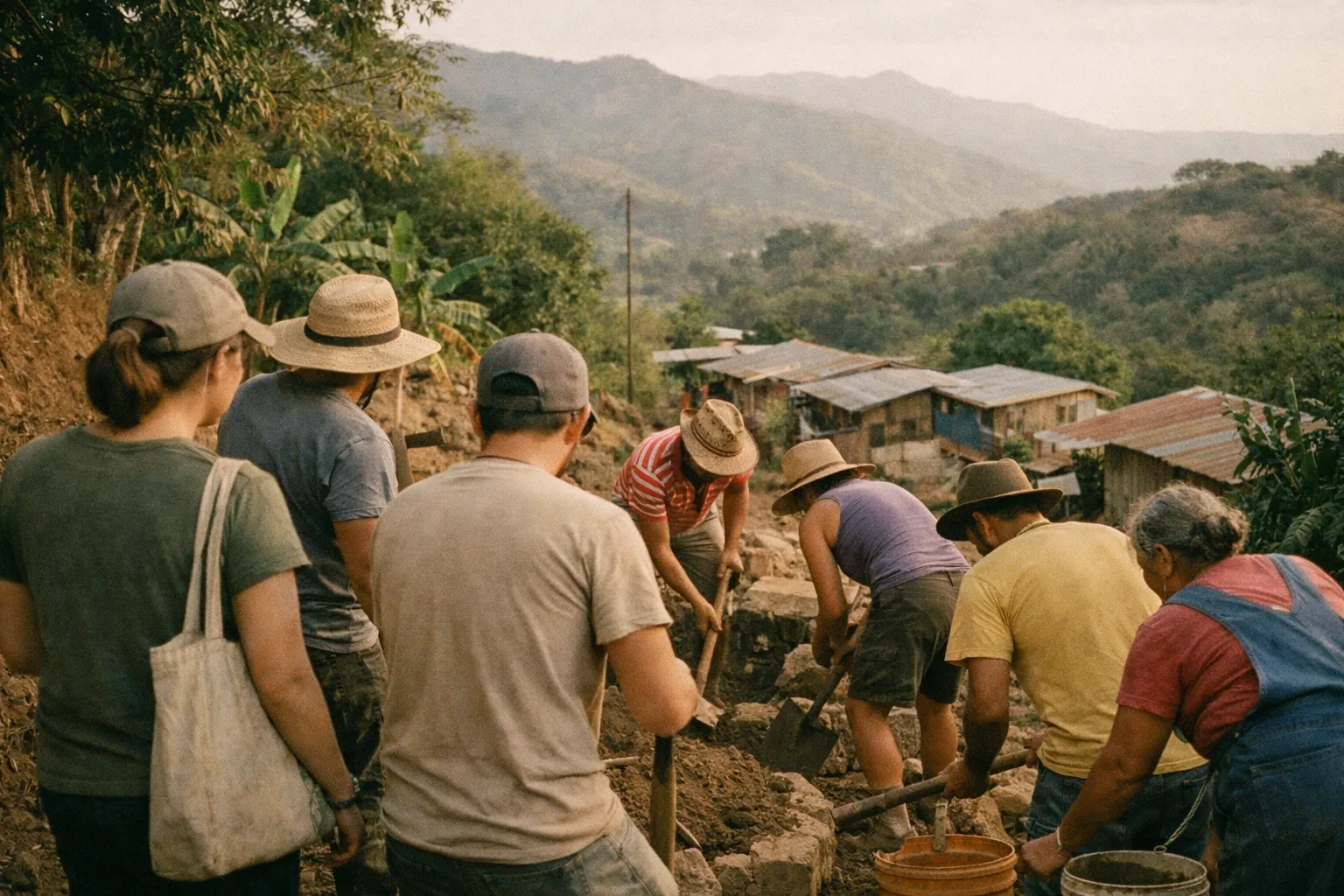
The service-learning piece put me in settings where classroom Spanish met the real world fast. Volunteering at a local school, I learned quickly that language is more than vocabulary - it’s gestures, expressions, and the kind of silent understanding that develops when words fail. There was one afternoon where I resorted to charades to explain a task to a group of kids. It was equal parts embarrassing and effective.
Many schools help arrange this kind of structured practice - conversation exchanges, volunteering, local clubs. Commit four to six hours a week to it outside of class and your speaking gains compound fast.
What it costs and how to budget
A serious two-to-four-week immersion runs roughly $1,000-$3,600 per person all in, before flights. Here’s how that breaks down.
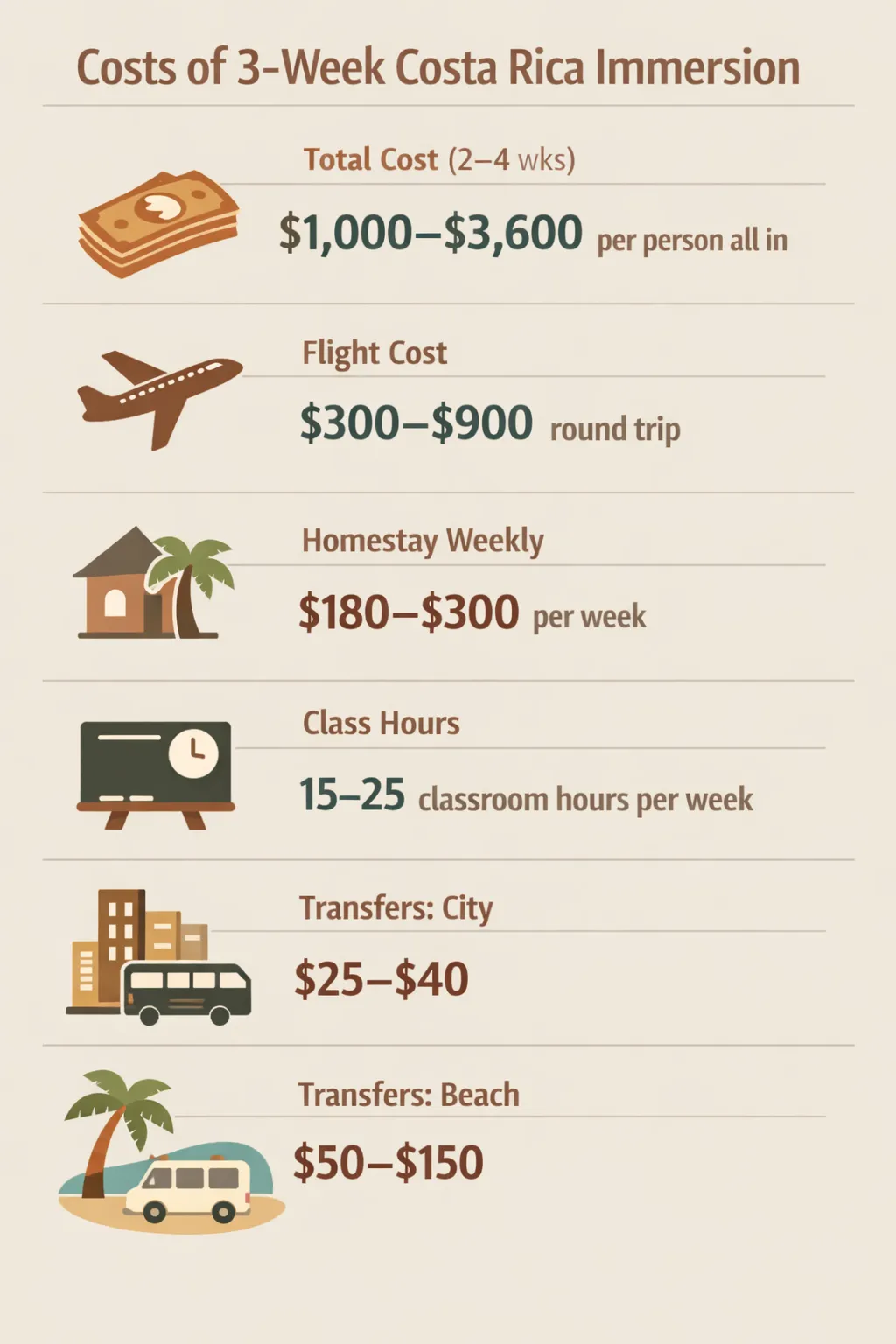 Typical 2-4 week Costa Rica Spanish immersion costs range from $1,000-$3,600 per person before flights, with flights $300-$900 and homestays $180-$300 per week, plus transfer costs.

Tuition (per person):
- Budget local schools / group classes: $250-$400 per week for 15-20 classroom hours.
- Mid-range internationally marketed schools: $350-$600 per week, often with activities included.
- High-end boutique retreat: Fluenz Spanish Immersion in Nosara runs from $7,355 per person (double occupancy) or $7,680 single for a six-day beachfront program, hotel and meals included (2).
Accommodation:
- School-arranged homestays: $180-$300 per week, usually with two to three daily meals and laundry.
- Private apartments or studios in Nosara/Sámara: $600-$1,200 per month, season-dependent.
Everything else:
- Flights from North America: $300-$900 round trip.
- Airport transfers: $25-$40 to the Heredia/San José area; $50-$150 to beach towns like Nosara or Sámara by shuttle or private transfer.
- Food beyond homestay meals: $15-$35 per day if you eat out or self-cater.
Most programs run 15-25 classroom hours per week, typically three to five hours a day, Monday through Friday (3)(9). Two weeks is the minimum that justifies the trip; three to four weeks is where conversational gains become obvious.
Best months to go: target the shoulder seasons - May-June or September-November. Class sizes shrink to two to four students, accommodation prices drop, and the weather on most coasts is still workable. The trade-off is afternoon rain, especially September and October. Pack for it and plan indoor study blocks around the downpours.
Top-Rated Schools for Learning Spanish in Costa Rica
These are the names that come up repeatedly in independent reviews and aggregators, with GoOverseas listing several among the best Spanish immersion schools in Costa Rica at ratings of 4.5-5.0/5 (6).
- Intercultura Costa Rica - beachfront campus in Sámara plus a city campus in Heredia; consistently cited as a top school and a strong pick for families (6)(7).
- CPI Costa Rica - a multi-campus system with beach, mountain, and city locations under one program brand, ideal for the hybrid strategy (8).
- Nosara Spanish Institute - small groups, full A1-C2 coverage, and surf/yoga add-ons, with online lessons available before you arrive (3).
- Tico Lingo (Heredia) - internationally accredited, focused on full immersion for adults and teens (5).
- Maximo Nivel - multi-country (Costa Rica, Guatemala, Peru) with volunteer and TEFL add-ons; one review describes a typical two-hours-per-day group schedule over two weeks (4).
- Fluenz Nosara - the premium end: a six-day intensive at a boutique beachfront hotel for adults, with scheduled cohorts running through 2026-2027 (2).
When you read Spanish Immersion Costa Rica reviews, weight the independent ones - GoOverseas aggregates and individual blog write-ups like the detailed Sámara family review (9) - over the testimonials on a school’s own site. Look specifically for comments on teaching style and homestay quality, since those are the two variables that make or break a stay.
Adult Programs: What to Expect and How to Choose
The standard adult format is straightforward: about 20 classroom hours per week in a group, paired with a homestay, ages 18 and up. Nosara Spanish Institute, Intercultura, CPI, and Tico Lingo all run this model (5)(8). Beginners (A0-A1) generally do better in city or family-style programs with heavy structured support; intermediate and advanced learners (B1-C1) get more out of beach or hybrid programs, volunteering, or professional tracks (4).
For Spanish immersion programs for adults that prioritize comfort and speed over budget, Fluenz Nosara is the outlier - small cohorts, rigorous classroom work, personalized coaching, and curated activities packaged into six days at an upscale hotel (2). It’s the right call for a professional who has a hard week of PTO and wants maximum structured progress without logistics to manage.
One move worth making before you fly: front-load your prep. Schools like Nosara Spanish Institute offer online immersion lessons using the same materials as their in-person classes (3). Taking five to ten lessons before you arrive can bump you into a higher placement group and save you days of review time on arrival.
Family Programs: Keeping Kids and Adults on the Same Schedule
Family immersion is one of the fastest-growing segments, and it works best when adult and children’s classes run concurrently - otherwise you’re juggling childcare gaps. Intercultura’s Sámara campus is built for this, with overlapping adult and kid schedules plus shared cultural activities like dance and cooking; the detailed family review of that campus reports high satisfaction on exactly those points (9).
For Costa Rica Spanish Immersion for families, structured group lessons for kids typically start around ages 5-7; younger children usually need private tutors or childcare. Homestays can be configured for families with multiple rooms in safe neighborhoods, and some programs help enroll kids in local camps or surf schools for afternoon immersion (1).
3-6 week family Spanish immersion combo programs in Ecuador & Costa Rica
If you have a longer summer window, the dual-country combo is worth a serious look. Common Ground International runs integrated 3-6 week family spanish immersion combo programs in ecuador & costa rica, rotating between a small, non-touristy city in Costa Rica’s Central Valley and partner locations in the Ecuadorian Andes (1).
The typical pattern is two to three weeks in Costa Rica plus one to three weeks in Ecuador, often in July or mid-year (1). Parents enroll in adult or professional tracks while kids attend leveled classes or local schools. The payoff is exposure to two distinct accents and cultures - Central American Tico Spanish versus Andean Spanish - inside a single trip, which is far harder to engineer on your own.
Budget accordingly: a six-week, two-country family program is a substantial commitment in both tuition and inter-country logistics. But for a family that wants one big immersion summer rather than annual short trips, the combo concentrates the experience and avoids paying for two separate international flights’ worth of overhead.
Medical Spanish Tracks: Who They’re For and What to Expect
Healthcare professionals are a distinct audience here, and they need a distinct program. Common Ground International includes a dedicated medical Spanish Immersion Costa Rica track within its Costa Rica and Ecuador programs, covering clinical terminology, patient-interaction simulations, and sometimes observational clinical experiences (1).
The key prerequisite most general guides skip: medical Spanish tracks expect at least low-intermediate ability (A2-B1) going in. The vocabulary load is heavy, and you won’t absorb terminology or run a mock patient interview if you’re still wrestling with present-tense conjugations. If you’re a nurse, physician, or therapist below that level, do a general immersion stay first - or stack a general program with add-on medical modules, which several schools offer as private specialist classes during a standard immersion.
Be explicit about your goal when you enroll. Professionals who book a generic course expecting clinical vocabulary come away disappointed; you need to request the medical track specifically (1).
The value of getting it wrong
Living in a Spanish-speaking country without fluency is a humbling experience, and that’s the point. Ordering food, asking for directions - every interaction is a small test you will sometimes fail. Those failures are also the most instructive moments.
I once tried to compliment my host mother’s cooking using what I was certain was the right vocabulary. The confusion and laughter that followed turned into an impromptu Spanish lesson and a better relationship with the family. Embarrassing, yes. But that kind of mishap teaches you the nuances of the language faster than any structured dialogue.
The lesson: be patient with yourself and with the people around you. Skipping the homestay to avoid that discomfort is the most common regret among past participants - and the homestay is consistently named the single biggest driver of real-world language gains.
La Fortuna Waterfall, Arenal Volcano, and weekend trips
Weekends are when the country pays you back for the weekday grind. La Fortuna Waterfall and Arenal Volcano are both worth the detour - hiking through rainforest to reach the falls, with water crashing into the pool below, makes a fitting backdrop for practicing Spanish with fellow travelers and guides. Conversing with a local guide about Arenal’s history in Spanish folds language practice into the experience without it feeling like homework.
A practical note from doing this in the rainy months: afternoon downpours make trail descents slick. Start volcano and waterfall hikes early and budget extra time for the return.
One structural tip that applies to the whole trip - don’t overload the schedule. Booking 20-25 class hours plus daily excursions and surfing burns people out fast. Leave time to rest and review; retention depends on it.
Sample 3-Week Spanish Immersion Itinerary
3 weeksA balanced schedule combining classroom hours, homestay life, volunteering, and weekend excursions.
- 1
Week 1: City Campus and Homestay
Focus on intensive classroom instruction (15-20 hours/week) in Heredia or San José, plus daily homestay immersion and local errands to practice Spanish.
- 2
Week 2: Service Learning and Volunteering
Add 4-6 hours per week of volunteering or conversation exchanges outside class to accelerate speaking skills.
- 3
Week 3: Beach Campus and Cultural Activities
Split time to a coastal campus like Sámara or Nosara for surf, yoga, and cultural immersion, targeting intermediate learners ready to push beyond tourist bubbles.
Frequently Asked Questions
- Can I extend my stay beyond 90 days without leaving the country?
- Costa Rica generally requires leaving the country to reset the 90-day tourist visa. Border runs are common but can be time-consuming and are not guaranteed to work. Check with the consulate for the latest rules before planning a longer stay.
- How do hybrid programs handle logistics between city and beach campuses?
- Multi-campus schools like CPI and Intercultura coordinate transfers and scheduling to allow students to split their enrollment seamlessly, but you should book flights and accommodations accordingly and confirm transfer options in advance.
- Are there medical Spanish immersion options for healthcare professionals at all levels?
- Medical Spanish tracks require at least low-intermediate Spanish (A2-B1). Beginners should first complete a general immersion program or add medical modules to build foundational skills before tackling clinical vocabulary.
- What should families consider when choosing immersion programs for kids?
- Look for programs with concurrent adult and child classes, safe homestay neighborhoods, and activities that support immersion outside the classroom, such as local camps or surf schools. Private tutoring may be necessary for younger children.
- How do rainy season conditions affect immersion programs?
- Afternoon rains are common from May to November, especially in September and October. Mornings are usually clear for classes and excursions, but plan indoor study or cultural activities during downpours.
- Is it better to book online prep lessons before arriving?
- Yes. Taking online lessons before arrival can improve your placement level, reduce review time, and help you maximize your immersion experience from day one.