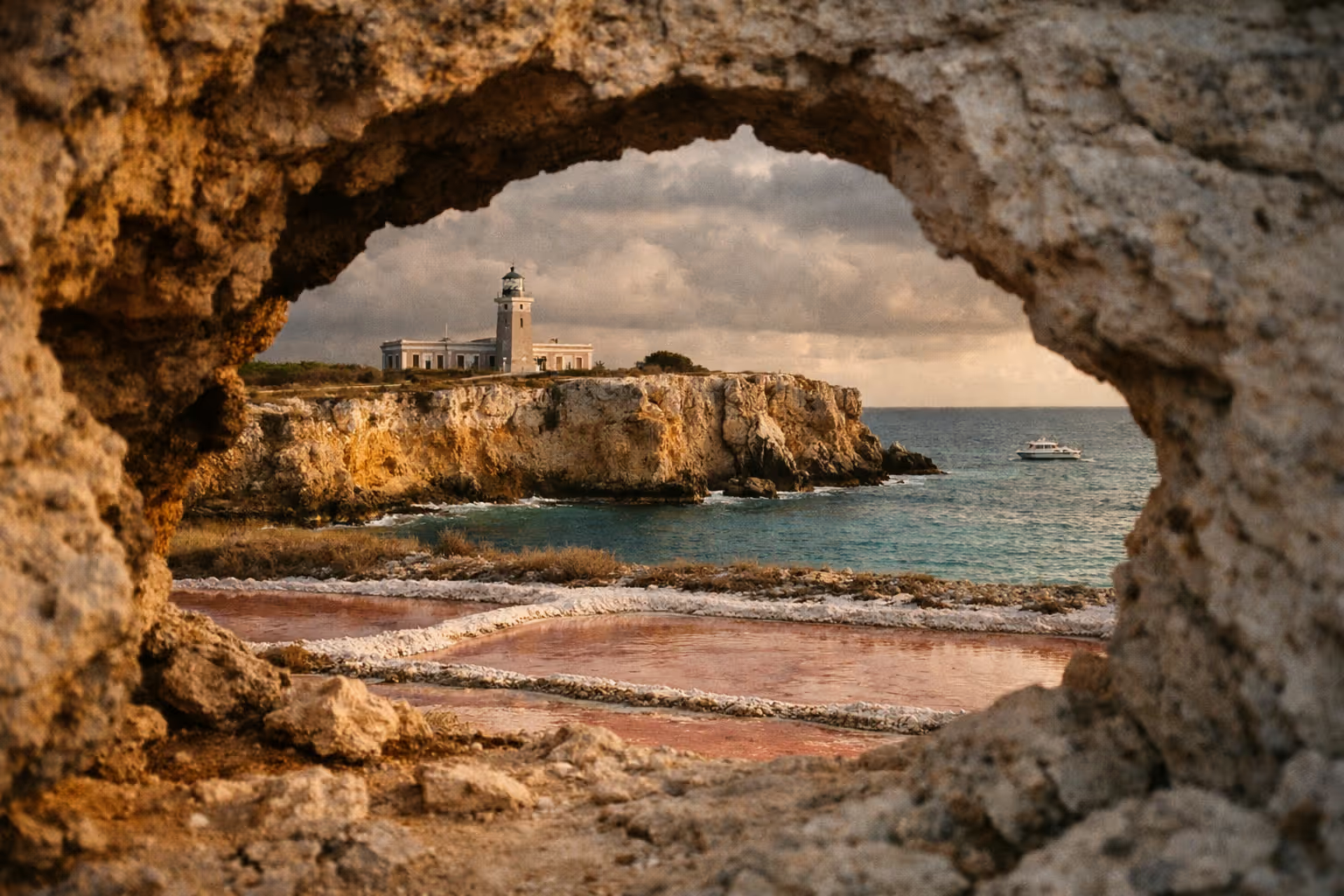
The best time to visit Puerto Rico for value is mid-April to June, not the fall window most guides push. Winter runs driest but San Juan rooms can top $400; the late-spring stretch keeps rain low, thins post-Easter crowds, and drops rates below peak. September and October are cheapest of all, with hotels falling from around $620 to $283, but that is hurricane season, so travel insurance stops being optional. Skip July, crowded with local school holidays and no price break for the heat.
Puerto Rico weather by month
Determining the best time to visit Puerto Rico largely depends on understanding the island’s weather patterns by month. Using San Juan as the baseline, the island stays warm and humid year-round; the main variations come from rainfall and hurricane exposure rather than temperature.
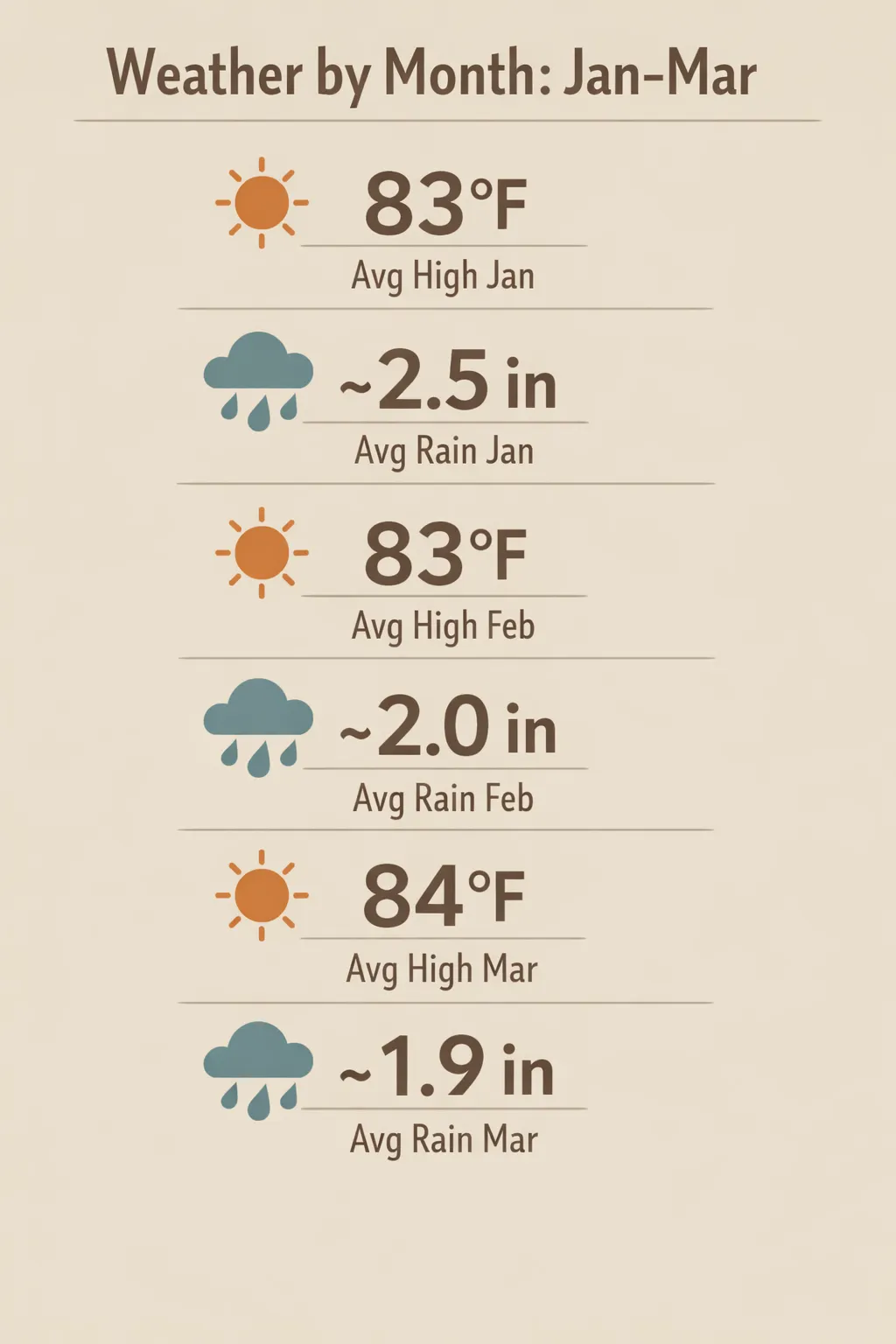 San Juan monthly weather shows avg highs of 83°F in January and February, and 84°F in March, with rainfall around 2.5 inches in January, 2.0 inches in February, and 1.9 inches in March.
| Month | Avg High | Avg Rainfall | Notes |
|---|---|---|---|
| January | 83°F | about 2.5 in | Peak dry season, cool trade winds |
| February | 83°F | about 2.0 in | Driest stretch, best beach odds |
| March | 84°F | about 1.9 in | Lowest rainfall month (1) |
| April | 85°F | about 3.5 in | Weather still excellent, crowds thinning |
| May | 86°F | about 4.3 in | Wet season begins, humid but quiet |
| June | 87°F | about 4.0 in | Hurricane season opens June 1 |
| July | 88°F | about 4.5 in | Hot, humid, local vacation crowds |
| August | 89°F | about 5.0 in | Storm risk climbing |
| September | 89°F | about 5.3 in | Wettest month, peak storm risk (1) |
| October | 88°F | about 5.4 in | Rainiest, still high hurricane risk |
| November | 86°F | about 4.5 in | Season winds down, shoulder pricing |
| December | 84°F | about 3.5 in | Dry weather returns, prices spike |
The dry season runs roughly December through April, with brief, lighter showers and about 9-13 rainy days a month. The wet season runs May through November, with 10-15 rainy days a month and heavier downpours (9). Rainfall also increases from east to west across the island, so if you’re visiting in a wetter month, basing yourself on the eastern side - near Fajardo or Luquillo - generally buys you more sun.
One thing most guides get wrong: they label the entire June-November stretch “rainy season” and leave it at that. In practice, May and June get afternoon showers that pass in 30 minutes. That’s a very different reality from the sustained systems that roll through in September and October. Don’t write off early summer because the calendar says “wet.”
Best time to visit Puerto Rico for good weather
For near-guaranteed beach weather with the lowest storm risk, book January through March. Rainfall drops below 3.3 inches a month, humidity is manageable, and hurricane season is behind you. Trade winds keep San Juan comfortable even when the sun is strong. This is why it’s peak season - the weather is simply the best the island offers (7).
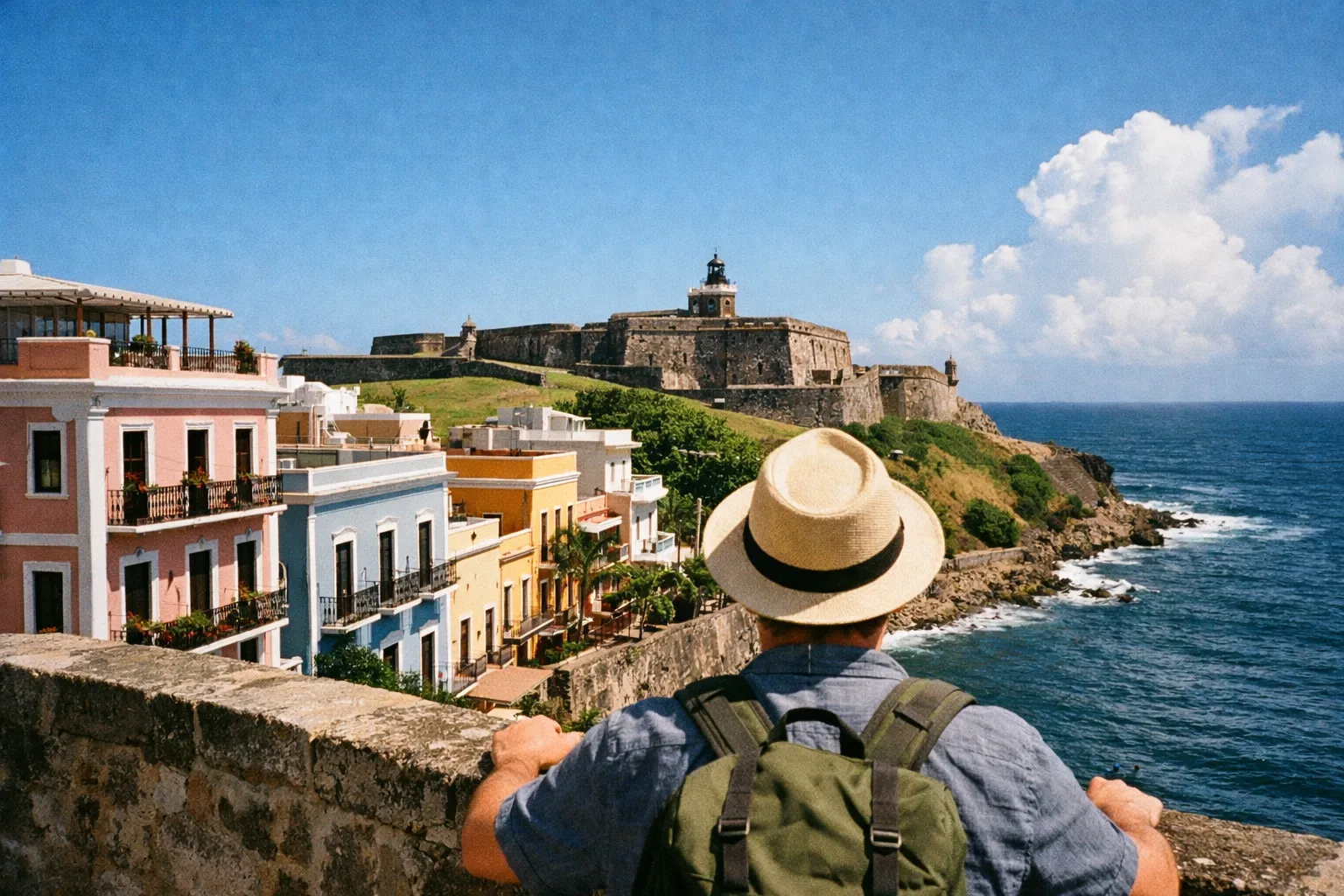
The trade-off is cost and crowds, covered below. If you want the same dry-season conditions without the winter price tag, mid-April to June is the sweet spot: rainfall stays in the 3.5-4.3 inch range, crowds thin out, and prices drop noticeably. This is the window I’d point most first-timers to.
I spent a week near Rincón in late April and got seven straight dry days with water calm enough to see straight to the bottom off the reef at Steps Beach. That same trip in September would have been a coin flip.
When to visit San Juan
For a city-focused trip, the best time to visit San Juan Puerto Rico depends on whether you’re chasing festivals or quiet streets. December through March delivers the liveliest scene - the San Sebastián Street Festival (Fiestas de la Calle San Sebastián) fills Old San Juan in mid-January with music, food kiosks, and crowds. Book that window 3-4 months out; local and tourist demand collide hard.
If you’d rather explore the forts and cobblestone streets without shoulder-to-shoulder foot traffic, come in May or June. You’ll get a quieter Old San Juan and easy day trips to beach towns and off-island escapes like Vieques and Culebra.
A booking note that saves real money in San Juan: stay in Condado or Isla Verde instead of the historic core. You’ll typically save $30-80 a night and still be 10-20 minutes from the main sites (4). Old San Juan is worth staying in for one or two nights for the atmosphere. Beyond that, the premium isn’t worth it.
Cheapest time to visit Puerto Rico
The cheapest time to visit Puerto Rico is September through early November. Hotel meta-search data shows average island rates around $283/night in September versus $620/night in December - the price can more than double between low and peak season. September consistently falls in the low-season window for both price and visitors, though crowd levels vary by property type and exact dates.
In San Juan, average hotel prices run about $210/night overall, but budget rooms drop to $77-$100/night in low season and climb past $300-600/night in winter and over holidays (4). Flights follow a similar pattern - fall fares often run 10-20% cheaper than winter.
A few tactics that actually move the needle:
- Book flights on Sundays. One major OTA’s pricing analysis found Sunday bookings save around 8% versus Fridays for Puerto Rico flights (3).
- Arrive mid-week. Tuesday-Thursday arrivals in shoulder or low season can cut both flight and hotel costs 5-15% versus weekend peaks (3).
- Time your booking window. For December-March, book 3-6 months ahead to lock mid-range San Juan rates under $250/night. For September-November, 1-2 months out still lands sub-$200/night deals.
The catch - and it’s a real one - is that September and October are also the peak of hurricane season. You’re trading the lowest prices for the highest weather risk. More on that below.
Best times to visit for smaller crowds
If empty beaches matter more than perfect weather, target May, June, September, October, and November. These months consistently show low or minimal crowds, and they overlap with the cheapest rates. Puerto Rico’s tourism hit record highs in 2024-2025 - STR data recorded hotel occupancy near 71% for July 2025, and cruise passengers surpassed 1.6 million for the year - so avoiding the winter peak matters more now than it did a few years ago (8)(6)(5).
Here’s how the crowd calendar breaks down:
- December-March: Busiest. Winter-sun demand, holidays, and festivals fill hotels and beaches. Skip if crowds bother you.
- April: Crowds thinning fast after Easter, weather still dry. A strong compromise.
- May-June: Quiet and humid, with short passing showers. Good local feel, moderate prices.
- July: A crowd exception - Puerto Rican school holidays bring domestic travelers, so beaches near San Juan can get busy despite it being low season for mainlanders.
- September-November: Fewest visitors of the year. Some beaches feel nearly empty midweek.
If your only goal is solitude and you’re comfortable with storm risk, late September and October deliver the emptiest island. Pair that with flexible bookings.
The worst time to visit Puerto Rico
The worst time to visit Puerto Rico - if you want to avoid weather disruptions - is September and October, with the broader danger window running August through October. Hurricane season officially spans June 1 to November 30, but the greatest storm risk clusters in those late-summer and early-fall months (2)(10). September is both the wettest month (around 5.3 inches of rain, 14-15 wet days) and the highest-risk period for named storms (1).
This is the central tension of planning a Puerto Rico trip: the cheapest, least crowded months are also the riskiest. That’s not a reason to avoid them outright - plenty of September travelers get beautiful weather - but it changes how you should book.
The other “worst” scenario is the opposite problem: Christmas through New Year’s. Prices peak, mid-range hotels run above $400/night, and availability tightens fast if you wait too long. If you want the holidays in Puerto Rico, treat booking as a fixed deadline months out, not a spontaneous decision.
July deserves an honorable mention for anyone chasing quiet - it’s low season on paper but crowded in practice due to local vacations, and it’s hot and humid without the price savings of fall.
Puerto Rico hurricane season, and how to plan around it
Hurricane season in Puerto Rico runs June 1 through November 30, with the highest activity from August through October (2)(10). Most of June and early July see little more than heavier afternoon rain; the serious systems tend to develop later in the season.
If you’re traveling in the risk window, plan defensively:
- Buy travel insurance that covers weather-related cancellations. Non-negotiable for August-October trips. The premium is small against the cost of a scrapped itinerary.
- Book refundable or flexible rates. Pay a little more for the option to move dates if a system forms.
- Watch the forecast, not the season. A named storm is rare on any given week; you’ll have several days of warning if one threatens.
- Stay east if you want more sun. Rainfall runs heavier on the western side outside of direct storm tracks.
The financial upside is genuine - you’re saving hundreds on lodging and flights. Just build the contingency in rather than pretending the risk doesn’t exist. That’s the mistake I see most often: booking September purely on price, then having no fallback when the weather turns.
Timing your adventure: surf, wildlife, and bio bays

For specific experiences, the calendar matters as much as the weather. Ranked by how much timing actually changes the experience:
Worth planning your trip around:
- Bioluminescent bays: The drier winter months give the best visibility and darkest skies for the bio bays at Mosquito Bay (Vieques), Laguna Grande (Fajardo), and La Parguera. Aim for nights around the new moon regardless of season - this is the single variable that most affects the experience, according to the Puerto Rico Tourism Company (6).
- Surfing: November through February brings the biggest, most consistent swells, especially on the west coast around Rincón. October marks the start of the season with smaller crowds still around.
- Whale watching: February through May is prime time for spotting humpbacks off the west and southwest coasts - a narrow enough window that it’s worth building an itinerary around if this is on your list.
Worth the detour if your dates already line up:
- Sea turtle nesting: March through August is nesting season. On a June trip I watched a leatherback come ashore on a moonlit beach near Culebra - worth the detour if your dates align, but not a reason to rebook a trip.
Skip if short on time:
- Chasing specific festival dates in San Juan beyond the San Sebastián Street Festival in January - the city has a good baseline energy year-round, and the smaller events don’t justify rearranging a tight itinerary.
Getting to Puerto Rico
Puerto Rico is served by Luis Munoz Marin International Airport (SJU) in San Juan, the main entry point for most visitors. Direct flights operate from major U.S. hubs including New York (JFK, EWR), Miami (MIA), Boston (BOS), Atlanta (ATL), Chicago (ORD), and Philadelphia (PHL). Flight times run roughly 3.5 hours from the East Coast and 5-6 hours from the Midwest. Because Puerto Rico is a U.S. territory, there are no customs or passport requirements for U.S. citizens - a government-issued ID is enough. Budget carriers including Spirit and Frontier serve SJU alongside American, United, JetBlue, and Delta. Round-trip fares from the East Coast typically run $180-$350 in low season and $350-$700 in peak winter. Book on Sundays and arrive midweek to shave another 8-15% off those numbers (3).
Is $1,000 enough for a week in Puerto Rico?
Trip scope: 7 nights, solo traveler. On-the-ground cost range: $740-$1,225 in low season; $2,300-$3,400+ in peak winter.
Short answer: yes for one person, if $1,000 covers your on-the-ground costs and you’ve prepaid the big-ticket items - or if you travel in low season and stay budget. It’s tight to impossible if $1,000 has to cover flights, lodging, food, and excursions all at once.
Here’s a realistic 7-night solo breakdown:
Low-season budget trip (September-November):
- Guesthouse or budget hotel at $60-90/night → $420-630
- Food from local kiosks and small eateries at $20-35/day → $140-245
- Local transport (taxis/rideshares $10-25/ride, occasional car rental $35-60/day) → $100-200
- A couple of excursions (bio bay tour, El Yunque) → $80-150
That lands roughly $740-1,225 before flights - so $1,000 is workable for the trip itself, and doable all-in if you snag a cheap fare and stay lean.
Peak-season trip (December-March):
- Mid-range hotel at $200-300/night → $1,400-2,100 lodging alone
- Flights from the mainland often $400-700
- Daily food and transport $60-100/day
Total realistically runs $2,300-3,400+ (4). In winter, $1,000 barely covers half a week’s lodging.
The takeaway: $1,000 is enough if you match it to the right season and treat it as spending money on top of a prepaid or budget base - not as your entire trip fund in December.
What I wish I knew before going to Puerto Rico
A few things that would have saved me time and money on early trips:
- Rain moves east to west. If your dates fall in the wet season, book on the eastern side (Luquillo, Fajardo) for more sun. The western beaches are beautiful but soggier.
- September’s discount is real, and so is the risk. Rates dropping from $620 to $283/night isn’t a typo. Just don’t book it without insurance.
- July is not the quiet bargain it looks like. Local school holidays fill the beaches near San Juan even though mainland tourism is low.
- Don’t overpay for Old San Juan every night. One or two nights in the historic core for the atmosphere, then move to Condado or Isla Verde to save $30-80/night (4).
- Humidity in July-October is no joke. Pack lightweight, quick-drying clothes and take sun protection seriously - heat exhaustion sneaks up on people who assume “Caribbean” means “breezy.”
- Book winter early. Christmas-New Year availability tightens fast, and last-minute mid-range rooms run above $400/night.
Making the most of the rainy season
Traveling May through November doesn’t mean writing off your trip. The wet season has genuine advantages if you plan around it:
- Pack for it. Lightweight, quick-drying clothes and a real rain jacket, not a flimsy poncho.
- Build flexible days. Rain often passes in under an hour, so keep an indoor option - a museum, a long lunch, Old San Juan’s shops - paired with each outdoor plan.
- Enjoy the payoff. The rain feeds El Yunque’s waterfalls and greenery. The rainforest is at its most dramatic in the wet months.
- Bank the savings. Lower lodging and flight prices are the reward for the flexibility.
- Insure the trip. Especially August through October, coverage for weather cancellations is worth every dollar (10).
On one wet-season visit, a sudden downpour drove everyone into a bar in Old San Juan, which turned into impromptu salsa lessons. The rain isn’t the enemy - rigid plans are.
✓ Pros
- Year-round warm temperatures with minimal variation
- Mid-April to June offers a good balance of weather, price, and crowds
- Eastern side of the island tends to be drier during wet months
- September-November offers lowest prices and smallest crowds
- Easy access for U.S. citizens without a passport
✗ Cons
- Hurricane risk peaks August through October
- Winter season is crowded and expensive
- July can be unexpectedly crowded due to local vacations
- Wet season brings frequent afternoon showers
- Old San Juan accommodations are pricey beyond short stays
Bottom line: which month to book
- Want the best weather and don’t mind crowds or cost? January-March.
- Want the best all-around trip? Mid-April to June - dry enough, quieter, cheaper.
- Want the lowest prices and emptiest beaches? September-November, with travel insurance and flexible bookings to cover the hurricane risk.
- Want San Juan’s festivals? January, booked months ahead.
- On a $1,000 budget? Travel in the fall, stay budget, prepay excursions.
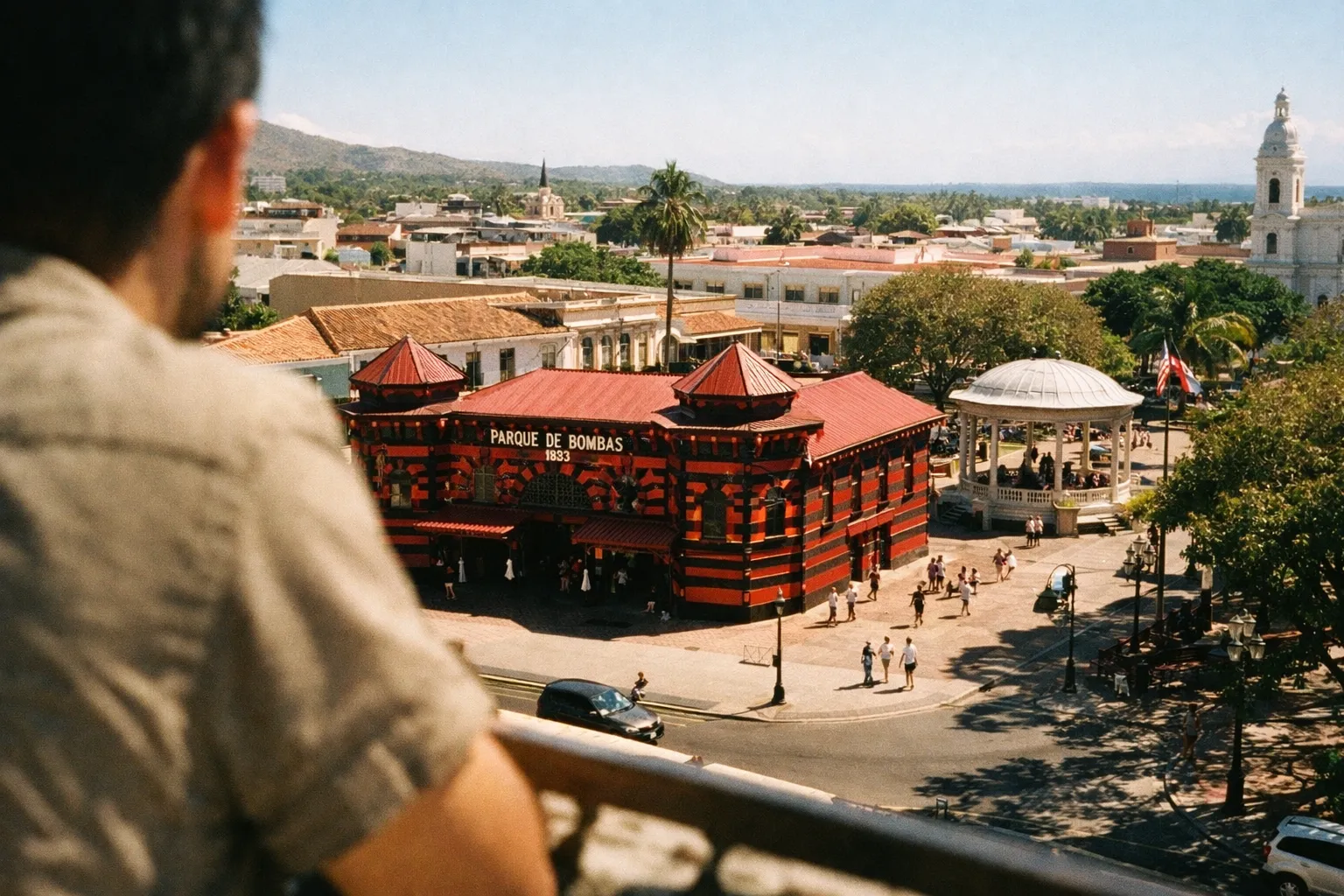
Match the month to your priority - weather, price, or quiet - and Puerto Rico rewards the planning. Book flights on a Sunday, arrive midweek, and if you’re anywhere near hurricane season, insure the trip before you do anything else.
Frequently Asked Questions
- Do I need a passport to travel to Puerto Rico?
- U.S. citizens do not need a passport to visit Puerto Rico, only a valid government-issued ID.
- Is it safe to visit Puerto Rico during hurricane season?
- Visiting during hurricane season is possible with travel insurance and flexible bookings, but risk of weather disruptions is higher.
- What areas of Puerto Rico are driest during the wet season?
- The eastern side, near Fajardo and Luquillo, tends to be drier than the western coast during wet months.
- How far in advance should I book for peak winter season?
- Booking 3-6 months ahead secures better rates and availability for December through March.
- Are there any local events worth timing my trip around?
- The San Sebastián Street Festival in mid-January is the biggest event in San Juan, attracting large crowds.
- Can I find budget accommodations near Old San Juan?
- Staying in Condado or Isla Verde offers budget savings while keeping you 10-20 minutes from Old San Juan.
- What is the best time for whale watching in Puerto Rico?
- February through May is prime time for humpback whale sightings off the west and southwest coasts.