Old San Juan is barely half a square mile of cobblestone, and that compactness is the whole appeal: two massive Spanish forts, centuries of colonial color, and dozens of restaurants all within an easy walk. One 10 dollar ticket covers 24 hours at both El Morro and San Cristobal, which is the best deal in the city. The main thing to get right before booking a hotel is that this old core is a different world from modern San Juan. Sort that out and the rest falls into place.
What’s the difference between Old San Juan and the rest of the city
This trips up more travelers than anything else, so let’s clear it up before you book a hotel in the wrong place.
Old San Juan (sometimes written as old city San Juan Puerto Rico) is the historic walled core - roughly 1.5 miles long and half a mile wide, sitting on its own islet connected to the mainland by bridges (1)(2). It’s the forts, the cobblestones, the cathedral, the galleries. Everything is dense and walkable.
Modern San Juan is the sprawling metro around it: Condado and Isla Verde for beaches and high-rise hotels, Miramar for boutique stays, Hato Rey for business. Those districts have sand and nightlife, but you’ll need a car or rideshare to move between them - see our guide to Isla Verde’s beaches (4).
The practical consequence: if your priority is the colonial streets and forts, stay in or immediately next to Old San Juan. Book a hotel in Isla Verde thinking it’s a short walk to El Morro and you’ll be paying $15-30 round-trip in rideshare fares every day just to reach the old city.
Getting to Old San Juan and getting around
Luis Muñoz Marín International Airport is about 8-10 miles from Old San Juan - roughly 20 to 30 minutes by car depending on traffic. A taxi or Uber runs $20-30. The airport handled 6.6 million passenger arrivals in 2024, an 8% jump over the prior year, so expect company at the rental counters.
Cruise passengers have it easiest. Ships dock immediately adjacent to the district, and it’s a 5- to 10-minute walk from the pier to Plaza de Armas or Calle Fortaleza.
Can you just walk around Old San Juan? Yes - completely. The entire district fits within a 0.5- to 0.75-mile radius, and the main streets (Calle Fortaleza, Calle San Francisco, Calle del Cristo, Norzagaray) plus both forts sit on the same walkable ridge (6)(7). You do not need a car once you’re inside. If you’re driving in from elsewhere, public parking garages charge $5-12 for the day; metered street parking runs $1-2 per hour and fills up fast.
Time budget:
- Minimalist loop (Calle Fortaleza, Plaza de Armas, one fort): 2-3 hours
- Full day (both forts, city walls, cathedral, museums, food stops): 6-8 hours
Exploring the historic fortifications
Old San Juan’s most impressive feature is its fortification system, built when the city guarded the entrance to the Spanish empire’s Caribbean shipping lanes.
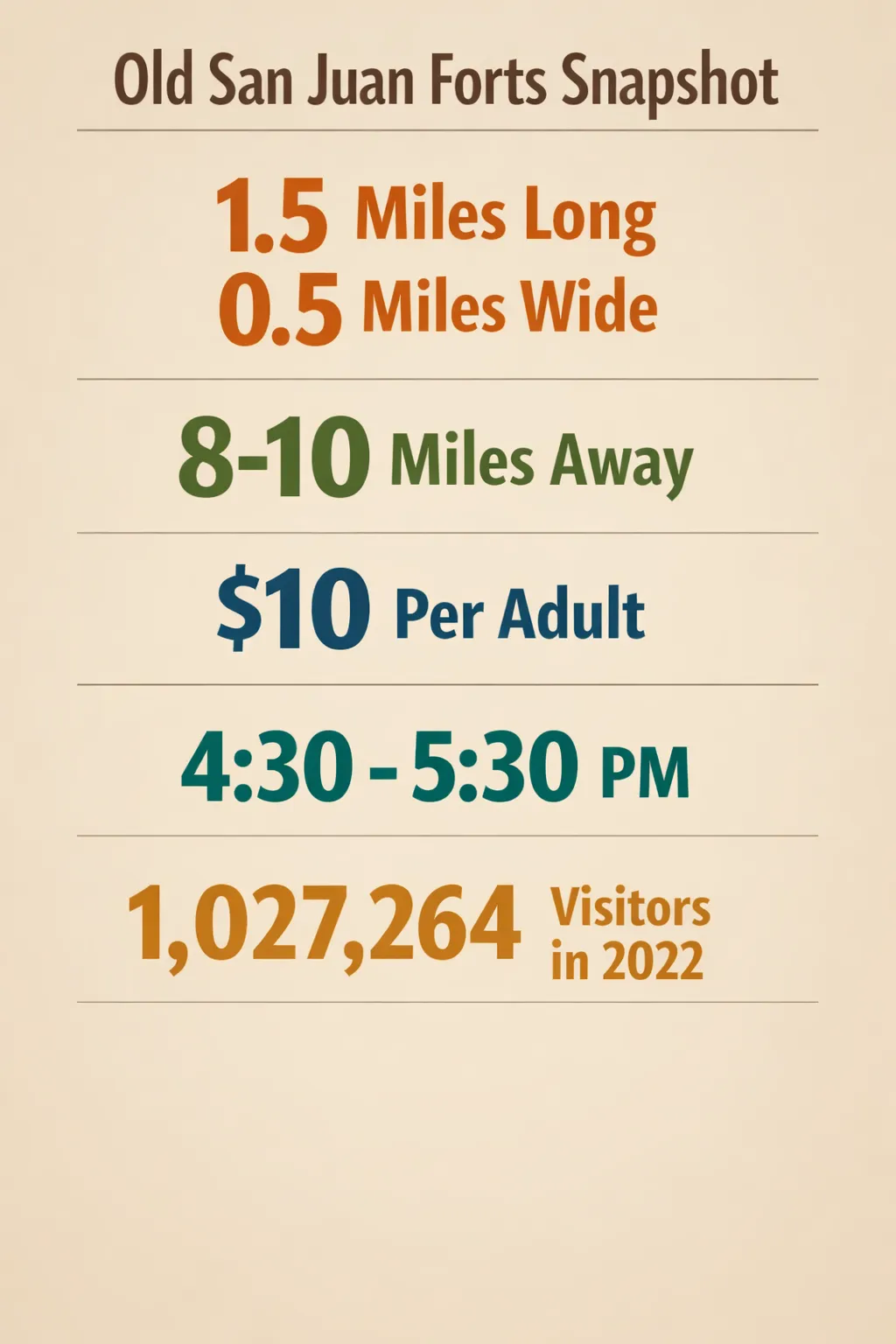 A concise data snapshot of Old San Juan fort access, timing, and visitor figures.
Castillo San Felipe del Morro - El Morro - sits on a rocky promontory over the Atlantic. Its six levels of walls, ramps, and gun positions look out over water that shifts from deep blue to gray depending on the weather. Construction began in 1539, and the fort’s job was defending against sea attacks.
Castillo San Cristóbal, a short walk east, was the land-facing counterpart. Begun in 1634, it’s a warren of tunnels, outposts, and artillery positions - engineering built to stop assaults coming overland rather than from the harbor. You can spend a couple of hours in the tunnels alone.
Both forts, along with the city walls and La Fortaleza, form the La Fortaleza and San Juan National Historic Site, inscribed as a UNESCO World Heritage Site in 1983 for its outstanding example of European military architecture in the Americas (8)(9). The National Park Service has protected the site as a unit since February 14, 1949 (10).
This is not a quiet ruin. San Juan National Historic Site drew 1,027,264 visitors in 2022, one of the busiest historic sites in the Caribbean.
Booking mechanics: A 24-hour pass covering both El Morro and San Cristóbal runs about $10 per adult, with children under 15 typically free; America the Beautiful national park passes are accepted. The critical detail most guides skip: the forts close around 4:30-5:30 pm. Arrive after 4 pm and you’ve paid full price for a rushed visit. Go in the morning or early afternoon.
Old San Juan Forts Comparison
| Castillo San Felipe del Morro | Castillo San Cristóbal | |
|---|---|---|
| Construction Began | 1539 | 1634 |
| Primary Purpose | Defend against sea attacks | Defend against land attacks |
| Size | 70 acres | 27 acres |
| Unique Feature | Iconic lighthouse | Extensive tunnel system |
Walking the cobblestone streets of Puerto Rico’s colonial district
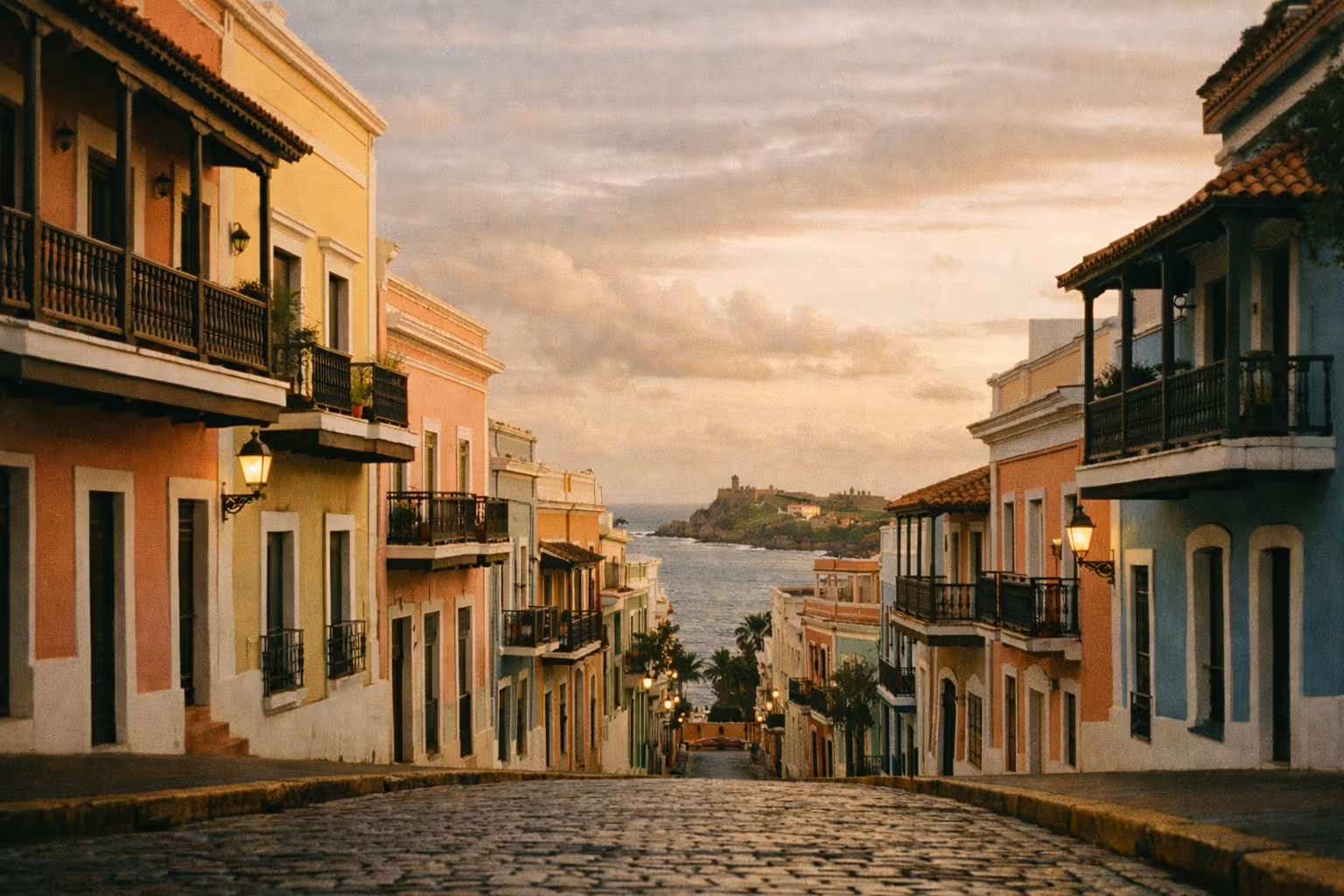
The forts get the photos, but the streets are the reason to come. The district’s blue-gray adoquín cobblestones - ballast bricks from Spanish ships - pave a grid of restored colonial buildings, many 200 to 400 years old. The wider city has its own draw - see things to do in San Juan. Ranking the streets by whether they’re actually worth your feet:
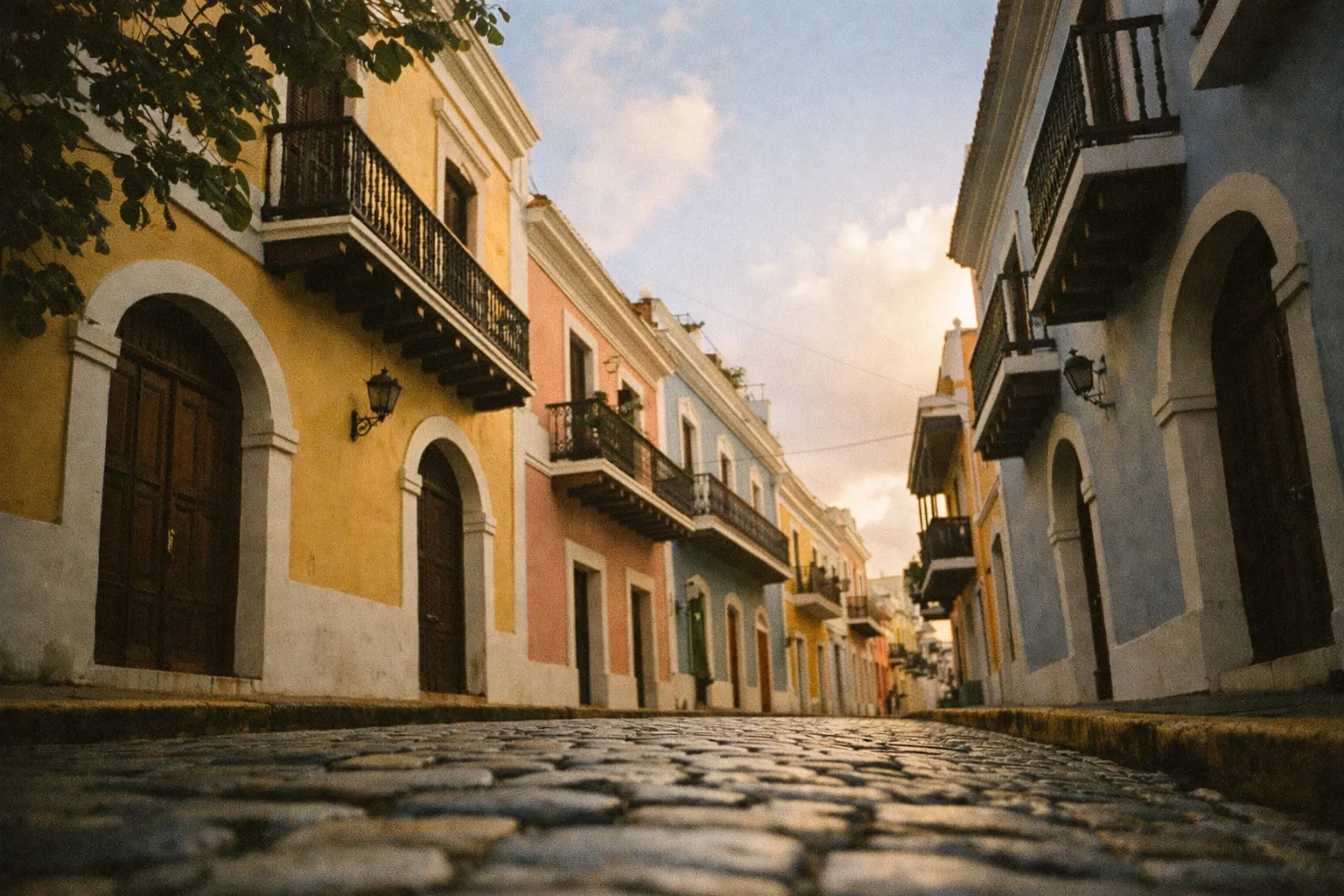
Worth the detour:
- Norzagaray - Runs along the northern edge with constant Atlantic views, connecting El Morro, the cemetery, and the bastions. This is the best photo route in the city: pastel houses against sea walls. Use it as your spine.
- Calle del Cristo - The postcard street. Cobblestones, boutiques, the cathedral, and Capilla del Cristo at the far end.
- Calle Fortaleza - Runs from the port up toward La Fortaleza. The stretch with the umbrella canopy is heavily photographed but genuinely worth it.
Worth it if you have time:
- Calle San Sebastián - The nightlife spine, quiet by day, loud after dark.
- Calle Sol and Calle Luna - Quieter residential blocks that show the city without the crowds.
Elevation matters here. The streets climb toward El Morro on the northwest, and the cobblestones get slick after rain. I’ve watched more than one person go down hard on the descent near the cathedral after an afternoon shower. Wear real shoes, not flip-flops.
Walking it yourself is the point, but the facades give up very little on their own. A short group walk over the same spine puts names and dates on what you’re looking at, at a fraction of what a private guide costs:
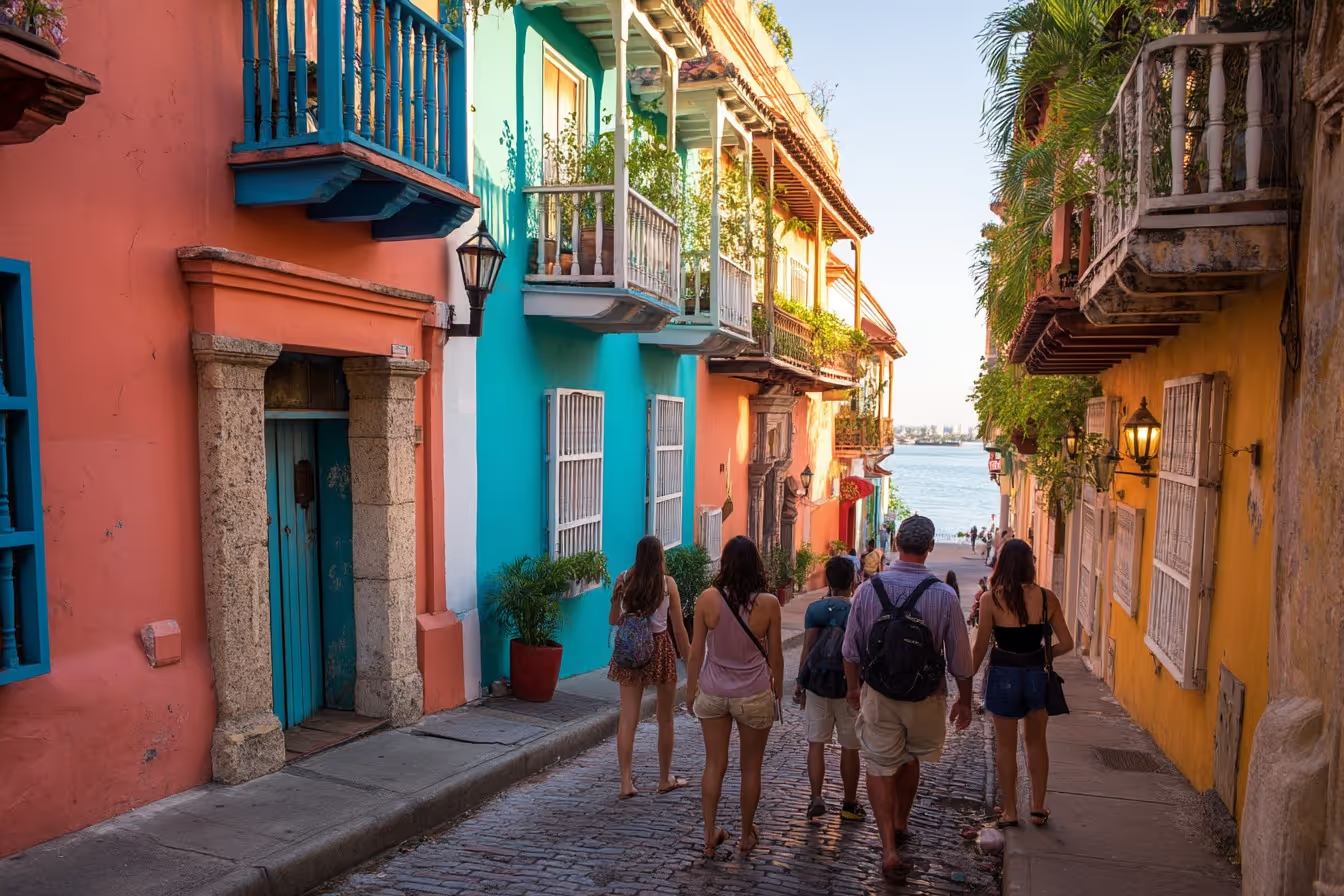
Old San Juan Guided Walking Tour
Two hours over the same cobblestone spine, with someone explaining what the facades don't.
Check availabilityBest restaurants Puerto Rico
Food and drink account for about 14% of what visitors spend in Puerto Rico, and it’s a genuine reason to plan your day around meals. Mid-range sit-down spots charge roughly $18-30 for mains - mofongo, seafood, steaks - with appetizers at $8-14 and cocktails $10-16. High-end entrées run past $40. A casual lunch with a drink or two lands at $40-60 per person, which surprises budget travelers.
Ranking the restaurants in old San Juan Puerto Rico by what they’re actually good for:
- Marmalade Restaurant & Wine Bar - The fine-dining benchmark, rated 4.8-5.0 across platforms, with multi-course tasting menus running $95-$135 per person before drinks. Book this 3 to 7 days ahead in high season.
- Sofia’s Old San Juan - Italian steakhouse, around 4.8/5 with 1,500-plus reviews; mains $28-45. Reliable and lively.
- Local cafeterias and fondas - For $10-15 you get the food Puerto Rico actually eats: mofongo (mashed plantains with garlic and pork cracklings), alcapurrias (fritters stuffed with meat or seafood), and rice-and-beans plates. Skip the tourist-menu places on the port blocks and walk two streets inland.
Save room for a piña colada - legend credits the Caribe Hilton with its invention, though that hotel sits just outside the old city.
Nightlife
Calle San Sebastián is the center of gravity after dark. My picks:
- La Factoría - A multi-room cocktail bar named among the World’s 50 Best Bars, with cocktails at $12-16. Each room has a different feel; keep walking through the back and you’ll find a salsa floor.
- Nuyorican Café - Intimate venue for live salsa and dancing. If you want the real thing rather than a hotel show, this is it.
- La Taberna Lúpulo - Deep craft beer list, local and imported.
- El Batey - A no-frills dive with character stapled to the walls. Good for a quiet late drink.
- US Ghost Adventures - A guided walk through the old town after dark, if you’d rather open the evening with the district’s history than with a drink; readers get a discount with the code LYNX10.

San Juan Ghost Tour
The colonial district after dark, told as its own ghost stories: the cemetery, the chapel legend, the walls.
See tour timesLandmarks and attractions beyond the forts
The forts anchor the visit, but several smaller sites reward a detour off the main streets.
- Santa María Magdalena de Pazzis Cemetery - Just outside El Morro’s walls, this seaside cemetery holds ornate mausoleums set against crashing Atlantic surf. Worth the short walk down from Norzagaray.
- Casa Blanca - The house-museum built for Juan Ponce de León’s family (he never actually lived here). Good for 16th- and 17th-century colonial context, and the gardens are a genuine cool-down spot mid-day.
- Capilla del Cristo - A tiny 18th-century chapel at the end of Calle del Cristo, tied to a local legend about a rider and horse saved from plunging off the cliff. Quick stop, high charm.
- Parque de las Palomas - Small park with panoramic harbor views and a resident pigeon population. Two minutes; take the view.
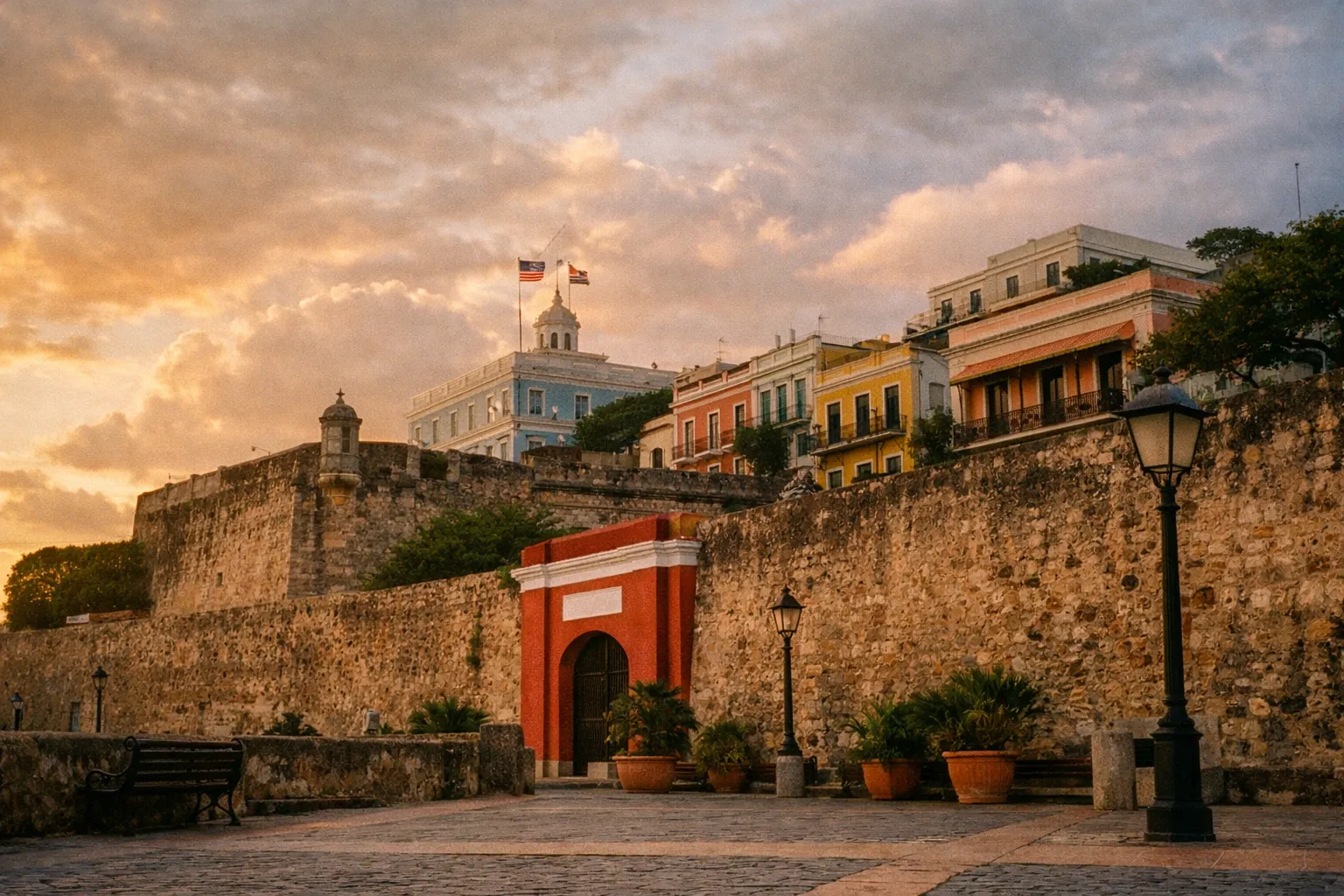
- Puerta de San Juan - One of the last surviving city gates, a red door in the wall near the water. Walk through it to understand how the city sealed itself off.
- Museo de las Américas - Cultural museum in a former barracks; skip if short on time, worth it if you want depth on the wider Americas.
Today: tourism and 500 years of history
Founded over five centuries ago as a walled Spanish stronghold, Old San Juan has spent its recent decades reinventing itself as the walkable historic core of a booming tourism economy. Puerto Rico generated $9.8 billion in tourism revenue in 2023, with about 92.7% of visitors arriving from the mainland U.S.. The momentum is still building: lodging revenue between January and October 2025 hit $1.707 billion, with hotel and rental demand up roughly 9%.
The typical visitor skews toward women (59%), ages 40-59, staying an average of 8 days and spending about $933 per trip. Notably, 96% travel independently rather than on packages, which is why self-guided walking works so well here. For the rest of the island, start with things to do in Puerto Rico. If you’d rather have a guide, group walking tours run 2-3 hours starting around $35-50 per person, often bundling fort admission or a rum tasting.
For lodging, most visitors base themselves in San Juan, Carolina, or Río Grande. Roughly 22% stay in hotels, 20% in short-term rentals, and 47% with family. Boutique and luxury properties in or near the old city run $250-500+ per night in high season.
Visiting guide: costs, timing, and what to be cautious of
Best month to visit
Go in the shoulder seasons - May through early June, or September. Hotel occupancy, which averaged 70.7% in early 2025, dips slightly, which means better room rates and easier restaurant reservations. The tradeoff is heat and hurricane-season risk in September; watch the forecast. Peak season (December-April) has the best weather and the worst crowds and prices.
What a day costs
- Budget (under about $60): Walk the streets and churches for free, pay the about $10 fort ticket, eat at cafeterias ($10-15). Buses run $1-2, short rideshare hops $6-10.
- Mid-range ($100-150): Fort admission ($10), one museum ($5-10), sit-down lunch ($20-30), a cocktail bar ($12-16/drink), some shopping ($20-40).
- High-end ($250+): Private history guide ($150-250 for 3-4 hours), tasting menu at Marmalade ($95-135), craft cocktails at La Factoria.
What to be cautious of in Puerto Rico
Nothing exotic - standard urban precautions plus tropical realities:
- Heat. The heat index regularly hits 90-105°F. Start your street walking by 8-9 am, retreat to shaded fort interiors or a garden by early afternoon, and carry water. People underestimate this and end up wrecked by 2 pm.
- Cobblestones after rain. They get slippery, and the descent toward the cathedral is steep. Sturdy shoes.
- Petty theft. Keep cash under $100-200, stick to lit, busy streets at night, and watch your bag in crowds.
- Booking the wrong neighborhood. Circling back to the earlier point - confirm your lodging is actually in or beside Old San Juan if that’s your priority.
Insider timing
Plan your route so you reach the El Morro lawn around 5-6 pm. The forts close by then, but the open lawn stays accessible, and the light over the walls at sunset beats anything you’ll get at midday. It also gets you off the cobblestones during peak heat.
✓ Pros
- Compact, walkable historic district with dense colonial architecture
- Two major forts with rich history and well-preserved tunnels
- Strong local food scene with authentic and fine-dining options
- Easy access from airport and cruise port
- Self-guided walking works well for most visitors
✗ Cons
- Forts close early afternoon, limiting late visits
- Cobblestone streets can be slippery after rain
- Heat can be intense by early afternoon
- Modern San Juan districts require transport from Old San Juan
- Hotel prices in or near Old San Juan can be high in peak season
Frequently Asked Questions
- Can I use public transportation to get around Old San Juan?
- Public buses exist but are infrequent; walking is the best way to explore the district.
- Are the forts accessible for visitors with mobility issues?
- The forts have uneven cobblestones and stairs; accessibility is limited and challenging.
- Is it safe to visit Old San Juan at night?
- Stick to busy, well-lit streets like Calle San Sebastián; petty theft can occur in crowds.
- Do I need to book restaurants in advance?
- High-end places like Marmalade require booking 3-7 days ahead in high season; casual spots usually do not.
- Can I visit both forts with one ticket?
- Yes, a single $10 pass covers El Morro and San Cristóbal for 24 hours.
- What is the best way to avoid the afternoon heat?
- Start early, visit shaded forts or parks midday, and plan to be on the El Morro lawn near sunset.
- Are guided tours worth it in Old San Juan?
- Guided tours cost $35-50 and add historical context; self-guided walking is sufficient for many.