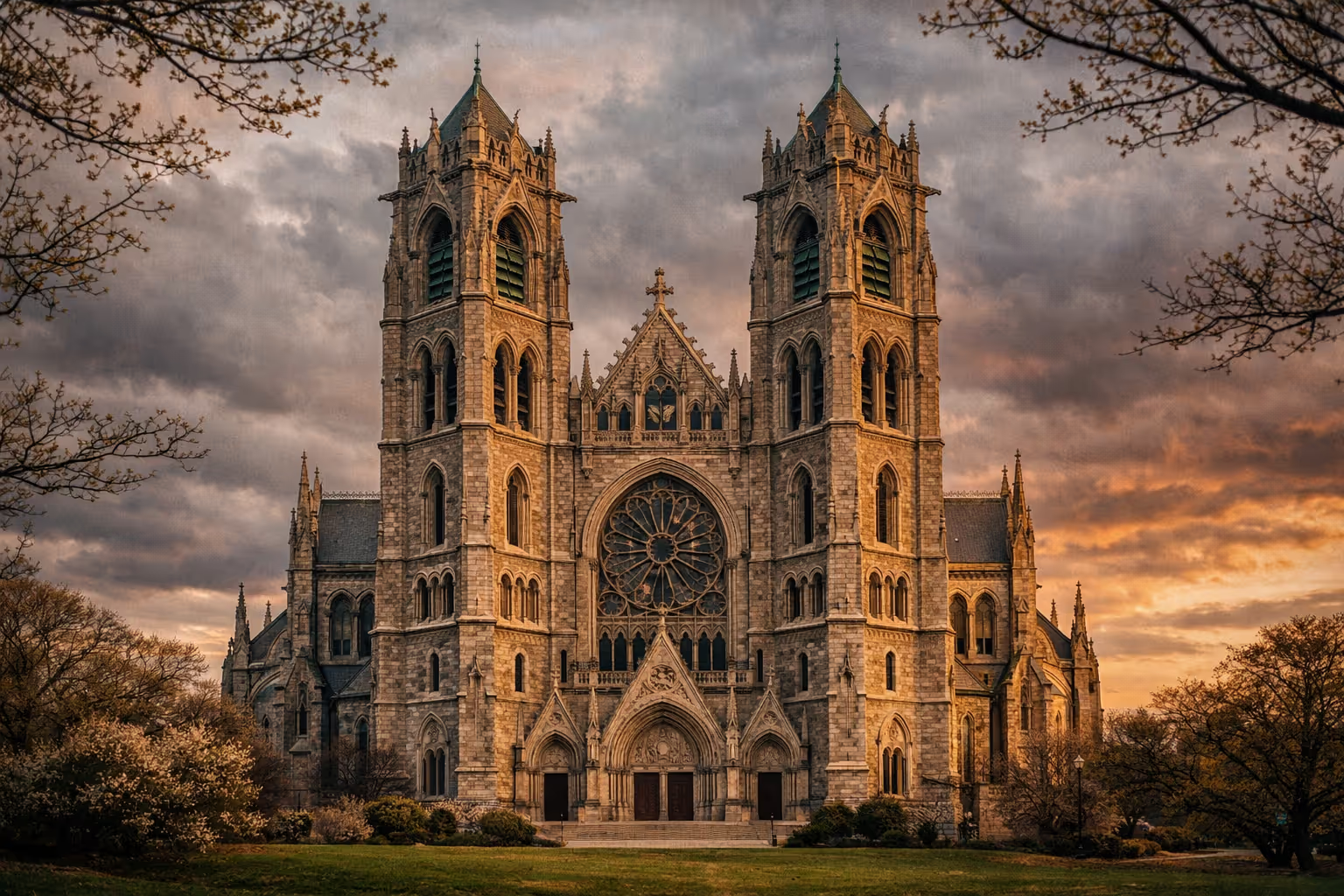
The Cathedral Basilica of the Sacred Heart in Newark is longer inside than St. Patrick’s in Manhattan, costs nothing to enter, and parks you for free, which is a combination you rarely get this close to New York. It is a working parish, open daily for prayer, and reachable in about 25 minutes on the PATH for three dollars. Most visitors come for the French Gothic scale and leave surprised it is free. Here is the practical side: hours, parking, and getting there.
Background: What You’re Actually Looking At
The Cathedral Basilica of the Sacred Heart is the seat of the Roman Catholic Archdiocese of Newark, which serves roughly 1.2 million Catholics across Essex, Union, Hudson, and Bergen counties. It’s a working parish, not a museum - there is no ticket desk, no audio guide, and no gift shop loop. Walk in through the Ridge Street entrance, sit down, and the building does the rest.
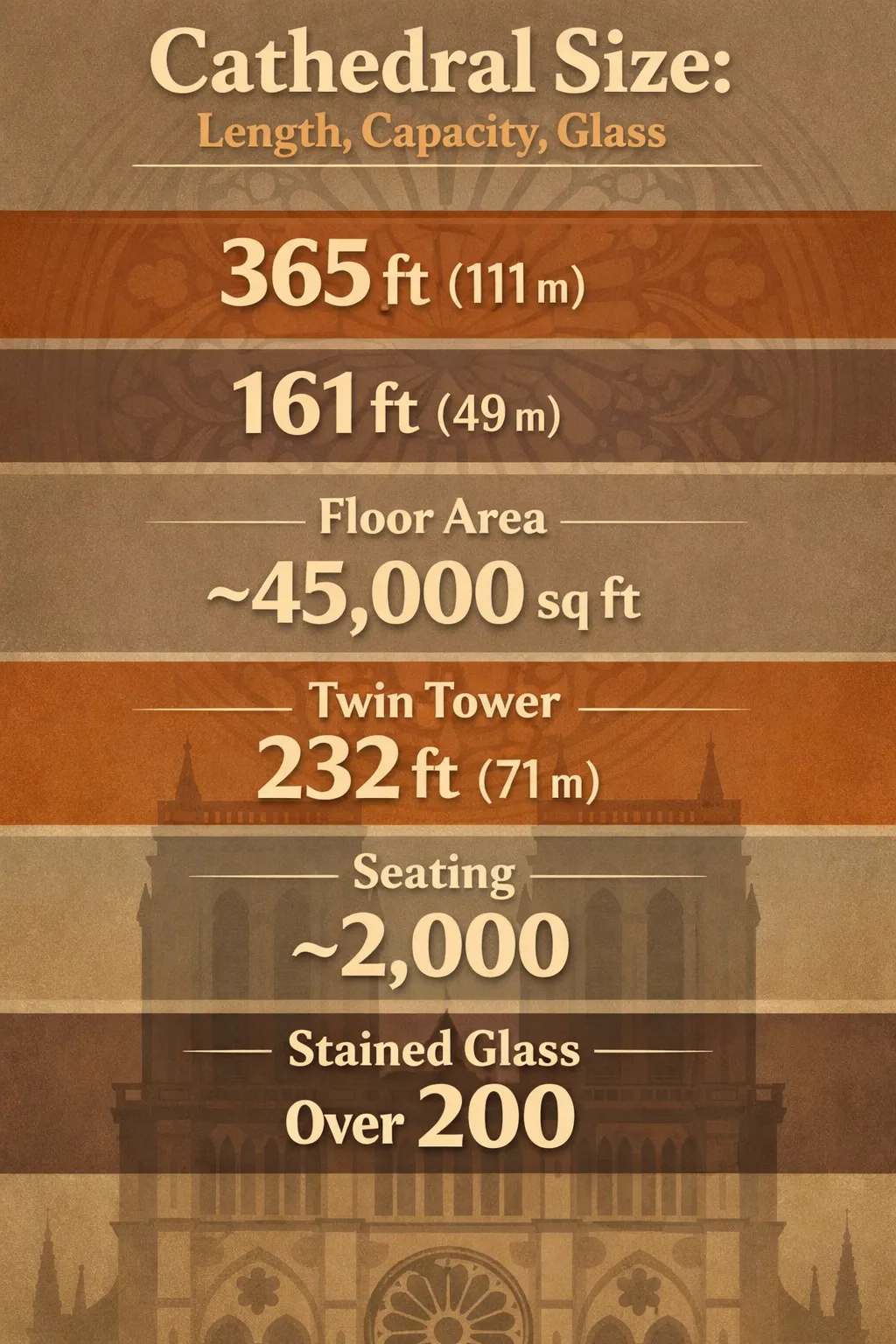 The Cathedral Basilica of the Sacred Heart in Newark measures 365 ft long, 161 ft wide, with about 45,000 sq ft of floor area, 232 ft twin towers, seating about 2,000, and more than 200 stained glass windows.
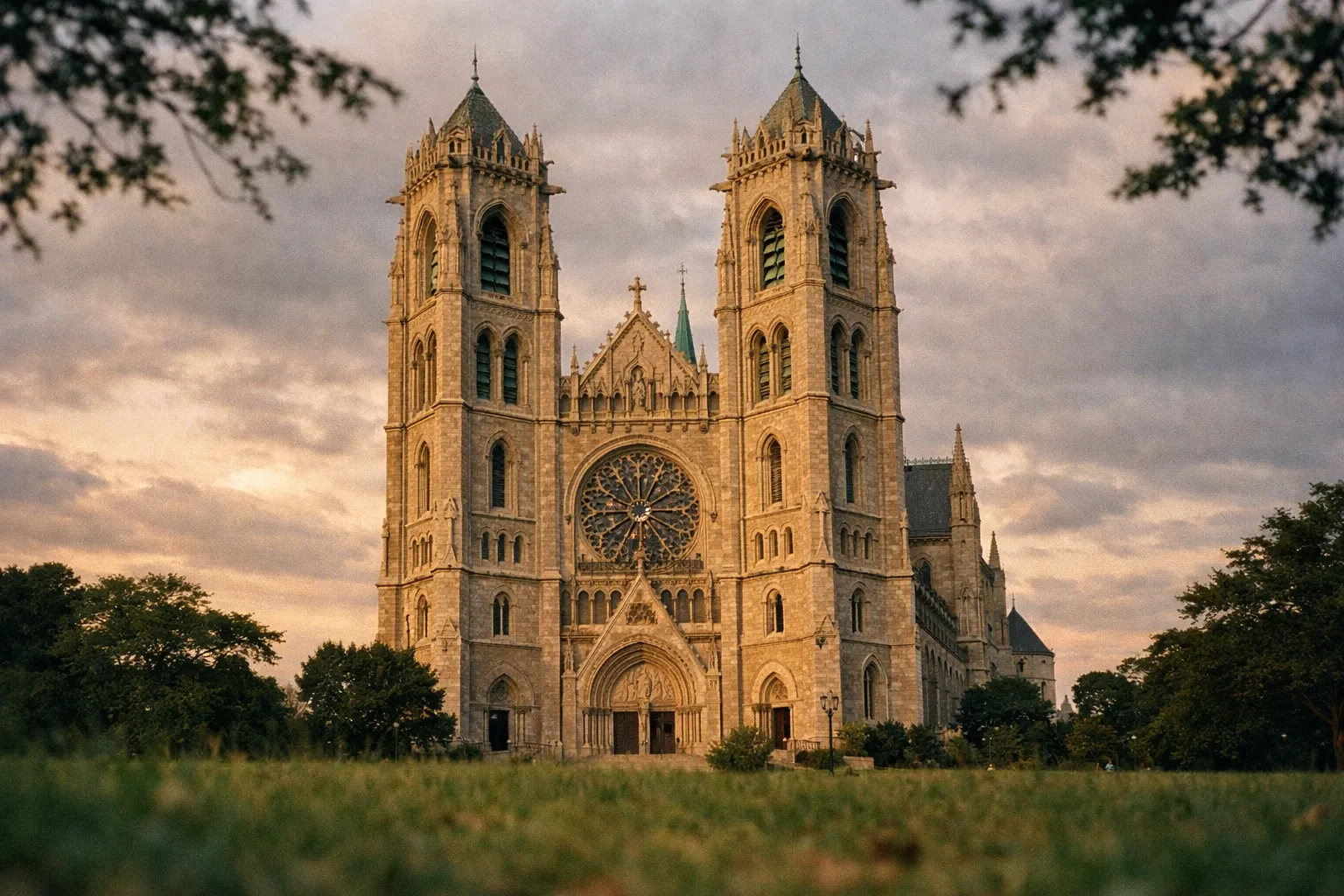
The numbers that matter:
- Length: 365 ft (111 m)
- Width: 161 ft (49 m)
- Floor area: approximately 45,000 sq ft
- Twin tower height: 232 ft (71 m)
- Seating capacity: roughly 2,000
- Stained glass windows: over 200
Those dimensions put it in the same size class as London’s Westminster Abbey and make it longer than St. Patrick’s Cathedral in Manhattan (1)(2). Most guides get this wrong - they default to St. Patrick’s as “the big New York Catholic cathedral” and skip Newark entirely. By interior length, Newark wins.
The building is widely considered one of the most faithful examples of French Gothic Revival in the Western Hemisphere. Look for the ribbed vaulting, the rose window above the main entrance, and the flying buttresses on the exterior. The side chapels each represent an immigrant community that built the archdiocese - Irish, Italian, Polish, German - and that’s honestly the most interesting interpretive layer if you’re walking through without a guide.
Who Built the Cathedral Basilica of the Sacred Heart
The land was purchased in 1871 for $60,000 (roughly $1.5 million in 2024 dollars). Construction broke ground in 1898-1899 under Jeremiah O’Rourke, an Irish-American architect active in New Jersey who supervised much of the federal government’s church-adjacent building in the late 19th century (2). His original plan leaned English-Irish Gothic.
Midway through the build - around the 1910s - the design pivoted to French Gothic Revival, which is why the window tracery, sculptural program, and tower detailing read more like Reims than like a parish church in Dublin. Multiple architects and contractors carried the project through subsequent decades, with the superstructure largely standing by the late 1920s and interior finishing dragging through the Depression and World War II.
The final dedication came in October 1954. Total cost: approximately $18 million, or about $200-$220 million in today’s dollars when adjusted for inflation (1)(2). For context, a 55-year build is actually fast by historic-cathedral standards. Milan Cathedral took nearly 600 years from groundbreaking in 1386 to its commonly cited completion in 1965. Newark got off easy.
Visit by Pope John Paul II and Elevation to Basilica
On October 4, 1995, Pope John Paul II visited Newark as part of his U.S. apostolic tour, celebrated evening prayer at the cathedral, and formally elevated it to the status of minor basilica (2). That’s the “Basilica” half of the name.
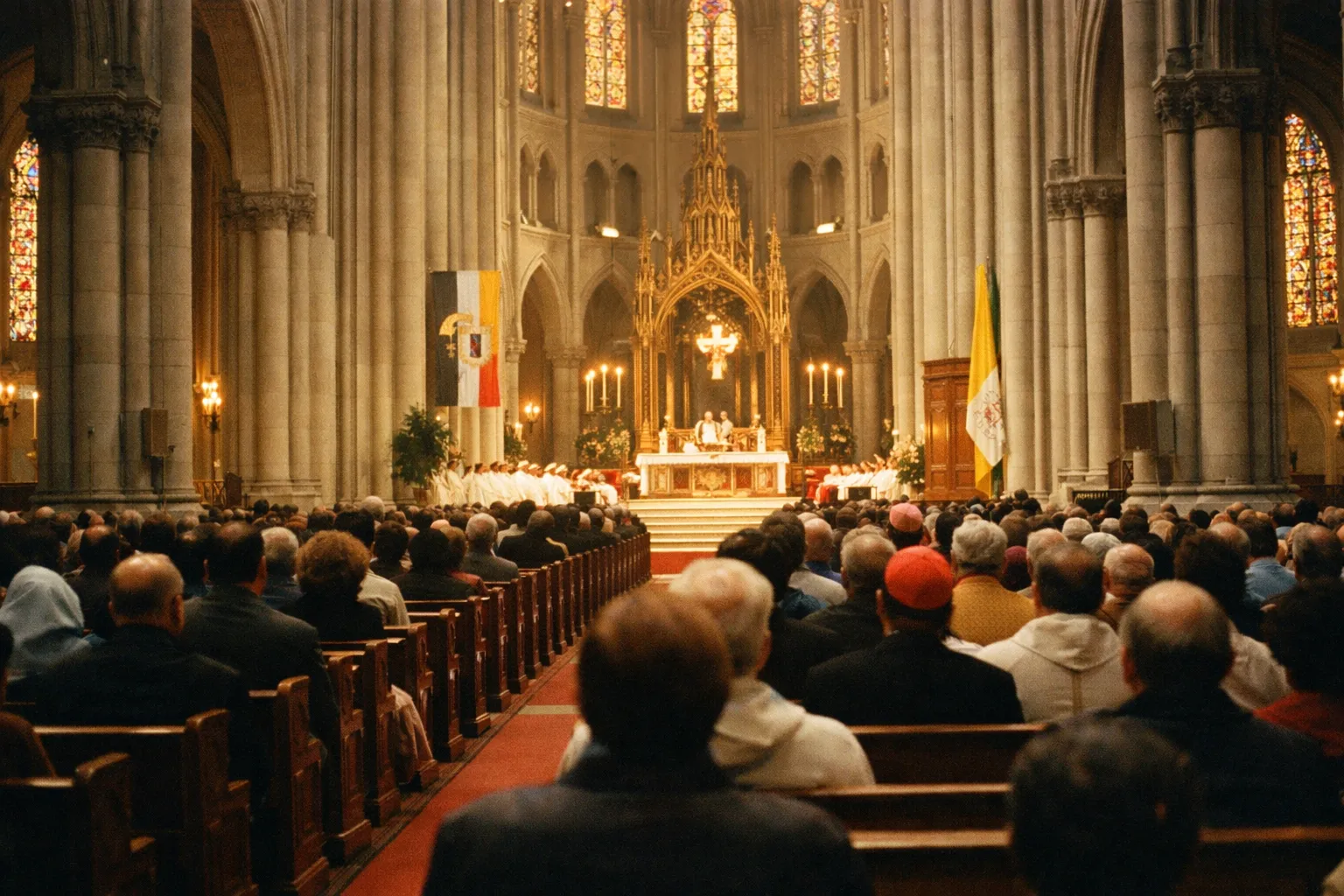
Minor basilica status is honorary and liturgical. It grants the church a handful of specific privileges:
- Use of the papal symbol (crossed keys) in the church’s iconography
- Right to display the ombrellino (a ceremonial canopy) and tintinnabulum (a bell on a pole) in processions
- Authority to grant plenary indulgences on specific feast days under standard conditions
It does not make the cathedral independent of the archbishop. It remains Cardinal Tobin’s seat. People sometimes assume “basilica” implies a separate jurisdiction - it doesn’t. The designation recognizes historical, architectural, or pastoral importance, awarded by the Pope.
One related question that comes up: basilica comes from the Latin basilica and Greek basilikē, meaning “royal hall” or “royal stoa.” In Roman architecture it referred to a rectangular public hall used for legal and commercial business. Early Christians adopted the floor plan, and the term eventually became both an architectural label and an ecclesiastical honor. In modern Italian, the word still covers both meanings - architectural type or papally designated church.
A Letter to the Faithful from Cardinal Tobin
The cathedral’s current archbishop is Cardinal Joseph W. Tobin, C.Ss.R., appointed by Pope Francis in 2017. He’s a Redemptorist (the C.Ss.R. after his name) and one of the more publicly visible American cardinals on social and immigration issues.
In May 2025, on Pentecost, Cardinal Tobin launched “We Are His Witnesses,” a pastoral initiative for the Archdiocese of Newark focused on evangelization, parish renewal, and missionary discipleship (4). His accompanying letter to the faithful frames it as a multi-year priority and outlines how parishes - the cathedral included - should orient their programming around it.
For a visitor, this matters in two practical ways. Liturgies presided over by the cardinal often include themes from the initiative, and the cathedral’s events calendar increasingly features mission-focused gatherings, ethnic community celebrations, and large diocesan liturgies. If you want to attend a Mass with the cardinal presiding, the cathedral’s website lists upcoming dates - Chrism Mass during Holy Week and ordinations in late spring are the most reliable annual appearances.
Parking at the Cathedral: Options Ranked
Parking near the cathedral is one of the easier logistics problems in Newark - there’s almost always something within a block.
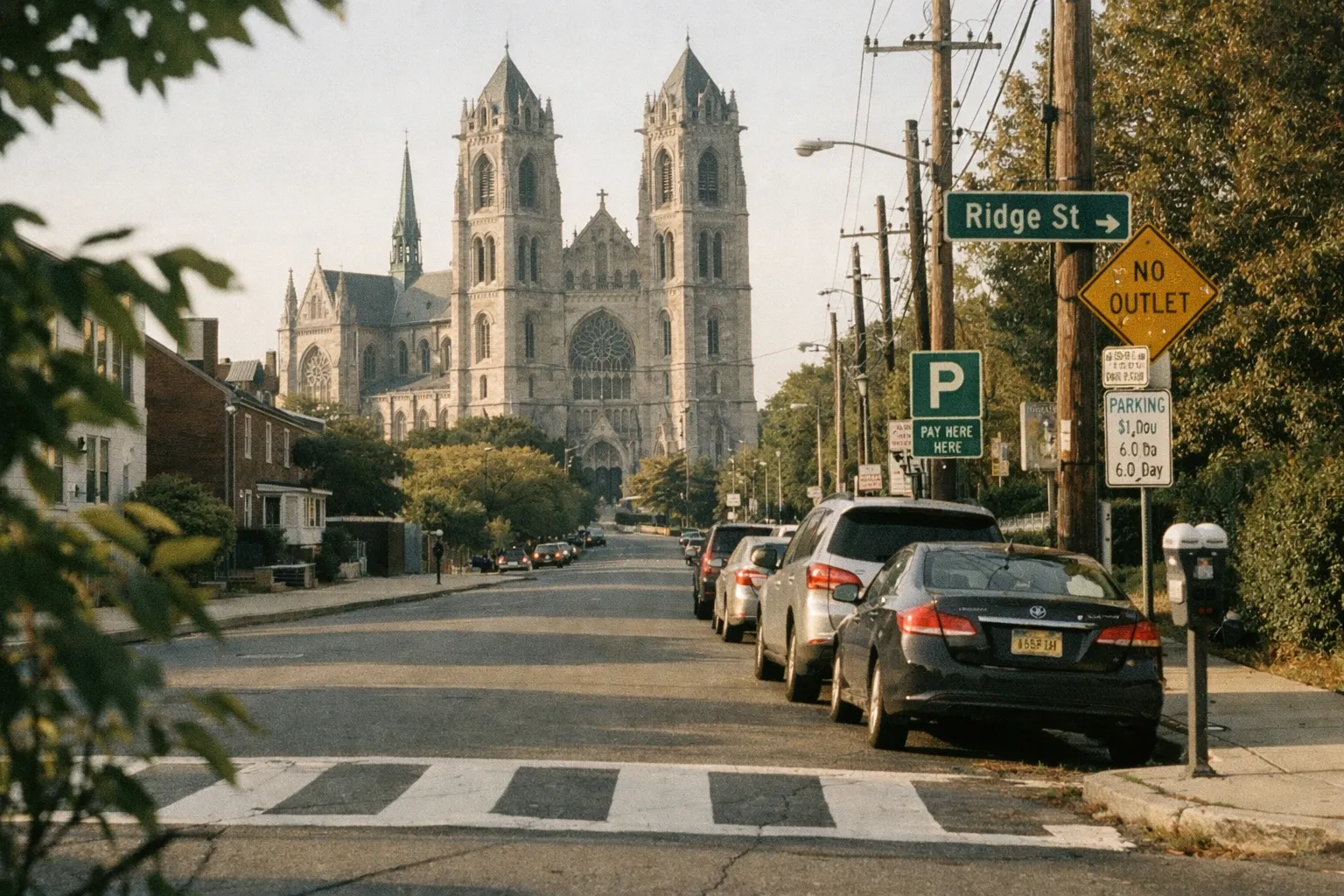
Options, ranked by worth-the-effort:
- Archdiocesan Center lot (across Clifton Avenue): roughly 100+ spaces, generally free for Mass and most cathedral events. This is your default.
- North lot adjacent to the cathedral: 50-100 spaces, also typically free. Fills first during major liturgies.
- On-street parking on Ridge Street, Clifton Avenue, and Grafton Avenue: usually free but with Newark city restrictions - read the signs. Some blocks have 1-2 hour limits or alternate-side rules.
- Paid lots and garages within walking distance: only relevant for major events (NJ Symphony concerts, Christmas Eve Mass) when the cathedral lots fill 30-45 minutes early.
Timing rules:
- Weekday midday visits: park almost anywhere. Lots and street are wide open.
- Sunday morning Mass: arrive 15-20 minutes early for the 10:00 a.m. English Mass - it’s the busiest.
- Major events (NJ Symphony, Christmas, Easter, ordinations): arrive 30-45 minutes early. Volunteers direct cars during the largest liturgies.
Accessibility: The main front doors require steps. The ADA-accessible entrance is on Ridge Street, with a ramp and elevator access to the nave (3). Designated handicapped parking is available in both lots.
Safety note: This is urban Newark. The Forest Hill / Branch Brook Park neighborhood is generally safer than downtown blocks, but standard urban precautions apply - park in the lots if you’re staying past dark, don’t leave valuables visible in the car, and consider rideshare directly to the Ridge Street entrance for evening concerts.
Getting There from NYC and Beyond
From Manhattan:
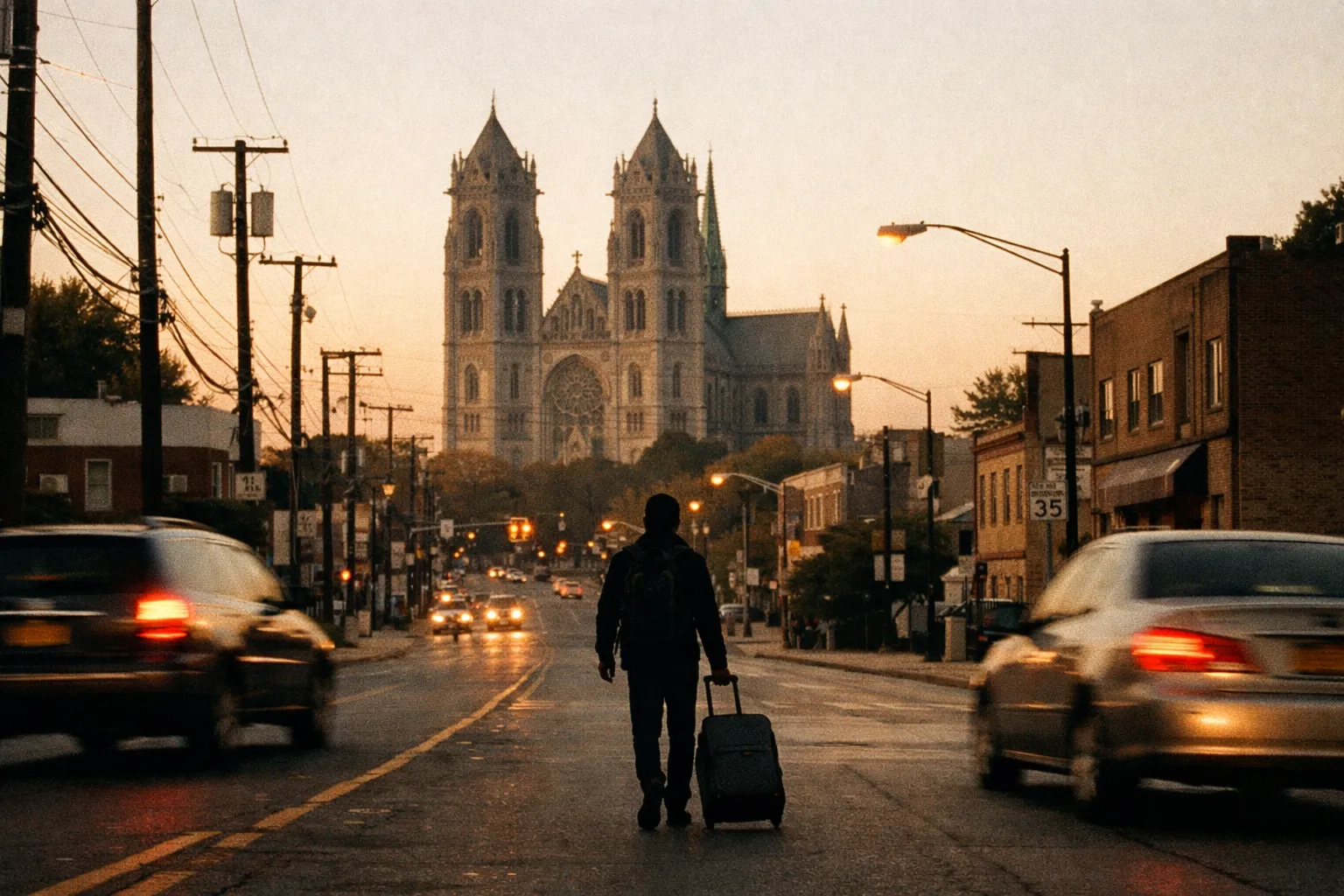
- PATH train from World Trade Center or 33rd Street to Newark Penn Station: ~25 minutes, around $3 one way.
- NJ Transit from NY Penn Station to Newark Penn Station: ~20 minutes, around $5-$6 one way off-peak.
- By car via Holland or Lincoln Tunnel, then I-78 or Route 280: 20-35 minutes off-peak, 45-60 minutes in rush hour.
From Newark Penn Station to the cathedral (roughly 1.7-2.0 miles):
- NJ Transit bus #108 from Gate 213 toward Clifton Avenue, ~10-15 minutes, then a 2-block walk (3).
- Uber/Lyft: 8-10 minutes off-peak, roughly $10-$18.
- Walking: technically possible at 45 minutes, but not recommended - it crosses several uninspiring blocks with no obvious benefit.
For an architecture-only visit from NYC, the PATH + rideshare combo is the cleanest option: under $20 round-trip per person and door-to-door in under an hour.
How to Get to the Cathedral Basilica of the Sacred Heart from NYC
About 1 hourStep-by-step transit and last-mile options from Manhattan to the cathedral.
- 1
Take the PATH train
Board at World Trade Center or 33rd Street station and ride to Newark Penn Station, approximately 25 minutes and $3 one way.
- 2
Last mile from Newark Penn Station
Choose NJ Transit bus #108 (10-15 minutes plus a short walk), rideshare (8-10 minutes), or walk (45 minutes, not recommended).
Mass Schedule and Visiting Hours
Visiting hours as of 2026: Monday 9:00 a.m. - 5:00 p.m., Tuesday through Friday 9:00 a.m. - 7:00 p.m., Saturday 9:00 a.m. - 5:00 p.m., Sunday closes at 2:00 p.m. These have shifted post-pandemic and may adjust again, so confirm on the cathedral’s website or call the office at +1-973-484-4600 within a day or two of visiting (4).
Typical Mass schedule:
- Monday-Saturday: at least one daily Mass, usually mid-morning (7:30-8:00 a.m. range)
- Sunday: generally three Masses - 8:30 a.m. and 10:00 a.m. in English, 12:00 noon in Spanish
- Confessions: Saturday afternoons and by appointment
- Holy Days and feast days: added liturgies; check the bulletin
Visitor etiquette during liturgies is worth spelling out. Don’t walk the aisles with a camera during Mass. Don’t talk through the homily. If you came specifically to see the building and a service is underway, sit in a back pew, observe, and tour during the gap between Masses - typically mid-morning weekdays and mid-afternoon Sundays.
Visit and Tours
There are no scheduled hourly tours. The cathedral runs guided tours by appointment only for groups - schools, parishes, cultural organizations - booked through the Cathedral Administrative Office at +1-973-484-4600. Most group tours are free; a donation of $5-$10 per person is customary.
For independent visitors, the building rewards a self-guided walk if you know what to look for. Suggested route:
- Exterior approach from Branch Brook Park, looking up at the west façade and twin towers
- Main nave from the back, taking in the full length and the ribbed vaulting
- Rose window above the main entrance - best lit late morning
- Side chapels along both aisles, each tied to an immigrant community
- Sanctuary and high altar at the east end
- Crossing and transepts, where the acoustics are strongest for concerts
Photography is permitted for personal use. Flash is discouraged. Tripods and professional equipment require permission from the office - call ahead. Bring a wide-angle lens (16-35mm on full-frame) for the nave and a fast prime (f/1.8 or wider) for interior detail shots.
Admission cost: $0. A donation of $5-$20 at the candle stands or envelope boxes is standard if the building moved you.
Music, Religious Customs and Traditions
The cathedral is one of New Jersey’s most important sacred music venues - not just a parish church with a choir.
Regular liturgical music:
- The 10:00 a.m. Sunday Mass typically features the full cathedral choir and large pipe organ
- Feast day liturgies (Christmas, Easter Vigil, Pentecost, Sacred Heart) include extended choral and brass settings
- The Spanish noon Mass has its own musical character, with bilingual hymnody and occasional mariachi or Latin choral groups for feast days
Concert programming: The New Jersey Symphony uses the cathedral as a regular venue, including annual Holiday concerts and large choral works - Mozart’s Requiem, Handel’s Messiah, Bach passions (3). Tickets typically run $25-$80 depending on section. Audiences for major concerts hit 1,500-2,000.
Where to sit for sound: 10-15 pews back from the altar, near the center line. Avoid the far back corners - the long nave creates noticeable echo that muddies the choral lines. The crossing is the sweet spot for both acoustics and visual angle on the choir.
Cultural traditions: The archdiocese’s ethnic communities celebrate major feasts at the cathedral throughout the year - Our Lady of Guadalupe in December (Mexican community), St. Patrick’s Day liturgies in March, Polish-language Masses for certain feasts, and Italian community celebrations around feast days for patron saints. The schedule rotates annually; check the cathedral website for current dates.
Twenty-First Century Events and Recent Developments
A few things have shifted since the early 2000s that affect a visit today.
Post-pandemic schedule: The cathedral, like most U.S. urban parishes, adjusted weekday Mass times and confession availability after 2020 to reflect changes in commuting and parish life. Some pre-2020 schedules online are wrong. Always check the current bulletin.
Livestreaming: The cathedral’s YouTube channel streams major Masses, ordinations, and concerts, and maintains an archive going back several years (5). For visitors evaluating whether to make the trip, the channel is a useful preview of the music program and liturgical style before you commit to the ride out.
Security and access: As with many U.S. urban cathedrals, side doors are often locked during quiet hours, with entry routed through a single monitored door. This is normal and not a sign the cathedral is closed.
Ongoing maintenance: Gothic stone structures need constant work. Expect periodic scaffolding on the exterior towers and rooflines, and occasional partial closures of side chapels during stained-glass restoration. If you’re traveling specifically for photography, call ahead to confirm nothing critical is wrapped.
“We Are His Witnesses” programming: Cardinal Tobin’s 2025 pastoral initiative has expanded mission-focused events at the cathedral, including additional adult formation gatherings and multilingual liturgies.
Pairing with Branch Brook Park
Skip-if-short-on-time becomes worth-the-detour from late March through mid-April, when Branch Brook Park’s 5,000+ cherry trees bloom. The park is larger than D.C.’s Tidal Basin display and far less crowded. Peak bloom typically falls April 10-20, with the Essex County Cherry Blossom Festival anchored around the second weekend of April.
Combined visit plan (3-5 hours):
- Park at the Archdiocesan Center lot
- Walk down into Branch Brook Park for the cherry groves (60-90 minutes)
- Hike back uphill to the cathedral for an interior visit (60-90 minutes)
- Optional: lunch at one of the Forest Hill neighborhood restaurants on Mt. Prospect Avenue
Outside of cherry blossom season, Branch Brook is a pleasant 20-minute walk-through but not a destination on its own. The cathedral does the heavy lifting the rest of the year.
Best Time to Visit
By season:
- April (cherry blossoms): the obvious peak. Plan around the second weekend, accept the crowds in the park, and the cathedral will still feel quiet.
- Christmas season: for the music - NJ Symphony Holiday concerts and midnight Mass are both significant events. Book concert tickets in October.
- Holy Week (March/April): for the full liturgical experience - Chrism Mass on Holy Thursday morning, Good Friday liturgy, Easter Vigil Saturday night.
- Summer weekdays: for empty interiors and unhurried photography.
By time of day: Weekdays between 10:00 a.m. and 3:00 p.m. give you the best balance of natural light through the stained glass and minimal liturgical activity to work around. Late afternoon during golden hour is best for exterior shots from the park side.
What Most Guides Get Wrong
Three corrections worth making.
It’s not a minor attraction. TripAdvisor reviewers consistently rate it 5.0/5.0 and rank it among Newark’s top 5 things to do (1). The dismissal in most NYC-centric travel content reflects bias against Newark, not the building. I’ve walked Gothic interiors across the Northeast and the nave here stops you cold - the scale reads differently in person than any photo suggests.
“Free admission” doesn’t mean “ungoverned.” It’s a working parish. Treat it as a place of worship first and a tourist site second, and you’ll have a better visit and a warmer reception from staff.
The cathedral and the basilica are the same building. Some readers see both names used and assume two churches. It became a basilica in 1995; the cathedral function - seat of the archbishop - was never lost.
Frequently Asked Questions
- What is the largest Catholic church in New Jersey?
- The Cathedral Basilica of the Sacred Heart in Newark is the largest Catholic church in New Jersey by floor area and seating capacity, and one of the largest cathedrals in North America - longer by interior length than St. Patrick's Cathedral in Manhattan.
- What does basilica mean in Italian?
- Basilica in Italian refers both to an architectural type and an ecclesiastical title granted by the Pope; Newark's cathedral holds the latter as a minor basilica since 1995.
- What church took 600 years to build?
- Milan Cathedral took nearly 600 years (1386-1965) to complete, much longer than Newark's 55-year build.
- Who built the Cathedral Basilica of the Sacred Heart?
- Jeremiah O'Rourke led the initial design and early construction, with later architects completing the French Gothic Revival style by 1954.
- Is parking at the Cathedral Basilica of the Sacred Heart free?
- Yes, parking in the cathedral's north lot and the Archdiocesan Center lot is generally free for Mass and most events; paid options only matter during major concerts.
- Can I attend Mass as a visitor or non-Catholic?
- Anyone may attend Mass; non-Catholics should not receive Communion but are welcome to observe and participate respectfully.
- How long should I plan to visit?
- Plan 60-90 minutes for architecture and photography, plus additional time if attending Mass; combined visits with Branch Brook Park take 3-5 hours.