The Bali airport code is DPS, not BAL, and that one mismatch quietly derails more bookings than any other Bali travel detail. DPS stands for Denpasar, so some flight sites file the island under a city name you were not searching for. There is only one commercial airport, Ngurah Rai, about 13 kilometers south of Denpasar, and no route from the USA reaches it nonstop. Here is what the codes mean and how to dodge the common booking traps.
What is the Bali Airport Code, Bali Which Airport, Ngurah Rai International Airport Bali Indonesia, Denpasar, Airport in Bali Island, and Bali International Airport?
The codes trip people up more than they should, so let’s get this out of the way first.
- IATA code: DPS - the three-letter code you search with on flight sites (1)(7)
- ICAO code: WADD - the four-letter aerodrome code used in aviation operations (1)(4)
The “3 letter code for Bali” is DPS, not “BAL” or “BLI.” Both are common guesses. Both are wrong. DPS comes from Denpasar, the provincial capital the airport serves - which is why some booking systems list your destination as “Denpasar” rather than “Bali.”
This actually matters when you search. I’ve seen travelers miss cheaper fares because they only searched “Bali” and the system had it filed under Denpasar. Search with both DPS and Ngurah Rai together for the cleanest results. What gets called Ngurah Rai International airport Bali Indonesia, Denpasar Airport, or simply Bali International airport depending on who wrote the listing (1)(7) - it’s all one airport.
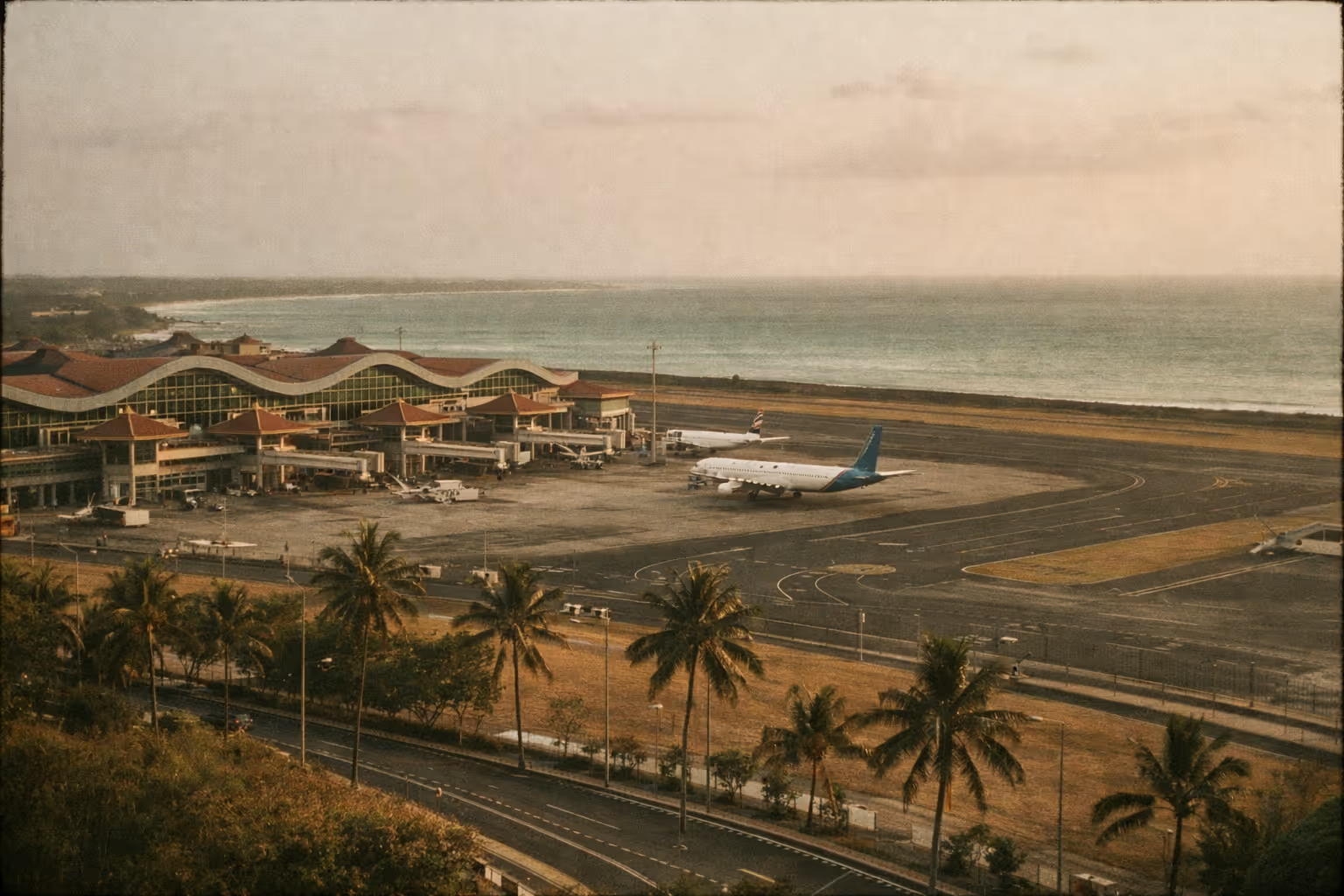
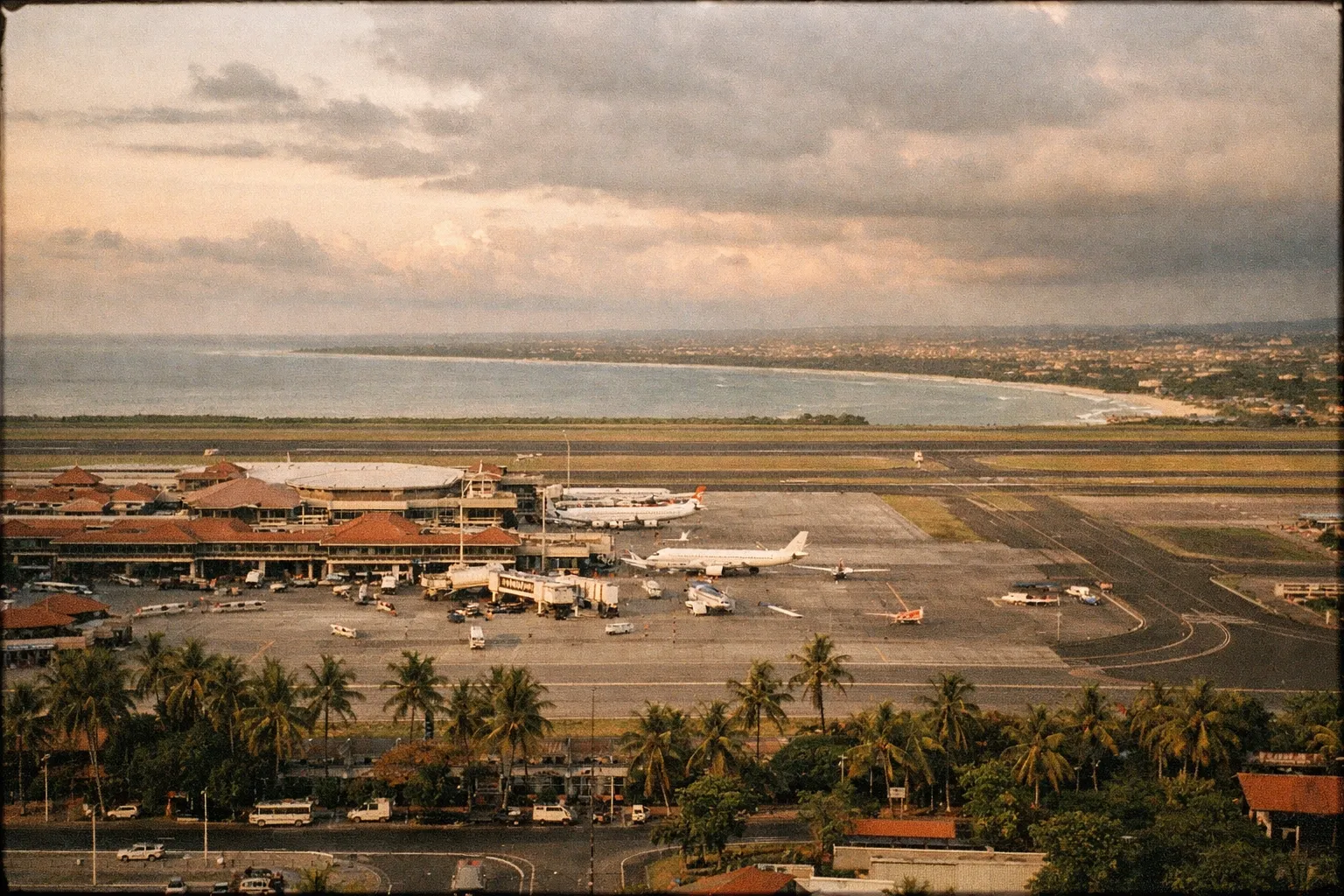
The airport sits in Tuban, Kuta, in Badung Regency on the southern tip of the island - roughly 13 km south of Denpasar’s city center (7). That position, wedged between Kuta’s beaches and Denpasar’s streets, is part of why you can clear arrivals and be at your hotel pool within the hour on a good traffic day.
Is there more than one airport on Bali?
No. Bali has one commercial passenger airport in scheduled service: Ngurah Rai International Airport (DPS) (1)(7).
The question comes up constantly - partly because Bali is large enough that multiple airports wouldn’t be surprising, and partly because the naming genuinely confuses people. “Denpasar Airport,” “Bali Airport,” and “Ngurah Rai International Airport” are not three airports. They’re three names for the same place. If a booking offers you a flight to “Denpasar,” you’re flying into DPS.
There’s been long-running talk of a second airport in North Bali to ease pressure on the south, but nothing is operational. Every flyer arriving for a Bali holiday lands at DPS. The Denpasar Bali airport code is DPS, and there’s no alternate code to learn.
Historical background and recent developments
Named after I Gusti Ngurah Rai - a Balinese resistance fighter who died leading forces against Dutch colonial troops - the airport carries a specific piece of Indonesian national history. The site started as a modest military airfield in the 1930s, and the renaming after Ngurah Rai anchored it in the island’s post-independence identity. You’ll see his name on signage throughout the terminal, and it’s worth knowing who he was before you breeze past it.
The airport has grown considerably since those origins. Successive upgrades - including the major 2013 terminal expansion - pushed facilities to accommodate wide-body aircraft and rising passenger numbers. The single runway now runs around 3,000 meters. While there has been informal discussion of extending it, no confirmed plans or timelines for a 3,400-meter runway exist.
The architectural detailing throughout the terminal is worth a moment. Carved stone, traditional Balinese motifs, and sculpture work run through both the international and domestic areas. It sets a tone before you’ve cleared the doors, which I suspect is entirely intentional.
A practical etiquette note: dress modestly through immigration and the terminal. Bali is relaxed once you’re at the beach, but you’ll head straight into temple-adjacent areas and more conservative neighborhoods on arrival. Beachwear in the terminal reads as careless, and you’ll be more comfortable in the air-conditioning anyway.
Facilities and current expansion
The airport’s infrastructure is in an active growth phase - worth knowing because terminal flows, parking configurations, and access roads shift as projects come online.
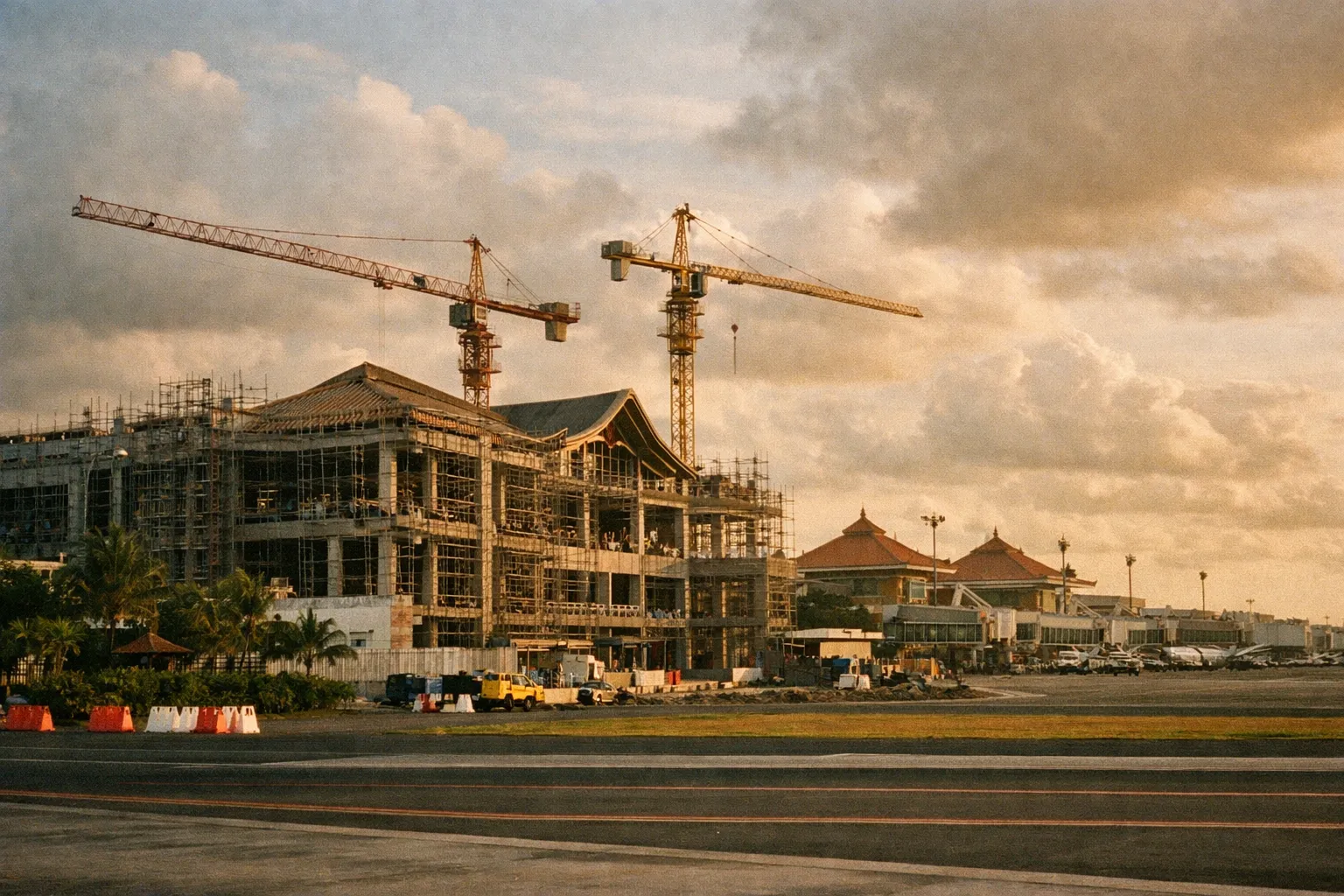
Current capacity sits at around 24 million passengers per year. Expansion plans have been proposed to increase capacity, but specific targets such as 28 million after phase one and 37 million at full buildout remain indicative and subject to change. Given the traffic numbers below, these expansions aim to address growing demand.
Two recent developments worth flagging:
- VVIP terminal (Nov 2022): A dedicated terminal inaugurated on 9 November 2022 ahead of the G20 Bali Summit, built to handle visiting heads of state.
- MRO facility (Dec 2024): FL Technics Indonesia opened a 17,000 m² maintenance, repair, and overhaul facility in December 2024, with capacity for up to six narrow-body aircraft at a time. Most passengers will never interact with this, but it signals where the airport is investing.
Inside the passenger terminals you’ll find duty-free, money changers, ATMs, prepaid SIM card kiosks, food courts, and airline lounges. The SIM kiosks near arrivals are worth stopping at before you exit - getting a local data plan sorted before you hit the taxi queue saves a lot of standing around trying to load Grab on roaming data.
Airlines, routes, and the DPS network
Connectivity at Ngurah Rai is what makes it work as a base for the region. Schedule data reports roughly 65 nonstop destinations across 19 countries from DPS, a network weighted heavily toward Asia-Pacific and the Middle East.
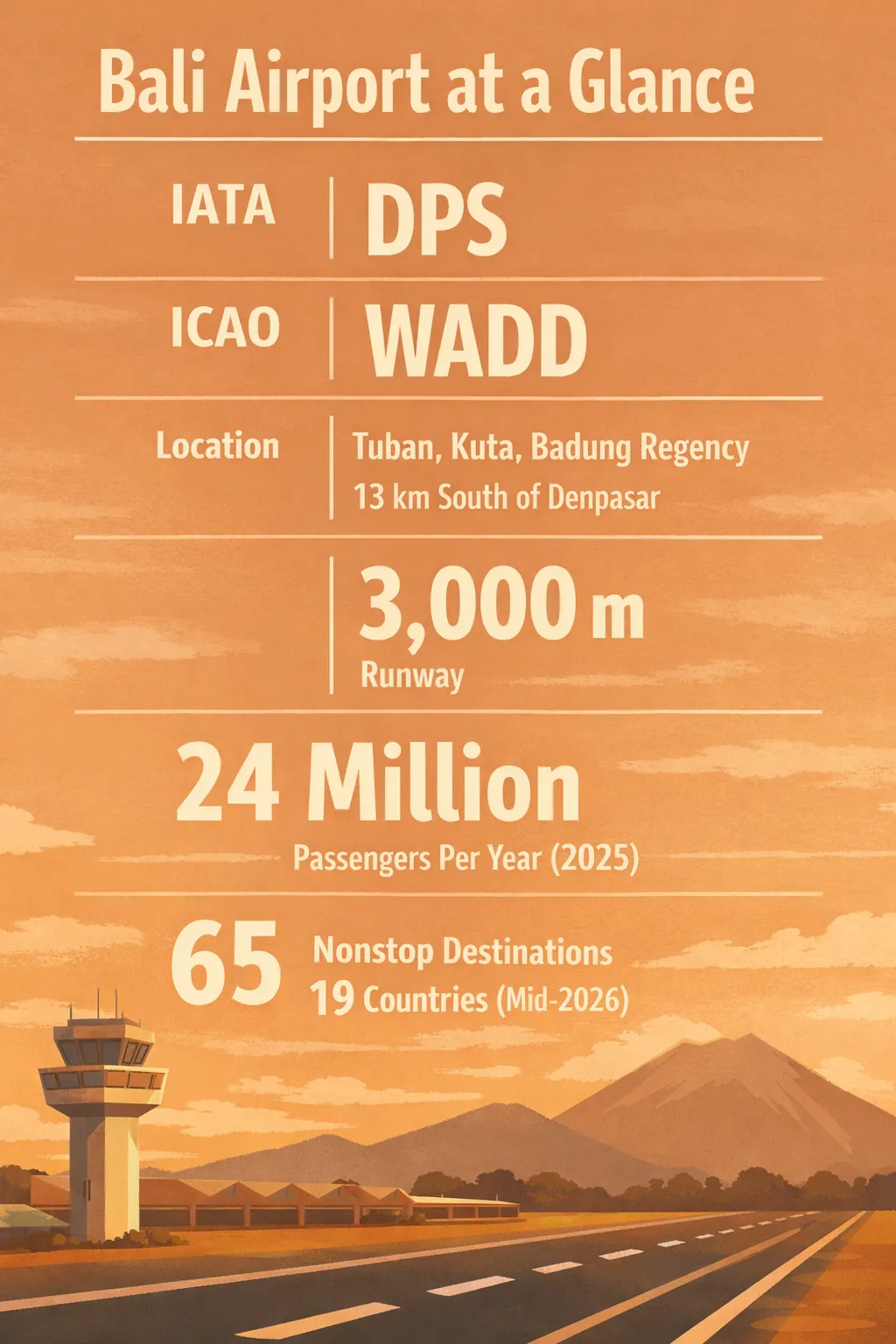 Ngurah Rai International Airport (DPS) handles about 24 million passengers per year and offers about 65 nonstop destinations across 19 countries.
Direct routes cover hubs including Tokyo, Singapore, Kuala Lumpur, Hong Kong, Sydney, Auckland, Doha, and Dubai. Carriers serving the airport include the major Asia-Pacific and Gulf airlines - Qatar Airways lists direct flights to Bali among its destinations (5).
Ngurah Rai Airport Key Features
| Ngurah Rai International Airport | |
|---|---|
| IATA Code | DPS |
| ICAO Code | WADD |
| Location | Tuban, Kuta, Badung Regency (about 13 km south of Denpasar) |
| Runway Length | about 3,000 m |
| Annual Capacity | about 24 million passengers per year (2025) |
| Nonstop Destinations | about 65 across 19 countries (mid-2026) |
| Named After | I Gusti Ngurah Rai, Indonesian national hero |
Flying direct to Bali from the USA: what you need to know
Short answer: no nonstop exists. Current route data shows no direct USA-to-Bali flight among DPS’s nonstop services (5).
The practical strategy from North America is a one-stop itinerary through a regional or Gulf hub. The most common connection points are:
- Doha (Qatar Airways) (5)
- Singapore (Singapore Airlines)
- Kuala Lumpur (Malaysia Airlines, AirAsia)
- Tokyo (multiple carriers via Narita or Haneda)
- Hong Kong, Seoul, or Taipei depending on your origin city
Expect total travel time around 20-30+ hours door to door depending on layovers. One thing worth knowing for frequent flyers: because DPS has roughly 65 direct destinations, you can sometimes save money by booking your long-haul ticket to a hub city and adding the Bali leg separately. It adds complexity, and you lose the protection of a single itinerary if something goes wrong - but the fare gap can be significant enough to be worth it.
Bali airport traffic: why crowds are a real issue
The numbers explain why peak-period congestion at DPS is genuinely bad and not just traveler complaining.
- January 2025: the airport handled 2,012,537 passengers in a single month (6).
- First half of 2024: reported traffic exceeded 11 million passengers (3).
That’s a steep demand curve against the current about 24 million annual capacity, which is exactly why the expansion plans matter. In practical terms, immigration queues, taxi lines, and exit-road traffic all balloon during high season - roughly July-August and the December holidays. Build buffer time into both arrivals and departures. I’d say an extra 45 minutes minimum on departure days during peak season, more if you’re coming from Ubud.
Ground transportation: getting from DPS to Kuta, Seminyak, and Ubud
The airport’s position near the southern resort belt is its biggest convenience. Here’s what to expect, with prices.
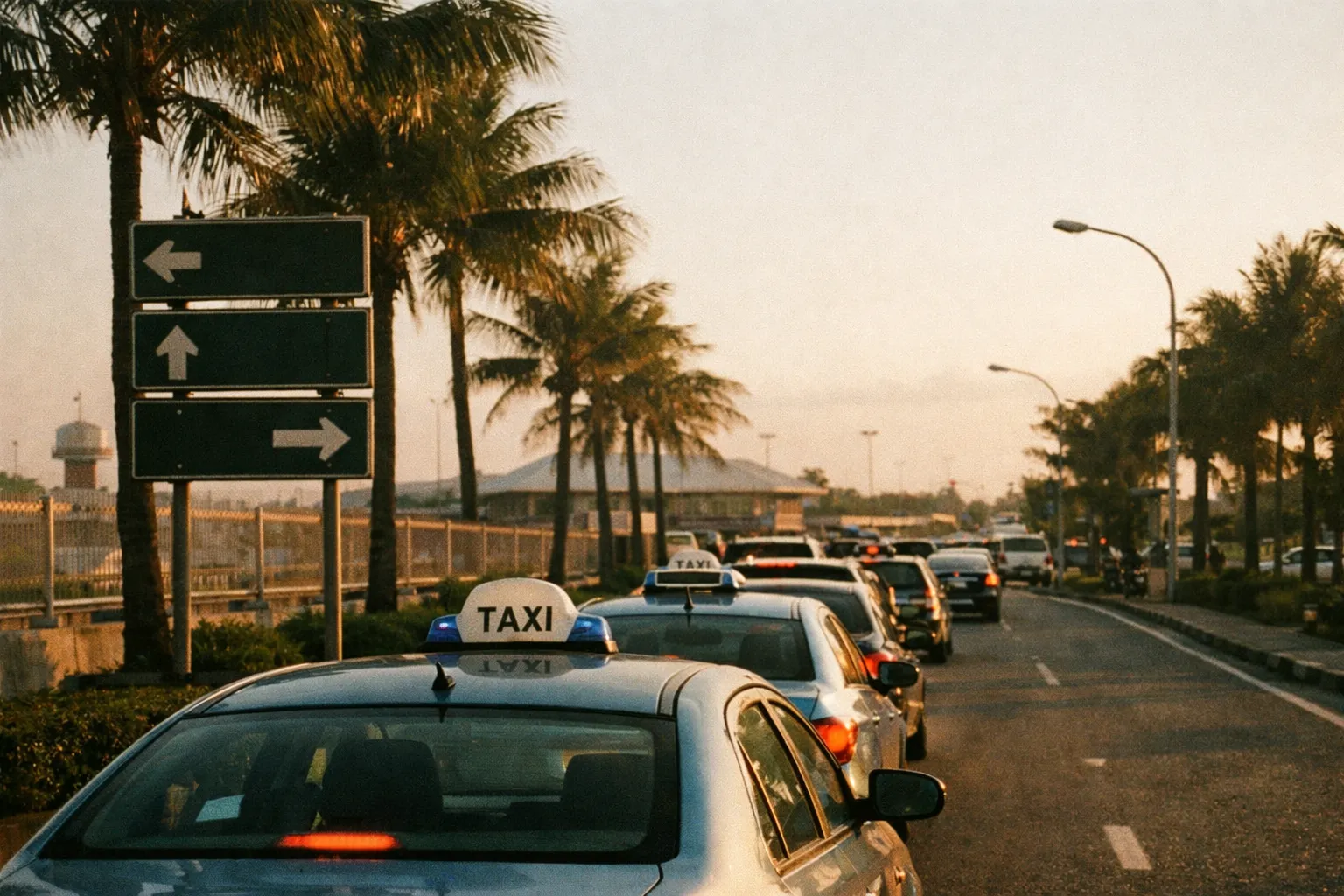
Airport taxis (fixed-zone pricing) Official airport taxi counters quote fixed fares by zone - typically around IDR 200,000-300,000 (about USD 18-27) for transfers to nearby city areas. The counter system removes haggling, which is genuinely useful late at night or when you’re traveling with kids and don’t have the energy to negotiate.
Ride-hailing apps (Grab, Gojek) App-based rides are often cheaper, but airport pickup rules and designated zones change, and the pickup points can be a walk from the terminal. Confirm the current pickup location before you land, because enforcement varies. I’ve had smooth Grab pickups at DPS and I’ve also stood in the wrong spot for 20 minutes while my driver circled. Check ahead.
Public buses Limited but cheap. The Trans Sarbagita system serves parts of the area, and the Kura-Kura Bus runs fares of roughly IDR 18,000-80,000 (about USD 1.50-6). Coverage is narrower than taxis, and you’ll be handling your own luggage on and off. Fine if your hotel sits on the route, frustrating if it doesn’t.
Transfer times by destination (normal traffic - can double at peak):
- Kuta / Legian / Tuban: 10-20 minutes
- Seminyak / Jimbaran: 20-30 minutes
- Canggu: 45-60 minutes
- Ubud: 60-90 minutes(2)
A pickup that should take 20 minutes on paper can stretch past an hour during Bali’s rush periods, especially around Kuta and the airport exit roads. If you’re landing after 8 p.m., booking a first night in Kuta, Tuban, or Jimbaran rather than Ubud can save you 30-90 minutes of bleary post-flight transit. It’s a small adjustment that makes a real difference after a long-haul.
A few logistics worth noting:
- Carry IDR 100,000-300,000 in small-denomination cash for drivers and small purchases - card readers fail, and some drivers prefer cash regardless(2).
- Booking a private transfer in advance guarantees a pickup and locks in the price, avoiding variable night surcharges and taxi queues. Some local services and cards bundle this with a discount, so it’s worth comparing before you land.
Health advisories and entry requirements
A few official advisories worth checking before you fly, beyond the standard tourism information.
U.S. State Department: Indonesia sits at Exercise Increased Caution (Level 2), citing terrorism and natural disaster risk. Bali is volcanic and seismically active, so this isn’t abstract - it’s about being aware of evacuation guidance and not panicking if you feel a tremor. Mount Agung has been active in recent years.
CDC guidance: The U.S. Centers for Disease Control highlights animal-bite risk (rabies is present in Indonesia, including Bali) and notes that some travelers may want pre-exposure vaccinations depending on their plans. The everyday practical risks for most visitors are more mundane: traveler’s stomach issues, mosquito-borne illness, and traffic accidents on scooters.
Sensible precautions: drink bottled or filtered water, be cautious around stray dogs and monkeys (the temple monkeys at Ubud and Uluwatu bite - this is not a metaphor), use mosquito repellent, and make sure your travel insurance covers scooter accidents. Most standard policies exclude them unless you hold the right license.
Entry requirements: carry a passport valid for at least 6 months and check current visa rules before you travel. One travel source cites the Indonesian visa-on-arrival fee at IDR 500,000 (roughly USD 30) (2). Rules shift, so verify before departure rather than relying on what was true six months ago.
Exploring the area around the airport
On one visit, a delayed outgoing flight gave me an unplanned evening near the airport. Rather than wait inside the terminal, I walked out toward the streets around Tuban - the neighborhood that sits directly adjacent to the airport’s southern edge.
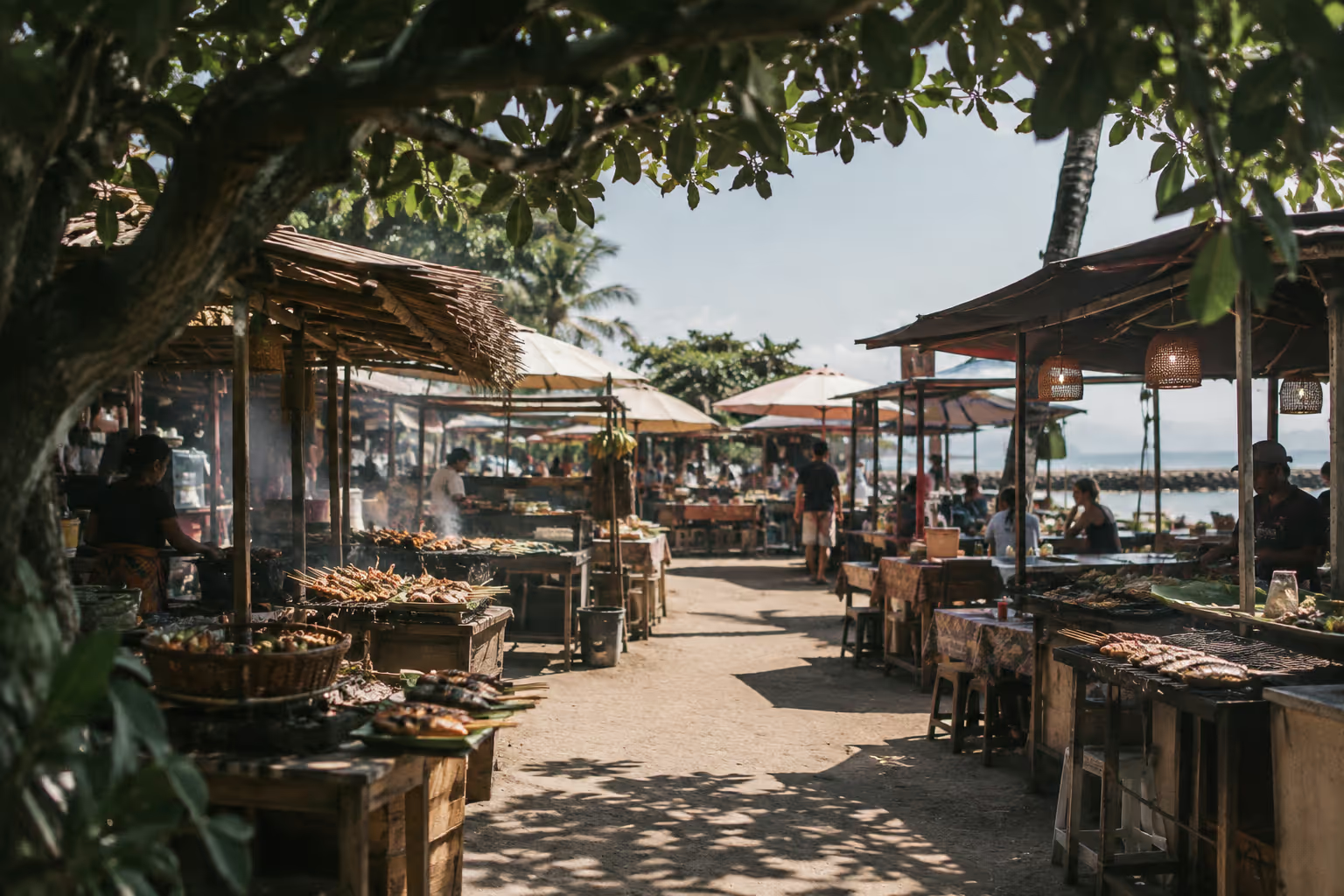
A short walk led to a local night market where sate (grilled skewers) and nasi goreng (fried rice) were sizzling at the stalls. It’s not a destination in itself, but it’s a decent way to spend two hours if you have them. The area around Tuban and the northern end of Kuta is often dismissed as purely transit territory, but there’s a working neighborhood there that most visitors drive straight through without stopping.
It’s also a practical argument for not booking your first night somewhere far away. Landing in Bali and immediately committing to a 90-minute drive to Ubud is a choice you’ll question at 11 p.m. after 24 hours of travel. Choosing the right best accommodation Bali area for your first night can make a real difference to how the trip starts.
✓ Pros
- Single well-connected airport simplifies travel logistics
- Close to southern resort areas like Kuta and Seminyak
- Growing capacity with ongoing expansions
- Multiple ground transport options including fixed-price taxis and ride-hailing apps
✗ Cons
- Peak season congestion causes long queues and traffic delays
- No nonstop flights from the USA, requiring at least one connection
- Airport area outside terminal offers limited visitor attractions
- Ride-hailing pickup points can be confusing and variable
Frequently Asked Questions
- Is there a second airport in Bali operational for commercial flights?
- No second commercial airport exists yet; all scheduled passenger flights use Ngurah Rai International Airport (DPS).
- Why do some flight bookings list Denpasar instead of Bali?
- The airport code DPS comes from Denpasar, so some systems file flights under Denpasar rather than Bali.
- What is the best way to get a local SIM card at Ngurah Rai Airport?
- Purchase a prepaid SIM card at kiosks near arrivals before exiting to avoid roaming data issues.
- Are ride-hailing apps reliable for airport pickups at DPS?
- Ride-hailing pickups are cheaper but can be confusing due to changing designated zones and walking distances.
- What should travelers know about tipping and cash at the airport?
- Carry small-denomination rupiah cash as card readers often fail and some drivers prefer cash tips.
- How long should I allow for airport transfers during Bali's peak season?
- Add at least 45 minutes extra for arrivals and departures during peak months like July-August and December.
- Is beachwear appropriate inside Ngurah Rai Airport?
- No; dress modestly through immigration and terminals as the airport is near temple areas and conservative neighborhoods.