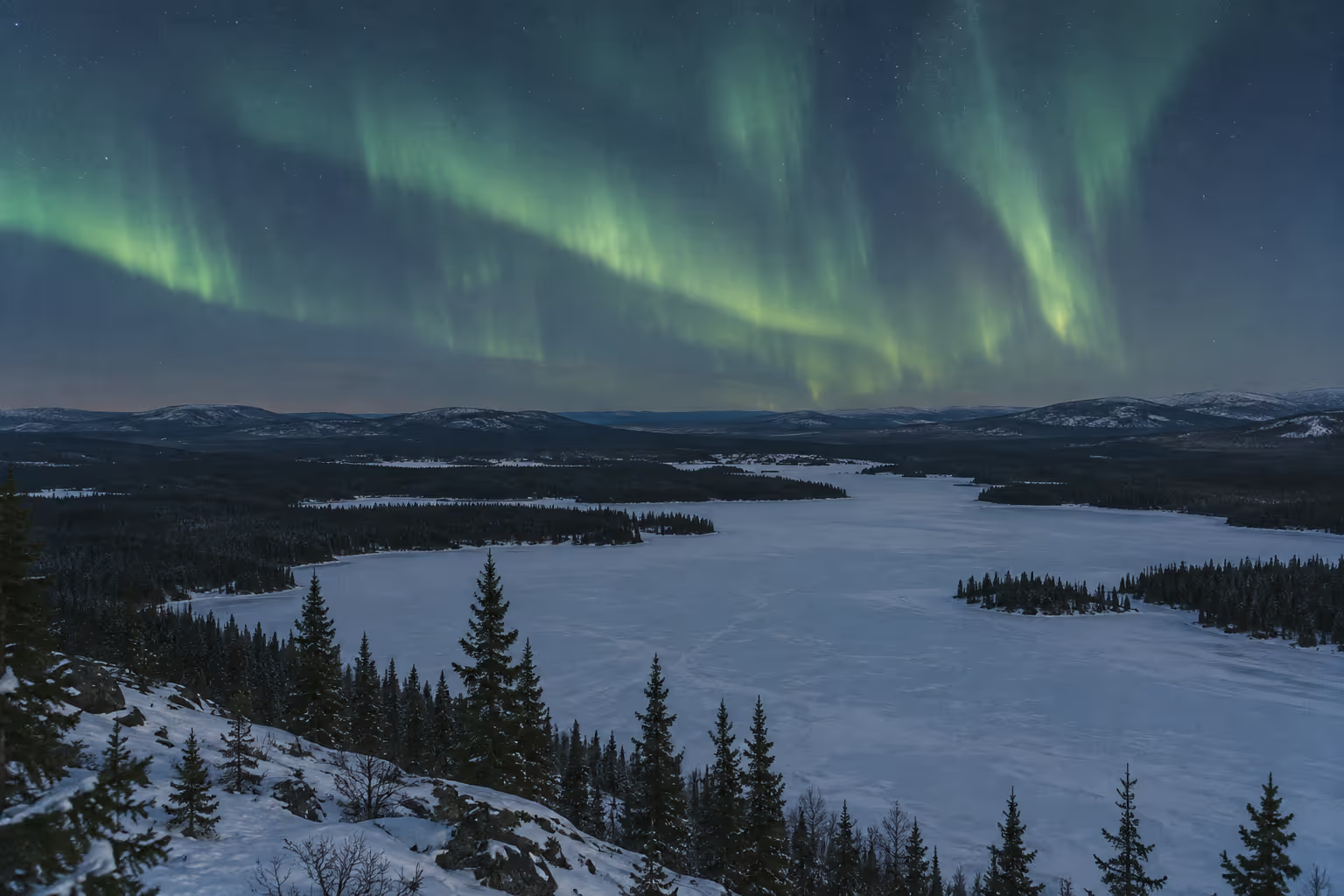
Travel Manitoba reports aurora over Churchill on an average of 300 nights a year (5), and Northwest Territories Tourism reports up to 240 nights a year across the NWT (13). Neither figure promises you a show once cloud, moonlight and town glow get involved. If you are deciding where to see the northern lights in Canada, the answer depends on the month you can travel. Yellowknife and Churchill have the strongest deep-winter odds. Whitehorse covers a long August-to-April season and is the easiest place to self-drive. The Alberta Rockies work as a dark-sky bonus on a mountain trip, not as a dedicated aurora destination.
✓ Pros
- Several regions offer a long viewing season, so travel dates can be matched to a preferred season.
- The four destinations support different trip styles, from a Yukon rental-car plan to guided northern excursions.
✗ Cons
- A high aurora-activity count does not protect a short trip from cloud or bright moonlight.
- Remote access and long cold nights can add travel time and make a missed display costly in effort.
Where to See the Northern Lights in Canada: Four Regions at a Glance
The four main places to see the northern lights in Canada are Yellowknife (NWT), Whitehorse (Yukon), Churchill (Manitoba) and Alberta’s Rockies, and each has a different season and access style.
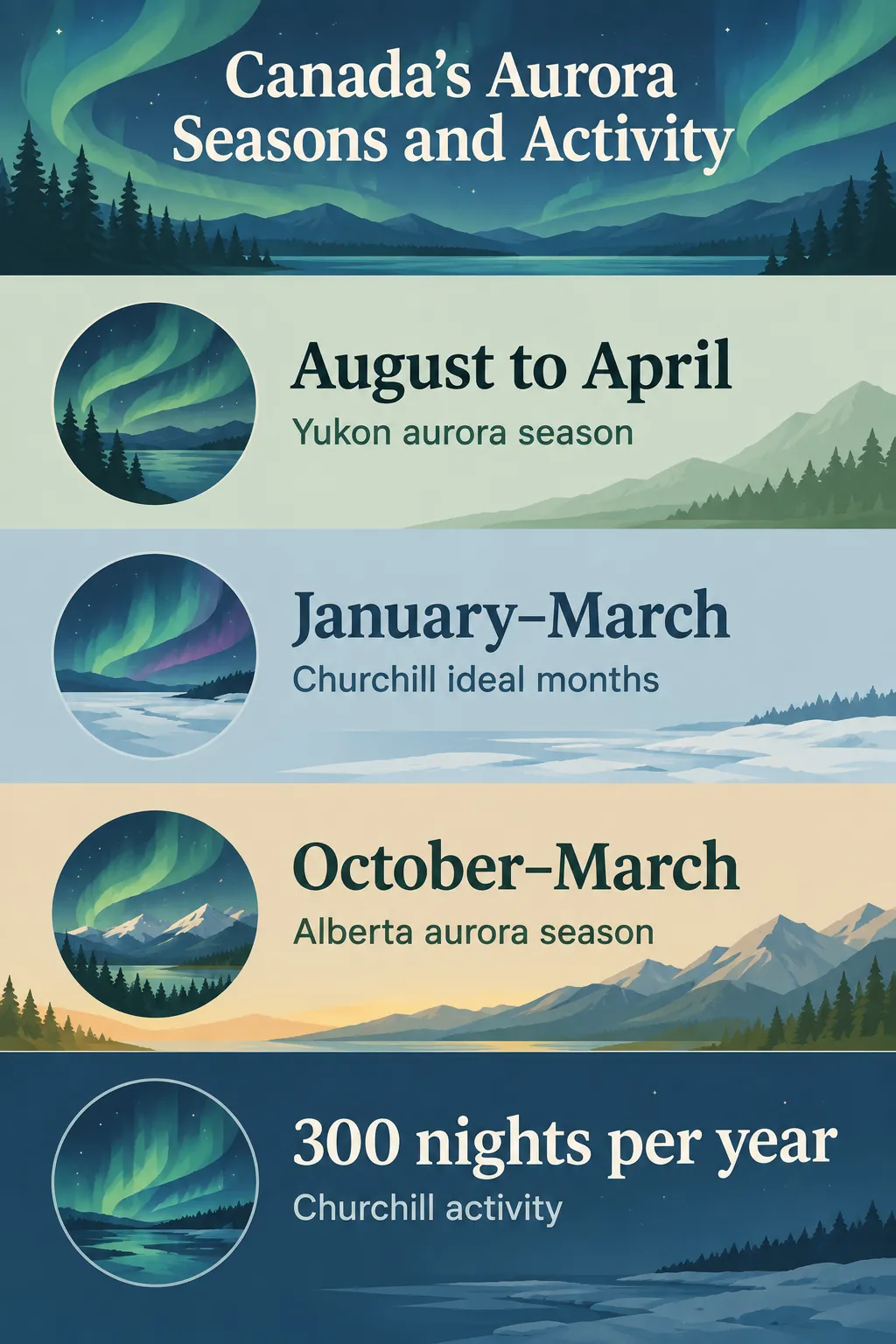 Compare Canada’s aurora seasons: Yukon, August to April (1); Churchill, January-March (3) and 300 nights per year of reported activity (5); Alberta, October-March (9).
Destination Canada names the Yukon, Manitoba’s Churchill and the Northwest Territories as the best places to see the lights, and lists Alberta’s Rockies among the places where sightings are rarer (15). The comparison table below breaks out the specifics.
Your region choice also sets your trip length. Travel Yukon’s own autumn aurora itinerary runs 3-4 days (1), and a Whitehorse trip with a rental car fits that length. Churchill adds a long leg on each end: VIA Rail’s train from Winnipeg takes about 45 hours and runs twice a week, as of November 2026 (20). The Rockies slot into a longer mountain itinerary because the aurora is a side bet there.
On cost, no flat price applies across regions. As a relative comparison, Churchill costs the most to reach because it has no road connection. Yukon self-driving is the leanest option because you don’t need a nightly tour.
Compare Canada's Northern Lights Regions
| Yellowknife | Whitehorse/Yukon | Churchill | Alberta Rockies | |
|---|---|---|---|---|
| Best months | Mid-November-early April; late summer-early autumn | August-April | January-March | October-March |
| Viewing hours | 10 p.m.-3 a.m. | 10 p.m.-3 a.m. | Late night | Nighttime, conditions permitting |
| Reported active nights | Up to 240 per year (NWT-wide) | - | 300 per year | - |
| Access style | Guided tours; self-guided in late Aug-Sept | Strong self-drive option | Air or rail; guided tours available | Mountain-trip add-on |
| Standout feature | Under the auroral oval | Late-summer lake reflections | No road connection | Jasper Dark Sky Preserve |
Yellowknife and the Northwest Territories
Yellowknife sits in the middle of the auroral oval, where NWT tourism says visitors have the highest chance of catching a show at this latitude (18), and that position is the main draw of the Yellowknife northern lights. Much of Canada’s North lies under that same oval (15). The city’s long, clear winter nights make mid-November to early April its strongest window (2). That is the best month range to book if you want high odds and can handle deep cold. Most airlines connect to Yellowknife Airport (YZF) through Edmonton or Calgary, as of November 2026 (21).
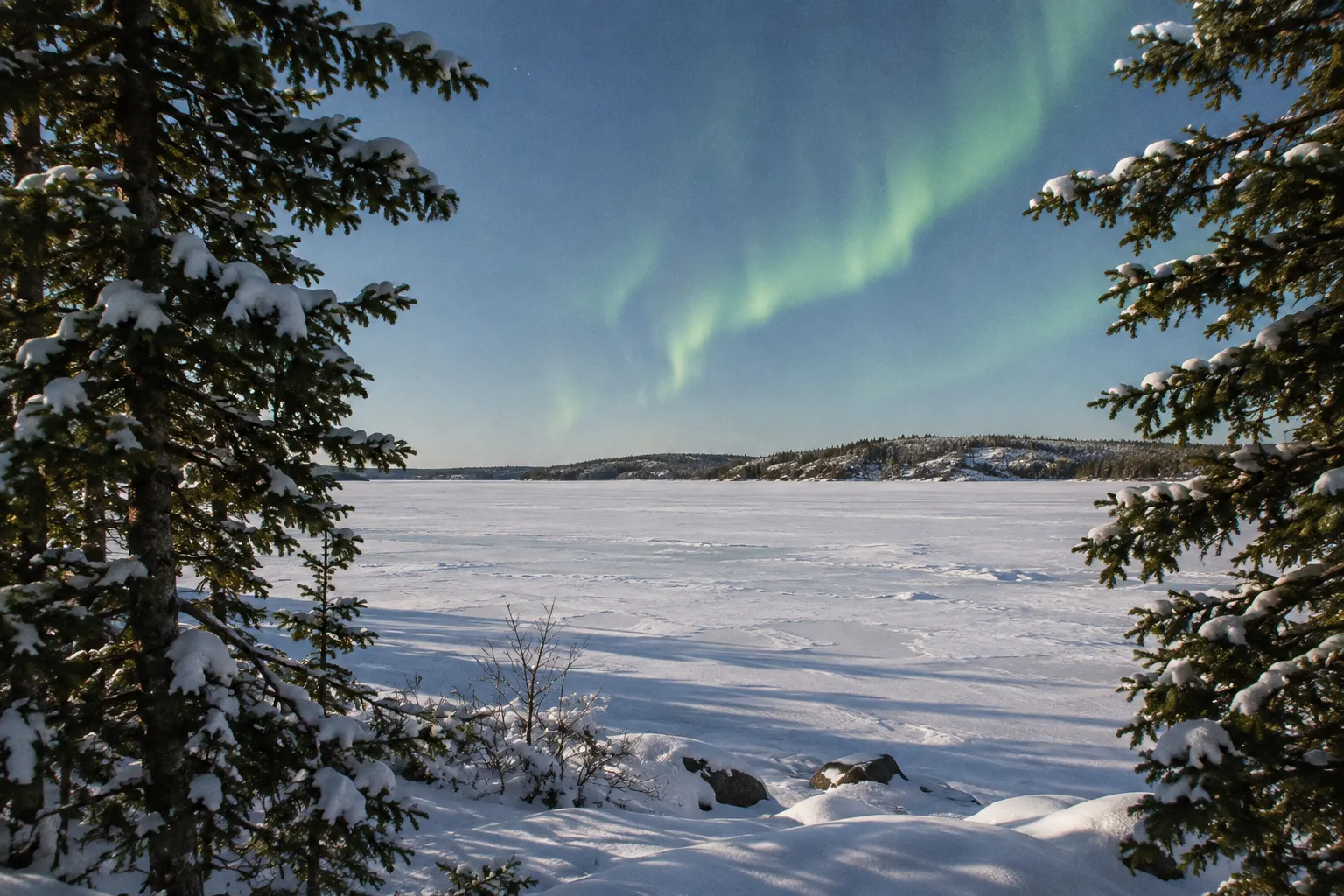
Tours are the common choice here. NWT tourism’s tour listings include evening aurora tours with door-to-door pickup that run about four to five hours, as listed in November 2026 (17), and Canadian aurora experiences run from dogsledding and snowshoeing outings to cabins, resorts and teepee villages (6).
Best Viewing Spots Near Yellowknife
In late August and September, NWT tourism says you can chase the aurora on your own (16). Head away from town lights to a beach, a dock or a large field with only a few trees on the horizon. The tourism authority also links a map of safe aurora viewing locations (16). Prelude Lake Territorial Park on the Ingraham Trail is one named spot. Its park manager says the volume and atmosphere change when people see the lights for the first time: “It’s like Christmas” (18).
Northern Lighthouse Alerts and City Forecasts
Small “Northern Lighthouses” around Yellowknife alert residents and visitors when the evening aurora forecast is active (2). For the day-to-day outlook, the city points visitors to Astronomy North (2).
Whitehorse and the Yukon
The Yukon aurora season runs August to April, with the best viewing from 10 p.m.-3 a.m. (1). Whitehorse is the most practical base if you want to drive yourself. From US hubs, flights to the Yukon connect through airports such as Vancouver or Calgary (6). You can see the lights from inside Whitehorse, but getting away from artificial light improves what you see (1). Travel Yukon also notes that full-moon nights are brighter and can wash out a display (1). Check the lunar calendar before you lock in dates.
Self-Drive Spots: Chadburn Lake Road and Fish Lake Road
Travel Yukon names Chadburn Lake Road and Fish Lake Road near Whitehorse as self-drive viewing spots, and it recommends checking aurora forecasts before you head out (4). Both roads leave straight from town, one south and one north (4), so you can wait in a warm hotel until the forecast looks good, then leave. That flexibility is the main reason to choose Whitehorse over a tour-centric destination.
Fall Reflections on Unfrozen Lakes
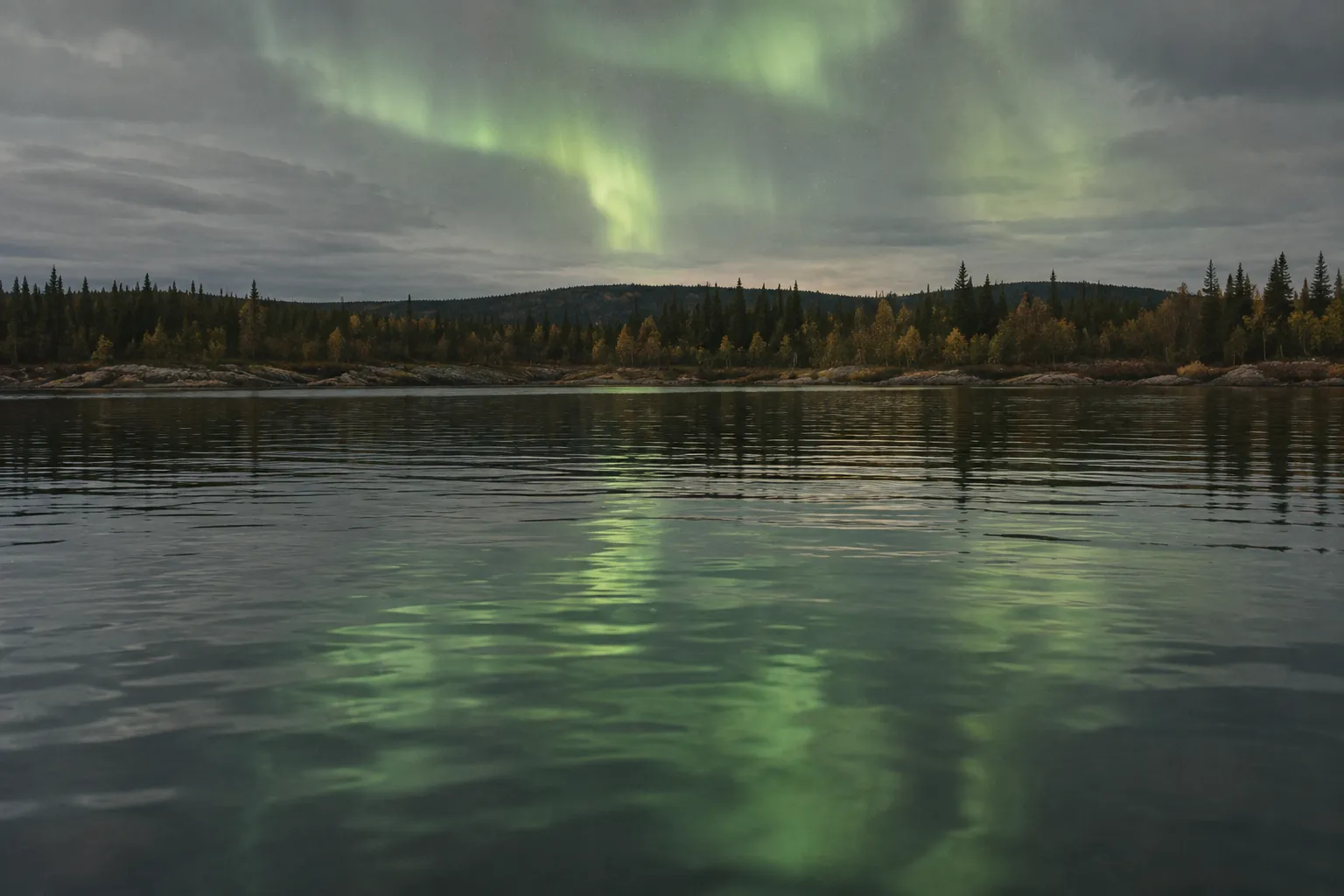
Yukon fall runs roughly late August to early October (4). In that stretch, the lights can reflect on lakes that haven’t frozen yet, an effect Travel Yukon highlights for the season (4). This is the one thing a deep-winter trip can’t give you. If you photograph more than you watch, it is worth timing your trip around.
Churchill, Manitoba
Churchill’s ideal aurora months are January-March, when the nights are longer and the weather colder (3). Travel Manitoba reports green-and-purple displays on an average of 300 nights per year (5). That number measures activity, not guaranteed clear skies on the night you book. The town lists several aurora tour operators, including Frontiers North Adventures, Great White Bear Tours and North Star Tours (3).
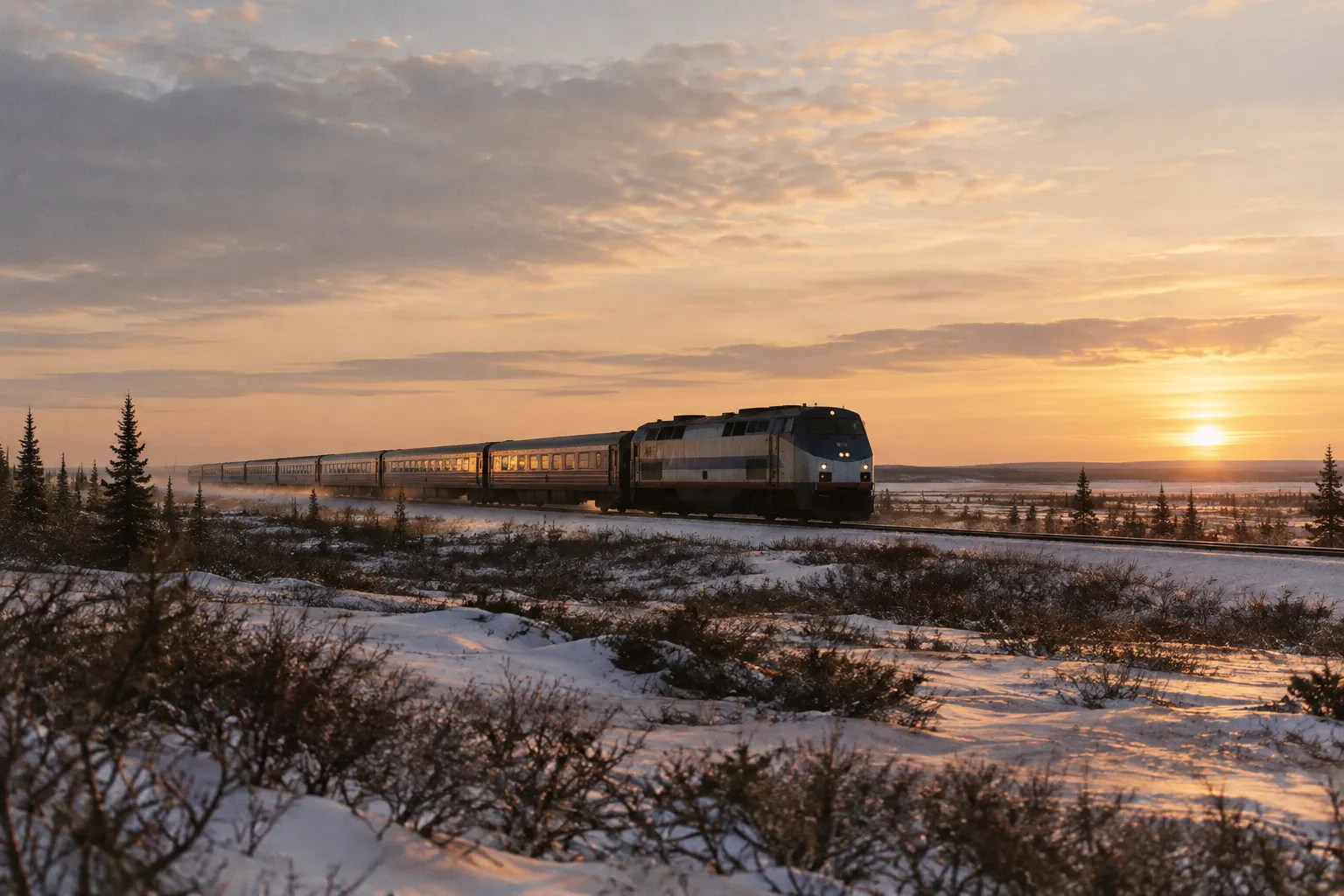
Getting to Churchill Without a Road
Churchill has no road connection to the rest of Manitoba. You reach it by air or by train. Another option is to travel to Thompson and continue by air or rail from there (5). Book transport before lodging, because your arrival day sets everything else.
Wildlife Add-Ons: Belugas, Bears and Birds
Travel Manitoba sets out Churchill’s wildlife calendar (5):
- Worth the detour: polar bears, October to early November, seen from tundra vehicles, eco lodges or walking safaris (5). This overlaps with the darker autumn nights.
- Worth the detour in summer: belugas, July to August (5). The bright summer nights limit aurora odds then.
- Skip if short on time: birding, mid-June to mid-July (5), unless birds are your main reason to go.
Alberta’s Rockies: Jasper, Banff and Dark-Sky Preserves
Alberta’s best aurora season is October-March, when nights are longest, though sightings are possible year-round (9). Displays still depend on geomagnetic activity, cloud and darkness. Alberta has several Dark Sky Preserves, including Jasper, Beaver Hills and Cypress Hills, plus the Waterton-Glacier International Dark Sky Park shared with Montana’s Glacier National Park (9)(10). Dark-sky status cuts light pollution, but it can’t produce an aurora.
Why Jasper, Not Banff, Is the Dark-Sky Pick
This is the point most guides get wrong. You can see the aurora from Banff on a strong night, but Travel Alberta’s list of the province’s Dark Sky Preserves includes Jasper and not Banff (9). Jasper has held the designation since 2011 (9). If the northern lights are a priority on a Rockies trip, base yourself in Jasper. Treat any sighting as a bonus rather than the reason you flew in.
Northern Lights in Canada: Best Time by Season and Destination
The best time to see the northern lights in Canada is late August through early April (15). Churchill’s ideal months are January to March (3), and Yellowknife’s strongest window runs mid-November to early April (2). Summer is the weak season: Destination Canada says the Yukon’s midnight sun makes the lights impossible to see then (15).
Why 10 p.m. to 3 a.m. Matters Almost Everywhere
Travel Yukon names 10 p.m.-3 a.m. as the best viewing window (1), and Destination Canada gives the same sweet spot for the country as a whole (15). Plan to be outside late. Leaving at dusk and giving up by 10 p.m. is the most common way to miss a display.
Summer-Into-Fall vs Deep-Winter Trips
Use this decision rule:
- August or September: go to the Yukon for lake reflections (4). In Yellowknife, NWT tourism says you can chase the aurora on your own in late August and September (16).
- October-March: Alberta’s best months (9), with Jasper’s Dark Sky Preserve as the add-on to a Rockies itinerary (10).
- Mid-November to early April: Yellowknife (2).
- January-March: Churchill, for its longer nights and colder weather (3), or Yellowknife, still inside its mid-November to early April window (2).
Checking Forecasts and Conditions Before You Go
Aurora forecasts predict geomagnetic activity, but local cloud, precipitation, moonlight and city lights decide whether you see anything from the ground. You need to check both.
The aurora itself forms when charged particles from the sun, carried on the solar wind, collide with oxygen and nitrogen in the upper atmosphere (15). The resulting colours range from green to yellow and pink (15).
Activity Versus Visibility: Why High Night Counts Aren’t a Guarantee
The 300 nights per year in Churchill (5) and up to 240 nights per year in the NWT (13) describe how often the aurora is active, not how often the sky is clear. Travel Manitoba itself says the lights are most visible on clear nights (5). A week of overcast skies under a strong forecast is still a week of nothing.
Tools to Check Before You Head Outside
- Astronomy North: this community-specific forecast for Yellowknife, Whitehorse, Dawson City and other northern towns uses NOAA space-weather data (7). It is normally updated daily before 2 p.m. Mountain Time, and the expanded format is labelled beta (7). The forecast can be revised when storms are expected (8), so recheck it in the evening.
- Space Weather Canada: Natural Resources Canada’s service publishes a geomagnetic activity forecast for the sub-auroral, auroral and polar zones (19). Cross-check it with a local cloud forecast.
Run through the steps below before each night out.
Check Conditions Before an Aurora Viewing Night
Use both space-weather and local conditions to decide whether and where to head out.
- 1
Check the aurora forecast
Review the local aurora forecast after its afternoon update, then check again in the evening in case expected storm conditions have changed it.
- 2
Check local cloud cover
Look up cloud conditions for the specific viewing area; geomagnetic activity alone does not mean the sky will be clear.
- 3
Review moonlight and light pollution
Check the moon phase and choose a darker location away from town lights when conditions allow.
- 4
Choose a safe viewing location
Select a dark spot where you can pull fully off the road rather than stopping in a travel lane.
- 5
Plan for the overnight window
Arrive by 10 p.m. and be prepared to stay through 3 a.m.
Tour vs Self-Drive: Which Fits Your Trip
Self-drive suits flexible travellers in the Yukon, where Travel Yukon names roadside viewing spots (4). Guided tours suit Yellowknife and Churchill, where NWT tourism and the Town of Churchill list aurora tour operators (17)(3). Budget-conscious or flexible travelers can self-drive in Yukon, while those wanting logistics handled should book an NWT tour.
What a Guided Aurora Tour Typically Includes
A guide gets you to the best viewing spots, supplies quality viewing equipment and explains the sky as you watch (9). Formats vary widely, from cozy cabins and resorts to teepee villages, dogsledding and snowshoeing (6). Confirm in writing whether your tour includes lodging, gear rental and transport. Inclusions differ by operator.
Self-Drive Essentials and Safety
Never stop on the road to watch or photograph the sky. NWT tourism advises pulling off safely first (16). For gear, pack warm layers, a flashlight, your camera and a tripod (16). For photos, use a tripod and an exposure of at least five seconds (16). Dress for hours of cold rather than a short forecast window.
Frequently Asked Questions
- Does a strong aurora forecast mean I will see the lights?
- No; an aurora forecast estimates geomagnetic activity, while local cloud, precipitation, moonlight and artificial light determine whether the display is visible.
- Is a guided tour necessary in Yellowknife or Churchill?
- No, but guided excursions are the common option in both destinations; compare transport, viewing equipment and lodging inclusions before booking.
- What makes late-summer Yukon aurora photography different?
- Unfrozen lakes can reflect the lights in late summer and early autumn, giving photographers a foreground effect unavailable on a deep-winter trip.
Choosing Your Region
Pick the month first, then the region. Go to the Yukon in August or September for lake reflections and self-drive freedom. Go to Yellowknife or Churchill in January to March for the strongest deep-winter odds. Treat Jasper as a dark-sky bonus on a Rockies trip. Whichever region you choose, check Astronomy North after its daily afternoon update and look at the local cloud forecast before you commit to a night out.