The price on INAH’s site page is not what a foreign visitor pays at the gate. When you’re visiting Chichen Itza, the federal admission of MXN 105 is one charge and the Yucatan state fee of MXN 592 is a separate one (2). Any headline figure that quotes only the first understates your bill. This guide covers the full ticket cost, the transport that fits your travel day from Cancun, Tulum or Merida, the arrival window that beats the tour buses, and which cenote to pair with the ruins.
Visiting Chichen Itza: What to Expect at the Ruins
Chichen Itza is a UNESCO World Heritage archaeological site in Yucatan, inscribed in 1988, and UNESCO ranks it among the greatest Maya centres of the peninsula across a history of nearly 1,000 years (6)(10). The city prospered between the 9th and 13th centuries (12). Different peoples left their mark on it. UNESCO describes it as one of the most important examples of the Maya-Toltec civilization in Yucatan, because Maya construction techniques fused with new elements from central Mexico (6).
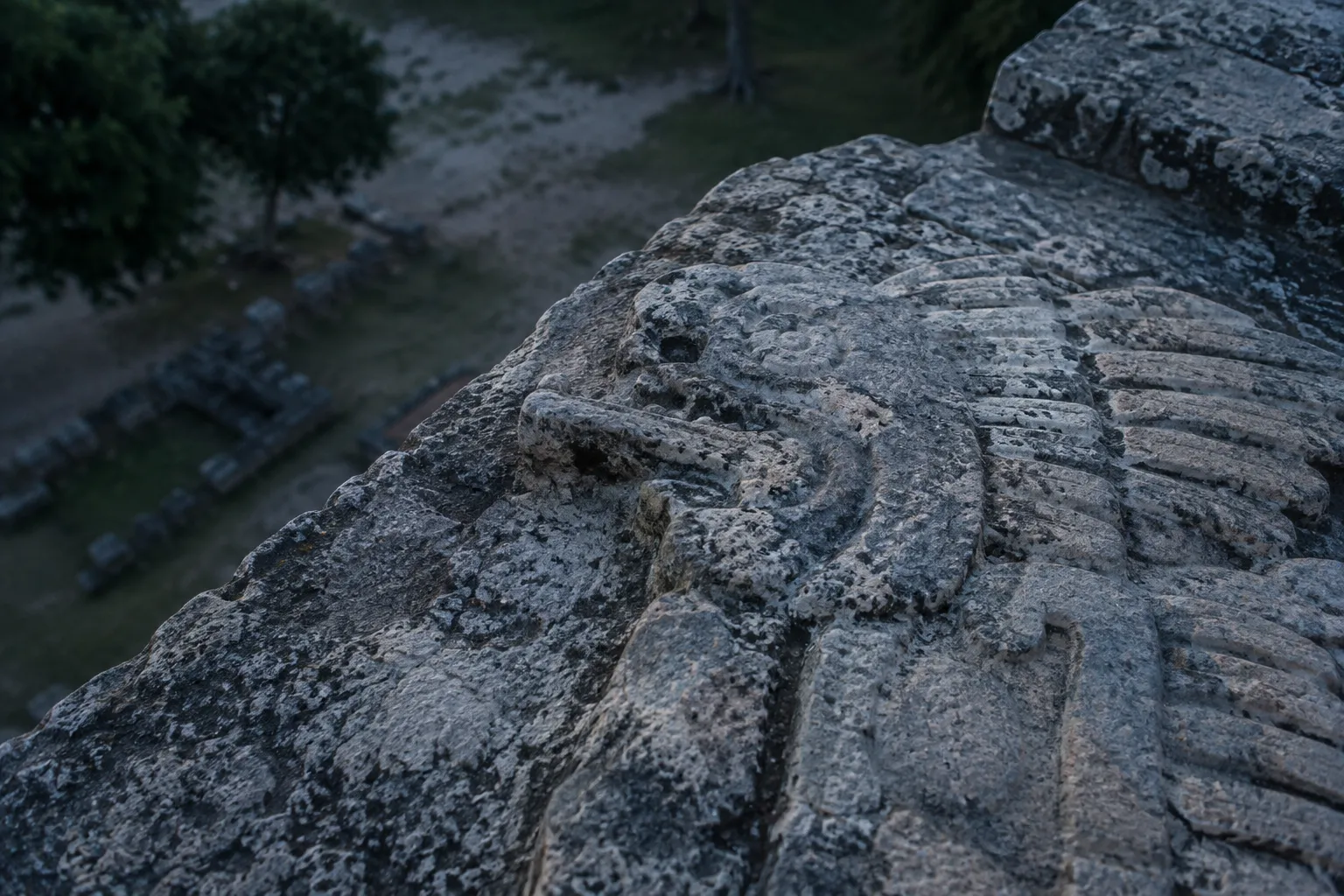
INAH gives the name’s meaning as “the city at the edge of the well of the Itzá” (2). That well, a cenote, is part of why the site sits where it does. It is also why cenotes make such a natural add-on to the day.
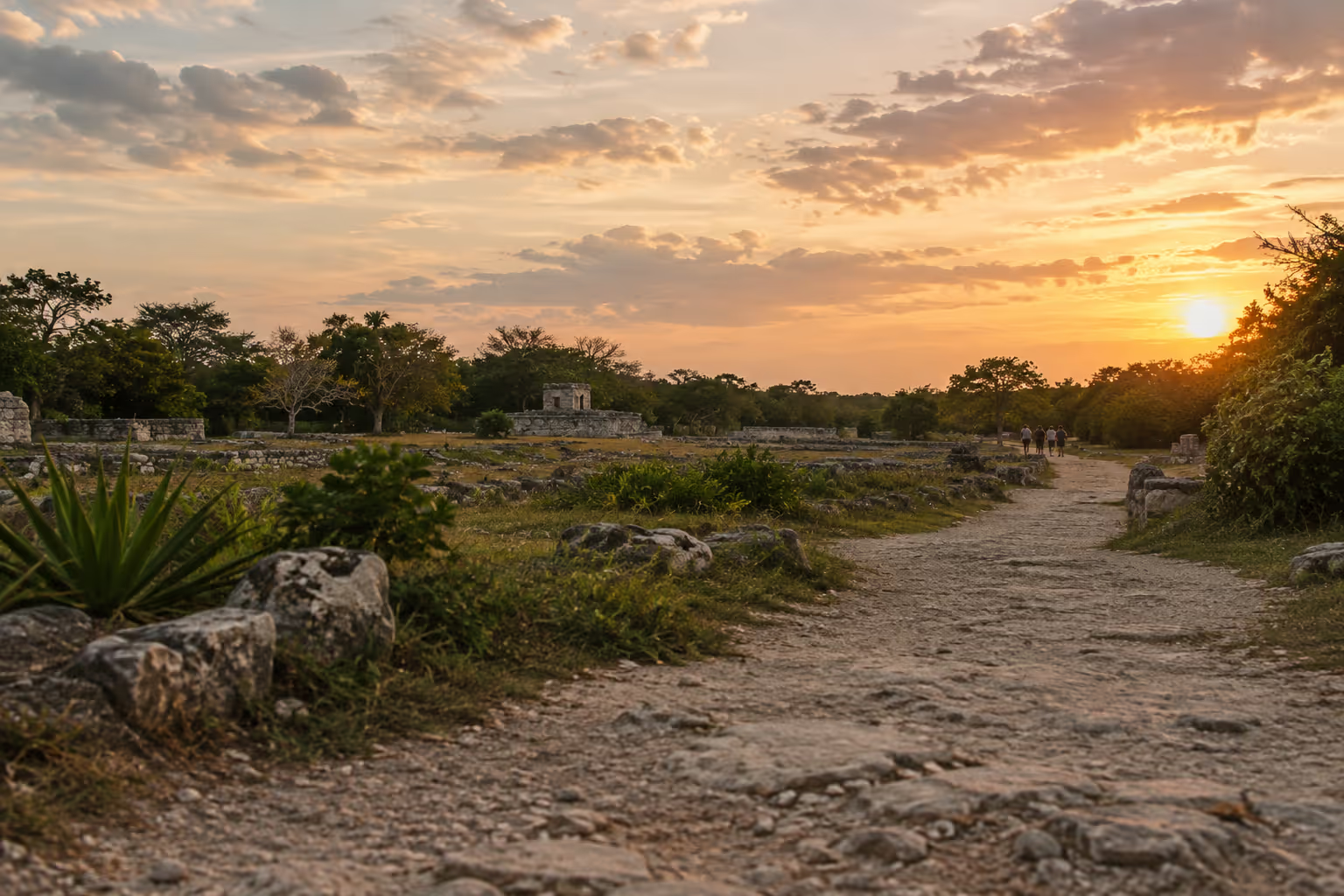
The grounds are large, flat and exposed. Several major buildings have survived, including the Warriors’ Temple, El Castillo and the circular observatory known as El Caracol (6). Expect long walks on open ground between them.
Kukulkan Pyramid and the Great Ball Court
The Kukulkan pyramid, also called El Castillo, stands 30 m (98 ft) tall including its top temple. Each of its four sides has a stairway of 91 steps (12). The four stairways come to 364 steps, and the upper platform adds the 365th. That total matches the days of the solar year, according to UNESCO’s NHK World Heritage material (12). The same building hosts the equinox light-and-shadow effect covered below, so the calendar link is built into the architecture twice.
The Great Ball Court measures 168 m (551 ft) long and 70 m (230 ft) wide (16). Ball games similar to football were held there as part of a harvest ritual. A carved wall panel shows a ball with a skull inside it and the winning warrior kneeling beside it (12). The carvings are easy to walk past, so stop at the wall panels.
Here is how the main sights rank if your time is limited.
Worth the detour:
- El Castillo (Kukulkan pyramid): the reason most people come. Its step count and its alignment both carry meaning.
- Great Ball Court: the scale is hard to grasp from photos. The carved panels reward a close look.
- El Caracol: the circular observatory is unlike anything else on the main plaza.
Skip if short on time:
- Warriors’ Temple: well preserved, but if you only have a morning before a long drive back, it is the first one to cut.
- Noches de Kukulcán: the evening light-and-sound show is operated by the Yucatan state government, not INAH (2). It only works if you sleep nearby, so it is not practical on a Cancun day trip.
Is Chichen Itza Worth the Trip?
Chichen Itza is worth visiting if you arrive at opening on a weekday. It is far less rewarding at midday on a Sunday after a 3-hour drive. The architecture holds up to its reputation. The visiting conditions are what decide whether the day works: the grounds have no shade, tour buses pour in from about 10:00 (15), and from the coast you spend more time on the road than on site.
✓ Pros
- The site rewards close attention to architecture, carvings and the relationship between buildings.
- Independent visitors can set their own pace and choose a cenote that fits the return route.
- A morning visit can combine major structures with a swim without requiring an overnight stay.
✗ Cons
- The admission system can be confusing if you budget from the federal fee alone.
- The open, exposed grounds make the visit less comfortable during heat or rain.
- Coastal day trips leave little margin for traffic, delays or an unplanned stop.
How long you need depends more on your base than on the ruins. The site is open 08:00-17:00, with last entry at 16:00 (2). If you arrive at opening, you can cover El Castillo, the Great Ball Court and El Caracol in a morning and still add a cenote in the afternoon. The bigger time cost is the transport, which from Cancun takes 2.5-3 hours each way by car (5).
The case for going:
- One of the most important Maya-Toltec sites in Yucatan, with clear calendar and astronomical design
- Manageable to visit on your own, with public transport access confirmed by INAH (2)
- Cenotes within a short drive make for a full, varied day
The case against, or at least for planning carefully:
- Two separate fees for foreign visitors, which inflate the real cost above the headline figure
- Equinox dates and Sundays bring heavy crowds
- Long drives from Cancun and Tulum, on grounds with little shade
Chichen Itza Tickets and Entrance Fees
Chichen Itza tickets for foreign visitors cost MXN 697 in total, sold as a single INAH-AAFY ticket that combines the federal and state charges (17). This is the figure to budget around. Most guides get this wrong by quoting only INAH’s federal fee.
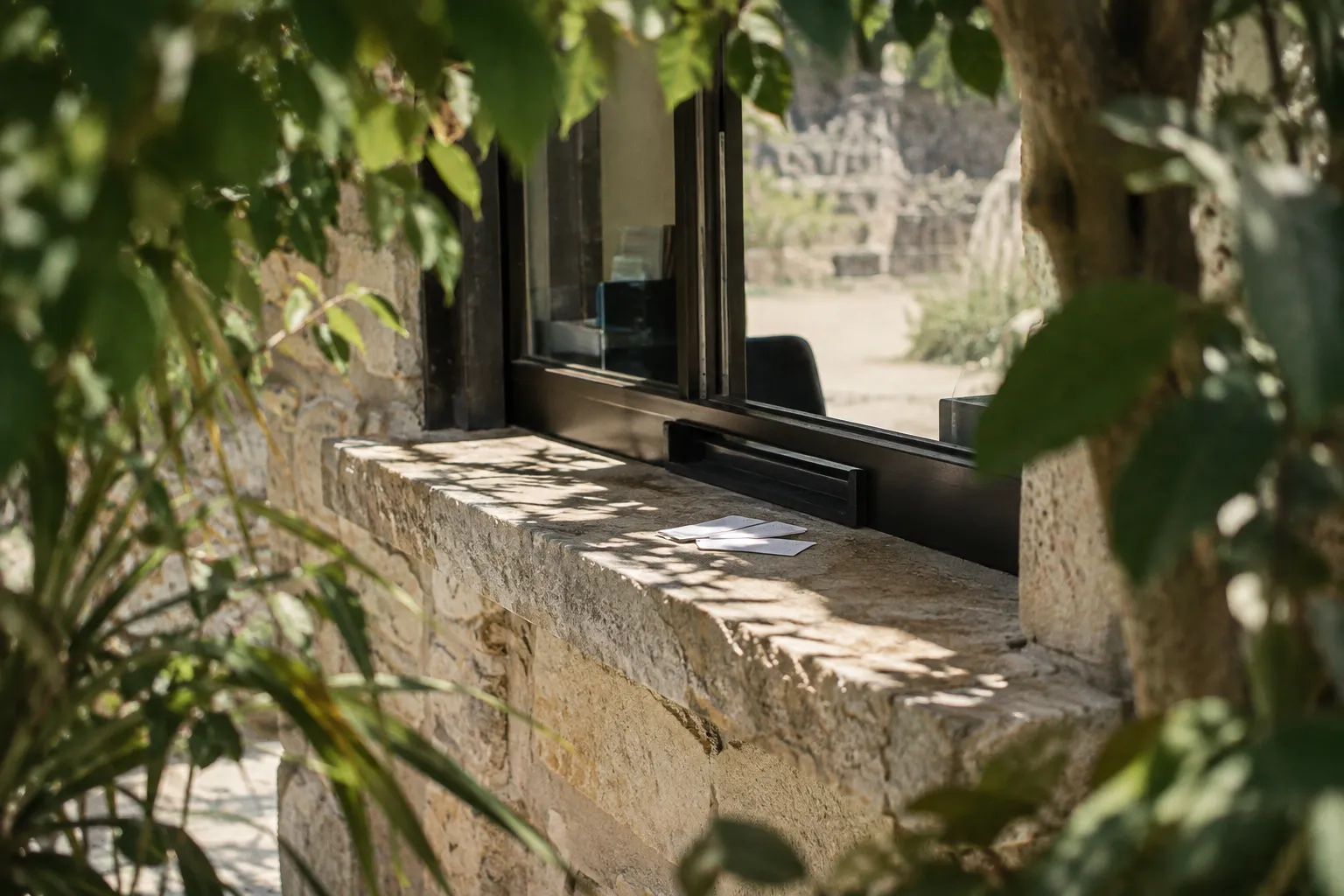
Federal Fee vs State Fee
INAH’s own site page, last updated in October 2026, lists a general admission of MXN 105 (2). Directly under that figure, the page notes that its fees do not include additional charges applied by third parties such as state governments (2). For Chichen Itza, that additional charge is the Yucatan state fee. INAH lists it at MXN 592 for foreign visitors and MXN 205 for Mexican nationals (2).
Foreign visitors who budget on the MXN 105 figure are short by more than five times that amount. INAH’s September 2026 bulletin describes the two charges as one INAH-AAFY ticket at MXN 697 for foreign visitors (17), which removes some of the confusion at the window.
Several groups are exempt from payment under Mexico’s federal duties law, including children under 13, adults over 60, and students and teachers with valid ID (17). Two exceptions matter most for planning:
- Sundays: regular free Sunday admission applies to Mexican nationals and foreign residents in Mexico who show proof of status (4)(17). It does not apply to foreign tourists. This is also why Sunday is the busiest day of the week (15).
- Yucatan residents: anyone living in any of the 106 municipalities of Yucatan can enter free of both the federal and state fees on any day for the rest of 2026 (4). You prove residence with a valid official ID showing your address (17).
Where and How to Buy Your Ticket
Chichen Itza tickets are sold at the site’s CATVI visitor center. INAH’s September 2026 bulletin states that INAH tickets can only be bought at the CATVI ticket windows (17). The single-ticket system is new in 2026 (4), so check the latest notice a few days before you go.
Booking-mechanics notes for the ticket window:
- Confirm the hours and procedure close to your date. INAH’s site page still describes the state fee as a separate ticket bought at the site (2), while its September 2026 bulletin describes one combined ticket (17), so the most recent bulletin is the one to trust.
- Read the fine print on bundled tickets. If a tour or third-party seller says “tickets included”, confirm the price covers both the federal and state components rather than the MXN 105 INAH fee alone.
- Arriving on the direct ADO bus? ADO’s route page says the bus drops you at the ticket booth (1), so you join the CATVI line straight off the coach.
Chichen Itza From Cancun: Routes and Travel Times
Chichen Itza from Cancun takes about 2 hours 45 minutes each way on ADO’s direct tourist bus, which ADO lists as a Sunday service (1). It is not the only public option. One transport guide lists one to two regular direct ADO buses a day from Cancun, leaving around 08:45 and reaching the ruins around 11:30 (5). The Tren Maya has a Chichen Itza station, with its Tren Maya Conecta transfer to the site (19), and its timetable lists several departures between Cancun and Merida-Teya (18); check that your departure stops at Chichen Itza when you book. Driving takes roughly 2.5-3 hours each way (5) and is the independent option that lets you choose your arrival time.
The direct ADO tourist bus is a Sunday service. It leaves from Cancun’s ADO bus terminal and drops you at the ticket booth, with no transfer in Valladolid. The return bus brings you back to Cancun the same evening (1). One-way fares start at around MXN 496 on ADO’s route page, as of October 2026 (1). Verify the operating day and departure time on ADO’s route page before you plan around it, because the schedule is what the whole trip hangs on.
There is a catch. The direct bus runs on Sunday (1), and Sunday is also the busiest day at the site, because entry is free for Mexican nationals and residents (15). If crowds matter more to you than convenience, the bus becomes a trade-off rather than an easy answer. ADO also runs regular intercity buses on the corridor (3), but on the regular coastal service you reach the ruins in late morning, not at the opening (5).
For driving, you have two roads:
- Highway 180D (toll): a fenced dual carriageway with few exits (3). It is the faster, more predictable choice. Fill your tank before you get on, because the limited exits mean limited stops.
- Federal Highway 180 (free): this road follows the same corridor through villages including Valladolid and Piste (3). It is slower, with town traffic and speed bumps, but it lets you stop in Valladolid and at the Dzitnup cenotes on the way.
For scale, Cancun sits 187 km (116 miles) from El Castillo in a straight line (3). The road distance is longer. The 2.5-3 hour drive estimate comes from one transport guide (5) and assumes the toll road. Your actual time depends on traffic leaving Cancun’s hotel zone and on any stops you make.
Here is the decision rule. If you’re traveling on a Sunday and want zero logistics, take the direct ADO bus. If you want the 08:00 opening on any day, rent a car and take the 180D. Use the free 180 on the way back if you want a cenote stop near Valladolid.
Getting There from Tulum and Merida
Merida is the closest major base for Chichen Itza, at 115 km (71 miles) via Highway 180 (2). One transport guide estimates the drive at about 1.5 hours (5). INAH’s directions run along Highway 180 toward the town of Piste, and the archaeological site sits 2 km (1.2 miles) beyond it (2).
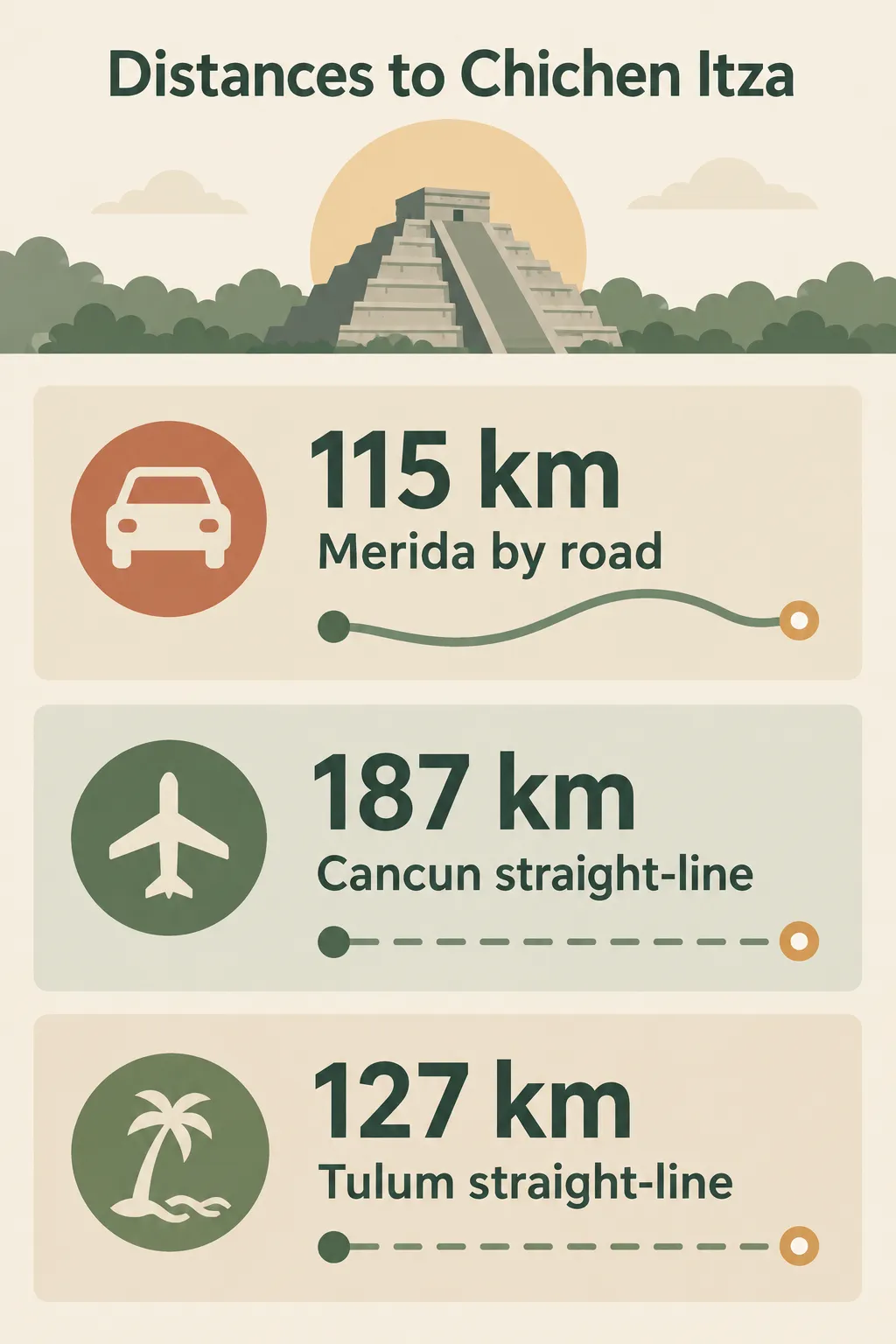 Merida is 115 km from Chichen Itza by road; Cancun and Tulum are 187 km and 127 km away in a straight line.
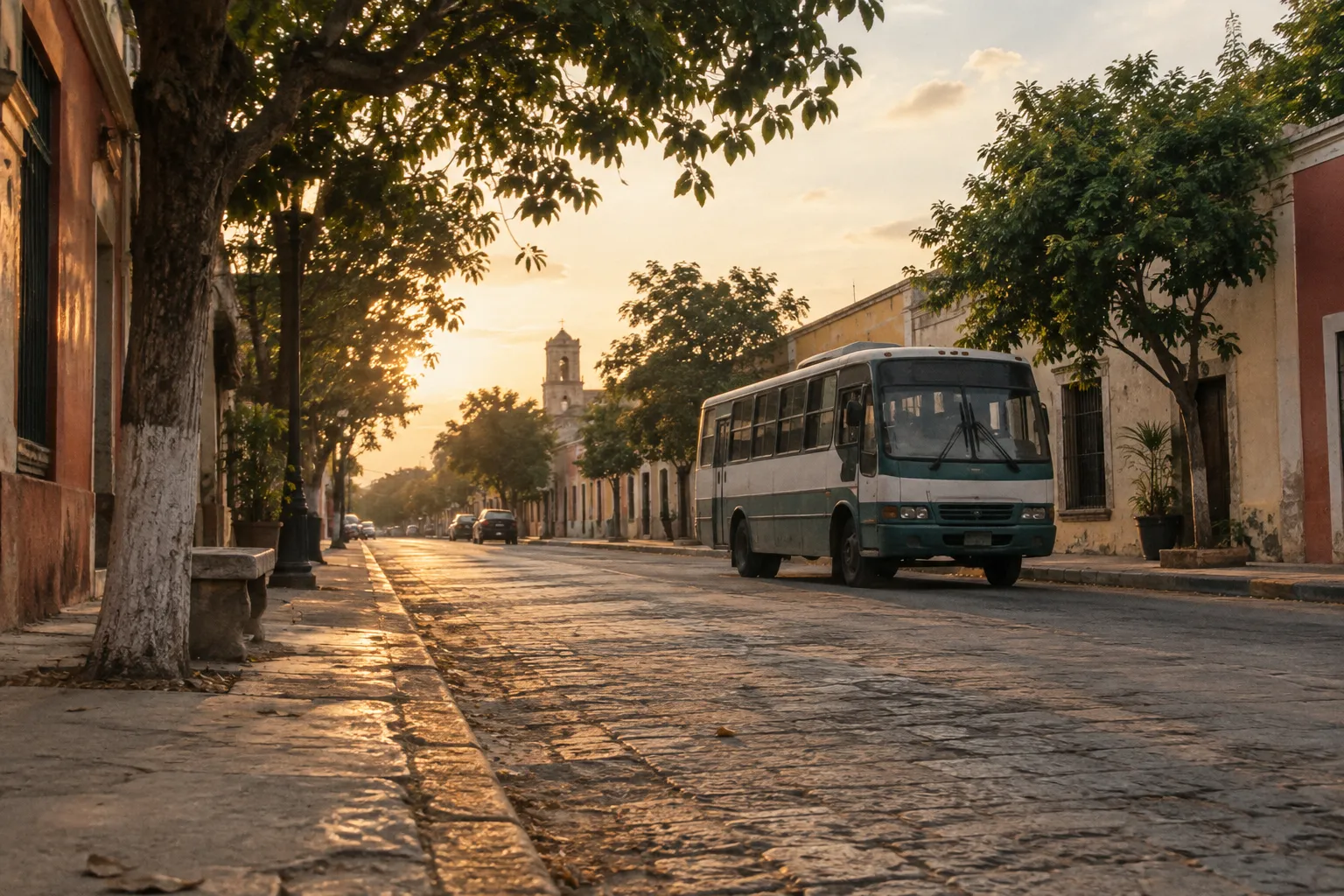
From Merida, you can choose between the 180D toll highway and the free 180 through Piste (3). ADO intercity buses and tours with pickup also serve the route (3). On Sundays since September 2026, the Tren Maya also runs a restaurant train from Merida-Teya to Chichen Itza at 08:20, returning at 16:00 (19). If you’re choosing a base and the shortest overland trip is your priority, Merida beats Cancun by more than an hour each way. You give up beach-resort access in exchange.
From Tulum, the route runs via Cobá and Valladolid, then onto road 180 (3). One guide puts the drive at about 2 hours (5). Tulum sits 127 km (79 miles) from El Castillo in a straight line (3), and the road distance is longer. Tours with hotel pickup cover the route. Public transport means an ADO bus via Valladolid rather than a direct service (3). One transport guide notes there is no direct ADO service from Tulum most days (5), so driving or a tour are the main options.
Treat every drive time in this section as a planning estimate. Route choice, toll versus free road, and stops all change the result (3)(5). Before you set an alarm for a 08:00 arrival, check the route on a live map the night before and add a buffer.
Valladolid deserves a mention as a fourth option. It sits 38 km (24 miles) from El Castillo in a straight line, and colectivo shared vans and ADO buses run between the two (3). Staying a night there, about 45 minutes from the ruins, is the easiest way to be first through the gate at opening (15).
Choosing a Base for Chichen Itza
| Cancun | Tulum | Merida | |
|---|---|---|---|
| Distance | 187 km (116 miles) straight-line | 127 km (79 miles) straight-line | 115 km (71 miles) by road |
| Estimated drive | About 2.5-3 hours | About 2 hours | About 1.5 hours |
| Direct bus option | Direct ADO tourist bus on Sundays; regular ADO buses other days | No direct bus; ADO via Valladolid | ADO intercity buses; Sunday Tren Maya restaurant train |
| Best fit | Keeping a resort base for a long day trip | Travelers already staying on the southern Riviera Maya | The shortest overland trip and an easier early arrival |
Best Time to Visit Chichen Itza
The best time to visit Chichen Itza is a weekday between November and February, arriving at the 08:00 opening, according to a timing guide built around the site’s hours (15). INAH lists the site as open daily from 08:00 to 17:00, with last entry at 16:00 (2), so plan to be through the gate by 16:00. Arriving at opening beats both the tour buses, which pour in from about 10:00, and the midday heat on the shadeless grounds (15).
The months break down by weather (15):
- November-February: cool and dry. This is the best combination of comfortable temperatures and clear skies.
- March-May: hot and dry. The exposed site can be brutal by midday.
- June-October: the rainy season. The landscape is greener and the site quieter, but it’s humid and afternoon storms are common.
The day of the week matters too. Sundays are the busiest day because of free entry for Mexican nationals and residents. Weekdays are noticeably calmer (15).
The Equinox Shadow and Why It Draws Crowds
The equinox serpent shadow appears on El Castillo’s western balustrade. INAH describes triangular forms of light and shadow that seem to descend toward a serpent head at the base of the staircase (2). It happens around the spring and autumn equinoxes, near March 20 and September 22 (15), as the setting sun lights the stairway (1).
The equinox is a spectacle worth seeing, and the opposite of a quiet visit (15). Expect the largest crowds of the year. Both dates also fall in the less comfortable seasons: March sits at the start of the hot season and September falls in the rainy season (15). Since the effect comes with the late-afternoon sun, you also lose the early-arrival advantage. Plan on heat or rain, long lines at the CATVI ticket office, and a slow exit. If you want to see the shadow, sleep nearby rather than attempting it as a day trip from Cancun.
Early Morning vs Midday Arrival
Arriving at 08:00 is the single change that improves a Chichen Itza visit most. You get cooler air, thinner crowds, and photos of El Castillo without coach groups in front of it. By late morning, tour buses have arrived (15) and the sun is high over open ground with little shade.
Chichen Itza runs on Yucatan time, one hour behind Cancun (1). To reach the gate at 08:00 by car, leave Cancun around 06:00 local time, given the 2.5-3 hour drive estimate (5). From Merida, a departure around 06:30 works. If you’re on the Sunday ADO bus, check what time it reaches the site. Its schedule is fixed, so you cannot choose an early arrival (1).
A midday arrival is not wasted, just harder. Carry more water than you think you need, wear a hat and sun protection, and plan your route between the major structures before you start walking. The alternative is to sleep near the site. Ik Kil has bungalows 3 km (1.9 miles) from the archaeological zone (7), which turns the 08:00 opening from a pre-dawn start on the coast into an easy morning.
Nearby Cenotes to Pair With Your Visit
The Sacred Cenote and Cenote Xtoloc lie inside the archaeological zone (16), and the Sacred Cenote is not open for swimming (9). For a swim, Ik Kil is the easy pick, 3 km (1.9 miles) from the site. Its operator says it is about 5 minutes away, open 365 days a year, with the cenote open 09:00-17:00 (7). That makes it the easiest same-day add-on, especially after a morning on the hot, shadeless ruins.
Ik Kil is an open cenote. It formed when the roof of an underground cavern collapsed, exposing deep, clear water, and its walls are covered in vegetation (7). The site also has bungalows and a restaurant (7), which is useful if you want an overnight stay before an 08:00 entry. Check its current visiting arrangements before you build it into your itinerary.
Samula and Xkeken (also called Dzitnup) are the stronger pick if you’re heading back toward Cancun or Tulum. They sit in the community of Dzitnup in the municipality of Valladolid. To reach them, turn off the Merida-Valladolid highway 3 km (1.9 miles) before Valladolid. At the soccer field, Samula is on the left and Xkeken on the right (9). Combined admission to both is listed at MXN 125 (9). No date is given for that price, so confirm it on arrival.
The two cenotes are different experiences, and they are linked by an underground river system (11):
- Samula: a spacious cavern with stalactites and turquoise water lit by a hole in the ceiling. Tree roots hang down to the surface. You descend by stone stairs, and swimming is possible (9).
- Xkeken: smaller, with the whole cavern measuring about 30 x 20 m (98 x 65 ft) and the water reaching 20 m (65 ft) at its deepest. It is not suitable for diving, but you can snorkel with your own gear and see small fish (11).
Here is the ranking for a same-day trip. Ik Kil is worth the detour if you’re returning toward Merida, or if you just want the closest swim. Samula and Xkeken make the better stop for anyone driving back east on the free Highway 180 through Valladolid. If you’re on the Sunday ADO bus from Cancun, it has no cenote stop: it runs from the ruins back to Cancun the same evening (1).
Visiting on Your Own vs Booking a Tour
You can visit Chichen Itza on your own. INAH confirms the site can be reached by public transport (2), and ADO runs a direct tourist bus from Cancun (1). The constraint is the clock: the direct tourist bus runs on Sundays (1), and the regular coastal bus reaches the site in late morning (5). To be at the gate for the 08:00 opening on your own, you need a car or a night nearby.
Going independently gives you control of the clock. With a rental car, you can arrive at 08:00 opening, leave before the worst heat, and stop at whichever cenote suits your return route. ADO describes the main appeal of its direct bus in similar terms: no rental car, no transfer in Valladolid, and no guided-tour schedule, so you explore at your own pace (1). The cost of that freedom is doing the logistics yourself. That means booking the car or bus, buying tickets at the CATVI office, and finding your way around the site without a guide.
An organized day trip trades control for convenience. Tours with hotel pickup run from Cancun, Playa del Carmen, Tulum and Merida (3). Tours have no single standard itinerary or duration, so compare exactly what each one includes before you book. Check these points:
- Tickets: does the price include both the federal and the Yucatan state fee, or only the INAH portion?
- Arrival time: many tours from the coast reach the site after the morning opening, which puts you in the late-morning crowd.
- Time on site: how many hours you actually get at the ruins, as opposed to on the bus.
- Cenote and meals: which cenote, if any, how long you stop there, and whether lunch is included.
- Pickup point and return time: these decide how long your day really is.
A guide does add context you won’t get alone, especially for the Great Ball Court carvings and El Castillo’s calendar design. If you go independently, read up on the main structures before you arrive.
Frequently Asked Questions
- Is Chichen Itza worth visiting if you have limited time in Yucatan?
- Yes, if you can give the site a focused morning; prioritize El Castillo, the Great Ball Court and El Caracol rather than trying to see every structure.
- How long should you allow for Chichen Itza and a cenote?
- Allow a full day from a coastal base; the ruins can fit into a morning, but driving and a cenote stop take the rest of the day.
- Is Chichen Itza safe to visit right now?
- Check your government's current Yucatan advisory and the latest site notice before departure; on site, plan for heat, exposed walking and changing operations.
- Can you visit Chichen Itza independently without a guided tour?
- Yes; independent travel is practical if you arrange transport, confirm the current CATVI ticket procedure and are comfortable navigating the site without a guide.
- What should foreign visitors budget for Chichen Itza admission in 2026?
- Budget for the combined federal and state admission, not the federal fee alone, and verify the latest INAH bulletin because ticket procedures have changed.
- Can you bring a tripod or fly a drone at Chichen Itza?
- Not without prior authorization: INAH requires a permit from its legal office (CNAJ) for drones, tripods and professional photo or video equipment, according to its September 2026 bulletin.
- What should you prioritize seeing at Chichen Itza?
- Start with El Castillo and the Great Ball Court, then add El Caracol if time allows; the court's carved wall panels are easy to pass without noticing.
- When should you arrive at Chichen Itza to avoid the busiest conditions?
- Choose a weekday opening-time arrival outside the equinox period; Sundays and the equinox dates draw larger crowds and make a quiet visit less likely.
Planning Your Chichen Itza Day
Two decisions shape a Chichen Itza trip more than any others. First, budget for the full ticket. Foreign visitors pay both INAH’s MXN 105 federal fee and Yucatan’s MXN 592 state fee, now sold together as one MXN 697 ticket at the CATVI office (17). Second, match your transport to your arrival time. The direct ADO bus from Cancun runs on Sundays (1); for an 08:00 arrival on any day, drive the 180D or base yourself in Merida or Valladolid.
Then set your arrival for the 08:00 opening, and decide on your cenote before you leave. Choose Ik Kil if you’re returning toward Merida, or Samula and Xkeken if you’re heading back east through Valladolid. Check the latest INAH bulletin and ADO’s route page a few days out, because the single-ticket system is new in 2026 (4) and ADO says its schedules can change by season (1).