Only 180 people can set foot on Skellig Michael on any given day, and in peak summer those spots are gone before you’ve even decided to go. Skellig Michael is a 6th-to-8th-century monastic island roughly 11-12 km off the Iveragh Peninsula in County Kerry, UNESCO-listed since 1996, and it is physically demanding in a way that most Irish attractions simply aren’t. This is not a place you visit on a whim.
The Star Wars fame and the puffin photos are real, but they’re bonuses layered on top of a site that was extraordinary long before a film crew showed up. What follows is the logistics (how to get there, what to book, the traps to avoid) and the honest answer on whether the climb is worth it.
How to Get to Skellig Michael
Skellig Michael sits roughly 11-12 km off the Iveragh Peninsula, and getting there is a two-stage problem: reaching County Kerry, then reaching the pier.
Getting to Kerry: Kerry Airport (KIR) near Farranfore handles flights from Dublin and a handful of European routes. Cork Airport is a two-hour drive and opens up more international connections. By rail, the nearest station is Killarney, served by Irish Rail from Dublin Heuston (roughly 3.5 hours). From Killarney, Portmagee is about 70 km southwest, around an hour by car on the N70/R565.
Getting to Portmagee: A car is the practical answer. Public transport to Portmagee is limited, and the Skellig Ring has no meaningful bus service. Rental cars are available at Kerry and Cork airports and in Killarney. If you’re based in Killarney or Cahersiveen, some operators offer transfers; check when you book.
Portmagee is the primary departure point for most landing tours. Ballinskelligs and Caherdaniel handle some sailings too, so confirm your departure pier when you book: they’re not interchangeable on the morning of your trip.
✓ Pros
- One of Europe's most intact early medieval monastic sites, with six beehive cells and two oratories still standing after roughly 1,400 years
- Tightly controlled visitor numbers mean the island never feels like a tourist trap
- Puffins nest within arm's reach of the trail from April to early August
- The physical challenge and remoteness make it genuinely hard to top
- OPW guides on-site provide real historical context
✗ Cons
- Only 180 landing spots per day, so it books out weeks or months ahead in peak season
- 618 steep, uneven steps with no handrails; not suitable for everyone
- Basic toilet facilities only: no shelter, no food, and no bins on the island
- Weather cancellations are common; one-day visitors risk missing out entirely
- Children under 12 (and often under 14 per operator policy) cannot land
What Makes Skellig Michael Worth the Effort
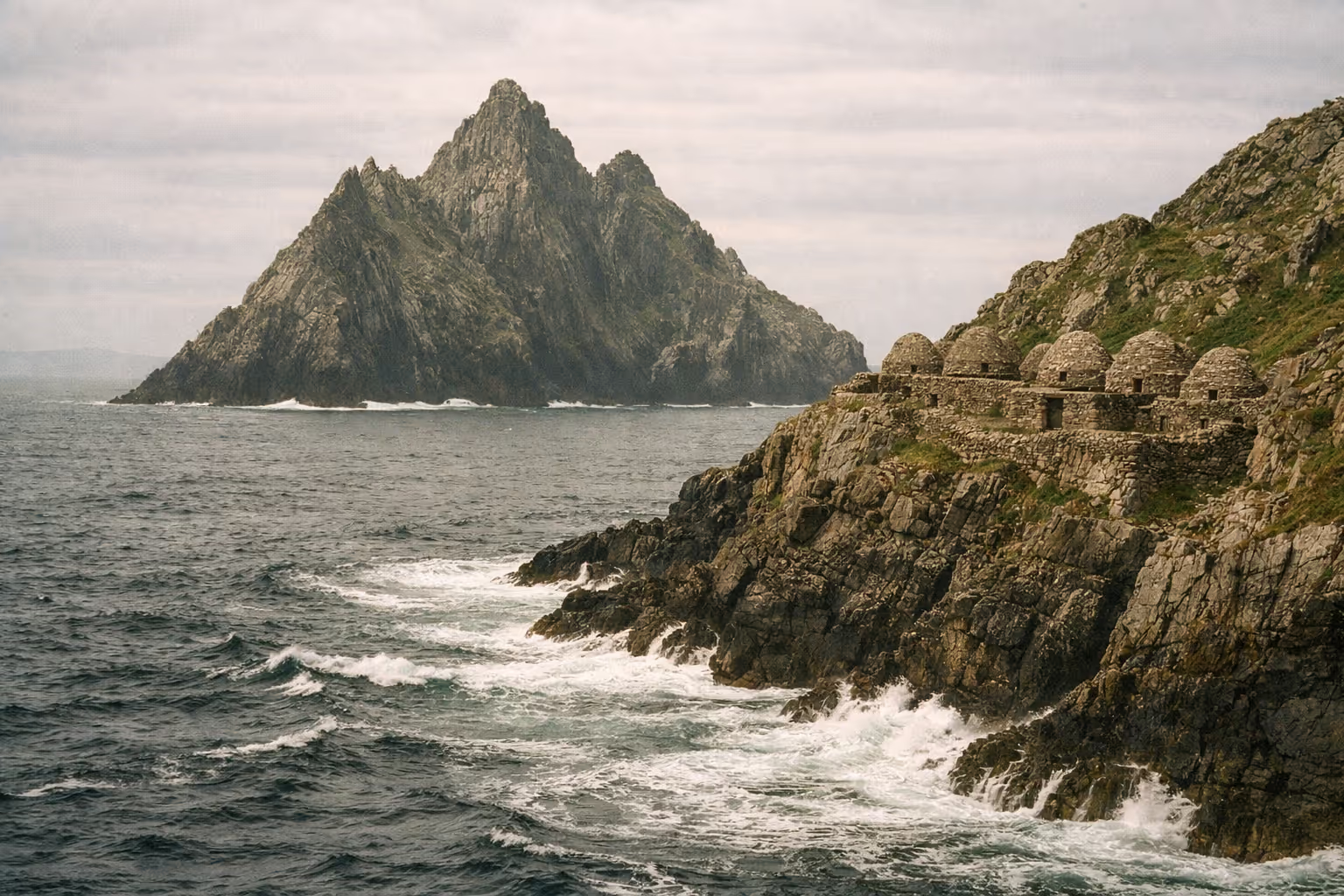
Skellig Michael is a twin-pinnacled rock rising about 218 m from the Atlantic, home to one of the most complete early medieval monastic settlements in Europe. That completeness is what earns it the effort. Monks established the community here between the 6th and 8th centuries and occupied it until the medieval period, when harsh conditions drove them to Ballinskelligs on the mainland (13). The isolation was the point: this was as far from ordinary life as they could get, and, by their reckoning, as close to God.
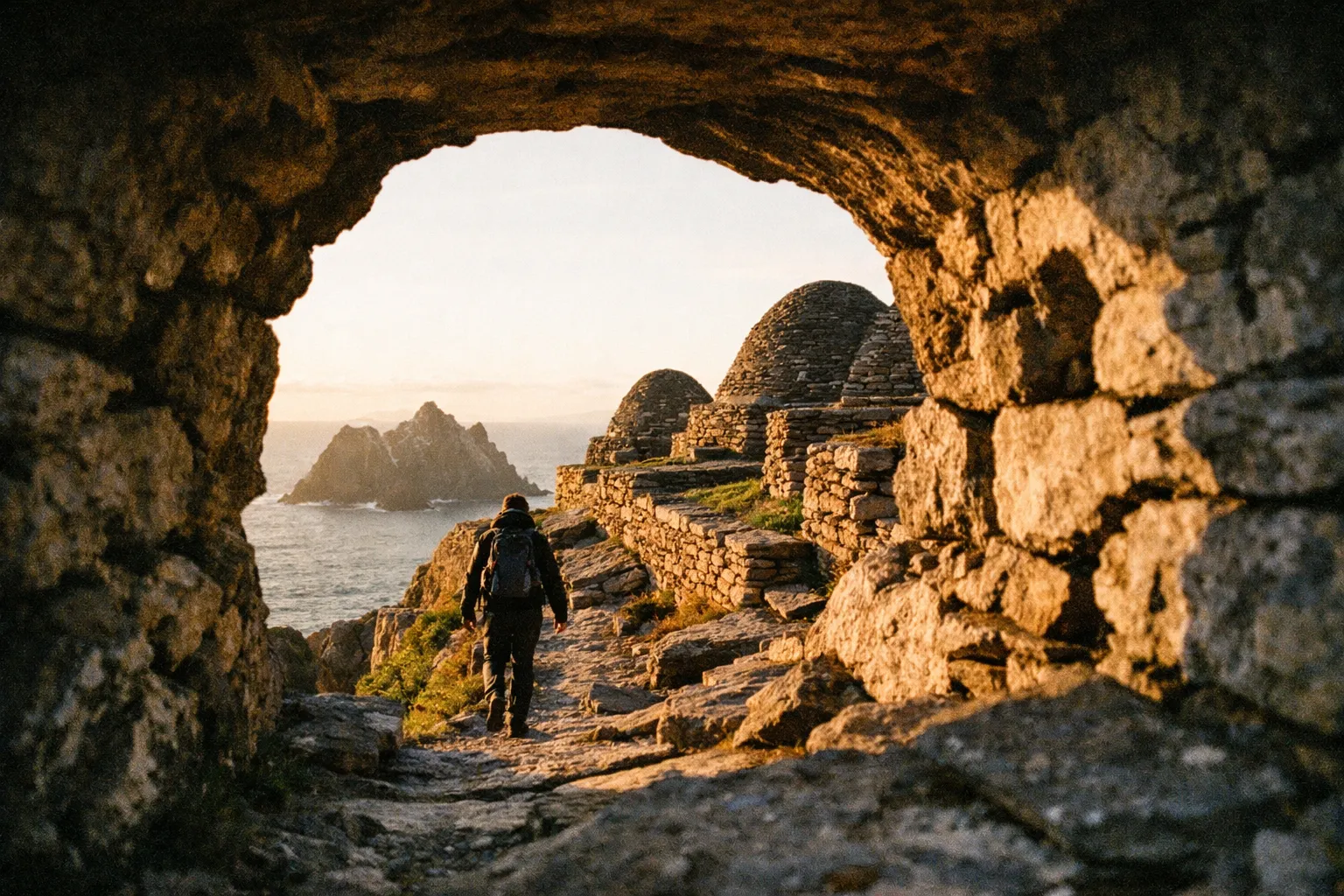
The island was inscribed on the UNESCO World Heritage List in 1996 for its outstanding universal value as an early medieval monastic settlement (6). What survives is not a reconstruction. The six beehive cells, two oratories, a later medieval church, stone crosses, and retaining walls all sit on a terraced shelf about 600 ft (roughly 180 m) above sea level, built in dry-stone corbel construction without a scrap of mortar.
So, is it worth it? For most people who make the trip, yes, with caveats. The booking difficulty, the physical demand, and the weather risk are all real and non-negotiable. But the site delivers. There is nowhere else in Ireland where you climb a monk-built stone stairway to a 1,400-year-old settlement perched on an Atlantic pinnacle, with seabirds nesting beside your feet the whole way up.
The monastic beehive huts and what you’re actually looking at
The beehive cells, clocháin in Irish, are corbelled stone structures, each course of flat stones laid slightly inward until the walls meet overhead in a dome. No mortar, no timber, no frame. They shed rain because the stones are angled outward, and they’ve stayed structurally sound for well over a thousand years on one of the most exposed sites in the North Atlantic. Standing inside one, you get the scale of monastic life here: cramped, dark, cold, shared by a community of around a dozen monks.
The terrace layout is compact. Six cells, two oratories, a church, and the retaining walls that hold the whole platform against the slope, all clustered at roughly 180 m elevation. OPW guides walk you through the site when you reach the top. Plan to listen rather than rush; the context they provide is what separates this from a photo stop.
The 618 steps you climb to get there are not a modern addition. They are the original monk-built route from the landing point, worn smooth in places and uneven throughout (10). One note for the ambitious: the South Peak hermitage is a separate, far more exposed climb that is not part of the standard visitor route and should not be attempted without real climbing experience.
Star Wars Filming Location
Skellig Michael stood in for Ahch-To, Luke Skywalker’s island refuge, in Star Wars: The Force Awakens (2015) and The Last Jedi (2017). The stone steps, the monastery terrace, and the landing area all appear on screen, and crucially they weren’t dressed or rebuilt for the camera. The beehive cells in those films are the same ones the monks built. The stairway Luke climbs is the same 618-step route you climb.
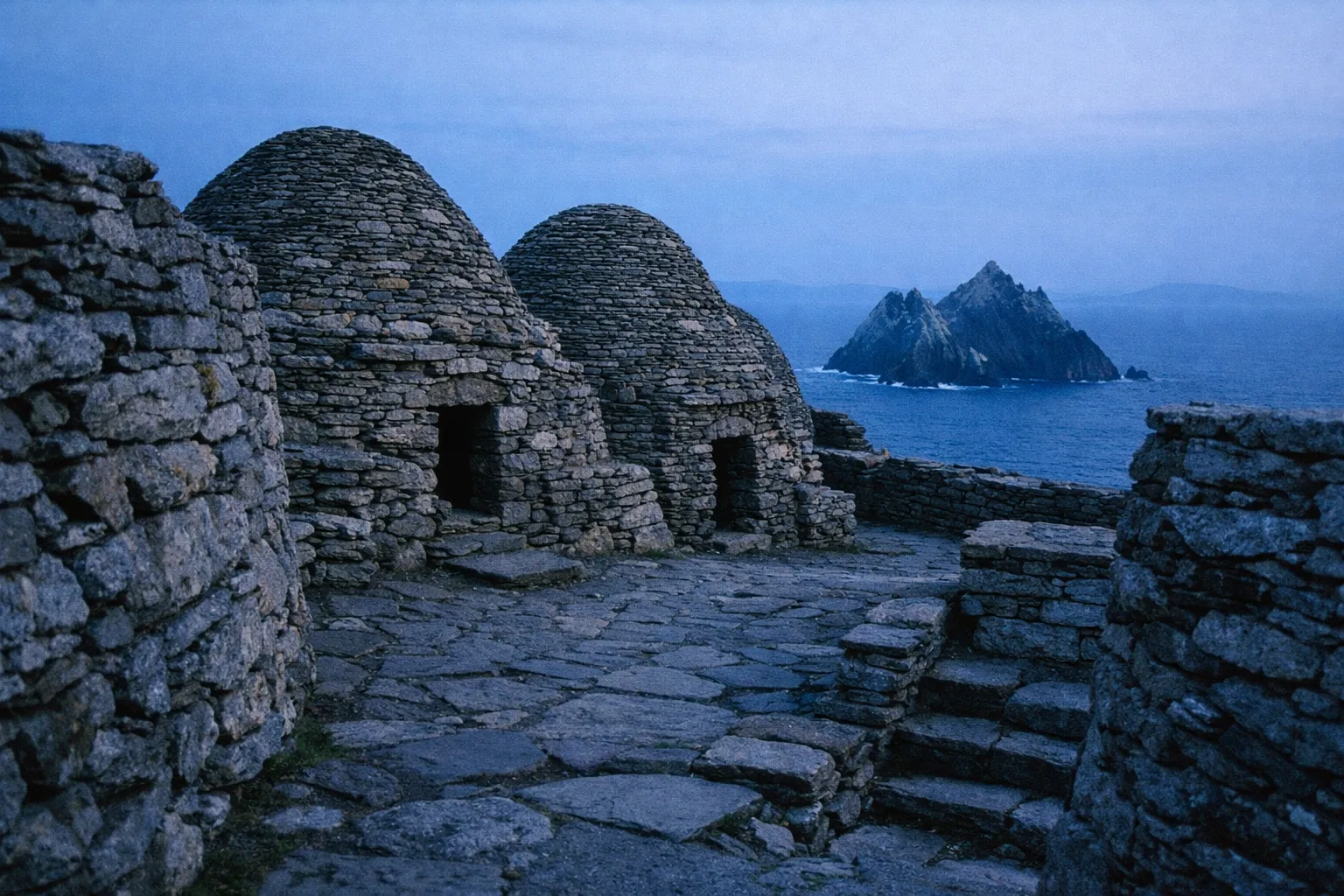
That’s what makes the Star Wars filming location work cinematically: the scale, the isolation, and the genuine antiquity meant the crew needed almost no set dressing. The rock does the work.
The practical reality for visitors is worth being clear about. You’re not touring a film set; you’re touring a working monastic site that happened to be filmed. Some operators lean into the Star Wars angle and will point out specific shooting spots; others focus on monastic history and ecology. Both approaches are valid, and you’ll get the same island either way.
There’s a balance to strike, though. The monks chose this rock as a place of extreme devotion, and the film connection brought a wave of new visitors that the site was never built to absorb. The 180-person daily cap is partly a response to that pressure. Treat the beehive huts and the burrow-lined steps accordingly: stay on the trail, don’t climb on the structures, and remember what you’re actually standing in.
How to Book a Landing Tour, and When to Start
The hard cap is the number that governs everything: 15 licensed boat operators, 12 passengers per boat, one trip per boat per day, for a maximum of 180 landings, full stop (2)(10). Demand does not flex that ceiling. There is no standby, no waitlist at the pier, no exceptions.
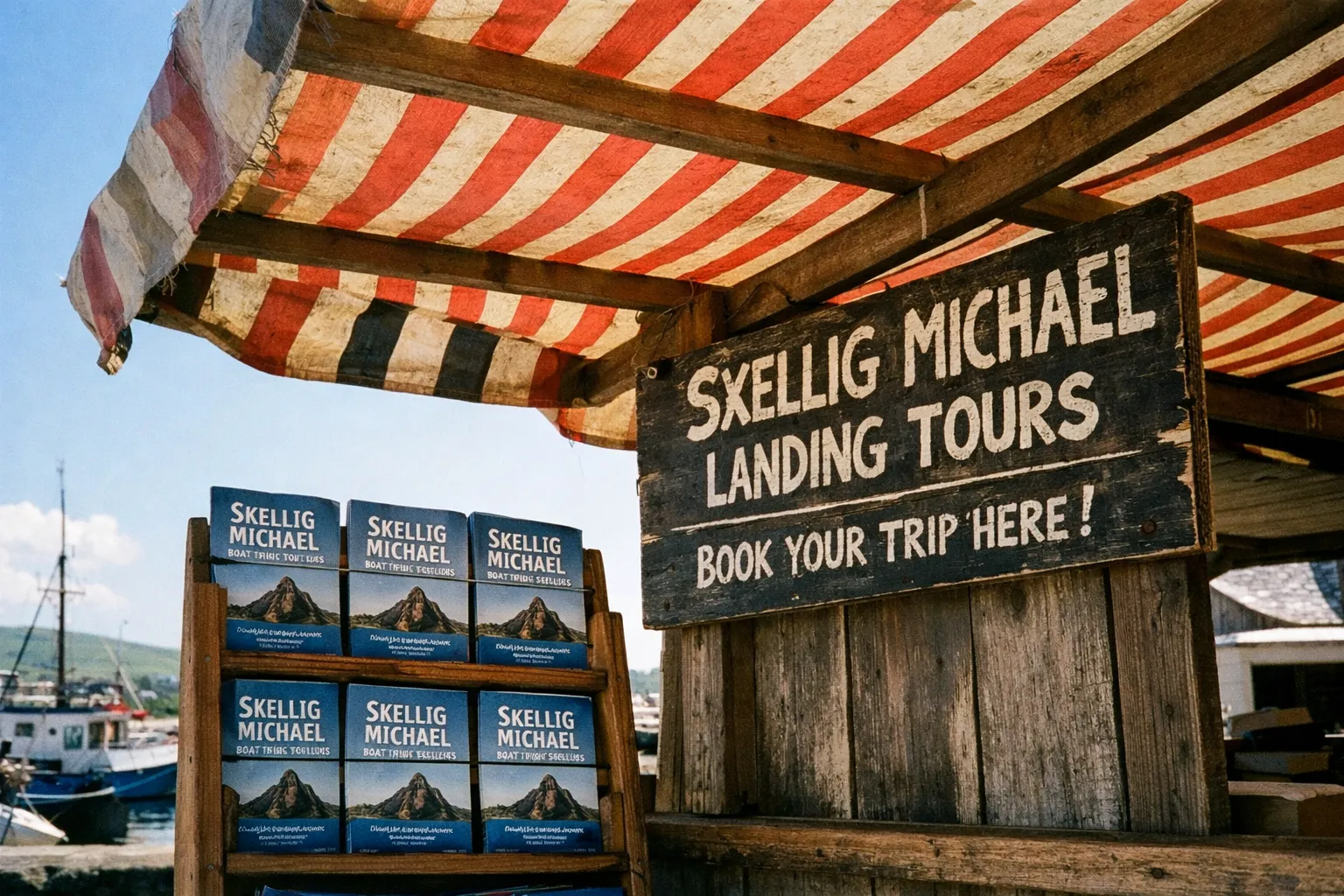
Heritage Ireland (OPW) publishes the 2026 landing season as 12 May to September, and says plainly that those dates are subject to change (10). Weather moves them in practice, so treat the opening as approximate until your operator confirms. Some eco and boat-only trips start earlier.
How far ahead should you book? For June, July, and August, think months, not weeks. Peak dates sell out well in advance, and 60-90+ days ahead is the realistic minimum for high summer. May and September are more forgiving but still require planning; these are not walk-up trips at any point in the season.
Book directly through licensed operators. Heritage Ireland maintains the official list of permitted 2026 operators; do not book through unlicensed third parties, and be aware that private boats cannot land at all. Departures typically leave between roughly 08:30 and 10:00 (some operators run a wider window into the late morning), with Portmagee the primary departure point and some sailings from Ballinskelligs and Caherdaniel. You’ll usually get your allocated departure time when you check in online the day before.
One more thing to build into your plan: weather cancellations are common. Operators refund or rebook when sea conditions force a cancellation, but if you’ve only got one possible day, a cancellation ends your chance entirely. Give yourself at least one backup day.
Landing tour vs. eco boat tour: which one to choose
Landing Tour vs. Eco Boat Tour
| Landing Tour | Eco Boat Tour | |
|---|---|---|
| Sets foot on island | Yes | No |
| Monastery access | Full climb to beehive huts | None |
| Season | Mid-May to end September | Late April to early October |
| Daily cap | 180 total (15 boats × 12 passengers) | No hard cap |
| Minimum age | 12 (OPW); often 14 (operators) | No restriction |
| Fitness required | High: 618 steps, unprotected paths | None |
| Trip duration | about 4-4.5 hours total | about 2-3 hours |
| Puffin viewing | Excellent (close range on trail) | Good (from boat) |
| Little Skellig gannet colony | Seen from boat en route | Close-up boat views |
| Booking lead time | Months ahead for peak season | Easier to book |
| Best for | Fit adults, history/archaeology focus | Families, wildlife focus, non-landers |
Age rules and eligibility
The OPW rule is firm: no children under 12 are permitted on Skellig Michael (10). Many operators set their own minimum higher, at 14+, for landing tours; Casey’s Skellig Islands Tours, for example, applies a 14+ age limit. Check your specific operator’s policy before you travel, because families do get turned away at the pier over this.
Dogs and other animals are prohibited from the island (6). Operators are also explicit that the tour may be unsuitable for visitors with heart conditions, respiratory conditions such as asthma, musculoskeletal conditions, vertigo, or seizures (4). If any of those apply, the eco tour is the sensible alternative.
The 618 Steps: Physical Reality of the Climb
The climb to Skellig Michael’s monastery is 618 uneven medieval stone steps, gaining roughly 600 ft (about 180 m) of elevation over a short horizontal distance (10). The OPW warns that there are no barriers or rails on the ancient paths and that the access route has unprotected edges; handrail and chain linkage exist only in a few places, and you are told to use them where they are provided (6). Treat the route as unprotected and plan accordingly. That’s the honest benchmark. These are not uniform, engineered steps: they vary in height, depth, and angle, and many are worn smooth by centuries of use.
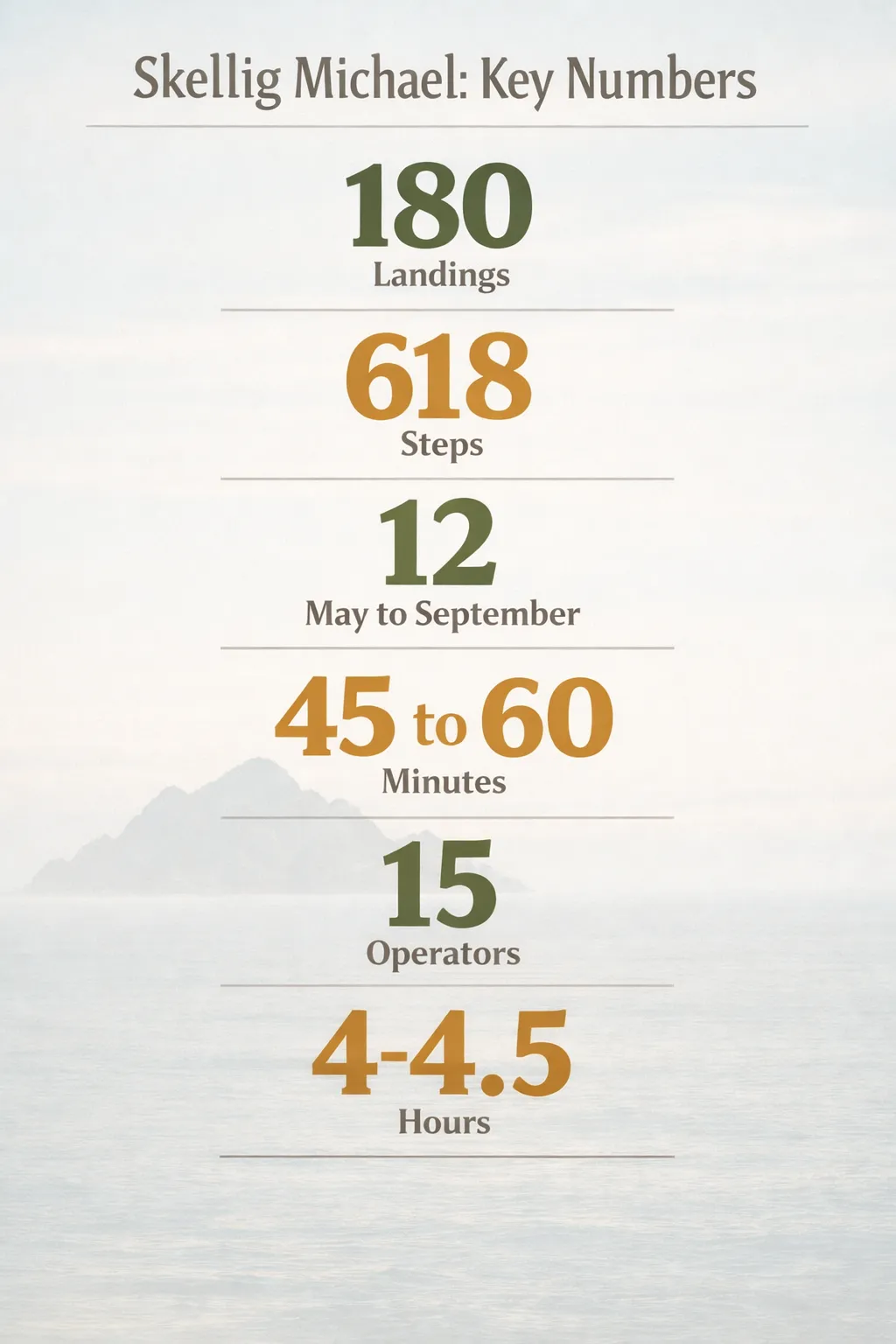 Skellig Michael by the numbers: 180 landings a day across 15 licensed operators, 618 steps, a 12 May to September season, a 45 to 60 minute crossing each way, and a typical landing day of 4 to 4.5 hours.
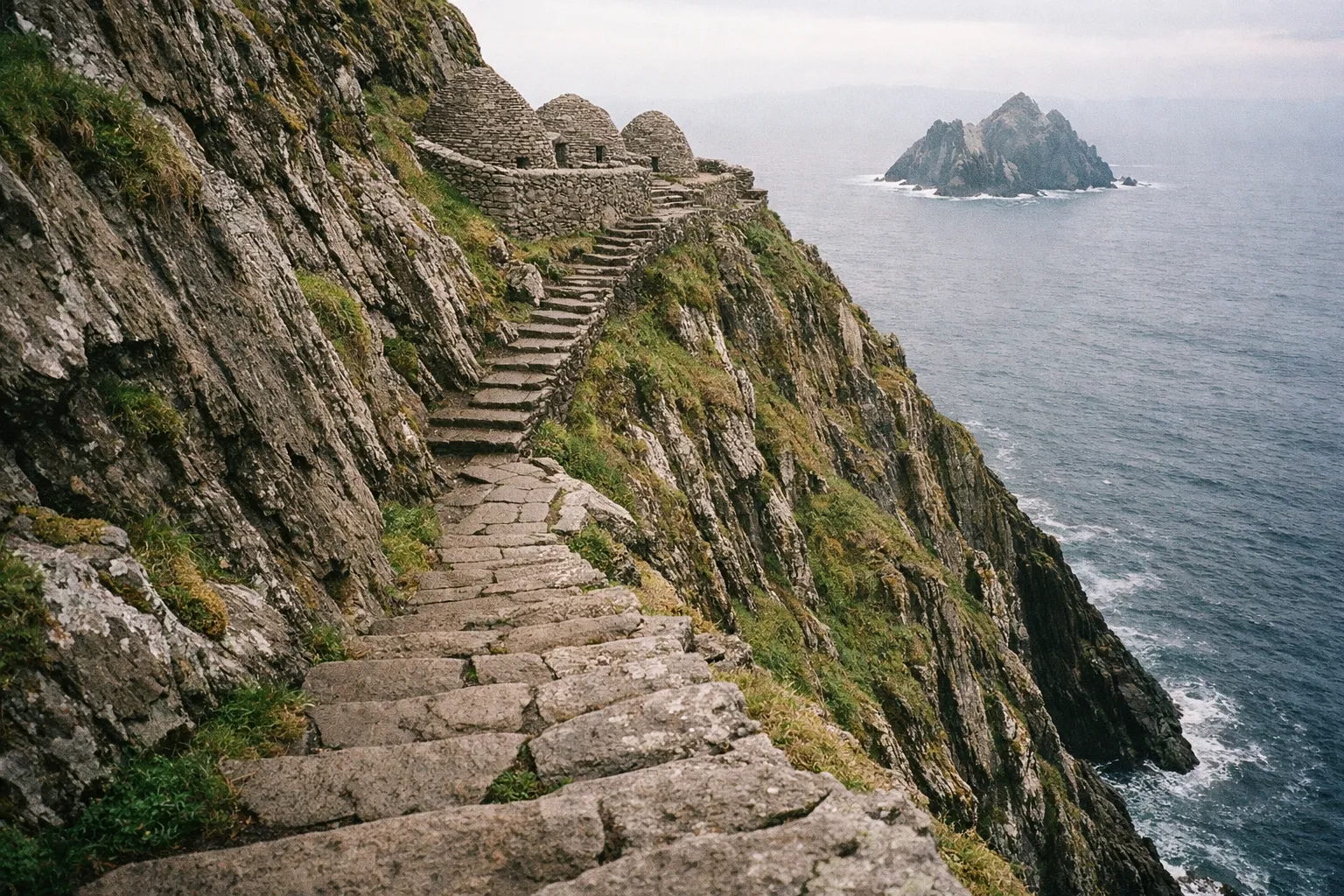
The exposure is significant, especially on the upper sections. Wind is almost always present out here, 12 km into the open Atlantic, and the steps turn slippery when wet, which is often. Falling rock is a documented hazard, flagged on OPW signage. Climbs are not permitted in very wet or very windy conditions, for good reason.
A realistic fitness gauge: if you can climb a long, steep hill in wet weather without stopping every few minutes, you can manage this. If you have knee problems, vertigo, or a cardiac condition, reconsider, or plan to stay lower on the steps and skip the summit. The OPW itself asks people with these conditions to think carefully before booking (10).
Pace yourself. There’s no schedule dictating how fast you go within your allotted island time. Take breaks. Stay on the recognised visitor route at all times: stepping off the trail damages puffin burrows and sharply raises your fall risk (10).
Footwear is non-negotiable. Sturdy closed-toe shoes with good grip are mandatory; sandals and flip-flops are not permitted on the island (6), and you can be refused boarding if your clothing or footwear fails the inspection held before the tour starts (4). Hiking boots or well-treaded trail runners are ideal. Bring a waterproof, windproof outer layer regardless of the forecast, because the weather out here delivers several seasons in a single day.
And if you can’t or don’t want to summit, that’s fine. You can still land, experience the lower steps, take in the landing area and the seabirds, and stop wherever your comfort runs out. The island has value at every elevation.
Puffins, Gannets, and the Seabird Wildlife of the Skelligs
Atlantic puffins are the headline species on Skellig Michael, present from roughly late March/early April to early August, nesting in burrows along the steps and cliff edges (8). In peak season, May through July, they nest right beside the visitor trail, close enough to photograph without a telephoto lens. The OPW asks visitors to stay on the recognised route for exactly this reason: straying from it damages the habitat of nesting birds (6).
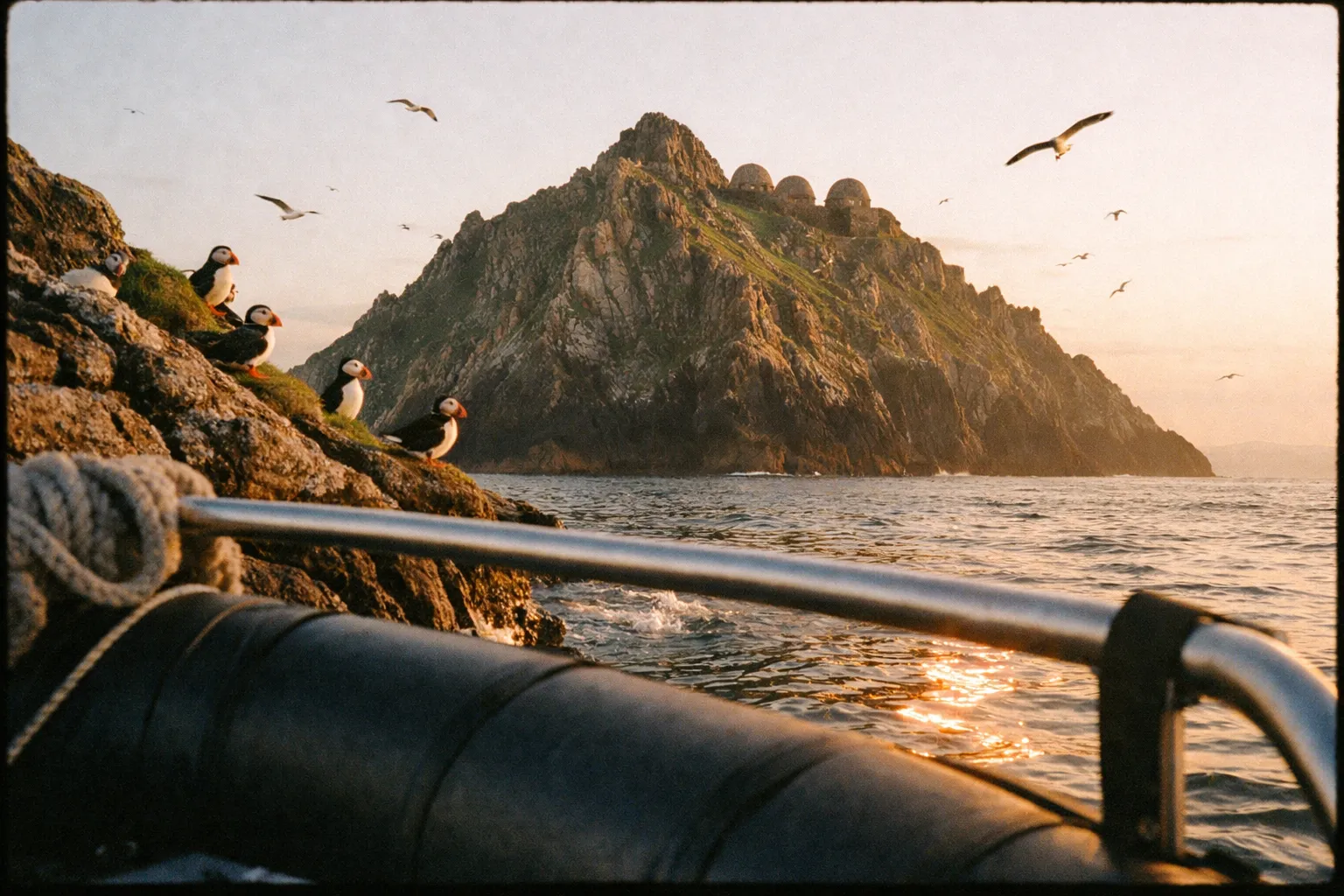
August is the transition month. Puffin numbers drop noticeably as the birds return to the water, and by late August most are gone. If puffins and seabird wildlife are your primary reason for visiting, do not plan around late summer.
After the puffins leave, the seabird spectacle shifts to the boat. Little Skellig, the sister island, supports around 35,000 breeding pairs of gannets, the largest breeding colony in Ireland and among the largest in the world, per BirdWatch Ireland, which owns the island as a nature reserve. By midsummer there can be at least 100,000 gannets on the rock once chicks and non-breeding birds are counted (16). The colony has to be admired from a boat, and eco tours and landing sailings both pass close to it (16), so the gannet show holds up long after the puffins have gone. You’ll also see kittiwakes, razorbills, fulmars, and storm petrels through the season.
The rules are strict and enforced: do not touch puffins or any seabird, and do not step off the trail, because burrows are underfoot everywhere on the grassy slopes. UNESCO and OPW take burrow protection seriously, and staying on the route protects both the birds and you.
Puffin season month-by-month expectations
- April-May: Puffins arriving and establishing burrows; numbers building through the period. The landing season opens mid-May, so early-season landings catch the buildup.
- June-July: Peak puffin numbers, and also peak booking competition. This is the window if the birds are your priority.
- Early August: Puffins still present but thinning fast. The last reliable window of the year.
- Late August-September: Puffins largely gone. Gannet viewing from the boat remains excellent, and seas are often calmer on average, a better window for landscape, archaeology, and a less crowded island.
Visit May through July for puffins plus archaeology, or August through September for calmer seas, fewer crowds, and a focus on the monastic site itself.
The Skellig Ring: What to Do If You Can’t Land (or Want More)
The Skellig Ring scenic drive is a roughly 50 km coastal loop (including Valentia Island) that branches off the Ring of Kerry near Cahersiveen, running through Portmagee and Ballinskelligs and rejoining the main route near Waterville. Driving the full loop adds about 1.5 to 2 hours to a Ring of Kerry day. It’s one of the better coastal drives in Kerry, and it works whether or not you ever get on a boat.
Two viewpoints stand out for sightlines to the islands. St. Finian’s Bay and the road above Portmagee both give you clear views of Skellig Michael on a good day; the twin pinnacles look dramatic from the mainland even without binoculars.
For context before or after a trip, or as a genuine alternative if you can’t land, the Skellig Experience Centre on Valentia Island is worth the stop. It runs exhibitions on the monastery, the lighthouse, and the islands’ seabirds, using graphics, a 15-minute film, models, and reconstructions (13). If the weather or the booking window closes the island off to you, this is where you get the history.
Portmagee is the primary departure point for most boat tours and makes a practical overnight base. Arriving the evening before lets you confirm the forecast and your departure time with your operator, which matters when sailings can change at short notice. Ballinskelligs, an alternative departure point for some operators, adds a beach and the ruins of a medieval priory to the mix.
As a standalone, the Skellig Ring fills a comfortable half-day from Killarney, or it slots neatly into a two-day Ring of Kerry itinerary that also takes in Valentia Island.
What to Bring and What to Expect on the Day
Budget the best part of a day: the OPW warns that a landing trip in its entirety can run up to six hours, and that is the number to plan around (6). Within it, the average visit on the island itself is 2.5 hours, excluding the boat trip (10). You depart the pier between roughly 08:30 and 10:00, and the crossing takes about 45 to 60 minutes each way, with boarding and disembarkation on top. Added up, a typical landing day runs 4 to 4.5 hours; the OPW’s six hours is the outer edge, not the average.
The crossing is on open Atlantic water, and it’s often rough. Seasickness is real out here. If you’re prone to it, take medication before boarding, not once you’re already on the boat and feeling the swell.
On the island, OPW staff are present and guide visitors through the monastery. There’s no fixed tour schedule; you move at your own pace within your allotted time. Use that freedom to slow down at the top rather than rushing the climb.
How to prepare for a Skellig Michael landing tour
About 1 hour of preparationFive essential steps to ensure a successful and safe visit
- 1
Book early
Check Heritage Ireland's licensed operator list and book directly. For June and July, aim for 90+ days ahead. For May or September, 4-6 weeks may suffice, but earlier is always safer.
- 2
Build in a backup day
Weather cancellations are common. Plan to be in the Portmagee/Skellig Ring area for at least two consecutive days so one cancellation doesn't end your chance.
- 3
Sort your gear before you travel
Prepare sturdy closed-toe shoes with grip, waterproof jacket and trousers, water, snacks, seasickness tablets, sunscreen, and a small daypack. Don't pack anything you can't carry up 618 steps.
- 4
Check the forecast the morning of your trip
Your operator will contact you if the sailing is cancelled. If conditions look borderline, call them directly, and arrive early: there are toilet facilities on the island, but nothing else, so eat and stock up before you sail.
- 5
Pace yourself on the steps
Start steady, take breaks, and stay on the marked route. Listen to the OPW guides; they know the site and the safety risks. The monastery will still be there if you take ten minutes to catch your breath.
What to pack:
- Sturdy closed-toe shoes with grip (non-negotiable)
- Waterproof, windproof jacket and trousers
- Water: at least 1 litre per person
- Snacks (there is no food on the island)
- Seasickness tablets, taken before departure
- Sunscreen (exposure is total; there is no shade)
- Camera or phone with a charged battery
- A small daypack so your hands are free on the steps
What not to bring: dogs, large bags that impede climbing, and anything you’re not prepared to carry back down.
On facilities, keep expectations low. There are toilet facilities on the island (6), and that is the extent of it: no food, no shelter, and no bins, so carry all your litter back to the mainland (6). Check the forecast the morning of your trip; if you have flexibility, a same-day rebooking is often possible when sailings are cancelled.
What Most Guides Get Wrong
Most coverage leads with the Star Wars angle or the puffin photos, which sets the wrong expectation. Visitors arrive primed for a wildlife spectacle or a film-set tour and are caught off guard by what the island actually is: a physically demanding UNESCO heritage site with strict rules, almost no facilities, and a climb that turns back a meaningful share of people who make it to the pier.
The other thing guides consistently underplay is the weather dependency. A cancellation isn’t a minor inconvenience: it ends your visit entirely if you’ve only built in one day. The 180-person cap means there’s no rebooking for the same afternoon, and peak-season dates don’t open back up. The buffer day isn’t optional padding; it’s the difference between visiting and not visiting.
Common Mistakes That Cost Visitors Their Trip
Booking too late. The single most common failure. 180 spots a day sounds generous until you realise it covers an entire island across an entire summer. June and July dates can be gone by March.
Planning only one day in the area. Weather cancellations happen regularly, even mid-season. One day is one chance. Two days is a real shot. Build the buffer.
Wrong footwear. The OPW turns people away at the pier over this. Sandals, flip-flops, and smooth-soled shoes are not permitted, and the footwear inspection before boarding is real (4). Don’t test it.
Bringing children under 12, or under 14 with some operators. Families arrive at the pier and are denied boarding. Check your operator’s specific age policy before you travel, not after you’ve driven to Portmagee.
Underestimating the physical demand. The 618 steps are not a gentle walk, and some visitors turn back partway up. That’s fine, but go in knowing exactly what you’re committing to.
Expecting facilities. There are toilets, and nothing else: no café, no shelter, no bins. Skellig Michael is a UNESCO heritage site, not a visitor attraction with infrastructure. Everything you need, you carry.
Frequently Asked Questions
Frequently Asked Questions
- Can tourists go to Skellig Michael?
- Yes, but access is tightly controlled. The island is open from mid-May to September via 15 licensed boat operators only, with a maximum of 180 people landing per day. Private boats cannot land, and outside the official season the site is unmanned and visits are prohibited.
- Is Skellig Michael worth it?
- For most people who make the trip, yes. The monastic site is genuinely remarkable and the strict visitor cap means the island never feels crowded. The physical challenge and booking difficulty are real, but eco tours and the Skellig Ring drive offer strong alternatives.
- How hard is it to climb Skellig Michael?
- Harder than most expect. The 618 steps are steep, uneven, and have no handrails, gaining around 180 m in a short distance. Wind and rain make them slippery. Fit visitors comfortable with heights will manage; others should reconsider or stay lower.
- When is the best time to visit Skellig Michael?
- May and June balance puffin sightings, manageable booking competition, and reasonable weather. July is peak puffin season but also peak booking pressure. August and September offer calmer seas and fewer visitors, but puffins are mostly gone by late August.
- What is the difference between a landing tour and an eco boat tour?
- A landing tour includes the climb to the monastery with OPW guides and lasts about 2 to 2.5 hours on the island. An eco tour circles Skellig Michael and Little Skellig without landing, has no age or fitness restrictions, and operates over a longer season.
- How far in advance should I book Skellig Michael?
- For June and July, book as soon as operator booking windows open, often early in the year. A minimum of 60-90 days ahead is realistic for peak months; May and September are more forgiving but still sell out. Monitor operator sites for announcements.
- Are puffins guaranteed on Skellig Michael?
- Nothing in wildlife is guaranteed, but from roughly April through early August, Atlantic puffins nest alongside the visitor trail and are reliably present in large numbers. After early August, numbers drop sharply as they return to sea.
Before you book
Skellig Michael is not a spontaneous trip. The 180-person daily cap and the weather dependency mean planning is the difference between visiting and not visiting, so book early, build in a backup day, and check the current OPW season dates before you commit to anything else.
If the landing tour doesn’t work out, whether through booking, fitness, age, or weather, the eco boat tour and the Skellig Ring scenic drive are not consolation prizes. Little Skellig’s gannet colony of around 35,000 breeding pairs, with midsummer counts reaching at least 100,000 birds per BirdWatch Ireland, alone justifies the boat trip, and the Skellig Ring is among the better coastal drives in Kerry.
The monks who stacked those beehive cells chose this rock deliberately, for its distance from everything. Whatever gets you out there, whether the history, the puffins, or the Star Wars connection, the island has a way of making all of that feel secondary once you’re standing on the terrace. Book early, pack right, and give yourself more than one day.