Pamukkale, Turkey is two sites sharing one hillside and one ticket. The first is a UNESCO-listed slope of white travertine terraces that you walk barefoot. The second is the Greco-Roman city of Hierapolis, spread across the plateau above. A third piece, the Antique Pool, sits among the ruins but charges its own admission at its own gate, and that catches out a lot of first-time visitors. This guide covers which gate to use from Denizli, where you can and can’t swim, and which opening hours to trust.
✓ Pros
- Combines geology and archaeology in a single visit, with no need to choose between them.
- The village at the foot of the slope makes an early start practical for overnight visitors.
- The ruins offer a quieter counterpoint to the busy terrace route.
✗ Cons
- A full visit involves substantial exposed walking, with limited shade on the plateau.
- The experience depends on seasonal water management, so the terrace pools may look different from photos.
- The single-entry ticket makes leaving the site for a village meal inconvenient.
Pamukkale, Turkey: What to Expect From the White Terraces and Ancient City
Pamukkale, Turkey combines calcite-rich thermal terraces with the ruins of Hierapolis, a pairing designated a UNESCO World Heritage Site in 1988 (8). UNESCO describes springs in a cliff almost 200 m (656 ft) high above the plain. Their calcite-laden water has built “mineral forests, petrified waterfalls and a series of terraced basins”, and the remains of a Greek and Roman spa city stand on top (7). The name translates as “cotton castle” (8).
The site stacks into three layers. Pamukkale village sits at the base, where most of the accommodation, restaurants and parking are. The white terraces rise from the village up the hillside. Hierapolis covers the plateau at the top, along with the theatre, the necropolis (ancient cemetery), the archaeology museum and the Antique Pool (18). A connecting trail links the levels, so you can treat the whole thing as one long walk.
Is Pamukkale, Turkey Worth Visiting?
Pamukkale is worth the trip if you want archaeology and a geological formation in one stop. It is less rewarding if you are after a quiet soak. One detailed review sums it up as worth the effort but easy to spoil with bad timing: summer heat, glare off the white rock and midday crowds can turn it into an endurance test (17). The same review says you can skip it if you can’t handle exposed walking or summer heat, or if all you want is a spa day without crowds (17).
People who come for the photo and leave after the terraces miss most of the site. One guide argues that the ruins are “the better half” and notes that the travertine and Hierapolis share a single ticket (5). If you have a full day, give the plateau as much time as the slope.
Visitors often weigh Pamukkale against Cappadocia, and the two are different kinds of trip. Cappadocia is in central Anatolia. It is a volcanic landscape of eroded rock formations, cave churches and balloon flights, and it rewards two or three nights. Pamukkale is a compact site in the Aegean interior that most people cover in a day. If you have time for only one and you like ancient cities, Pamukkale is the better fit.
What Is the White Stuff? Travertine Explained
The white surface is travertine. It is not snow or marble but a soft rock deposited by the thermal springs (3). Water rises through the hill warm and loaded with calcium. As it cools and spreads down the slope, it drops calcium carbonate as a chalky crust, building rims and basins one thin layer at a time (3)(7). NASA’s Earth Observatory describes the Pamukkale hot springs as having produced the world’s largest deposit of travertine (8).
Don’t expect every basin to be brimming. Staff rotate the water flow between sections so the formations can recover, which means some pools are full and blue while whole stretches sit dry and white (3)(5).
Cons:
- Most of the terrace field is off limits; you follow one managed corridor (5)
- Swimming in the Antique Pool costs extra (14)
- Opening hours shift seasonally, sometimes by several hours (14)(16)
- The necropolis adds more than 2 kilometres of exposed walking (7)
Hierapolis Ancient City: Ruins, Theatre and the 2-Kilometre Necropolis
Hierapolis ancient city was founded by the Attalid kings of Pergamon at the end of the 2nd century B.C. Today it holds a theatre, baths, temple remains and a necropolis that runs more than 2 kilometres (7). That necropolis alone is enough to turn a terrace-only afternoon into a half-day commitment: anyone adding the full archaeological zone above the slope should plan for markedly more walking time than the travertine route requires on its own. It grew wealthy on the spa trade (5). Earthquakes repeatedly levelled it, and most of what stands today was rebuilt on a Roman grid plan after the great earthquake of AD 60 (11).
What You’ll See at Hierapolis
The theatre is the highlight. UNESCO dates it to the time of Severus and points to a frieze showing a ritual procession and a sacrifice to the Ephesian Artemis (7). One guide calls it remarkably intact, with much of the ornate stage building still standing (5). Climb to the upper seats if your legs allow, because the view takes in both the stage and the plain below.
Other stops on a full circuit:
- The Temple of Apollo and the Plutonium: UNESCO notes that the temple was built over a geological fault that released noxious vapours (7), and the Ministry lists the Plutonium, a shrine to Pluto, among the city’s main buildings (11)
- Christian monuments: built between the 4th and 6th centuries, including a martyrium (memorial church) for St. Philip, who according to tradition was executed here (7)(11)
- The baths and temple remains along the main streets (7)
The Hierapolis (Pamukkale) Archaeological Museum occupies the old Roman bath, gymnasium and library. It covers 14,000 square metres (about 150,700 sq ft), and its halls sit inside vaulted bath buildings made of travertine blocks (10). It displays finds from Hierapolis, Laodikeia and Tripolis: tombs and statues, the reliefs of the theatre’s stage building, and coins from the Hellenistic period through the Ottoman era (10).
Check the museum’s hours separately from the rest of the site. As of November 2026, the Ministry’s museum page gives 08:00-17:30, with the ticket office closing at 17:00 (10), while the provincial winter table lists the museum at 08:00-17:00 (15). If you arrive after lunch in the cooler months, see the museum before you walk the terraces.
The Necropolis and How Much Time It Adds
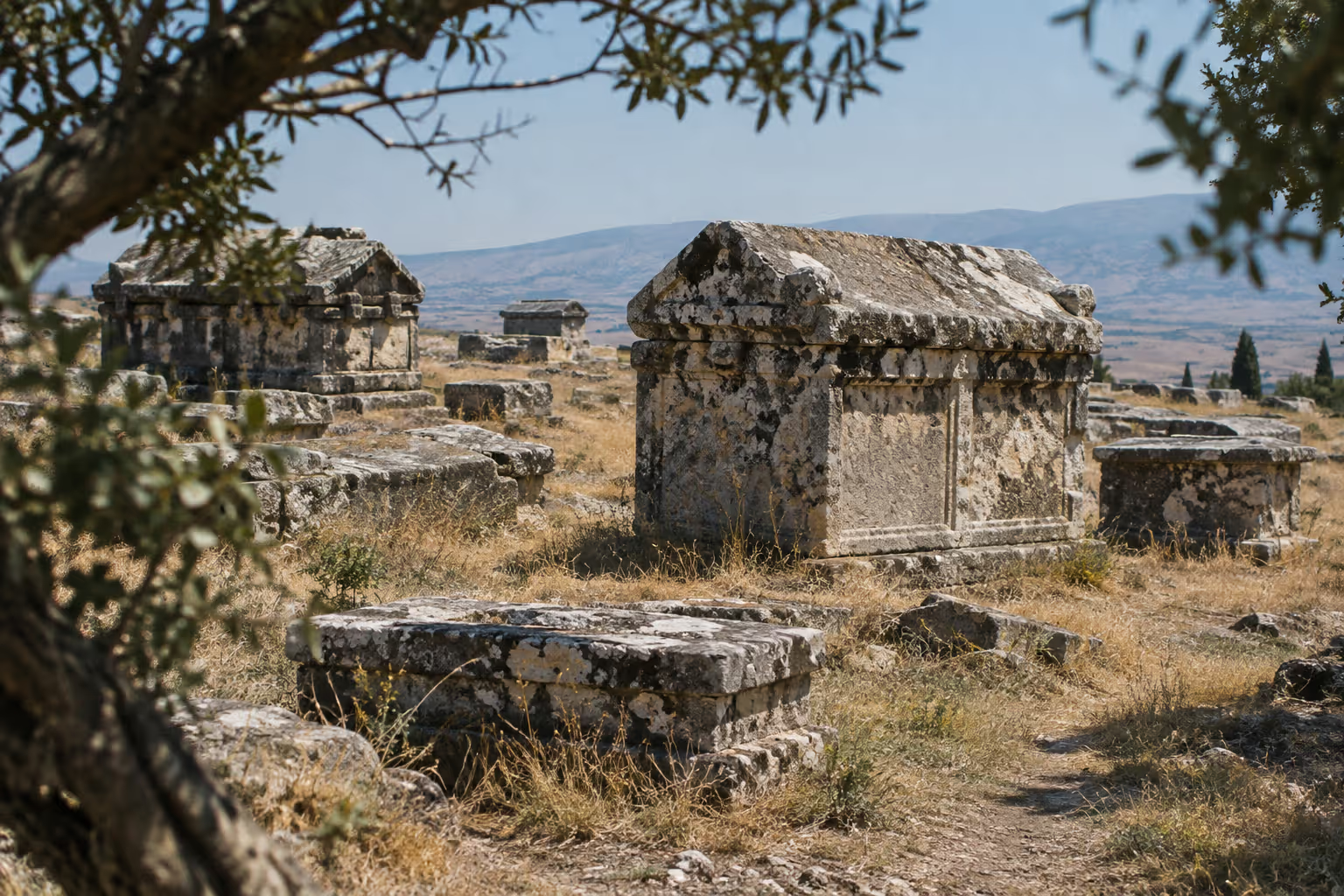
The necropolis extends for more than 2 kilometres (1.2 miles), and UNESCO describes it as a broad view of Greco-Roman funerary practice (7). One guide ranks it among the largest ancient cemeteries in Anatolia (5). Walking it means rows of sarcophagi, house-shaped tombs and round tumulus graves, with very little shade along the way.
If you’re tight on time or the day is hot, you can prioritise the terraces and the central ruins. The necropolis and the theatre are what stretch a full-site circuit (17). Carry more water than you think you’ll need. If you’re coming in from the north gate, you pass through the necropolis anyway, which is one argument for the ruins-first route covered below.
Pamukkale Travertines: Walking the Terraces Barefoot
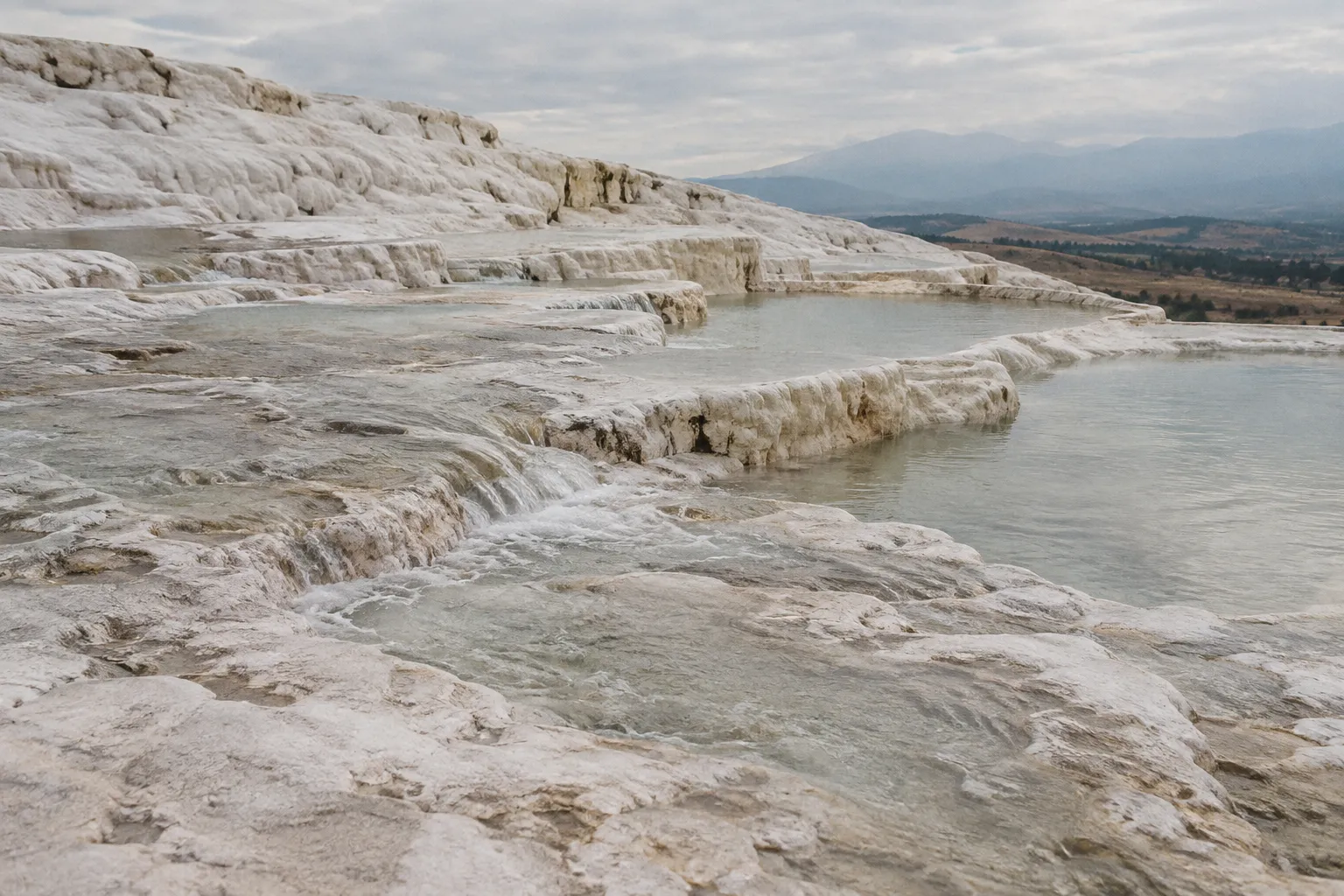
The Pamukkale travertines are terraces of white calcium carbonate built by warm spring water. Visitors walk them barefoot on a marked route (1)(3), and most of the slope stays closed to protect the water flow, colour and structure (7). UNESCO notes that visitor routes and designated bathing areas are provided (7). In practice that means a managed corridor, not open access to the hillside (5).
How the Travertines Formed
The water comes out of springs at the top of the ridge at around 35°C (95°F) (5). As it flows over the edge and cools, dissolved calcium carbonate precipitates and settles as travertine, forming rimmed pools and frozen-waterfall shapes (5). The underlying cause is tectonic. Western Anatolia sits where the Earth’s crust is pulling apart, producing faults, fissures and geothermal activity (8). The Pamukkale plateau runs about 6 km (3.7 miles) long, and its rock averages 50 m (164 ft) thick (8).
The strict rules come from past damage. Hotels were once built on the terraces, and people drove and bathed on them. Those hotels were demolished, and access has been tightly controlled since (5).
The Barefoot Walking Rule
Shoes come off on the white-terrace route, and you carry them (1)(3). Bring a bag for your footwear so your hands are free for balance and photos (2)(3). A light drawstring bag or a tote is easier than juggling sandals and a phone on a wet slope.
Wear swimwear or quick-dry clothes under your outer layer if you plan to wade. The surface varies more than you’d expect:
- Where water runs, the travertine is ridged and grippy (3)
- Where it’s dry, the white can be slick and hard (3)
- Some terraces are roped off for conservation and re-whitening, so stay on the marked trail (1)
- No soap or chemicals in the water (1)
The etiquette here is about protecting the rock rather than dress codes. Keep off roped-off basins, don’t step over rims for a better angle, and rinse off sunscreen or oil before wading if you can. Visit early for soft light and fewer people: one guide suggests arriving by 08:00 (1).
Pamukkale Thermal Pools: The Antique Pool and Where You Can Swim
The Pamukkale thermal pools offer two different experiences. Shallow wading on the travertine route is included in your ticket. Swimming happens only in the Antique Pool, which you pay for separately at its own gate (1)(14). Plenty of visitors arrive expecting to float in the blue terrace basins seen in photos. That isn’t how the site works anymore.
Can You Swim in the Pools of Pamukkale?
Yes, but only in one place. Swimming in the travertine terraces is not allowed. Wading in the shallow pools along the marked route is permitted, but full swimming is restricted to protect the formations (1). UNESCO restricts terrace access for the same reason (7). The Antique Pool is the one designated paid swimming option (5).
Expect only a few centimetres of warm water along the marked path (3). That’s enough to cool your feet, not enough to get in.
Bathing here has a long history. UNESCO records the springs’ historical therapeutic use as a spa (7), and one description calls the slope “a kind of Roman-era health spa” (2). Read that as heritage, not medical advice. If you have a health condition that heat or mineral water might affect, check with a doctor rather than relying on centuries-old reputations.
What the Antique Pool Offers
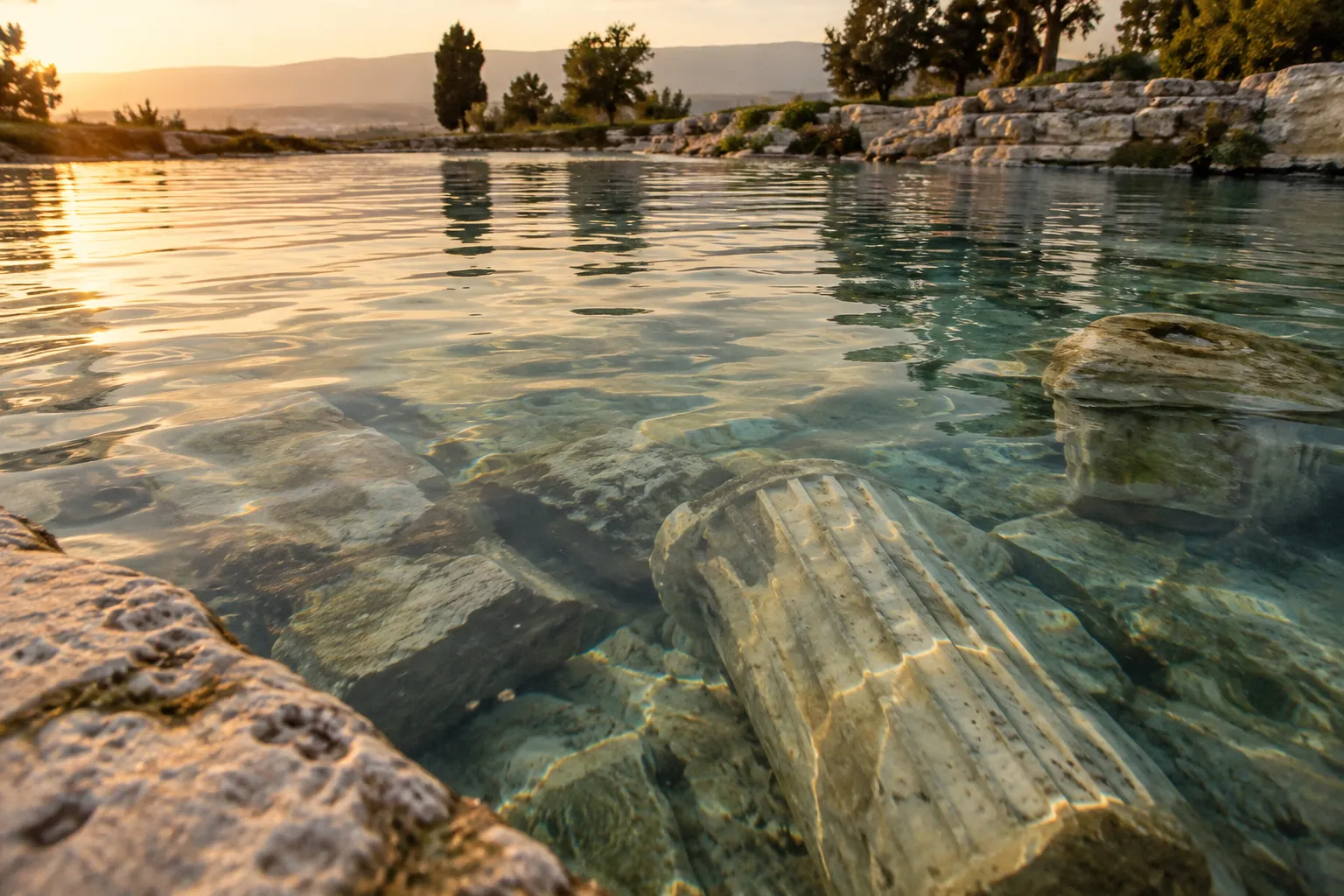
The Antique Pool, also sold as Cleopatra’s Pool, lets you swim in warm mineral water over marble columns lying on the bottom (14). According to NASA’s Earth Observatory, those columns fell during the Laodikeia earthquake in the early 7th century C.E. (8). It’s the only spot on the site where you swim among actual Roman masonry.
The pool reopened in spring 2026 after a long maintenance closure (14), and as of November 2026 the Ministry of Culture and Tourism’s site page lists it as open (11). The Denizli Provincial Directorate lists toilets, shower cabins, lockers and a prayer room inside. It also lists free entry for visitors with disabilities and one companion (15).
Hours run separately from the walking route. As of November 2026, the Denizli Provincial Directorate’s winter table, valid from 14 September 2026 to 1 May 2027, lists the Antique Pool at 08:00-17:30 (15), and local reporting of the 1 October switch gave the same time (16). Admission isn’t part of the site ticket (14): the directorate lists 600 TL for foreign visitors over 12, 300 TL for foreign children aged 7 to 12 and free entry for children up to six (15). Allow extra time if you plan to swim (17), and pack a towel.
Tickets, Prices and Opening Hours You Need to Know
As of November 2026, the single-entry ticket for the Hierapolis (Pamukkale) archaeological site costs foreign visitors the equivalent of €30, charged in Turkish lira at the gate. It covers the terraces, Hierapolis and the archaeology museum, but not a swim in the Antique Pool (14). Local reporting of the Ministry’s 2027 tariff puts the foreign-visitor price at €35 from 1 April 2027 (19). Turkish citizens can enter with the Museum Pass (Müzekart) (14). The ticket is usually single-entry (17), so don’t plan to leave for lunch in the village and walk back in on the same pass.
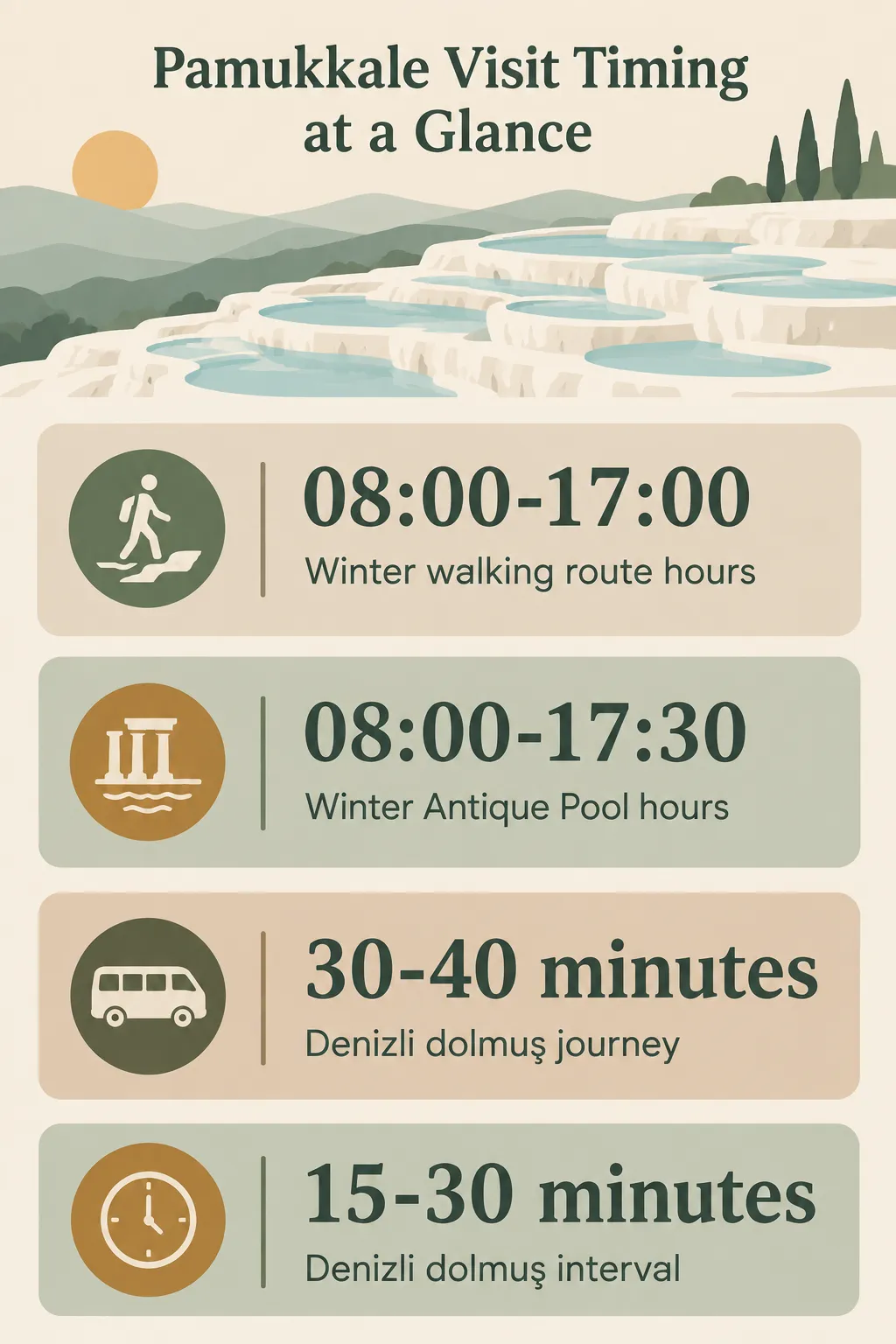 As of November 2026, Denizli’s winter schedule lists the walking route at 08:00-17:00 and the Antique Pool at 08:00-17:30 (15); the dolmuş from Denizli takes 30-40 minutes and departs about every 15-30 minutes (9).
The hours are where most visitors go wrong, because the walking route, gates, museum and pool can each close at a different time (11)(15). The Denizli Provincial Directorate publishes a seasonal table: the current one runs from 14 September 2026 to 1 May 2027 (15), and local reporting dated the switch to winter hours to 1 October 2026 (16). Check the current walking route, gate and Antique Pool times shortly before you travel rather than trusting a fixed schedule. Here’s what the Denizli authorities publish as of November 2026:
- Walking route: 08:00-17:00, per the Denizli Provincial Directorate (15)
- Antique Pool: 08:00-17:30 (15)
- South and north gates: open from 08:00, with daytime ticket sales until 18:00 (15)
- Night opening: suspended for the winter season (16)
The Ministry of Culture and Tourism’s site page also states that the south and north gates close at 18:00 and the pedestrian entrance at 17:00 (11). Local reporting of the 1 October switch gave 17:30 for the pedestrian entrance (16), half an hour later than both official pages, so plan around 17:00. In summer the schedule stretches: a July 2026 season update reported that evening hours had returned, with gates open until 21:00 (14). That’s a big difference if you plan a sunset visit. It also means any hours you read in a blog, including this one, are tied to a season.
The Denizli Provincial Directorate of Culture and Tourism publishes the current table (15): check it a day or two before you go. Pay close attention around seasonal changeovers. The October 2026 switch moved several closing times earlier overnight (16). If you’re arriving from Denizli in the afternoon, the pedestrian entrance closing time is the one that will catch you out.
Getting to Pamukkale from Denizli, Izmir and Kuşadası
Denizli is the transport hub for Pamukkale, about 20 kilometres (12 miles) away. The dolmuş (shared minibus) from Denizli otogar covers the trip in roughly 30-40 minutes (9). Nearly every route to the terraces passes through Denizli, so once you’re there, the last stage is short and cheap (9).
Denizli to Pamukkale by Dolmuş
Dolmuş minibuses leave from the lower level of Denizli otogar (the intercity bus terminal), signed for Pamukkale, about every 15-30 minutes (9). You pay the driver or an attendant on board in Turkish lira, and there’s nothing to book (9). Frequencies change, especially in the evening and off-season, so check at the terminal before you count on a late bus back.
A taxi takes about 25-30 minutes and costs well above the minibus. Agree on the fare before you get in (9). If you’re arriving by rail, intercity and regional trains run to Denizli Garı (Denizli station), and you continue from there by dolmuş (9).
From Izmir or Kuşadası
Izmir is roughly 230 km (143 miles) from Pamukkale, which sits well inland from the coast (18). Independently, the usual pattern is an intercity bus or train to Denizli, then the dolmuş. That makes a long day, and staying a night in Pamukkale village lets you reach the terraces at opening time, before tour coaches arrive.
From Kuşadası and the other Aegean resorts, most visitors take an organised day tour. Before booking, check exactly what’s included. One review warns that the entry ticket often has to be handled separately, so a cheap guide-only listing doesn’t help most visitors (17). Also confirm whether the tour includes the Antique Pool or leaves you time to pay for it yourself. The same review notes that most day-trippers rush the terraces and miss the theatre and the necropolis (17), so ask how much time the tour leaves for the ruins. If you’re basing yourself on the coast, our guide to the best beaches in Turkey compares the Aegean resorts with the Turkish Riviera.
Choosing Your Entrance: Terraces First or Ruins First
Pick your Pamukkale entrance by priority. Use the lower town entrance in the village for a terrace-first visit, or the north gate for a ruins-first route, and budget 3-5 hours for either, plus extra if you swim or visit the museum (17). The south gate, on the plateau, puts you closest to the central ruins, the Antique Pool and the upper terraces (17). The gates change the order and effort of your walk; the same single ticket covers the terraces and Hierapolis whichever you use (1)(18).
Terrace-first. The lower town entrance suits a terrace-first visit: from Pamukkale village you climb the white slope barefoot from the bottom up toward the plateau (17). This is the better choice for early-morning light and wading before the crowds arrive. It also means the climb happens while you’re fresh, and you finish among the ruins and the museum. The downside: you’re hiking uphill on wet travertine with your shoes in a bag.
Ruins-first. The north entrance starts among the Hierapolis ruins, and you work your way toward the terraces (1)(18). It’s the logical choice if the necropolis and theatre are your main interest, or if you’re arriving by car or tour bus. You save the terraces for late afternoon, which helps on summer days when the slope is crowded at midday. Watch the clock, though. As of November 2026 the Ministry gives 17:00 for the pedestrian entrance (11), and you don’t want to be rushing the barefoot section.
Three to five hours covers a full circuit at a reasonable pace (17). Add time if you swim in the Antique Pool or want to read the museum properly, and if you want the theatre, the necropolis and the museum without rushing, the same review suggests four to five hours (17).
Plan a One-Day Visit to Pamukkale
Allow at least three hours; add time for the museum, Antique Pool or full necropolis circuit.Order your visit around the entrance you choose, the walking route's closing time and whether you want to swim.
- 1
Check the current schedule
Look up the Denizli Provincial Directorate hours the evening before, paying particular attention to seasonal changes and the earliest closing time.
- 2
Choose your entrance
Start at the lower town entrance in the village for the terraces first, or use the north gate to begin among the ruins.
- 3
Buy your site ticket
Purchase the single-entry ticket at the gate and keep it with you; plan not to leave and re-enter.
- 4
Walk the terraces
Remove your shoes on the marked route, carry them in a bag, and stay out of roped-off basins.
- 5
Visit Hierapolis
See the theatre and central ruins, then visit the museum if its hours fit your schedule.
- 6
Decide whether to swim
Allow extra time for the Antique Pool and pay separately at its gate if you want to swim.
- 7
Leave a closing-time buffer
Finish before the earliest relevant closing time, which may differ between the walking route, museum, gates and pool.
Frequently Asked Questions
- Can you visit Pamukkale and Hierapolis without a tour?
- Yes, independent visitors can reach Pamukkale from Denizli by dolmuş and explore the terraces and Hierapolis on foot; check the return service before a late visit.
- Can you leave the site for lunch and come back on the same ticket?
- No, the site ticket is usually single-entry, so plan meals and breaks without leaving the archaeological site.
- Which entrance is easier if you are staying in Pamukkale village?
- The lower town entrance is the practical starting point from the village, especially if you want to climb the terraces first.
- Should you bring a towel to Pamukkale?
- Bring a towel if you plan to swim at the Antique Pool; terrace wading is shallow and is not the site's swimming option.
- Is the Antique Pool included in the Pamukkale site ticket?
- No, the Antique Pool has its own gate and fee: as of November 2026, 600 TL for foreign visitors over 12.
- Can you see Pamukkale and Hierapolis in a day from Izmir?
- Yes, but it makes a long day: travel to Denizli first, then continue to Pamukkale, and consider staying overnight to avoid rushing the site.
Before You Go
Make three decisions before you leave your hotel. First, pick your gate by priority: start at the lower town entrance for terraces first, or the north gate for ruins first, and give the visit 3-5 hours (17). Second, treat the Antique Pool as a separate item in your budget and schedule, because the €30 site ticket doesn’t cover a swim (14). Third, check the Denizli Provincial Directorate’s current hours the day before (15). The walking route, gates, museum and pool can close at different times, and the seasonal switch can move them earlier overnight (16). Bring a shoe bag, plenty of water and swimwear if you plan to swim.