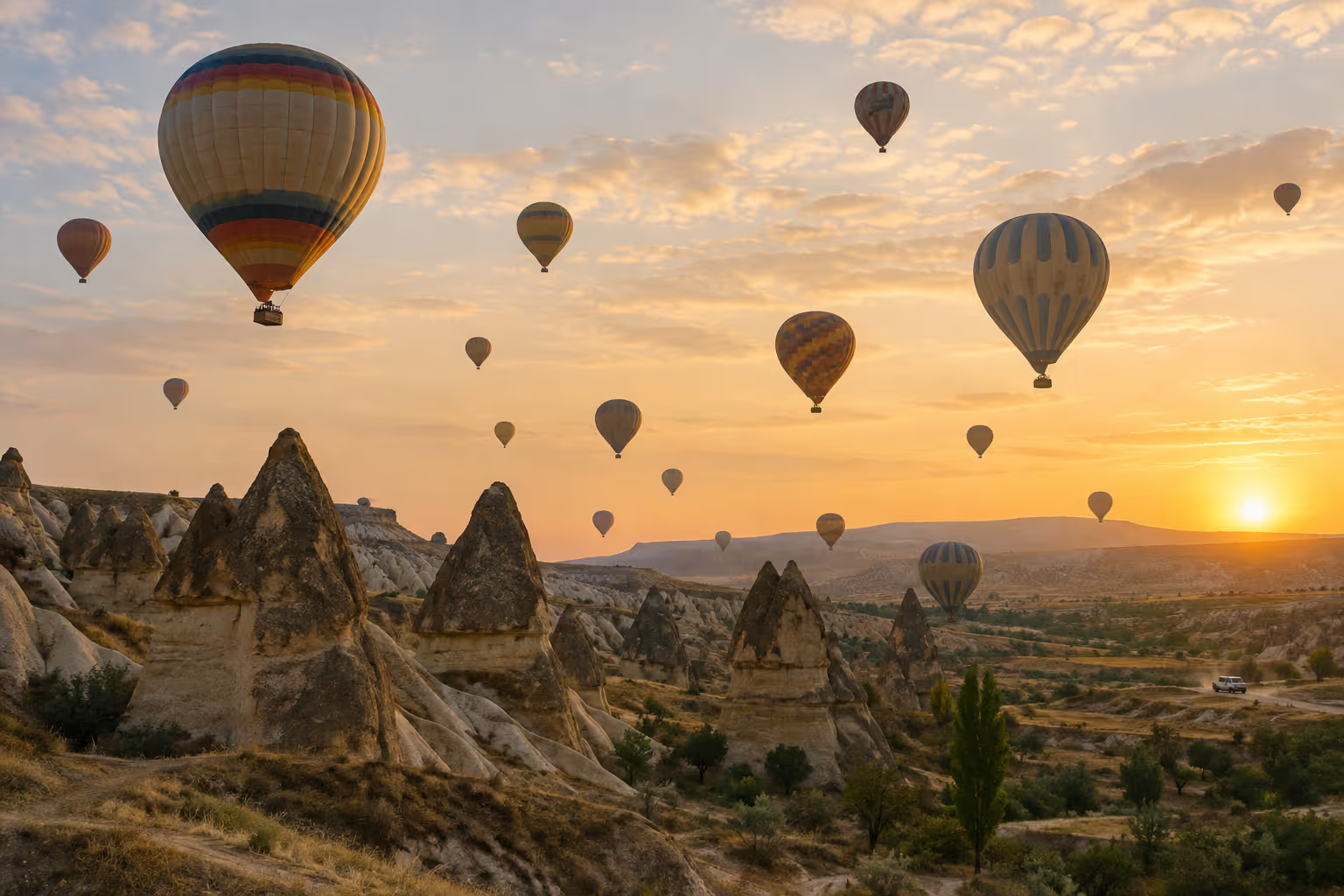
A Cappadocia hot air balloon ride is a sunrise flight of around 60 minutes over the valleys around Göreme. Your operator does not decide whether it happens on your date. Türkiye’s civil aviation authority does, sector by sector, usually around midday the day before. Twenty-seven licensed balloon companies share the same weather window, and one booking agency puts the annual average cancellation rate at around 35%, so the trip-saving moves are to book the right product from a licensed seller, aim for the calm months, put the flight on your first morning, and keep a ground-viewing tour as your fallback.
✓ Pros
- A memorable way to see the valleys from above, with the sunrise unfolding across a broad view.
- The morning ends early enough to leave most of the day open for other plans.
- A licensed, regulated activity has clear safety and authorization checks to ask operators about.
✗ Cons
- The route follows the wind, so you cannot choose which valley the balloon crosses.
- Standing through the flight may rule it out for some travelers.
- A pre-dawn start can make the first day of a short trip feel compressed.
What a Cappadocia Hot Air Balloon Ride Involves
A Cappadocia hot air balloon ride is a dawn flight lasting around 60 minutes. It is cleared daily under Türkiye’s civil aviation rules (1) and flown by the 27 licensed balloon companies that hold slots in the Cappadocia flight area (13). The flight is the middle of a longer morning. You get a pre-dawn hotel pickup and a drive to the launch field, then you watch the envelopes inflate. After that comes the flight over the region’s fairy chimneys (the cone-shaped rock pillars eroded out of soft volcanic tuff), a landing, and the drive back.
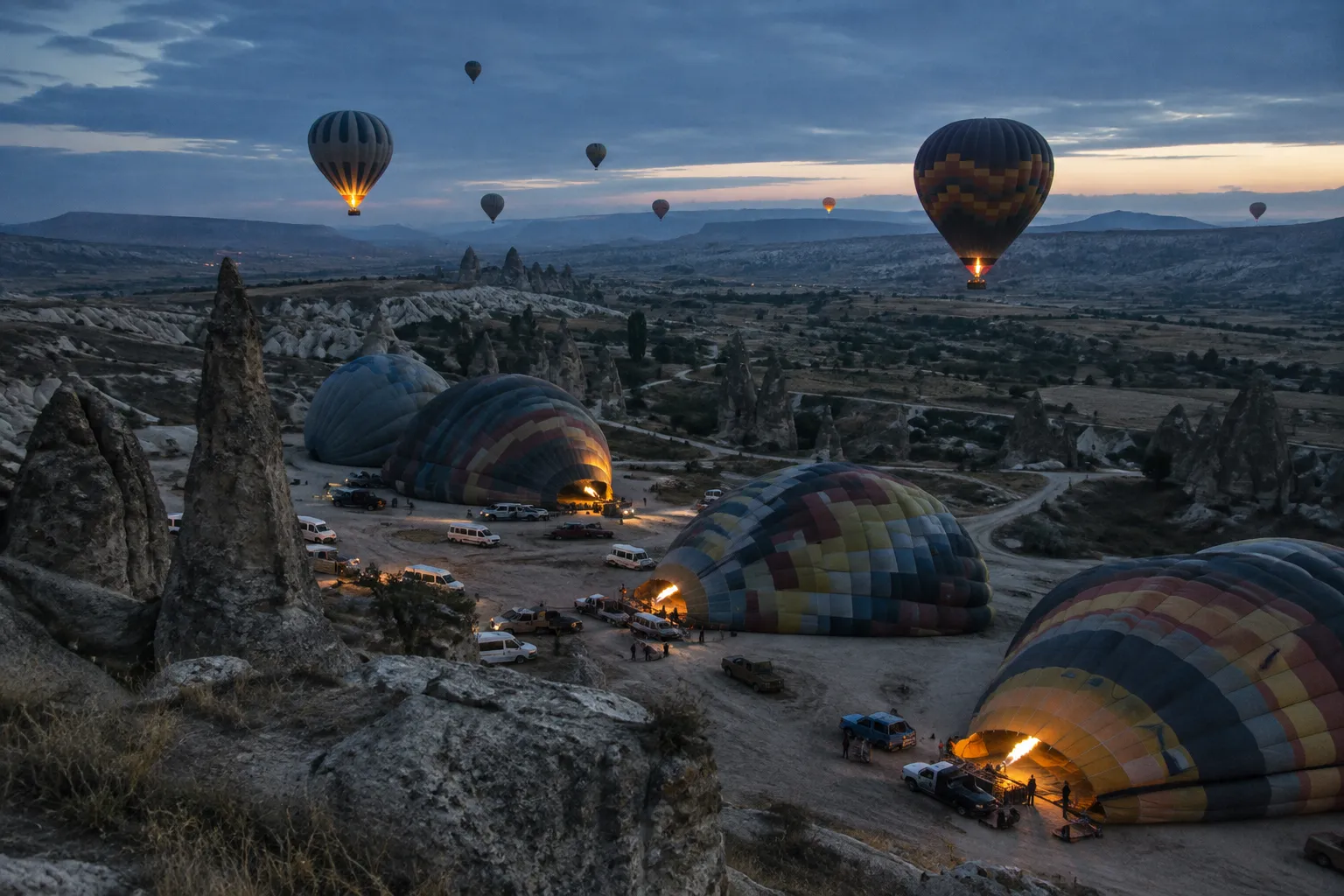
The scale surprises first-timers. One Göreme-based operator describes its main take-off area as a place where more than 150 balloons lift off at once (2). The official ceiling is set in slots: the civil aviation authority’s table gives the region 104 morning slots plus up to 52 second-wave flights (13), and its own figures count 754,098 commercial balloon passengers in Cappadocia in 2025 (12). You will not have the sky to yourself. Some people find the mass ascent the best part, because the photos you have seen of the valleys are only possible with that many balloons in the air.
Who decides whether you fly
Flights run under a civil aviation framework. Türkiye’s Directorate General of Civil Aviation (SHGM) licenses balloon operators (17) and allocates their flight slots (13). Its slot service center for the region, SHM Kapadokya, run by Kapadokya University (12), posts a green, yellow or red flag for each of three weather sectors, A, B and C (11). A red or yellow flag means no take-off clearance. On a green flag, the final decision to fly rests with the pilot and the operator (11). The sector status is normally published around midday the day before, and a sudden weather change can still cancel a flight that had been cleared (1).
The same framework covers equipment and cover. Passenger insurance is mandatory, and balloons go through annual airworthiness inspections (1). That doesn’t make ballooning risk-free, since no aviation activity is. It does mean “licensed” refers to something checkable, which matters when you get to choosing an operator.
A booking is not a departure
The most common planning mistake is treating a confirmed booking as a confirmed flight. A live status service for the region spells out that an official clearance for the morning does not confirm your individual booking (4). Your seat depends on the sector being open, your operator’s own go decision, and conditions holding overnight. Plan the trip so a grounded morning costs you nothing worse than an early alarm.
Is a balloon ride in Cappadocia worth it?
For most visitors, yes, with conditions attached. The flight is the reason many people route a Türkiye trip through Nevşehir province at all, and nothing on the ground replicates drifting over Göreme and Çavuşin as the light reaches the rock. Weigh it honestly against the downsides:
- For it: sunrise views over the valleys, a flight of around 60 minutes, and the mass ascent you can only see from among the balloons.
- Against it: an around 35% average cancellation rate, a pre-dawn start, basket sizes that vary widely by product, prices published only as “from” figures, and refund terms that differ by seller.
If you have one night in Cappadocia and a tight itinerary, a ground-viewing tour may be the smarter spend. If you have three nights, the flight is worth prioritizing.
Cappadocia Balloon Price: What You’re Paying For
The Cappadocia balloon price moves with the season and the basket. As of October 2026, one licensed booking agency lists its Classic sunrise flight from €119 per person and its Comfort flight from €139, its lowest rates for November and December (15)(16). Its seasonal table runs from about €119 in winter to about €249 in the April-May peak (15). Those are floors, not quotes. The number you pay depends on which basket product you book, the date, and what the package bundles in. Two companies selling different products for different mornings will give you different prices even if they share a launch field.
Treat any “from” price as the cheapest date for the cheapest product. Confirm the final, date-specific price and the inclusions with the seller before you hand over card details.
Classic vs. Comfort flight pricing
Most operators sell a tiered range. The baseline product is usually called Classic or Standard, and the upgrade is called Comfort or something similar. The main difference between tiers is how many people share your basket. The same agency’s FAQ lists a Comfort Flight at 20-24 passengers alongside a Classic Flight at 28-32 guests (5). The flight length is the same.
Operators position the smaller-basket products as the upgrade, and at that agency the Comfort floor sits above the Classic one (15)(16). Get the exact number from the seller for your date, because a published floor tells you little about what a seat costs on a given morning.
What drives the price difference
Several factors move the price, and only one of them is the operator’s name:
- Basket size. Fewer passengers per basket costs more per seat. This is the biggest variable between tiers.
- Date and season. Summer is busy (7), and demand pushes prices up. Winter brings lower hotel prices (7) but a much higher chance your flight gets grounded.
- Inclusions. Standard packages often bundle extras. One boutique operator’s listings, for example, include a champagne toast, a flight certificate, a flight medal, a light breakfast, passenger insurance and hotel pickup and drop-off across all three of its basket tiers (2). Check whether your quote includes transfers, because a lower headline price without hotel pickup is not cheaper if you need a taxi at 5 a.m.
- Booking channel. Buying through an agency or a resale platform adds a layer between you and the operator. That layer can affect the price, and it almost always affects how refunds work.
Be wary of a price far below what licensed operators publish. The likely explanation is a bigger basket than you assumed, missing transfers, or a seller you can’t verify. The licensing checks in the next section take a few minutes and cover all three possibilities.
The cheaper way to see the balloons
If the flight price or the cancellation odds put you off, ground viewing costs a small fraction. One sunrise balloon-watching tour lists $14 as of October 2026, including hotel transport, water and a croissant or simit (a ring of sesame-crusted Turkish bread) (6). The section on watching from the ground covers what you get and what you give up.
Choosing an Operator: Licensing, Pilots, and Basket Size
Choosing a Cappadocia balloon operator comes down to three verifiable checks: a licensed seller and a commercially licensed pilot (1), and the stated basket maximum for your exact product (5). Star ratings and photo galleries tell you what a company wants you to see. These three checks tell you what it is legally required to have.
There is no single “best” hot air balloon ride in Cappadocia. The best one for you comes from a licensed operator, puts you in a basket size you’re comfortable with, and has cancellation terms that fit your itinerary. Any ranking that skips those three things is ranking marketing.
Verifying licensing and TURSAB numbers
Check that whoever takes your money is either a licensed agency with a verifiable TURSAB number or a balloon operator with a verifiable SHGM operator licence (1). TURSAB is the Association of Turkish Travel Agencies, and it publishes a search of its member agencies (14). Sellers usually display their number on their website. The booking agency cited above, for example, shows TURSAB Licence No. 2290 on its FAQ page (5).
Seeing a number is not the same as verifying it. Look the number up on TURSAB’s own website (14) and confirm that the company name matches the one on your booking. This matters most when you book through a hotel desk, a tour shop on Göreme’s main streets, or a resale site. In those cases, ask outright which licensed balloon company will fly you, then check that company on SHGM’s list of licensed balloon operators (17). An agency can be legitimately registered and still resell a seat in a basket you would not have chosen.
While you’re asking questions, confirm that passenger insurance is part of the booking. Insurance is mandatory for operators, and so are annual airworthiness inspections of the balloons (1). A seller who goes vague on either point has given you a reason to keep looking.
Why “combined experience” claims aren’t a credential
Pilot credentials are the subject most competing guides cover, and the subject where marketing copy is least useful. You’ll see phrases like “over 100 years of combined experience” on operator sites. That figure adds up every pilot on the payroll, and it tells you nothing about the person flying your basket.
The real credential is the licence. Pilots on commercial balloon flights must hold a commercial balloon pilot licence. One booking agency’s safety guide describes the path to it as ground school, written exams, logged flight hours and a medical certificate (1). That is a minimum bar every legal pilot has cleared, and it’s the bar to verify.
Experience above that minimum varies. The same guide reports that many of the region’s most experienced pilots have logged more than 3,000 hours over this terrain (1). Read that as a description of the most experienced pilots, not a figure that applies to every pilot at every company. Ask the operator about the commercial credentials and experience of the pilot assigned to your flight, or at least what minimum experience they require before a pilot flies passengers in a full basket. A straight answer is a good sign. A pivot back to fleet-wide totals is not.
Comfort Flight vs. Classic Flight basket capacity
Basket capacity is not standardized, either across the region or within a single company. One booking agency’s FAQ lists a 20-24 passenger Comfort Flight next to a Classic Flight of 28-32 guests (5). If you book the cheaper product assuming you’ll get the smaller basket from the website’s hero photo, you won’t.
Product names don’t translate between companies either. A Göreme operator lists a Standart basket at 28 passengers, a Classic at 20 and a Comfort at 16 (2). So “Classic” means 28-32 guests at one company and 20 at another. When you compare quotes, compare the maximum passenger count, not the product label.
Large baskets are divided into compartments: a 28-passenger basket listed on that operator’s site has eight compartments for three or four passengers each (2), so you won’t be pressed against 27 strangers. That is big by ballooning standards: one company in our guide to hot air balloon rides in San Diego caps its shared basket at 10 guests. Basket size still shapes the experience. A bigger basket means less room at the rail for photos and more people between you and the pilot. A smaller one costs more but gives you more space at the edge.
Before paying, ask for these in writing, for the specific product and date you’re booking:
- Maximum passengers in the basket
- Expected flight duration
- Pickup window and the towns covered
- Cancellation, rescheduling and refund terms
- The licensed operator’s name and TURSAB number, if you’re booking through an agency
That list does more to pick the right flight than any review aggregator.
Best Time for Cappadocia Balloon Flights
The best time for Cappadocia balloon flights is April to June or September to October for mild conditions (7), while August has the lowest reported cancellation rate, at roughly 7% (1). Flights operate year-round whenever weather permits (7). The real question is how much cancellation risk you’re willing to carry in exchange for fewer crowds or cooler days.
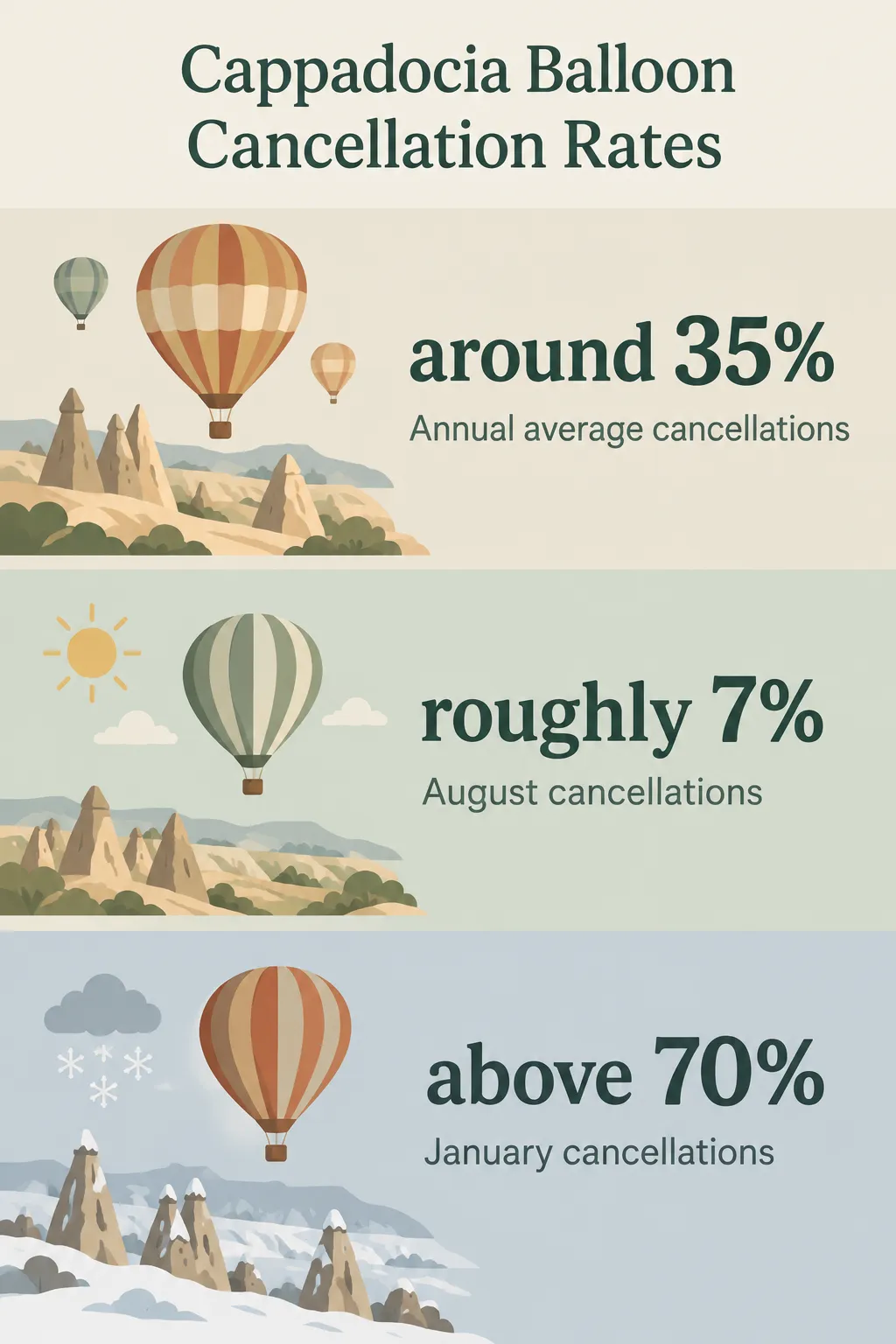 One booking agency’s reported cancellation averages are around 35% annually, roughly 7% in August, and above 70% in January.
A regional travel guide names April to June and September to October as the favorable periods for mild weather and good balloon odds. It also stresses that wind, fog, rain, snow and poor visibility can still stop flights in any month (7). The same guide picks April to November as the best stretch for balloons overall. It notes that summer has the highest flight reliability but hotter valley walks, while winter is quiet and beautiful with more frequent cancellations (7).
The cancellation figures make the trade-off concrete. One booking agency’s safety guide reports an annual average cancellation rate of around 35% across all seasons. That drops to roughly 7% in August, the calmest month, and rises above 70% in January (1). These are one source’s reported averages, not a promise for any given morning, but the gap between those two months is wide enough to plan around.
What is the best month to go hot air ballooning in Cappadocia?
If the flight is the whole point of the trip, August gives you the best reported odds. You’ll pay for that with heat for any hiking and summer crowds (7). If you want the balloon plus comfortable walking in Love Valley or Rose Valley, May, September or early October is the sweet spot. Those months also bring the strongest light for photography, according to the regional guide (7). January is for travelers who want empty trails and snow on the fairy chimneys, and who can accept that the flight probably won’t happen.
How the seasons compare
Spring (April to June): mild mornings, green valleys and good balloon odds (7). April to October is the high season for crowds (7). This is one of the two best all-round windows.
Summer (July to August): the most stable flying weather and the lowest reported cancellation risk, with roughly 7% in August (1). It’s also hot and busy (7). Hike at sunrise or in the last two hours before sunset, and book well ahead, because the calm months fill first. Summer is peak season on the coast too, so if you’re pairing Cappadocia with Turkey’s best beaches, book both early.
Autumn (September to October): similar to spring, with clear mornings, mild daytime temperatures and strong light (7). It’s the other best all-round window, though still inside the April-to-October high season (7).
Winter (November to March): the lowest crowds and lower hotel prices (7). Snow is possible from December to February (7), and January cancellations run above 70% (1). Bring warm layers for a pre-dawn start, and only come for the balloons if you can stay several mornings.
Whatever the season, the regional guide’s advice holds: if the flight matters, stay at least two or three nights and book it for your first morning (7).
Cappadocia balloon seasons at a glance
| Spring (April-June) | Summer (July-August) | Autumn (September-October) | Winter (November-March) | |
|---|---|---|---|---|
| Typical conditions | Green valleys, favorable odds | Hottest valley walks, most dependable skies | Clear, mild, strong light | Cold, occasional snow |
| Reported cancellation risk | Low-moderate | Lowest of the year | Low-moderate | Highest of the year |
| Crowds and prices | High season from April | Peak season | High season through October | Quietest, lower hotel prices |
Cappadocia Balloon Cancellations: Why Flights Get Grounded
Cappadocia balloon cancellations are decided through SHM Kapadokya, the slot service center that flags each flight sector open or closed (11) based on wind, visibility and ground conditions (1). Your operator doesn’t make that call and can’t override it. Once you understand how the decision works, you can see why the most useful thing you control is when in your trip you book the flight.
How the sector go/no-go decision works
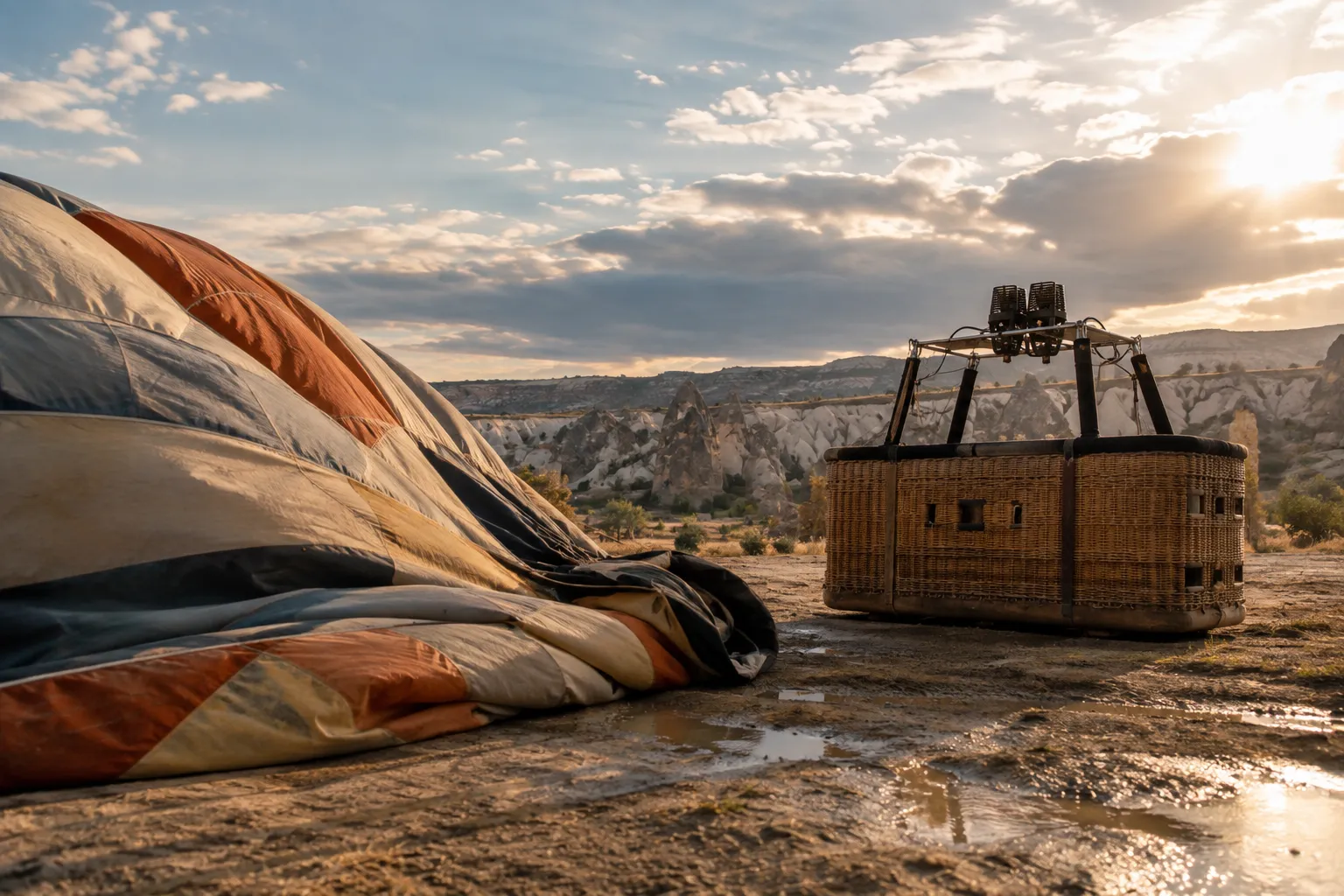
SHM Kapadokya reviews wind, visibility and ground factors, then normally publishes each sector’s go/no-go status around midday the day before the flight (1). That gives you an afternoon signal for the next morning. It’s a signal, not a lock. If conditions change overnight, a sector that was cleared can be closed, and a cleared flight can still be cancelled at the last moment (1).
The conditions that ground balloons are operational requirements, not guidelines. They include fog or low cloud, active precipitation or freezing conditions, and thunderstorm activity in the wider area (1), along with wind above safe limits. Calm, clear air at dawn is the narrow window every operator is waiting for, which is why flights launch at sunrise rather than mid-morning.
SHM Kapadokya’s own page shows the flag for each sector and the hours it covers (11), and third-party status pages that track those decisions are useful the afternoon before. Check the next-morning status close to the date rather than trusting a forecast you read a week earlier (4). Treat a third-party status tool as an estimate. Official decisions take priority, and your operator’s confirmation is the one that counts for your seat.
Why one grounded flight doesn’t mean another operator will fly
When SHM Kapadokya closes a sector, every operator flying in that sector cancels (1). It’s not a case of your company being cautious while a rival goes up. If you see balloons in the sky on a morning your flight was grounded, they launched from an area cleared under the same rules, not from a braver operator.
So be wary of anyone who answers your cancellation with “we can get you on another company’s balloon this morning.” On a morning when your sector is closed, the only seats are in sectors that were open, and those are booked by people who planned for them. Status is reported sector by sector for a reason, and it isn’t something a seller can work around.
Book the first morning, not the last
The midday-before announcement and the chance of an overnight reversal lead to one firm rule. Schedule your flight for the first morning of your stay, not the final one (1). If you’re grounded on day one, you still have days two and three to rebook. If you’re grounded on your departure morning, you leave without flying.
This is the cheapest protection available and costs nothing but a bit of itinerary planning. Two nights gives you one backup morning. Three nights gives you two, which is the minimum to consider in winter, when cancellations run above 70% in January (1). Keep your backup mornings free of fixed bookings that start early, or at least pick ones you’d be willing to drop.
Getting the refund and rescheduling policy in writing
Don’t assume a cancellation means automatic rebooking for the next morning. One booking agency’s safety guide says rescheduling depends on availability and that a full refund applies otherwise (1). That is one company’s stated policy, not a regional rule. Other sellers, especially resale platforms and agencies, may handle it differently.
Before paying, get answers to these in writing:
- Weather cancellation: do you get a full refund, a credit, or only a reschedule?
- Replacement date: if the offered new date doesn’t fit your trip, can you take the refund instead (1)?
- Refund timing: how long until the money returns to your card, and who issues it, the agency or the operator?
- Late cancellations: if the flight is cancelled after hotel pickup because conditions changed at dawn, does the same refund apply?
- Your own cancellation: what’s the cutoff for a full refund if your plans change?
The last two catch people out. Policies on “cancelled after pickup” vary, and ground tours sometimes refund only part of the price in that case. One balloon-watching tour states a 50% refund if flights are cancelled after you’ve been collected (6). Read the terms of what you’re buying rather than the terms you assume apply.
Flight Day Logistics: Pickup, Duration, and the Landing Briefing
A Cappadocia flight day takes 2.5-3 hours from hotel pickup to hotel return. That covers the transfer, pre-flight preparation, watching the inflation, a flight of around 60 minutes, the landing ceremony and the drive back (5). You’ll be back in time for a late breakfast and a full day of whatever else you planned.
Pickup and the night-before confirmation
Pickup is early. For comparison, one ground-viewing tour collects guests from their hotel lobby at about 5:30 a.m. (10). Flight pickups follow the same logic, because everything is timed to sunrise, so the exact time moves with the date and the flight plan (5). Expect an earlier alarm in midsummer than in late autumn.
Sellers usually send the pickup time by 18:00 the evening before (1)(5). This is also when you’ll find out whether the next morning is on. If the midday sector decision was a no-go, many operators message you then. If it was a go, you get a pickup window. Answer your phone and check messages before bed.
One booking agency includes pickup from Göreme, Ürgüp, Uçhisar, Çavuşin, Avanos, Mustafapaşa and Nevşehir (1). If you’re staying somewhere outside that cluster, confirm pickup coverage when you book, not the night before.
Dress in comfortable layers (5). Pre-dawn air at the launch field is cold for much of the year, while the burner overhead throws heat and the morning warms quickly after landing. Wear closed shoes you can walk in over a ploughed field.
What happens during the flight
The flight itself is usually around 60 minutes, though the exact length depends on weather, wind direction, landing conditions and the pilot’s planning (5). Balloons go where the wind takes them, which means no two flights follow the same route. The pilot controls altitude, not direction, rising and dropping to catch air currents moving the right way.
You stand for the entire flight (1). Anyone who can’t stand for an hour, or who has mobility limits affecting climbing into a chest-high basket, should raise it with the operator before booking. Some companies can accommodate certain needs and some can’t. Age rules vary: one boutique operator’s booking form lists child passengers as ages 6 to 18 (2), while a booking agency’s guide gives a minimum age of 4 (1). Confirm age, mobility and any medical restrictions directly with your operator.
The landing briefing: straps, knees, staying low
Before touchdown, the pilot gives a landing briefing. Follow it to the letter. According to one booking agency’s safety guide, the standard landing position is to hold the interior straps, bend your knees and stay low until the pilot gives the all-clear (1). Most landings are gentle. Some involve a bump or the basket tipping and sliding a short distance, and the position exists for those landings.
Don’t stand up, climb out or reach for your phone until the pilot says so. The ground crew, who have been chasing your balloon by truck since launch, will steady the basket and help you out.
Etiquette note: leave the drone at the hotel, because drones are not allowed during balloon operations (5). Balloons come down in open fields (1), so stay where the crew directs you and don’t wander into crops for photos.
What to expect on a Cappadocia balloon flight morning
About 2.5-3 hours from hotel pickup to returnFollow the booking and flight-day sequence from choosing an operator through the landing briefing.
- 1
Book a licensed operator
Check the seller's TURSAB number, the basket maximum for your specific product, and the cancellation policy in writing.
- 2
Confirm the evening before
Check your pickup time and whether the sector has been cleared; keep your phone available for the operator's update.
- 3
Meet the pickup
Be ready before dawn in comfortable layers and closed shoes, and confirm that your accommodation is within the pickup area.
- 4
Follow the flight briefing
Expect to stand during the flight and follow the pilot's instructions as the balloon moves with the wind.
- 5
Take the landing position
Hold the interior straps, bend your knees and stay low until the pilot gives the all-clear.
Watching from the Ground: The No-Flight Alternative
A ground-based balloon-watching tour shows you the sunrise launch for a fraction of the price of a flight. One tour lists $14 as of October 2026, including hotel transport, water and a croissant or simit (6). It suits travelers who are afraid of heights, families with children under the minimum flight age, budget travelers, and anyone with only one morning in Cappadocia who doesn’t want to stake it on a flight.
The format usually has two stages. One tour runs about two hours. It takes you close to the launch area to watch the burners fire and the envelopes fill, then moves you to a higher viewpoint for the wide sunrise scene, with about 70 minutes there for photos (6). Its pickup covers Avanos, Göreme, Ürgüp, Uçhisar, Ortahisar, Mustafapaşa and Çavuşin (6). Another tour collects you from your hotel lobby at about 5:30 a.m. and gets you back around 7:00 a.m., early enough for breakfast and a full day tour (10).
Be clear about what “lower risk” means here. Ground tours depend on the balloons flying too. If nothing launches, there’s nothing to watch. The difference is how much money you have at stake. One watching tour refunds only 50% if flights are cancelled after pickup (6), and losing half of a low price stings much less than a grounded flight. The trade-off is that you watch from below and don’t fly (10).
Choosing a ground tour that can relocate with the wind
Pick a ground tour that moves with the balloons rather than parking you at one fixed spot. Launch and landing points shift with wind and flight conditions, so a viewpoint that’s perfect one morning can leave you watching the balloons drift away from you the next (10). A good tour follows the flight by vehicle and changes viewpoint to match where the balloons launch that day (6)(10).
You can watch independently too, from a hotel terrace in Göreme or Uçhisar or a hilltop above town, and that costs nothing. The catch is the same one: because launch and landing locations vary with the weather, no fixed viewpoint is guaranteed to put you close to the action (10). If you’re staying in Göreme, a terrace view on a calm morning can be excellent. If the balloons go up on the far side of a ridge, it won’t be.
A sensible split if you have three mornings: book the flight for morning one, and if you’re grounded, rebook for morning two. Keep a cheap ground tour or a terrace alarm as your backup for the last morning, so you see the balloons one way or another.
Frequently Asked Questions
- Can I choose which valley the balloon flies over?
- No, passengers cannot choose the route; the pilot adjusts altitude to work with the wind, so the path varies from flight to flight.
- Does a clear forecast guarantee that balloons will fly?
- No forecast guarantees a flight; official sector clearance can change overnight, so wait for your operator's confirmation before treating the morning as set.
- What should I do if I have not received a flight update by evening?
- Contact the seller or operator directly and ask for the next-morning status and pickup instructions; do not treat a booking confirmation as clearance.
- If I book through an agency, who should confirm my cancellation terms?
- Get the refund and rescheduling terms from the seller that took your payment, and ask which balloon operator will provide the flight.
- Can I bring a child who is younger than the operator's stated minimum age?
- Do not assume an exception is possible; ask the operator directly about its age rule before booking or arranging a ground-viewing alternative.
- Is a ground-viewing tour guaranteed to show balloons?
- No, ground tours also depend on balloons being cleared to fly; a moving tour can change viewpoints, but cannot guarantee a launch.
Booking Order That Protects Your Trip
A confirmed balloon booking gives you a chance to fly on a given morning, not a guarantee, because SHM Kapadokya decides sector by sector, usually around midday the day before. That decision can still change overnight (1). Book in this order. First, fix your dates so the flight falls on your first morning in Cappadocia, with at least one free morning after it (1)(7). Next, choose a licensed operator, check its TURSAB number on TURSAB’s own site, and confirm the maximum passenger count for the specific basket product you’re paying for. Then get the cancellation, rescheduling and refund terms in writing, including what happens if you can’t take the replacement date. If the cancellation odds for your season or the price don’t work for you, book a ground-viewing tour that follows the balloons. You’ll still see the launch at dawn.