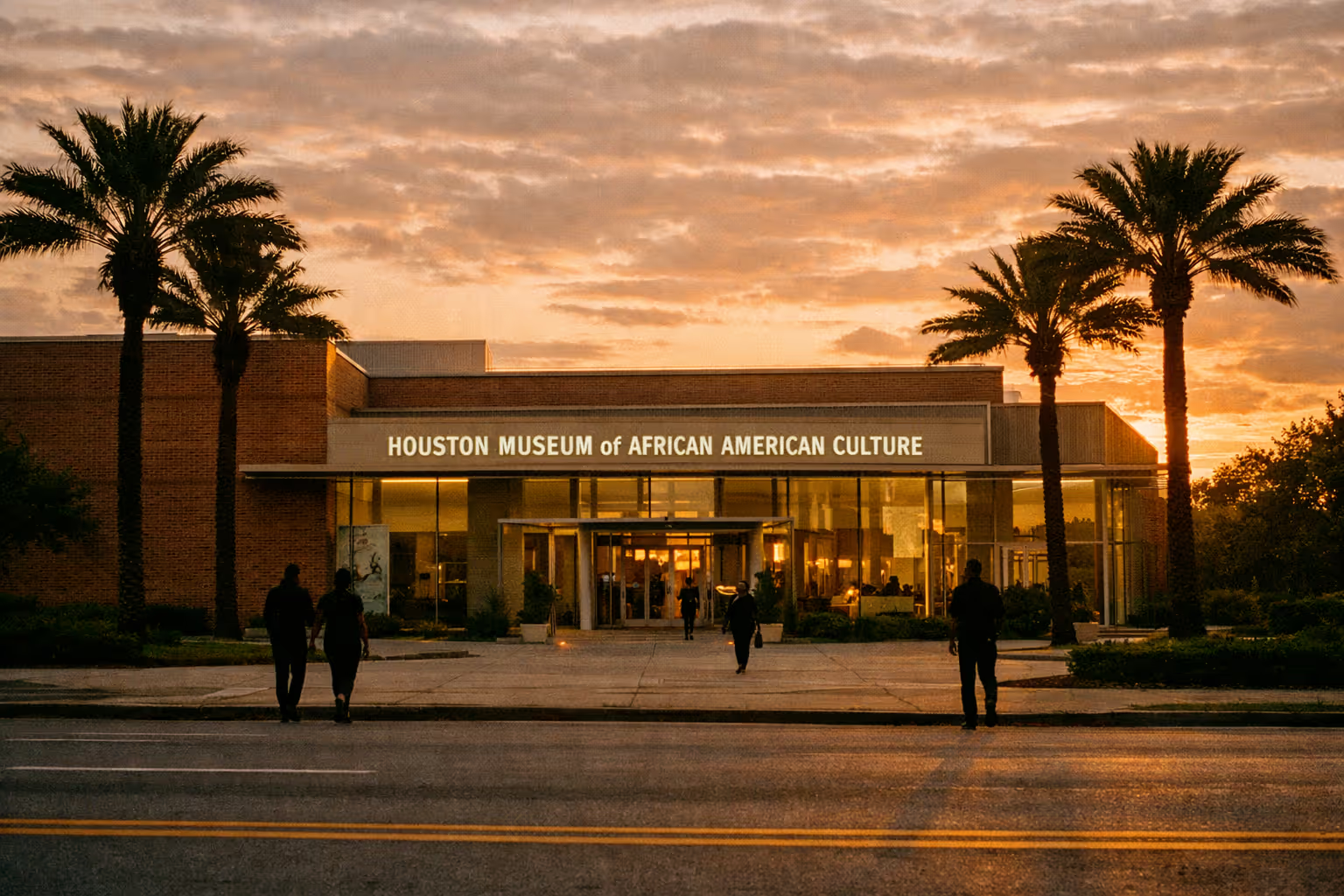
The Houston Museum of African American Culture is free to enter and free to park, but the catch is getting in at all. Posted hours run Wednesday to Saturday, 11 to 6, but staffing gaps sometimes leave the doors locked, so call the day you visit to confirm the galleries are open. Give it 60 to 90 minutes, more if a Jazz Church of Houston session is on, which is the real draw beyond the walls. One correction: the Galveston Juneteenth exhibit is a separate site, not a branch.
Hours, Tickets, and What It Costs to Visit the Houston Museum of African American Culture
Standard public hours are Wednesday through Saturday, 11 a.m. to 6 p.m. (1)(2). That’s a 28-hour weekly window - narrower than most Museum District neighbors, which typically run six or seven days. Some local listings show Thursday through Saturday only, so the Wednesday opening is the one worth confirming before you drive over (5).
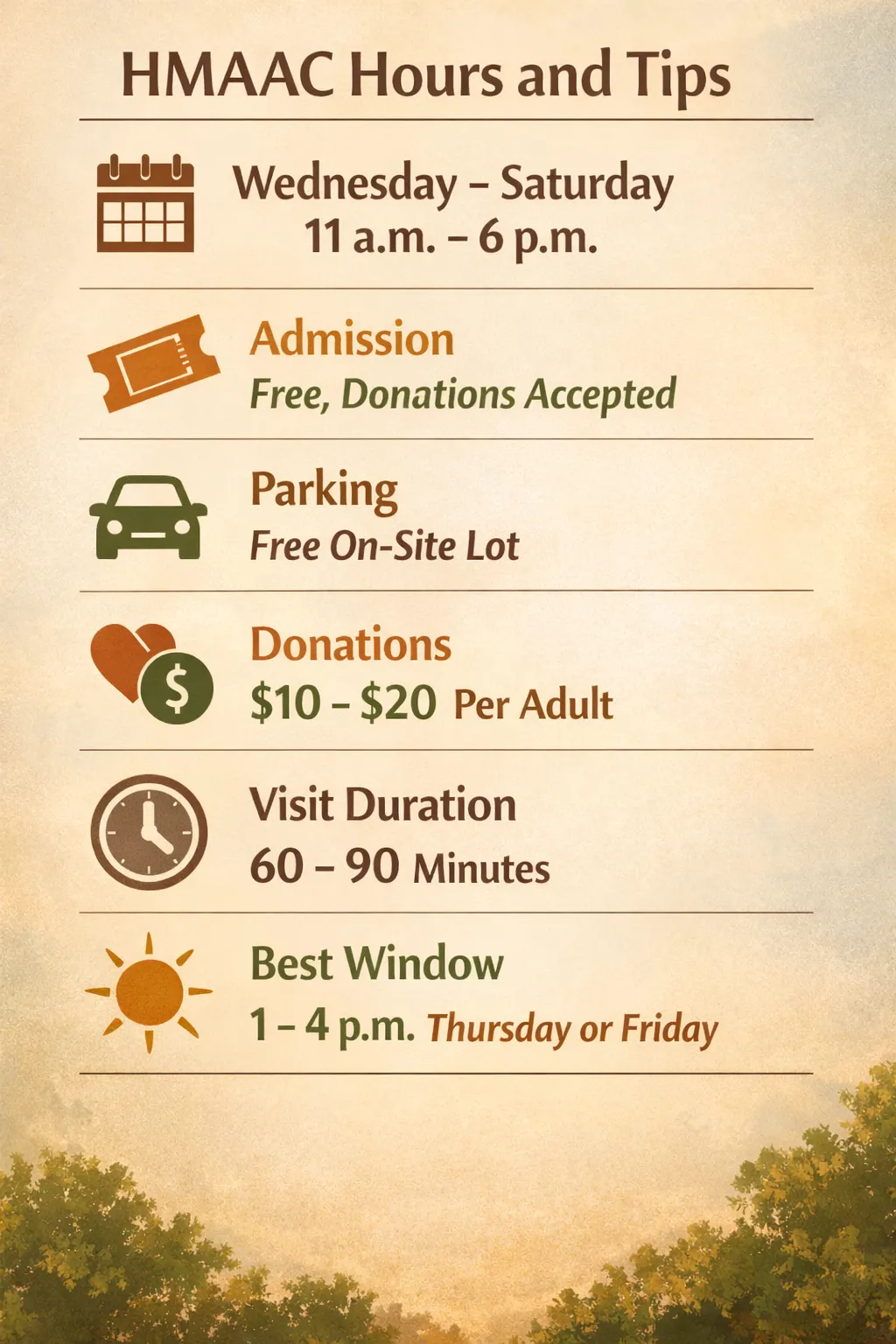 HMAAC is free to visit with on-site free parking; donations of $10-$20 per adult are common.
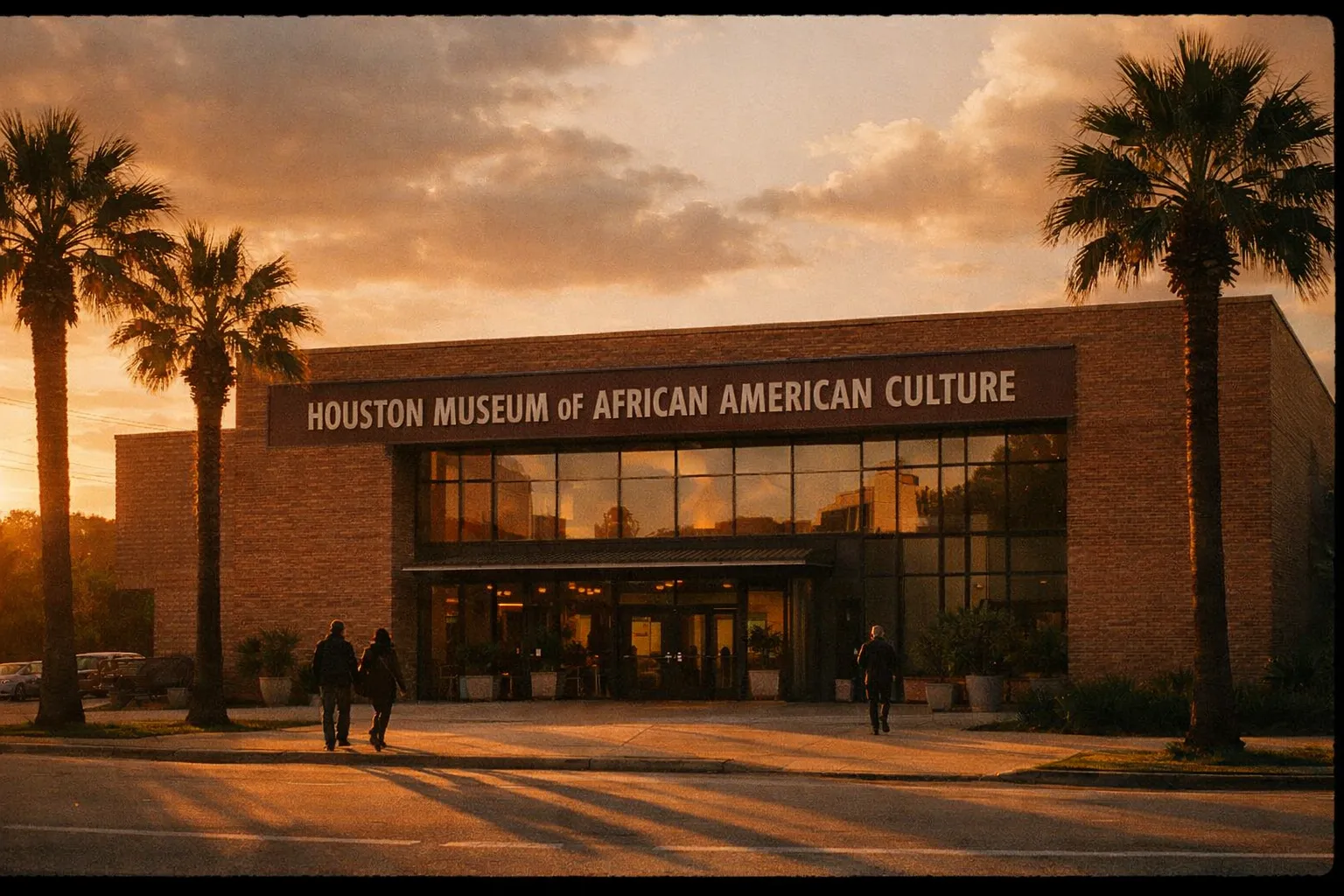
On cost: Houston Museum of African American Culture tickets don’t exist in the usual sense - general admission is free, with donations accepted (1). No box office, no timed-entry reservation, no advance purchase. You walk in during open hours. That answers the most common search around this museum directly.
What you might actually spend:
- Parking: Free on-site lot, per visitor reviews (4).
- Donation: Voluntary. A reasonable range is $10-$20 per adult if the museum’s programming moved you (4).
- Gift shop: Black art, clothing, jewelry, and purses generally run $15-$100 (4).
A couple visiting, including a modest donation, can do it for under $40 - or for nothing if you’re traveling lean.
One thing most guides get wrong: they print the free-admission line and stop there. They don’t warn you that the museum is small, or that the doors are occasionally locked during posted hours. That’s the single most useful thing to know before you commit a slot in your day - more on it below.
Why the Museum Might Be Closed When You Arrive
Yelp reviewers flag a recurring problem: arriving during listed hours to find the gates open but the doors locked (4). HMAAC runs on a lean staff, and special events or scheduling shifts can take a gallery offline without much notice online.
How to avoid wasting the trip:
- Call the day of your visit. The museum lists two numbers - (713) 526-1015 and (713) 353-1578 (4). Phone an hour or two before you head over and confirm galleries are open.
- Avoid major holidays. Staff schedules shift around dates like Juneteenth (June 19). The museum’s calendar gets busy and unpredictable in mid-June.
- Check social media for same-week notices. Recent Instagram posts often carry closure and exhibit-end information faster than the static website (10).
If you’ve seen the related And Still We Rise… Galveston’s Juneteenth Story exhibit listed as “temporarily closed” in your research, that’s a separate site - covered later in this guide - not HMAAC itself (6).
What’s on the Walls: Permanent Themes and Rotating Shows
HMAAC’s programming leans heavily toward rotating contemporary art exhibits rather than a fixed permanent collection. Shows typically run two to three months, so timing matters more here than at a museum with static halls (8). That rotation is a feature, not a bug - repeat visitors consistently report seeing something new each time, which is not something you can say about most Houston institutions with a fixed permanent collection.
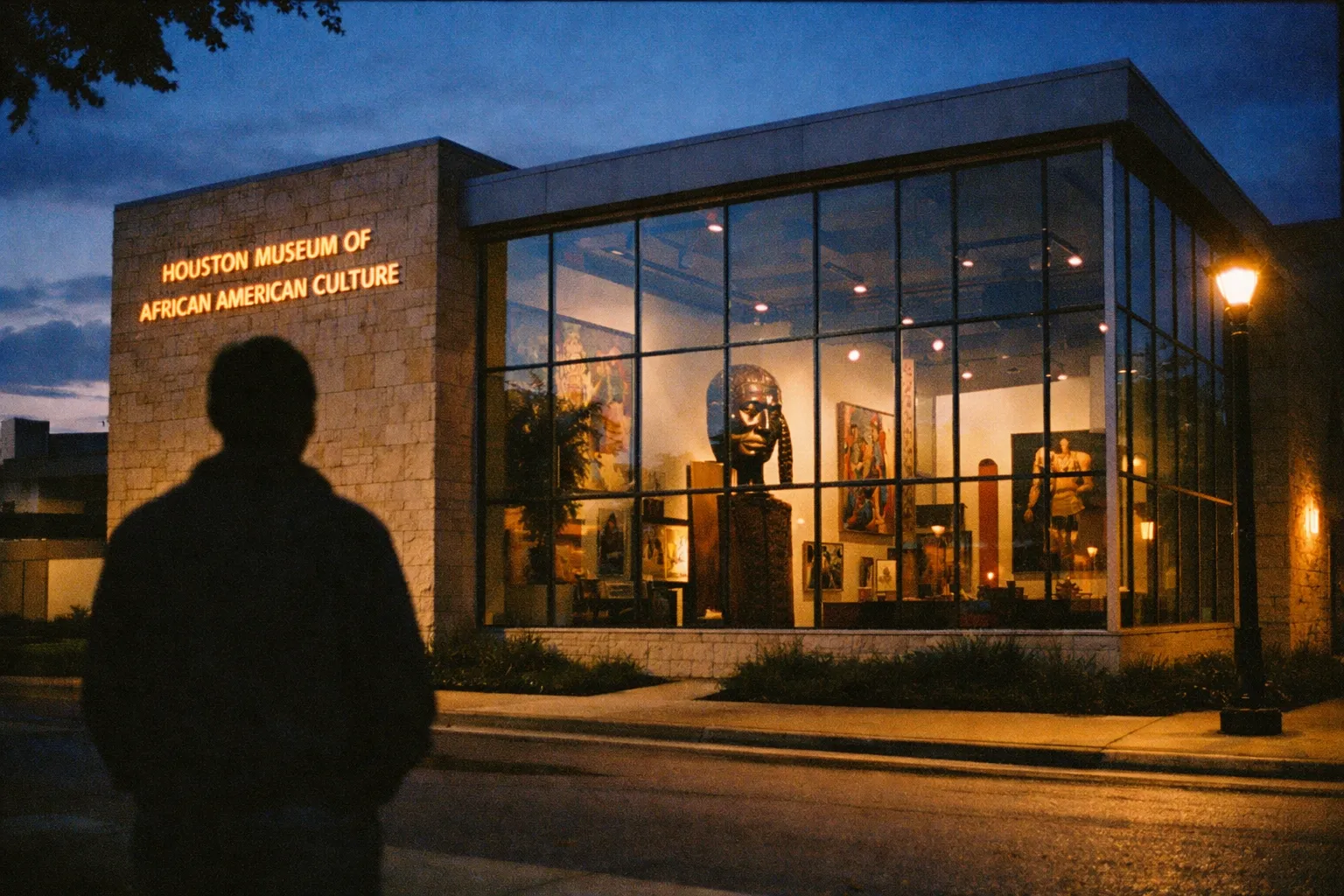
Curation centers on African and African American art, history, and contemporary culture - work by Black artists, photographers, and historians presented across the two-story gallery space (4)(7). Recent 2026 exhibitions included “Eden” by Clarence Heyward, “World: Photographs” by Dr. Jay Murthy, and “Allegiance to the People” by Kandy G. Lopez, free to view through early June (10). By late April 2026, some of those shows had already rotated out. Check current dates before you go rather than trusting an older listing.
The themes you’ll encounter across the museum’s programming over time:
- African roots - the civilizations and customs that fed into African American culture in the Americas.
- Slavery and Reconstruction - the system and the fight for freedom and equality that followed.
- Jim Crow and Civil Rights - segregation and the organized struggle against it.
- Achievement in art, science, and literature - the creative and intellectual output of African American figures.
What makes HMAAC’s curation distinct from a general history museum is the deliberate emphasis on living artists and contemporary voices alongside historical material. You’re not just reading about the past - you’re seeing how Black artists in 2025 and 2026 are responding to it. That dual-timeline approach is what most visitors describe as the museum’s strongest editorial choice, and it’s what separates a 60-minute visit here from a 60-minute visit to a more conventional institution. The Smithsonian’s National Museum of African American History and Culture in Washington D.C. covers similar ground at a much larger scale - HMAAC’s advantage is the tight curatorial focus and the rotating contemporary programming, which means the gallery changes meaningfully every two to three months rather than staying static for years.
A practical heads-up for families: some exhibits deal directly with racism and violence, and reviewers note sections can be jarring for younger children (4). Frame it ahead of time or plan a shorter route through the heavier galleries.
PRO TIP
Check the HMAAC website or its recent social posts for current exhibits before you go (10). Static third-party listings lag behind the actual gallery calendar by weeks.
The Jazz Church of Houston
The Jazz Church of Houston is the museum’s recurring music program, and it’s the thing that turns a quick gallery visit into a half-day cultural experience (2). Local guides covering Houston’s top Black cultural institutions consistently flag it as a reason to plan your visit around the calendar rather than dropping in randomly.
The format is built around listening to, learning about, and celebrating jazz history in Houston. It doesn’t always appear prominently on the main website - so when you call to confirm hours, ask staff directly about upcoming sessions (4)(2). Reviewers describe the staff as “super nice and helpful,” which tracks with my own experience at the front desk. If you can align your trip to a Jazz Church date, do it. It’s the museum’s strongest draw beyond the gallery walls.
How Long It Takes and How to Plan the Visit
Allow 60 to 90 minutes for a standard walkthrough - all galleries, the gift shop, and time to actually read the exhibit text. A slower, art-focused visit where you sit with each piece can stretch to two hours. Add another 60-120 minutes if there’s a Jazz Church session or an artist talk.
Best window to go: 1 to 4 p.m. on a Thursday or Friday. That sidesteps morning setup delays and lowers the odds of running into a late-afternoon event closure, while keeping crowds thin.
Getting there:
- By car: Roughly 10-15 minutes from Downtown Houston depending on traffic. Free on-site parking (7).
- By transit: The METRORail Red Line drops you at the Museum District station, a short walk away.
Because the museum is free and compact, it works best as an anchor for a Museum District day rather than the whole event. Other venues sit within about half a mile, so you can build a thematic afternoon around civil rights, immigration, or Houston history and walk between stops.
Museum District Combo Day
If you want a full day on a $30-$60 budget, pair the free HMAAC visit with a paid neighbor. The Houston Museum of Natural Science runs around $25-$30 general admission. Start at HMAAC to ground the cultural context, then move on. Worth the detour: hitting HMAAC first means you’ve got the lighter, free stop done before the bigger institution eats your afternoon and your energy.
Tours and Group Visits
Walk-in visitors don’t need a tour - the space is small enough to self-navigate without one. But Houston museum of African American culture tours for groups are worth arranging if you’re bringing a school class, a community group, or a bus.
For group bookings, contact the museum at the 713-area-code numbers and give yourself lead time. Two to four weeks ahead is the safe window for scheduling, especially around busy periods like June - the Houston Museum of Natural Science, by comparison, recommends booking school groups 4-6 weeks out, so HMAAC’s 2-4 week window is relatively accessible (6). Teachers can use HMAAC as a free field-trip site and build pre-visit materials on African American history around a 1.5-to-2-hour guided walkthrough.
Group visits work best when the organizer has done some pre-framing. The museum’s rotating exhibit format means the specific works on display will differ from what you previewed online - brief your group on the themes rather than the individual pieces, and the visit lands better regardless of what’s currently hanging. Staff are consistently described in reviews as willing to engage with groups directly, so don’t hesitate to ask a staff member to walk your group through the current show’s context.
If you’re a local who wants deeper involvement, the museum has been actively inviting the public to “become a volunteer and be part of the work” - a few hours a month assisting during exhibits and events.
What Visitors Actually Say: Ratings and Reviews
The Houston museum of African American culture reviews trend positive, with a few consistent caveats worth weighing before you go.
On TripAdvisor, HMAAC carries strong individual ratings - reviewers describe it as “small but very interesting” and praise both the staff and the exhibit selection (7). TripAdvisor’s listing for HMAAC places it among Houston’s top-ranked cultural institutions in the Museum District category - notable given that it competes against neighbors like the Houston Museum of Natural Science (roughly $25-$30 admission, 250,000+ square feet) and the Museum of Fine Arts Houston (around $19 general admission, one of the ten largest art museums in the US by square footage). The recurring praise:
- Helpful, welcoming staff (4)(7)
- Thought-provoking, well-chosen contemporary exhibits (7)
- Free admission and free parking - rare value in the Museum District (7)
The recurring complaints:
- Occasional closures during posted hours, doors locked despite open gates (4)
- Smaller scale than some visitors expect (4)
- Some content too heavy for young children without preparation (4)
Read together, the reviews tell you to set expectations correctly: this is a depth-over-breadth museum. Go for the curation and the programming, confirm it’s open first, and you’ll come away in the positive camp.
African American Museum Galveston: The Juneteenth Connection
A lot of travelers researching HMAAC also search for an African American museum Galveston option - because Galveston is where the original Juneteenth news of emancipation was delivered in 1865. These are two different places, and conflating them will cost you a wasted drive.
The Galveston site most relevant here is the “And Still We Rise… Galveston’s Juneteenth Story” exhibit at Ashton Villa’s carriage house. It is temporarily closed for rehabilitation of the building (6). When open, standard admission runs $10 for adults, $5 for youth ages 6-18, and free for children under 5, with hours of Friday-Saturday 10 a.m.-4 p.m. and Sunday noon-4 p.m. (6). Group tours by appointment are available any day.
Ashton Villa itself is a Galveston landmark - a 19th-century Italianate mansion that served as the site where Union General Gordon Granger read General Order No. 3 on June 19, 1865, officially notifying enslaved Texans of their freedom. The carriage house exhibit contextualizes that moment with photographs, documents, and oral histories. When it’s open, it runs about 45-60 minutes and pairs well with a walk through the East End Historic District. Admission at $10 per adult is reasonable for what it covers - comparable to a mid-tier museum in any Texas city.
If you’re building a Juneteenth heritage route, pairing HMAAC in Houston with the Galveston exhibit makes geographic sense - it’s roughly a 50-mile drive between them on I-45 South, about 50-55 minutes without traffic, compared to a 3-plus-hour drive if you were routing from San Antonio (6). The logical sequence is HMAAC in the morning, then drive to Galveston for the afternoon. Just confirm the Galveston exhibit has reopened before you plan around it. We cover the broader Galveston Juneteenth route separately.
Things to Do Near the Museum and How to Build a Full Day
Beyond walking the galleries, here’s how to get more out of a visit - and where to go next. Ranked by whether it’s worth the detour.
The Museum District is one of Houston’s most walkable cultural corridors. Within about half a mile of HMAAC, you have more than a dozen institutions covering natural science, fine art, health, and history. The practical advantage of HMAAC’s free admission is that it gives you budget room to pay full price at a neighbor without blowing your day’s spend. A two-stop day - HMAAC plus one paid institution - runs $25-$35 per adult and covers four to six hours of programming if you pace it right.
For visitors coming specifically for African American history and culture, the logical sequence is HMAAC first, then the Buffalo Soldiers National Museum, then a walk through the Third Ward. That route covers roughly three miles total if you drive between stops, and it gives you a coherent arc from pre-Civil War history through Reconstruction, Jim Crow, and contemporary art - all within a single afternoon. I ran this sequence on a Thursday in March and finished with time to eat in the Third Ward before dark.
Worth the detour:
- Time a Jazz Church of Houston session. The single best reason to plan rather than wing it (2).
- The Buffalo Soldiers National Museum. A focused deep dive into the African American regiments formed after the Civil War - one of Houston’s strongest Black-history institutions. Buffalo Soldiers National Museum.
- The gift shop. One of the few Museum District spots selling curated African American art, clothing, jewelry, and purses in the $15-$100 range (4).
Worth it if you have time:
- The Third Ward. Walk this historic African American neighborhood; Emancipation Park, galleries, and restaurants anchor it. The Third Ward.
- The Alley Theatre. Catch a production; the company regularly stages work tied to the African American experience. The Alley Theatre.
Skip if short on time:
- Special one-off film and performance events are great when they line up with your dates, but don’t reshape your trip around the Houston Black Film Festival unless it’s actually running while you’re in town.
Making a wider Texas trip of it? The Blue Lagoon in Texas is an easy add-on for a different pace, and if you’re chasing scenery across the country, here are the best places to watch the sunset in the USA.
Frequently Asked Questions
- How much does it cost to go to the Houston Museum of African American Culture?
- Nothing. General admission is always free, with donations accepted. No advance tickets; parking is free on-site.
- Why is the African American Museum temporarily closed?
- HMAAC in Houston is not permanently closed but may have locked doors during posted hours due to staffing. The Galveston exhibit is closed for building rehabilitation.
- How long does it take to walk through the African American Museum?
- Plan 60 to 90 minutes for a standard visit; up to two hours for a slower walkthrough. Add time for Jazz Church sessions.
- What days is the Houston museum free?
- Every open day: Wednesday through Saturday, 11 a.m. to 6 p.m. Confirm Wednesday hours before visiting.
- Can I visit the Houston Museum of African American Culture without a tour?
- Yes. The museum is small and easy to self-navigate. Tours are recommended only for groups or educational visits.
- Is the Jazz Church of Houston program included with museum admission?
- Yes, Jazz Church sessions are free but scheduled. Call ahead to confirm dates and plan your visit accordingly.
- Is the African American Museum in Houston suitable for children?
- Some exhibits contain heavy themes like racism and violence. Parents should prepare children or plan a shorter visit.