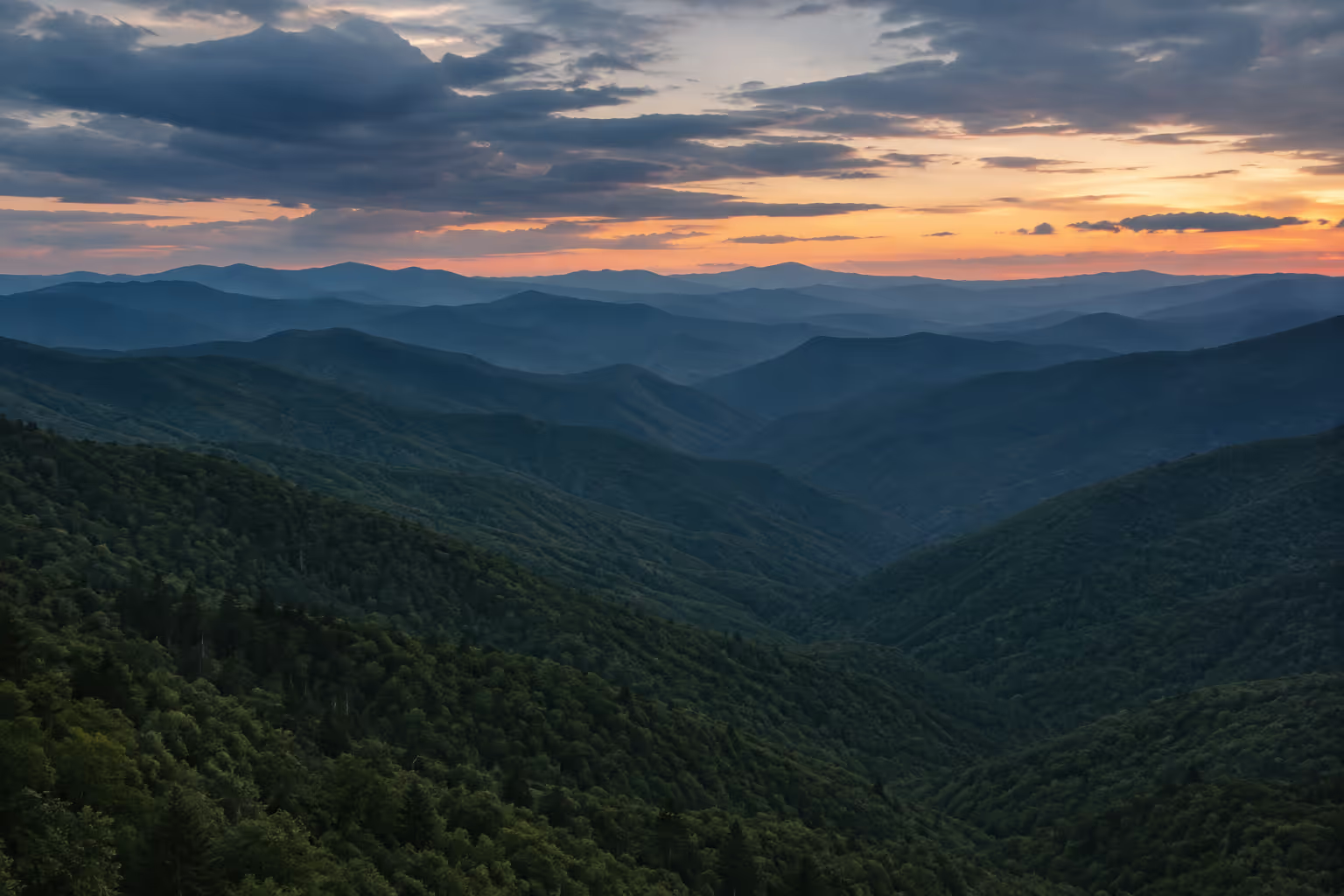
Since April 30, 2026, every new Smokies backcountry permit runs through Recreation.gov instead of the park’s old system, although any permit issued before that date is still honored (7). The rules about where you can pitch a tent have not changed. Great Smoky Mountains backcountry camping still comes down to five rules: reserve a permit for every night, sleep only at the sites and shelters it names, carry the permit with you, hang everything scented on the bear cable, and pack out everything you carry in. Here is the full sequence, from booking to the trail.
Great Smoky Mountains Backcountry Camping: What You Need to Know
Backcountry camping in Great Smoky Mountains National Park is allowed year-round, but only at designated campsites and shelters, with a permit and an advance reservation for every night (11)(4). You cannot walk in and camp wherever looks flat. The permit names where you enter, where you sleep each night, and where you exit.
The park has more than 800 miles (1,287 km) of trails (11). The official trail map marks every trail, campsite, and shelter, so download it before you plan anything. The park’s Recreation.gov permit page describes the backcountry as a mountainous wilderness environment that is “much more challenging than many people realize” (4).
For trip-planning questions, the park’s backcountry page lists, as of October 2026, the Backcountry Information Office at 865-436-1297 by phone from 8:00 am to 5:00 pm EST, and in person from 9:00 am to 5:00 pm EST at the Sugarlands Visitor Center near Gatlinburg, Tennessee (11)(4).
Getting a Smoky Mountains Backcountry Permit
A Smoky Mountains backcountry permit covers up to 7 nights, can be booked up to one month before your first night, and is tied to specific sites on specific dates (4).
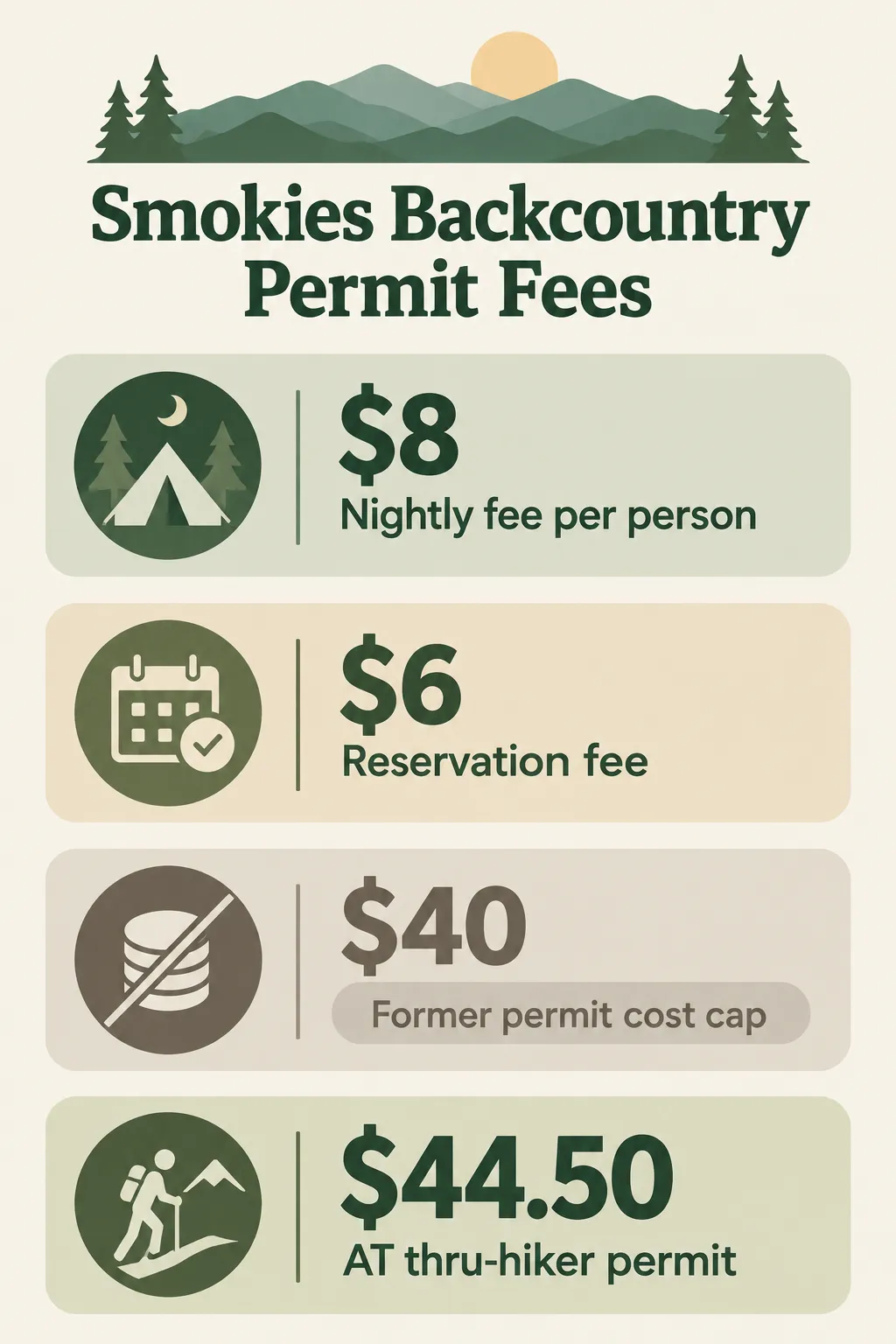 As of October 2026, Great Smoky Mountains permits cost $8 per person per night plus a $6 reservation fee; the former $40 cap has been removed, and the Appalachian Trail thru-hiker permit is $44.50.
Booking window and what a full trip actually costs
Check closures when you book: as of October 2026, the Recreation.gov permit page lists several campsites closed for a broken bear cable system or aggressive bear activity (4).
As of October 2026, the fee structure set at the April 30, 2026 transition is:
- $8 per person, per night, which is unchanged (11)
- $6 non-refundable administrative fee per general backcountry permit reservation (8)
- No $40 cap. The old maximum total permit cost has been removed (8)
- $44.50 for an Appalachian Trail thru-hiker permit, which already includes the administrative fee (8)
The Recreation.gov fee policy and the Appalachian Trail Conservancy’s notice agree on how these pieces add up: the $6 fee is charged once per permit, on top of $8 per person, per night (4)(8). Two hikers on a three-night trip pay 2 × 3 × $8 = $48 in camping fees plus the $6 permit fee, $54 in total. Both fees are non-refundable, and adding people after booking means paying their nightly fees, while dropping people earns no refund (4).
With no cap, every added night and every added person now raises the total, so check the live checkout total on Recreation.gov before you commit.
Why the platform moved to Recreation.gov in 2026
On April 30, 2026, the park retired its own permit system and moved to Recreation.gov (8), a switch the park says improves reliability, security and customer support for backcountry users (7). Park fee revenue stays in the Smokies and funds programs and maintenance that improve visitor safety and park facilities (8).
Printed permit and parking tag: two separate requirements
Carry your permit: the park’s compendium requires it to be in your possession in the backcountry and shown on request (5). Print it from your Recreation.gov account before you leave; once printed, it counts as issued and can no longer be changed or cancelled (4).
If you leave a car in the park during your trip, it also needs a valid parking tag. Your backcountry permit does not cover the vehicle (11), and a tag does not reserve a space: trailhead parking is first-come, first-served, so plan to arrive early (4).
How to book a Smokies backcountry permit
Reserve a site-specific itinerary, then carry the permit and a parking tag.
- 1
Choose your route and overnight sites
Pick an entry point, a site for every night, and an exit point on the official trail map.
- 2
Check availability on Recreation.gov
Search your exact sites and dates, and check listed closures.
- 3
Reserve within the booking window
Book up to one month ahead, for up to seven nights.
- 4
Review the checkout total
Confirm the live total, nightly fees plus the reservation fee.
- 5
Carry the permit and arrange parking
Print and carry the permit, and get a parking tag for any car left in the park.
Choosing Smokies Backcountry Campsites and Shelters
Smokies backcountry campsites and shelters must each be reserved for the exact night you will use them (5). Your route is built around which sites have availability, not the other way around.
Consecutive-night limits also shape your route (11):
- Most individual campsites: a maximum of 3 consecutive nights
- Any shelter, plus campsite 113: no consecutive nights at all
Group size limits and the six larger-capacity sites
The standard maximum party size is 8. Campsites 17, 20, 46, 60, 86, and 90 can take up to 12 people (5), under a special permit (11). If your group has 9 to 12 people, those six sites are your only options, and two parties from the same group may not share a campsite or shelter on the same night (11). Contact the backcountry office before you build the route.
Shelter sleeping rules and the thru-hiker tenting exception
If your itinerary includes a shelter night, you must sleep inside the shelter. You cannot pitch a tent next to it, and hammocks cannot be hung inside or attached to the shelter (11). The only exception is for Appalachian Trail thru-hiker permit holders, who may tent outside when the shelter is full (11).
Black Bear and Elk Safety in the Backcountry
Every Smokies campsite and shelter has a bear cable system. All food and scented items must hang on it whenever you are not using them (11)(4). That list goes well beyond dinner:
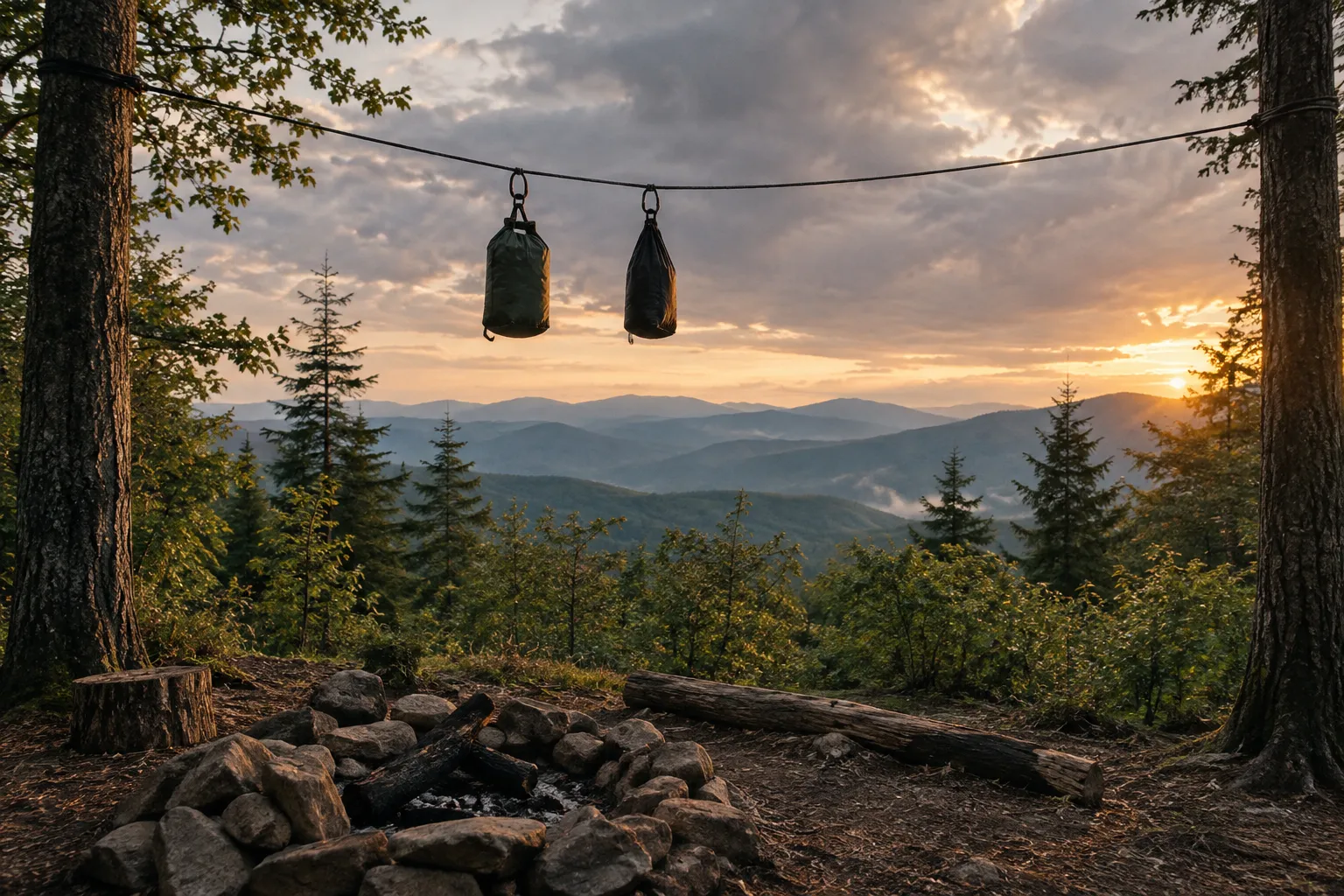
- Food and trash
- Cookware
- Toiletries, including toothpaste and lip balm
- Stock feed and hay, if you travel with animals (11)
A bear canister, if you carry one, also goes on the cable (4).
Bear activity is especially high from May to August, and over the last 10 years an average of 339 negative human-bear encounters have been reported each year, according to the Recreation.gov permit page (4).
Park rules prohibit willfully approaching within 50 yards (150 feet) of bears, or within 25 yards (75 feet) of elk, or close enough to disturb either animal’s behavior (5). Feeding, touching, or teasing any wildlife is also prohibited (11). If an animal walks toward your site, the distance rule still applies to you, so back off (5). Elk range on the North Carolina side of the park, around Cataloochee, Balsam Mountain, and Oconaluftee (12). The park’s backcountry regulations page lists 50 yards (150 feet) for elk as well as bears (11), so keeping 50 yards from both meets every park rule.
Trash Packout, Catholes, and the 200-Foot Question
Everything you carry in has to come out with you, including food, trash, clothing, gear, and personal items (11). Burning trash or food is not a disposal method. Burning anything other than dead wood is prohibited (11).
For human waste, dig a cathole at least 6 inches (15 cm) deep, at least 100 feet (30 m) from any campsite, shelter, water source, or trail (11).
The “200 rule” you may have read about is the general Leave No Trace guideline: catholes 6 to 8 inches deep, at least 200 feet (61 m) from water, camp, and trails (13). Following it keeps you compliant, but the 100-foot figure is the one written into the park regulations (11).
Planning Smokies Backpacking Routes and Mileage
For Smokies backpacking, your reserved sites fix where each day ends, so measure each leg from one booked site to the next on the park trail map (11).
A short first overnight for new backpackers
On a first trip, pick one designated campsite a short hike from a trailhead, confirm it is open on Recreation.gov, and make it an out-and-back: one parking tag, no shuttle, and a low-mileage night to test your gear and bear-cable routine.
If you are coming with horses, check the trail map for stock designations first. Stock users may only use trails, campsites, and shelters designated for stock use (11).
The Appalachian Trail crossing: Fontana Dam to Davenport Gap
This route is for experienced backpackers. Skip it if your time is short or this is your first trip. One published itinerary puts the park crossing at 71.6 miles (115 km) from Fontana Dam to Davenport Gap, hiked over seven days (10). It is a point-to-point route, so it needs a shuttle, and it depends on shelter availability.
You qualify for the $44.50 thru-hiker permit only if your A.T. hike begins and ends at least 50 miles (80 km) outside the park (8). Section hikers doing just the park crossing need a general permit with reserved sites (10).
Before departure, check road and weather conditions: seasonal or weather-related road closures can cut off trailhead access (4). Spring is the height of the A.T. thru-hiking season in the park, with crowded shelters (10), which makes your booking date matter even more.
Campfires, Water Sources, and Backcountry Pet Rules
The Smokies backcountry rules on fires, water, and pets are short, and a violation of park regulations can bring a fine of up to $5,000 and/or 6 months in jail (11).
Campfires: established rings and dead wood only
Fires are allowed only at designated sites and shelters, inside the established fire ring, using dead wood already on the ground (11)(4). Do not build a new ring, cut standing wood, or burn food or trash.
Treating water even where a spring exists
A spring or stream marked near a site is not a guarantee of safe water. Carry a filter on every trip: the Recreation.gov permit conditions commit you to filtering any drinking water (4).
Why pets stay out of the backcountry
No dogs or other pets may be carried into the backcountry (11). Only two park trails allow dogs: the Gatlinburg Trail and the Oconaluftee River Trail (11). A dog on the trip stays at a frontcountry base.
Frequently Asked Questions
- Can a Smokies backcountry permit be used for a different campsite if plans change?
- No; the permit is tied to the sites and dates in its itinerary. Before printing, Recreation.gov lets you change the group size, entry and exit points, travel method, and emergency contact; a new start date means cancelling and rebooking, and a printed permit can no longer be changed.
- Can a group of nine backpackers use any designated campsite?
- No; a group of nine to twelve needs one of the six larger-capacity campsites and must make the required special arrangement.
- How many hikers go missing in the Smokies each year?
- The park's permit pages give no annual count. The Recreation.gov permit conditions state that rescue is not a certainty and that the permit holder is responsible for the group's safety, so leave your itinerary with someone at home and call the Backcountry Information Office for current conditions.
Confirm current site availability on Recreation.gov, and check the park’s road and trail closures page the week you leave.