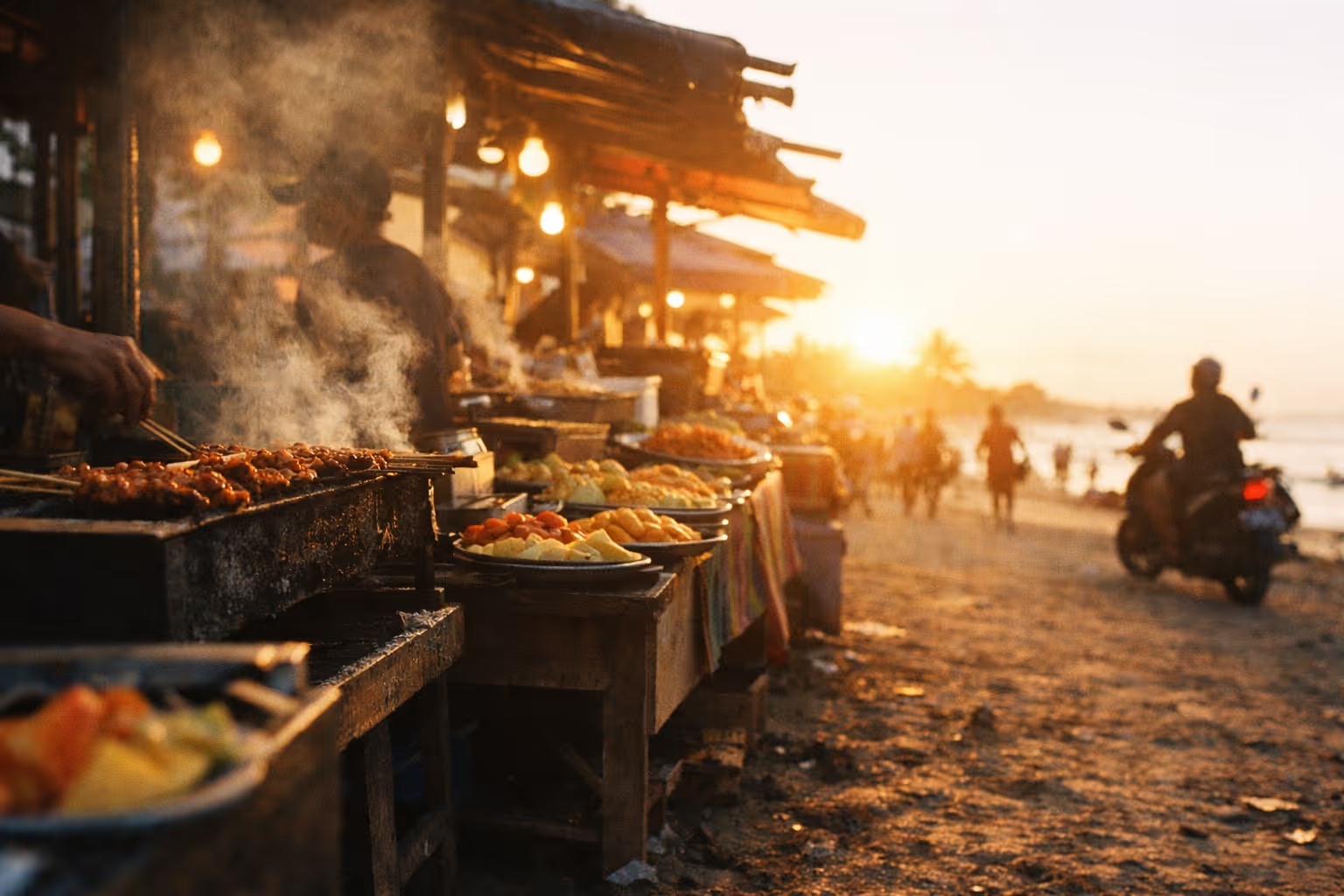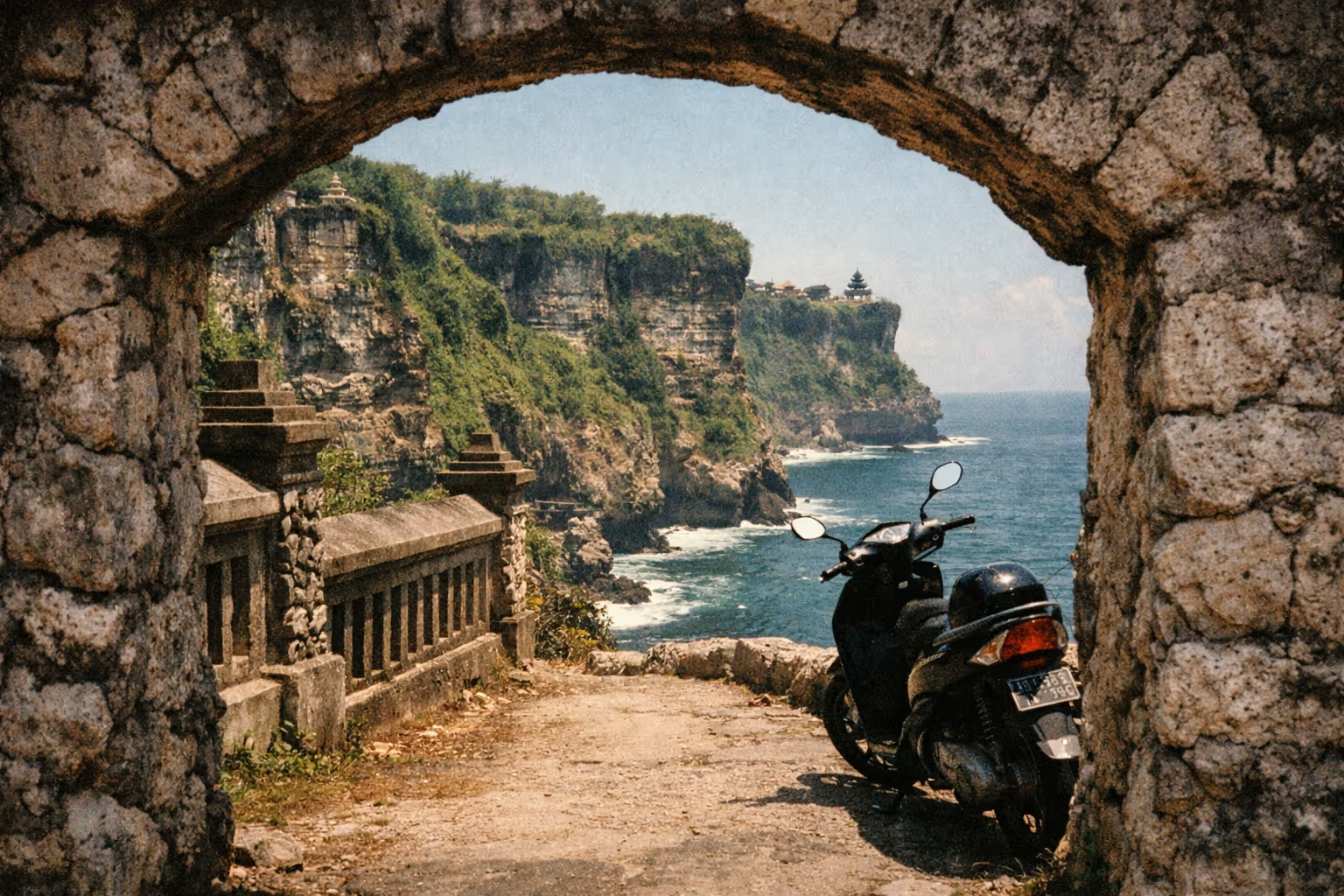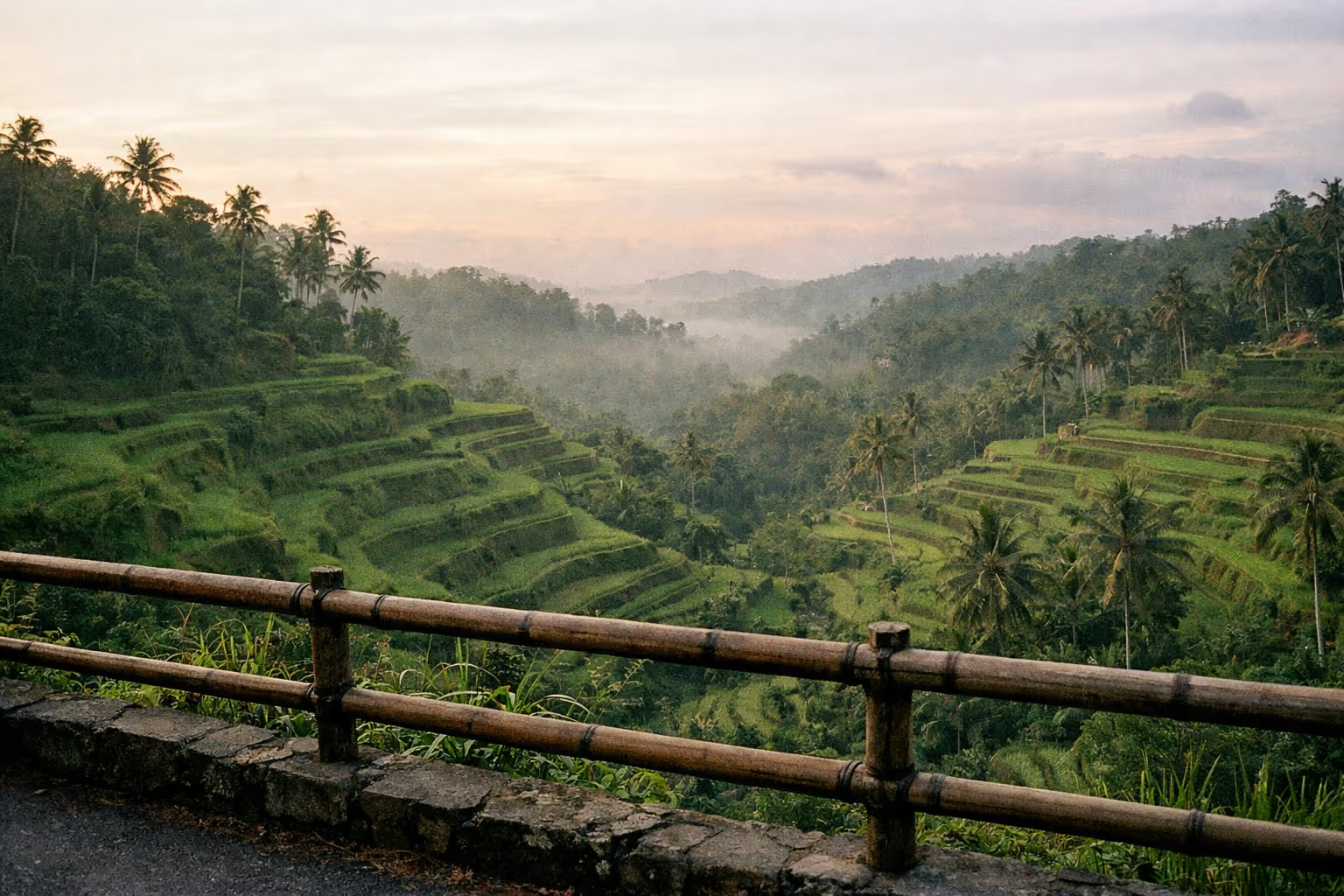
The best time to visit Bali is not the dry-season peak everyone books, it is the shoulder months that bracket it. May, June, and September stay dry while hotel rates sit 15 to 25 percent below the July and August crush. Go in January instead and you save even more, 30 to 50 percent, at the cost of afternoon rain and murky dive water. One date to never miss: Nyepi shuts the whole island down. Here is the month-by-month tradeoff.
When is the best time to visit Bali?

The best time to visit Bali for most travelers is between May and September. During these months, rainfall is at its lowest, humidity drops, and the south coast beaches are ideal for swimming, surfing, and diving (1)(2). July and August offer the driest, sunniest conditions, but they also bring the biggest crowds and the highest prices.
If you want the weather without the peak-season surcharge, aim for the shoulder months:
- Late May to mid-June: dry days, fewer tourists than July, hotel rates still 15-25% below peak.
- September: consistently dry, schools back in session in Australia and Europe, prices ease back down.
- Early October: still mostly dry before the rains build, and one of the quieter stretches on the island.
December gets singled out as the rainiest month and the trickiest weather-wise (3), though it’s still walkable between downpours. January through mid-April brings the heaviest rains and occasional tropical storm activity (1).
A quick scorecard:
- Best overall weather: July-August
- Best value with good weather: May, June, September, early October
- Worst for weather: December-February (heaviest rain, lowest dive visibility)
- Worst for crowds and price: mid-December to early January, mid-July to mid-August, Chinese New Year week
Bali weather by month
Temperatures barely move. Rain is the variable. Here’s the month-by-month picture for the Denpasar/south coast area:
Bali Weather by Month (Denpasar/South Coast)
| Jan | Feb | Mar | Apr | May | Jun | Jul | Aug | Sep | Oct | Nov | Dec | |
|---|---|---|---|---|---|---|---|---|---|---|---|---|
| Avg High | 84°F / 29°C | 84°F / 29°C | 86°F / 30°C | 90°F / 32°C | 91°F / 33°C | 88°F / 31°C | 88°F / 31°C | 88°F / 31°C | 88°F / 31°C | 88°F / 31°C | 86°F / 30°C | 86°F / 30°C |
| Avg Low | 73°F / 23°C | 73°F / 23°C | 73°F / 23°C | 72°F / 22°C | 73°F / 23°C | 72°F / 22°C | 72°F / 22°C | 72°F / 22°C | 72°F / 22°C | 73°F / 23°C | 73°F / 23°C | 73°F / 23°C |
| Rain | Very high | High | High | Moderate | Low | Very low | Very low | Very low | Low | Rising | High | Very high |
| Vibe | Wet, humid, cheap | Wet, CNY crowds spike | Tapering rain, Nyepi falls here | Shoulder - strong value | Excellent, dry, calmer | Excellent, prices rising | Peak season, packed | Peak season, packed | Excellent, quieter | Shoulder, good deals | Rainy season returns | Wettest month, then holiday spike |
Highlands like Ubud, Munduk, and Bedugul run a few degrees cooler - evenings can dip into the upper 60s°F (around 20°C), so pack a light layer even in dry season.
Bali rainy season - should you avoid it?
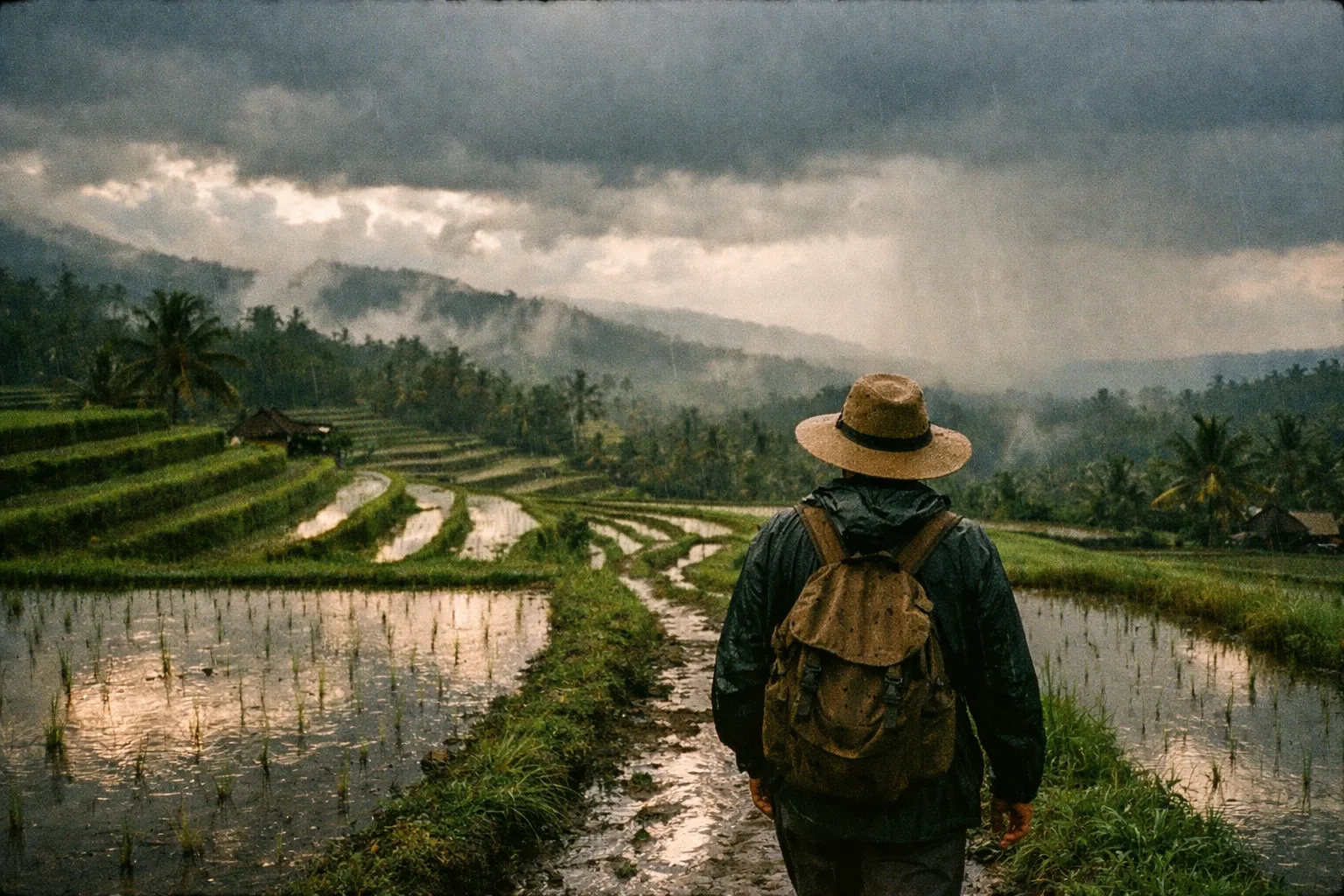
Short answer: no, not entirely. The Bali rainy season runs roughly November to March, and the rain pattern matters more than the rain total. Heavy downpours typically last one to three hours - often late afternoon or overnight - rather than washing out whole days (3). I’ve spent rainy-season weeks in Ubud where mornings were sunny enough for rice-paddy walks and the rain timed itself perfectly for an extended lunch.
What rainy season actually affects:
- Diving and snorkeling visibility drops, especially January and February, when runoff clouds the water near river mouths.
- Beach quality suffers on south and west coasts (Kuta, Seminyak, Canggu), which catch debris washed in by currents. East coast spots like Sanur, Nusa Dua, and Amed stay cleaner.
- Roads flood in low-lying areas; scooter rides get unpleasant fast.
- Hiking Mount Batur and Agung is often closed or unsafe due to mud and poor visibility.
What rainy season is genuinely good for:
- Prices. Hotels frequently run 30-50% below peak rates (2). Flights drop too.
- Ubud, temples, and culture. Indoor and shaded experiences don’t care about rain.
- Photography. Rice terraces are at their greenest from December to February.
- Avoiding crowds - except for the late-December holiday window and Chinese New Year, when prices and crowds spike back to peak levels (3).
One critical date inside rainy season: Nyepi, the Balinese Day of Silence, usually falls in March. The entire island - including Ngurah Rai Airport - shuts down for 24 hours. No flights land or leave, no driving, no lights at night. If your trip touches that date, you need to be inside your hotel for the day and you cannot fly in or out. I’ve seen travelers book around it and still get caught out because they didn’t check the exact date for that year. Look it up before you finalize anything.
What if I go during Bali peak season?
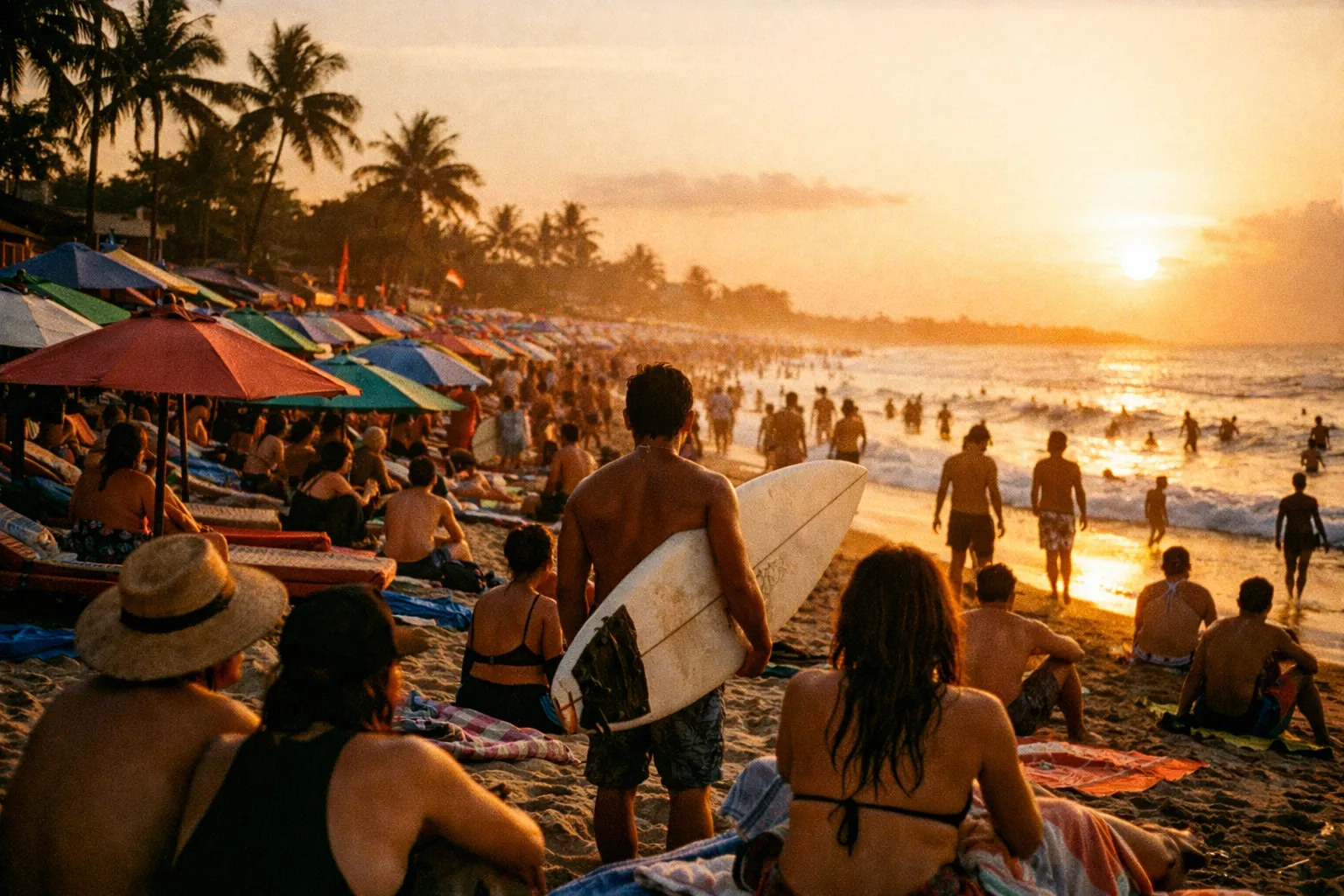
Bali peak season runs June through August, plus the mid-December to early January holiday window and Chinese New Year week in late January or February (3). These periods bring:
- 20-60% higher flight prices from regional hubs like Singapore, Kuala Lumpur, and Sydney
- 20-50% higher hotel rates, with luxury villas seeing the steepest jumps
- Heavy traffic in Canggu, Seminyak, and Ubud - a 25 km drive can take 2+ hours
- Long waits at popular sights: the Gates of Heaven at Pura Lempuyang (a temple complex in East Bali), the Tegallalang rice terraces, Mount Batur sunrise climbs
- Booked-out restaurants in trendy zones - make dinner reservations the day before, not the day of
The trade-off is real energy. Beach clubs are at full tilt, every yoga studio has classes running, and the calendar fills with cultural ceremonies. If you want Bali at its most socially alive, peak season delivers that.
Tactics for surviving it:
- Book accommodations 2-3 months out, especially for July-August and Christmas week.
- Pre-book major experiences - Mount Batur sunrise, Nusa Penida boat trips, popular restaurants.
- Base yourself smartly. Staying in central Canggu in July means traffic kills your day; quieter Pererenan, Bingin, or Amed gives you a way out.
- Move early. Sunrise at sights is genuinely empty even in August. By 9 a.m., the tour buses arrive.
What is the cheapest time to go to Bali?
The cheapest time to visit Bali is January through March - the heart of monsoon season (2). Discounts of 30-50% off high-season hotel rates are common, and airfares from major hubs drop in parallel.
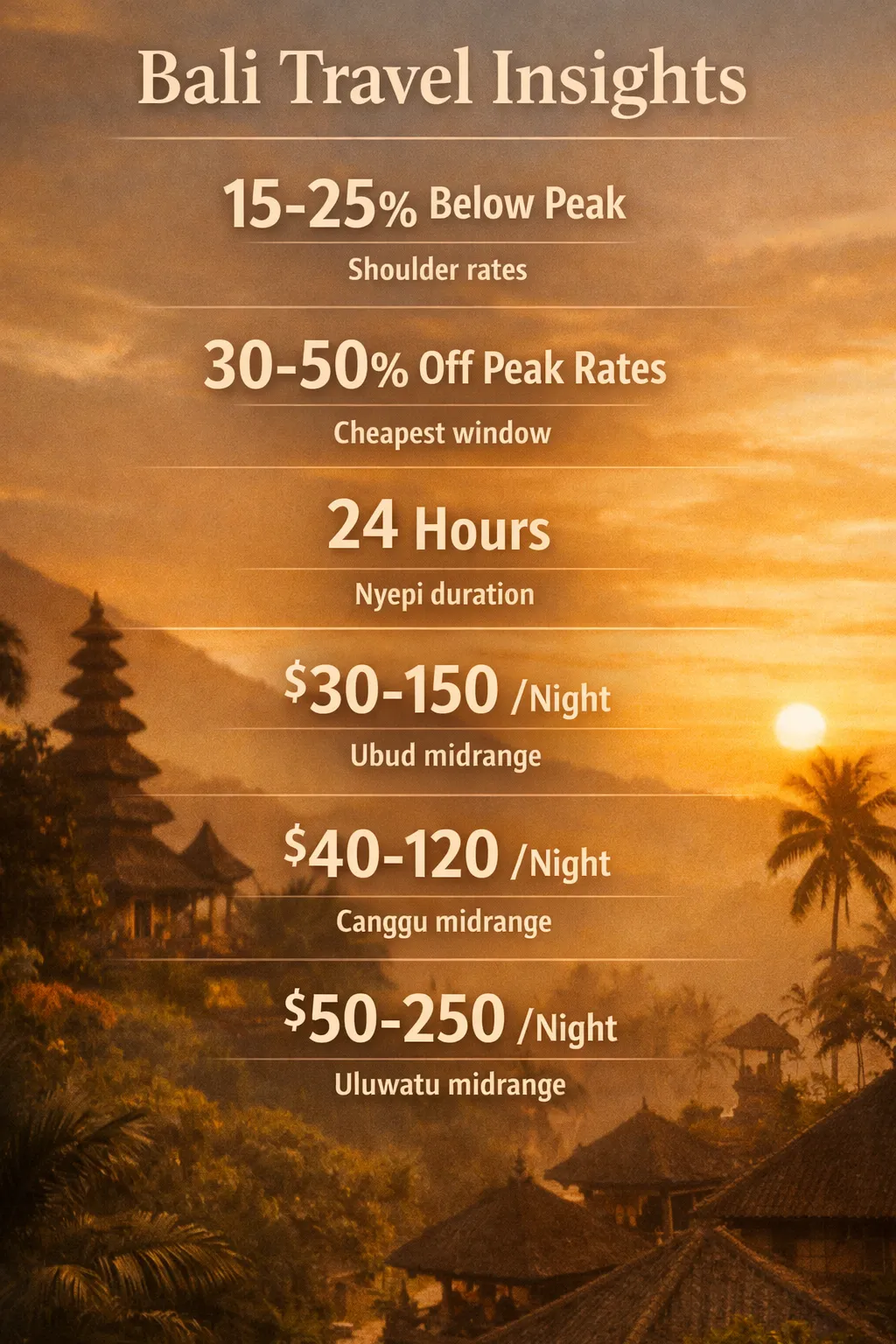 Cost windows and base-night ranges in Bali: shoulder-season rates are 15-25% below peak; cheapest months offer 30-50% off peak rates; Nyepi lasts 24 hours; Ubud $30-150/night; Canggu $40-120/night; Uluwatu $50-250/night.

April, early May, late September, October, and November are the next-cheapest tier - shoulder months with mostly good weather and noticeably lower prices than peak. For travelers who want the rain-free experience without the peak surcharge, early May and late September are the strongest value windows.
A few booking tactics that actually move the needle:
- Avoid the late-December to early-January spike. Even in rainy season, prices roughly triple for this two-week window.
- Skip Chinese New Year week. Bali fills up with regional travelers; rates jump 30-50% for a week, then drop back.
- Book flights for Tuesday or Wednesday departures. Weekend departures from Sydney, Singapore, and Kuala Lumpur consistently cost more.
- Negotiate weekly stays directly with villas. Off-season, a 7-night booking can pull rates down another 15-25% versus the listed nightly price.
Is $1000 enough for a week in Bali?
For most travelers, yes. $1000 over 7 days works out to roughly $143/day, which lands solidly in the midrange band for Bali. This excludes international flights but covers everything once you land. Here’s what that buys:

Budget tier - about $50-70/day
- Guesthouse or hostel private room: $15-30/night
- Three meals at warungs (local eateries): $8-15
- Scooter rental + fuel: $7-10
- One paid activity every other day: $10-20 amortized
A week at this level runs $350-490 - you’d come home with money left over.
Midrange tier - about $80-150/day
- Boutique hotel or villa with pool: $50-100/night
- Mix of warungs and Western cafés: $20-35
- Mix of scooter + Grab/Gojek rides: $8-15
- 1-2 paid activities daily (cooking class, Nusa Penida day trip, spa): $20-40
A week at this level runs $560-1050 - exactly the $1000 sweet spot.
Luxury tier - about $200-400+/day
- Private villa with staff: $200-500/night
- Fine dining and beach clubs: $60-120
- Private driver for the week: $40-60/day
- Premium experiences and spa: $50-150/day
$1000 won’t stretch a full week here, but it covers two or three nights of indulgence within a longer midrange trip.
Rough cost references: a meal at a warung runs $2-4, a coffee at a Canggu specialty café is $3-4, a beach club cocktail is $10-20, a 90-minute massage runs $10-25 in Ubud and $30-60 in Seminyak, and a private driver for a 10-hour day trip costs $40-60.
How many days do I need in Bali as a first-timer?
Minimum: 5 days - enough for one base, but you’ll feel rushed.
Sweet spot: 7-10 days - splits comfortably between two bases. The classic combo is 4 nights Ubud + 3 nights Canggu, Seminyak, or Uluwatu. Flip it to 3 + 4 if beaches matter more than rice terraces.
Ideal: 10-14 days - adds 2-3 nights on Nusa Penida or Nusa Lembongan for cliffs and snorkeling, or 2-3 nights in Amed or Munduk for diving and waterfalls.
A common first-timer mistake is trying to cover Ubud, Uluwatu, North Bali, and Nusa Penida in seven days. Drive times kill the math. Distances look short on a map - 25-35 km between regions - but actual travel takes 1.5-3 hours thanks to narrow roads and traffic. Stick to two or three bases maximum per week. I’ve watched people burn a full day just shuttling between Ubud and Uluwatu, arriving too tired to do anything.
A 7-day first-timer template:
- Days 1-2: Land in Denpasar, drive to Ubud, settle in, easy temple walk
- Day 3: Tegallalang rice terraces, Tirta Empul (a holy spring temple), waterfall (Tibumana or Tukad Cepung)
- Day 4: Mount Batur sunrise hike or a relaxed day with a cooking class
- Day 5: Transfer to the south coast (Canggu, Seminyak, or Uluwatu)
- Day 6: Beach day, sunset at Tanah Lot or the Uluwatu temple kecak (fire dance) performance
- Day 7: Final beach morning, departure
7-Day First-Timer Bali Itinerary
7 daysA practical day-by-day plan for a balanced first trip to Bali.
- 1
Days 1-2: Ubud Arrival and Easy Exploration
Land in Denpasar, drive to Ubud, settle in, and enjoy a relaxed temple walk.
- 2
Day 3: Cultural and Nature Highlights
Visit Tegallalang rice terraces, Tirta Empul holy spring temple, and a nearby waterfall like Tibumana or Tukad Cepung.
- 3
Day 4: Active or Relaxed Day
Choose between a Mount Batur sunrise hike or a cooking class for a more laid-back experience.
- 4
Day 5: Transfer to South Coast
Move to Canggu, Seminyak, or Uluwatu for beach time and nightlife.
- 5
Day 6: Beach and Sunset
Spend the day at the beach and catch sunset at Tanah Lot or watch the Uluwatu temple kecak fire dance performance.
- 6
Day 7: Departure
Enjoy a final beach morning before heading to the airport.
When visiting Bali for the first time, where should you go?
Three regions cover most first-time itineraries:
Ubud - The cultural and inland anchor. Rice terraces, the Monkey Forest, temples like Tirta Empul, waterfalls within an hour’s drive, and the densest cluster of cooking classes, yoga studios, and craft markets on the island. Evenings are cooler than the coast. Good year-round.
Canggu or Seminyak - South coast beach bases with the strongest café and restaurant scenes. Canggu skews surf and digital nomad; Seminyak skews boutiques and beach clubs. Both are crowded and traffic-heavy in peak season but pack the most variety per square kilometer.
Uluwatu (Bukit Peninsula) - Clifftop scenery, world-class surf breaks (Padang Padang, Bingin, Uluwatu), and dramatic sunset spots. Quieter than Canggu and Seminyak but spread out - you’ll need a scooter or driver to move between beaches.
Skip on a first trip unless you have 10+ days: Lovina (long drive, dolphin tours are hit-or-miss), Sanur (quieter and family-friendly, but lacks the variety most first-timers want), and remote North Bali waterfalls (the drive eats a full day each way).
Where to stay in Bali
Where to stay in Bali comes down to matching the neighborhood to your trip style. Here’s a quick decoder:
Bali Neighborhoods: Where to Stay by Trip Style
| Seminyak | Canggu | Kuta/Legian | Ubud | Uluwatu/Bukit | Nusa Dua | Sanur | Amed/Tulamben | Munduk | Nusa Penida/Lembongan | |
|---|---|---|---|---|---|---|---|---|---|---|
| Best For | Boutique shopping, beach clubs, dining | Surf, cafés, nightlife, nomads | Cheap stays, party scene | Culture, yoga, nature | Surf, cliff views, luxury resorts | Family resorts, calm beaches | Older travelers, families | Diving, quiet stays | Highland trekking, waterfalls | Snorkeling, cliffs, day trips |
| Vibe | Polished, busy | Trendy, crowded | Mass-tourism, dated | Lush, slower-paced | Spread out, dramatic | Gated, predictable | Quiet, walkable | Sleepy, simple | Cool, misty | Rugged, island-paced |
| Typical Midrange Price | $60-150/night | $40-120/night | $15-40/night | $30-150/night | $50-250/night | $150-400/night | $40-120/night | $15-60/night | $25-80/night | $25-100/night |
Matched to traveler types:
- First-time couples: Ubud + Seminyak or Uluwatu
- Families with kids: Sanur or Nusa Dua, with a 2-night Ubud add-on
- Surfers: Canggu, Uluwatu, or Medewi
- Honeymooners: Uluwatu (cliff villas) or Ubud (jungle villas)
- Digital nomads: Canggu, Ubud, or Uluwatu
- Divers: Amed, Tulamben, or Nusa Lembongan
- Budget backpackers: Canggu (Berawa side), Ubud center, Amed
One thing worth repeating: avoid booking too far from where you actually want to spend time. A “great deal” villa 40 minutes from anything costs you in transport and frustration. I’ve made this mistake in Canggu - the villa was beautiful, the commute was not.
What is famous in Bali to buy?
Bali’s craft tradition is genuinely deep, and shopping is one of the better rainy-day activities. The standouts:
- Batik textiles - sarongs, scarves, wall hangings. Ubud Market and Sukawati Art Market have the widest selection; small handmade pieces $3-15, larger quality pieces $20-80. Bargain to about 50-60% of the opening price.
- Silver jewelry - the village of Celuk, between Denpasar and Ubud, is the silversmithing center. Pieces from $20 for simple rings to $100+ for elaborate work. Buying at source workshops gets you better quality and prices than tourist-zone shops.
- Wood carvings - Mas village specializes in fine carvings; small pieces $10-30, large statues $80+.
- Stone carvings - Batubulan is the stone-carving village.
- Balinese paintings - traditional Kamasan and Ubud-style work. Ubud galleries range from $20 prints to $500+ originals.
- Kopi luwak coffee - civet coffee. Skip the touristy plantations on the Ubud-Kintamani route (overpriced, sometimes unethical) and buy sealed bags from a reputable Ubud shop for $15-30 per 100g.
- Homewares - rattan bags, ceramics, woven baskets. Canggu and Seminyak boutiques carry curated selections at higher prices than markets.
Bargaining is expected in markets but not in fixed-price boutiques or modern shops. A reasonable opening counter is around 40-50% of the asking price, settling around 60-70%.
What else should you know before visiting Bali?
A few practical things that prevent first-trip headaches:
Visas: Most nationalities need a Visa on Arrival or e-VOA, currently around $35 USD for a 30-day stay. Your passport needs 6+ months validity and at least one blank page. Check Indonesian immigration for the latest before you book.
Tourist levy: Bali introduced a tourist levy of 150,000 IDR (about $10) per visitor in 2024, payable online before arrival or at the airport.
Cash vs card: Cards work at hotels and mid-to-upmarket restaurants. Warungs, markets, scooter rentals, and most temples expect cash. ATMs are common in tourist areas - withdraw in larger amounts to minimize fees.
Transport:
- Scooter rental: $5-10/day. Helmets are mandatory. You technically need an International Driving Permit; police checks have increased and fines for non-compliant foreigners are common.
- Grab and Gojek apps work in most areas, but some neighborhoods (especially Canggu and Ubud center) restrict pickups due to local taxi disputes - you may need to walk a block before requesting a ride.
- Private drivers: $40-60 for an 8-10 hour day; ask your hotel for a referral or use the WhatsApp number on signs in cafés.
Temple etiquette: Sarongs and sashes are required at temples - most provide them for $1-3 or free. Don’t enter if menstruating (this is a Hindu custom that’s still observed). Keep your head lower than priests during ceremonies.
Etiquette:
- Use the right hand for giving and receiving.
- Don’t touch anyone’s head, including children’s.
- Step around the small palm-leaf offerings called canang sari on sidewalks - don’t kick them.
- Photography during ceremonies is usually fine but keep your distance and don’t use flash.
Tipping: Many restaurants add 10% tax + 5-10% service charge automatically. If service charge isn’t included, 5-10% is appreciated. Round up for drivers and spa therapists.
Nyepi: The Day of Silence (usually March) shuts the entire island down for 24 hours. Airport closed, no driving, lights off at night. Check the exact date if your trip falls in March.
Safety:
- Tap water isn’t drinkable; use refill stations or bottled water.
- Monkey Forest macaques will steal sunglasses, water bottles, and phones - keep them in a closed bag.
- Surf conditions on the south coast can be dangerous; check daily forecasts and use lifeguarded beaches if you’re not experienced.
Frequently Asked Questions
- Can I visit Bali during Nyepi, and what should I expect?
- Nyepi is the Balinese Day of Silence, usually in March, when the entire island shuts down for 24 hours. No flights, no driving, and no lights at night. Visitors must stay inside their hotels. Check the exact date before booking.
- Are scooters safe to rent in Bali, and what are the legal requirements?
- Scooter helmets are mandatory, and technically you need an International Driving Permit. Police checks have increased, and fines for foreigners without proper permits are common. Ride cautiously, especially in wet season.
- How does traffic affect travel times between Bali regions?
- Although distances may look short on maps (25-35 km), narrow roads and congestion can make travel between regions take 1.5-3 hours. Plan to base yourself in two or three areas max per week to avoid long commutes.
- Is bargaining expected everywhere in Bali's markets?
- Bargaining is common in traditional markets like Ubud and Sukawati but not in fixed-price boutiques or modern shops. Start offers around 40-50% of asking price and expect to settle around 60-70%.
- What are the best neighborhoods for digital nomads in Bali?
- Canggu, Ubud, and Uluwatu are popular with digital nomads, offering good WiFi, coworking spaces, and a mix of social and quiet environments.
- How much cash should I carry, and where can I use cards?
- Cards work well at hotels and mid-to-upmarket restaurants, but warungs, markets, scooter rentals, and most temples expect cash. ATMs are common but withdraw larger amounts to minimize fees.
- What should I know about tipping in Bali?
- Many places add 10% tax plus 5-10% service charge automatically. If service charge isn't included, tipping 5-10% is appreciated. Round up for drivers and spa therapists.
The short version
Go in May, June, or September if you want the easiest first trip. Spend 7-10 days, split between Ubud and one south coast base - Canggu, Seminyak, or Uluwatu. Budget around $100-150/day excluding flights, and book accommodations a couple of months out. If you’re on a tight budget and don’t mind rain, February or March will cut your costs by a third or more - just plan around Nyepi.
The weather rarely ruins a Bali trip. Overpacking the itinerary, underestimating drive times, and booking the wrong neighborhood do. Pick two bases, leave space in your days, and the island handles the rest.