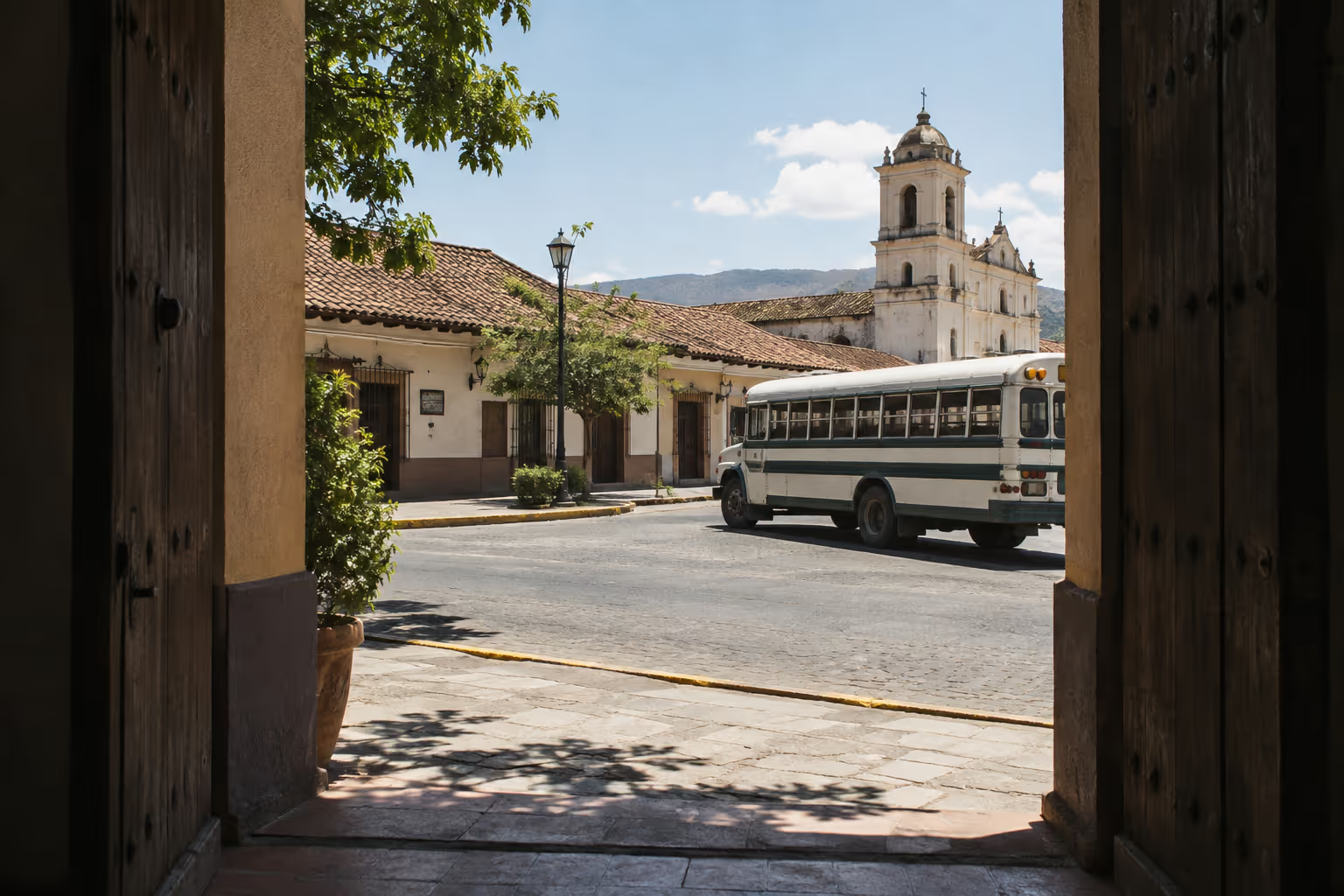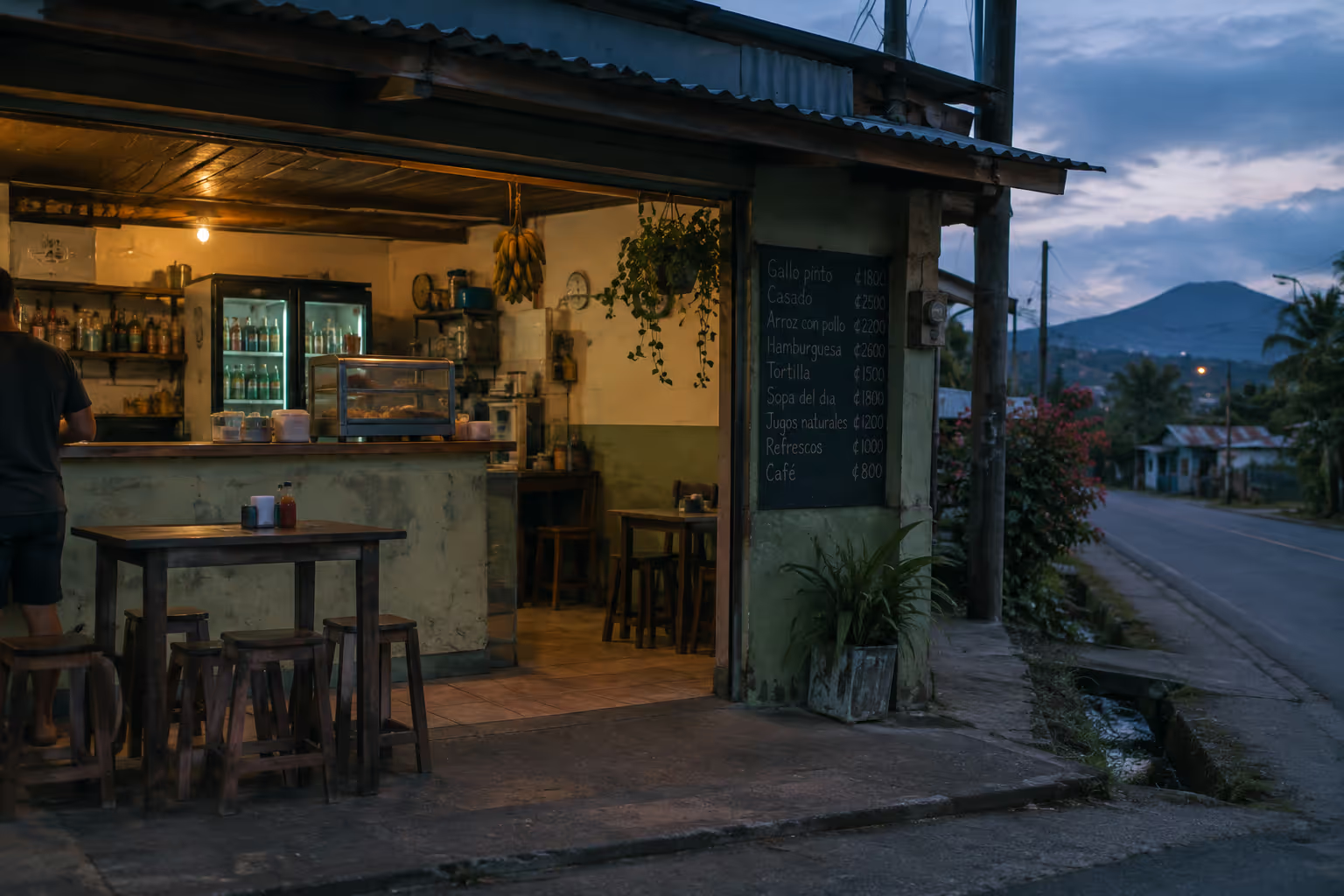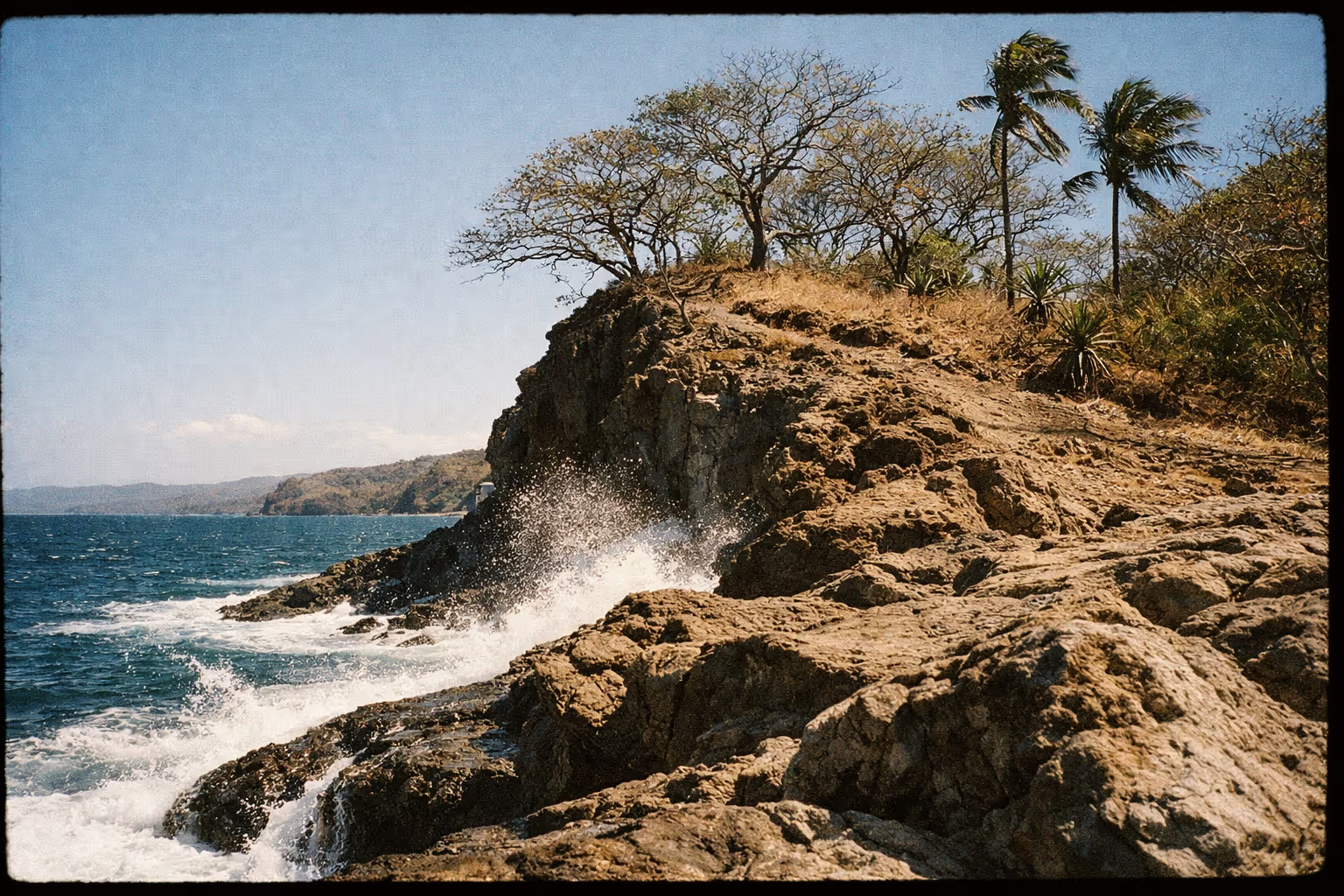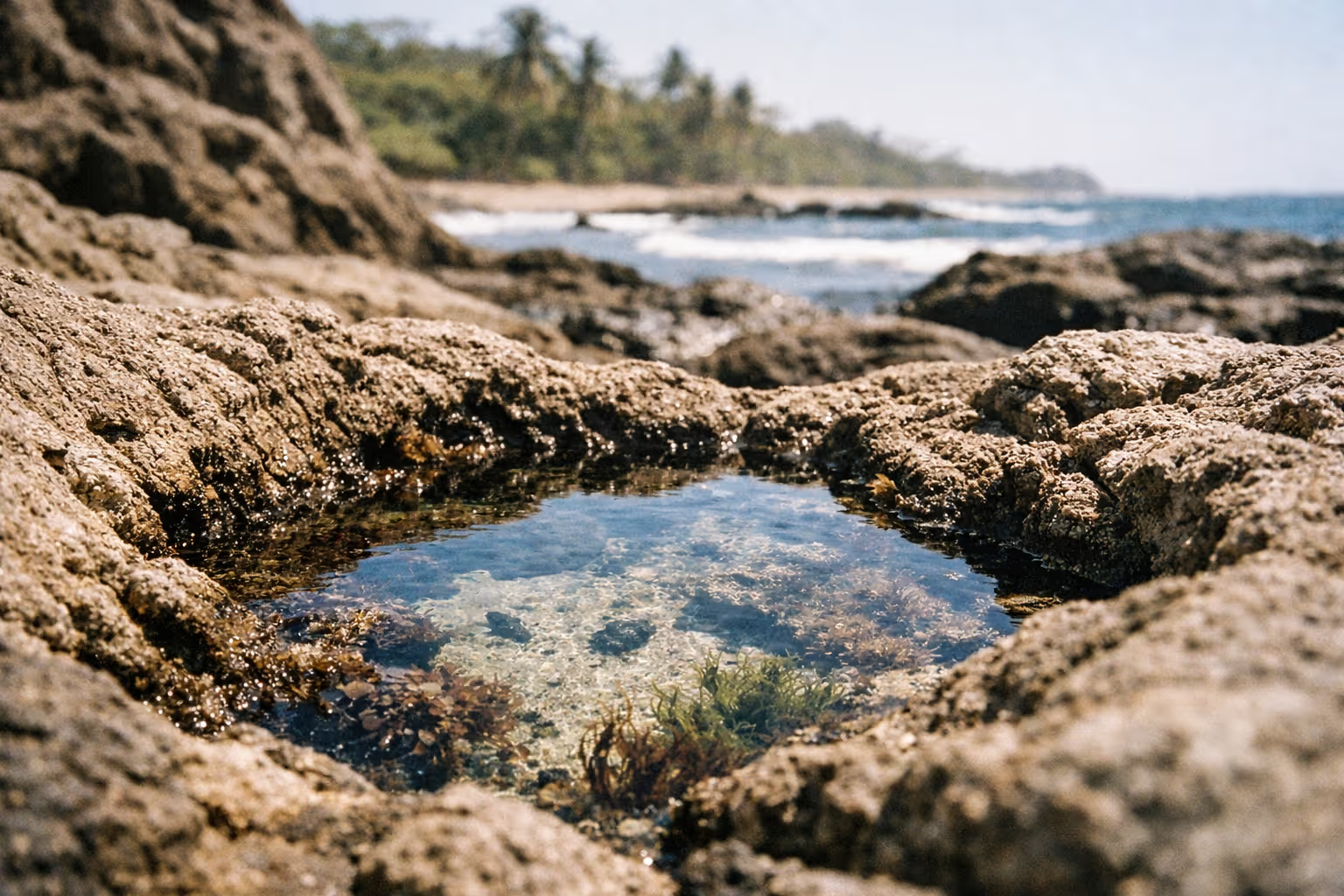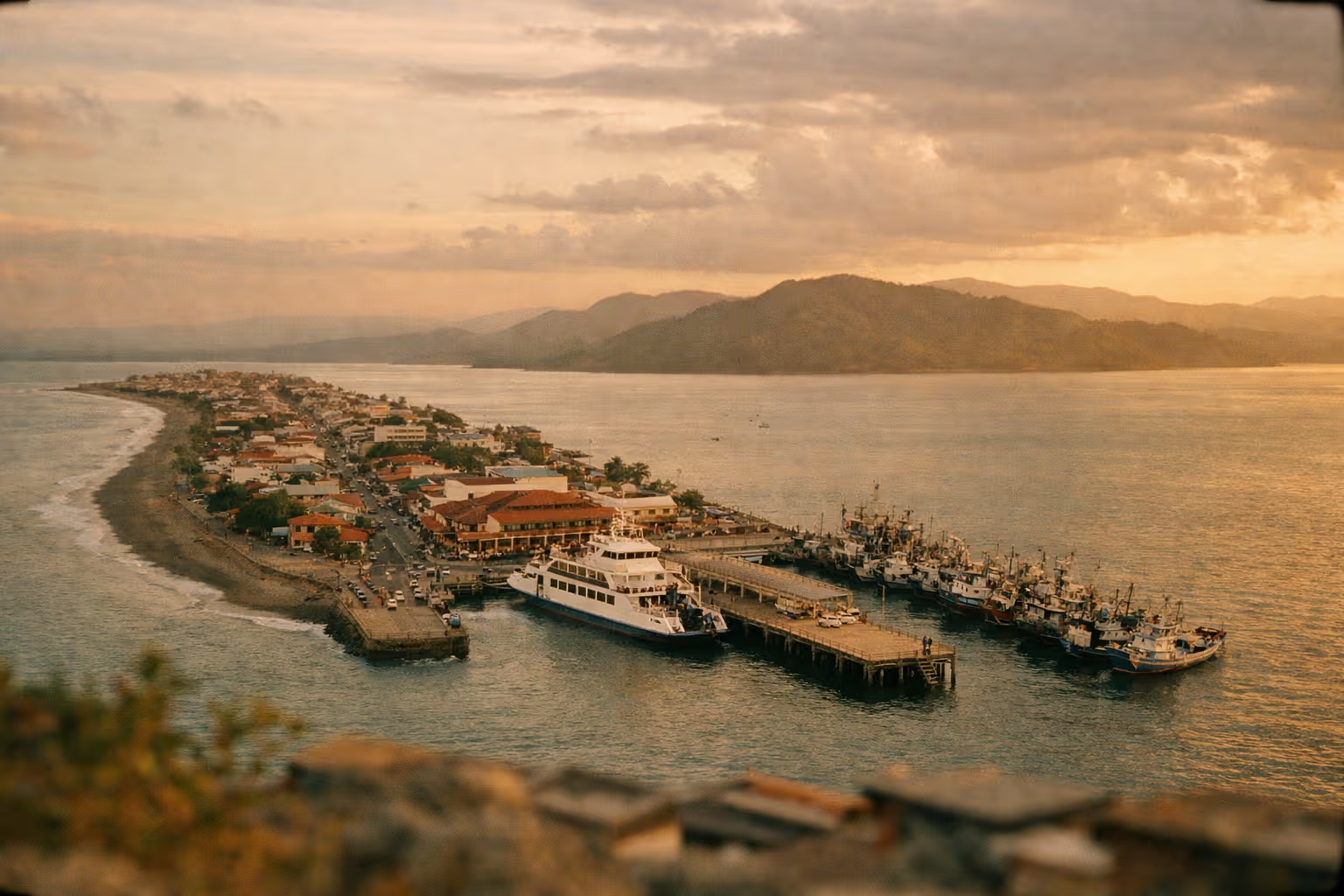
Looking for things to do in Puntarenas, Costa Rica that justify the detour? The city itself is a compact transit hub with a handful of solid half-day options, but the real value sits in the surrounding province - the Paquera ferry to Nicoya, the Tárcoles crocodile tours, and the Monteverde cloud forest day trip. Below: what works in a 4-to-8-hour window, what’s not worth it, and what cruise passengers tend to miss.
Puntarenas city vs Puntarenas province: location and layout
If you’re planning a trip and wondering about things to do in Puntarenas Costa Rica, it’s important to understand that Puntarenas refers to two distinct places. The city is a narrow sand spit about 110 km west of San José, jutting into the Gulf of Nicoya. You can walk its width in ten minutes. The province is Costa Rica’s largest - at roughly 25,000 km² out of the country’s ~51,000 km² total, it accounts for close to half the national territory - and it holds a substantial stretch of Pacific coastline running from the Gulf of Nicoya south to the Panamanian border(2).
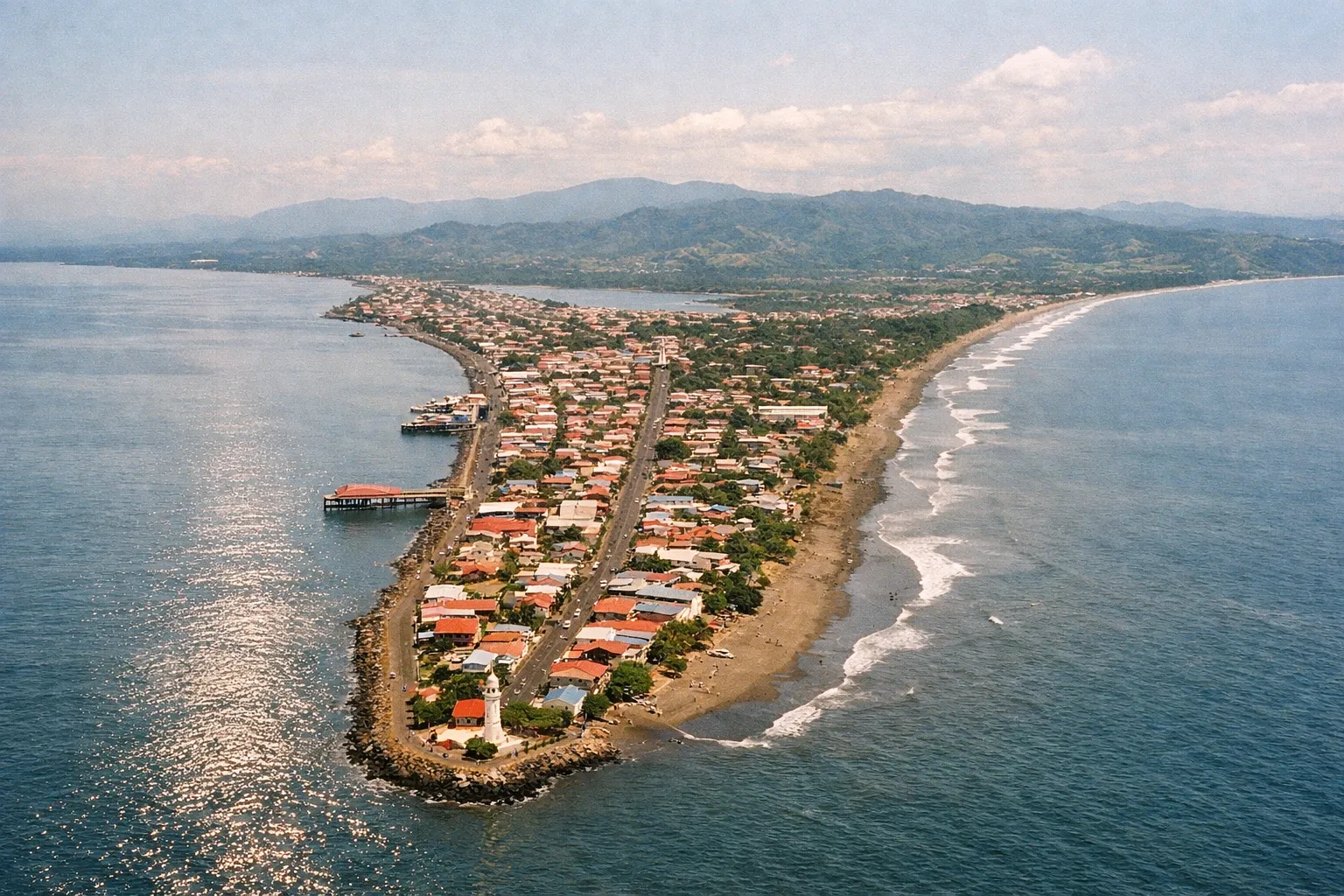
That province stretches from the Nicaraguan border region down to the Panamanian frontier and contains Manuel Antonio National Park, Corcovado, Marino Ballena, Monteverde Cloud Forest, Isla del Coco, Isla Tortuga, and Isla San Lucas (3)(4)(5). When a tour operator says “Puntarenas,” ask whether they mean the port or the province - the difference can be a 5-hour drive.
✓ Pros
- Ferry hub to the Nicoya Peninsula - the Paquera crossing cuts hours off overland routes
- Day-trip access to Tárcoles crocodiles, Carara National Park, and Isla Tortuga from a single base
- Lower accommodation prices than Manuel Antonio or Monteverde for equivalent comfort
- Authentic port-city food culture: ceviche and Churchill desserts at soda prices
- Monteverde and Manuel Antonio both reachable as day trips or overnights from the city
✗ Cons
- City beach is gray sand and unremarkable - not a reason to come here
- Downtown fills and empties with cruise ship schedules; off-ship days feel half-closed
- High-end lodging inventory is thin in the city itself
- September-October rain can shut down boat tours and wash out inland roads
- Province scale means you cannot cover Nicoya Peninsula and Osa in the same trip without significant driving
Province map logic that actually helps:
- North of the city: Nicoya Peninsula - Montezuma, Santa Teresa, Mal País (reached via the Paquera ferry)
- Center: Puntarenas city, the ferry terminal, Tárcoles, Carara
- South: Jacó, Quepos, Manuel Antonio, Dominical, Uvita, Osa Peninsula
You cannot day-trip across the province from a single base. Pick a corridor.
How to get to Puntarenas and what it costs
From San José: Route 27 (the autopista) puts you in Puntarenas in about 90 minutes by car. Buses from Terminal Puntarenas in San José run roughly every 30-60 minutes and cost around $5-7. Driving is faster if you plan to continue into the province; the bus is fine if Puntarenas city is the endpoint.
From SJO airport: Roughly 2 hours by car. Private shuttles run $80-130; shared shuttles around $50-60 per person.
From the Nicoya Peninsula: The Puntarenas-Paquera ferry is the standard route, with multiple daily crossings (typically 5 AM to 8:30 PM, around 70 minutes). Check the current Naviera Tambor or Ferry Peninsular schedule the week of your trip - sailing times shift seasonally and the operators don’t always sync. Foot passenger fares run roughly $2-4; vehicles $25-35 depending on size.
By cruise: Puntarenas is a major Pacific port-of-call. Cruise ships dock at the Muelle de Cruceros at the western tip of the spit, walking distance to the Paseo de los Turistas.
Ballpark trip budget for two people, three nights based in or near Puntarenas: $500-900 for mid-range lodging, local food, and two organized day tours. Cut that in half if you stick to beach days and sodas; double it for catamaran charters and Monteverde overnights.
How to Get to Puntarenas
Up to 2 hoursStep-by-step travel options and costs from major points.
- 1
From San José
Drive 90 minutes via Route 27 or take a bus from Terminal Puntarenas for $5-7.
- 2
From SJO Airport
Drive about 2 hours; private shuttles cost $80-130, shared shuttles $50-60 per person.
- 3
From Nicoya Peninsula
Take the Puntarenas-Paquera ferry (5 AM to 8:30 PM, 70 minutes). Foot passengers pay $2-4; vehicles $25-35.
- 4
By Cruise Ship
Dock at Muelle de Cruceros on the spit, within walking distance to city attractions.
When to visit: weather and seasonality
Puntarenas runs hot. Dry season (December-April) brings reliable sun and coastal highs of 32-37°C / 90-100°F (6)(7). Rainy season (May-November) means afternoon downpours, lower prices, greener landscapes, and - counterintuitively - better surf at several breaks.
Best month overall: late January through early March. Dry, warm, and you’re past the holiday price spike that hits late December.
Best for surfers: May-October at Boca Barranca and the south Pacific breaks.
Worst window: September-October. Peak rain, some roads in the Osa and Monteverde region wash out, and visibility on island tours drops. I tested the Tárcoles corridor in late September 2024 - the bridge was fine, but afternoon storms shut down the boat tours by 2 PM most days.
Bring sun protection, repellent, and electrolytes regardless of season. The combination of humidity and direct sun on the spit hits harder than the temperature suggests.
What Puntarenas is known for
Three things, in this order:
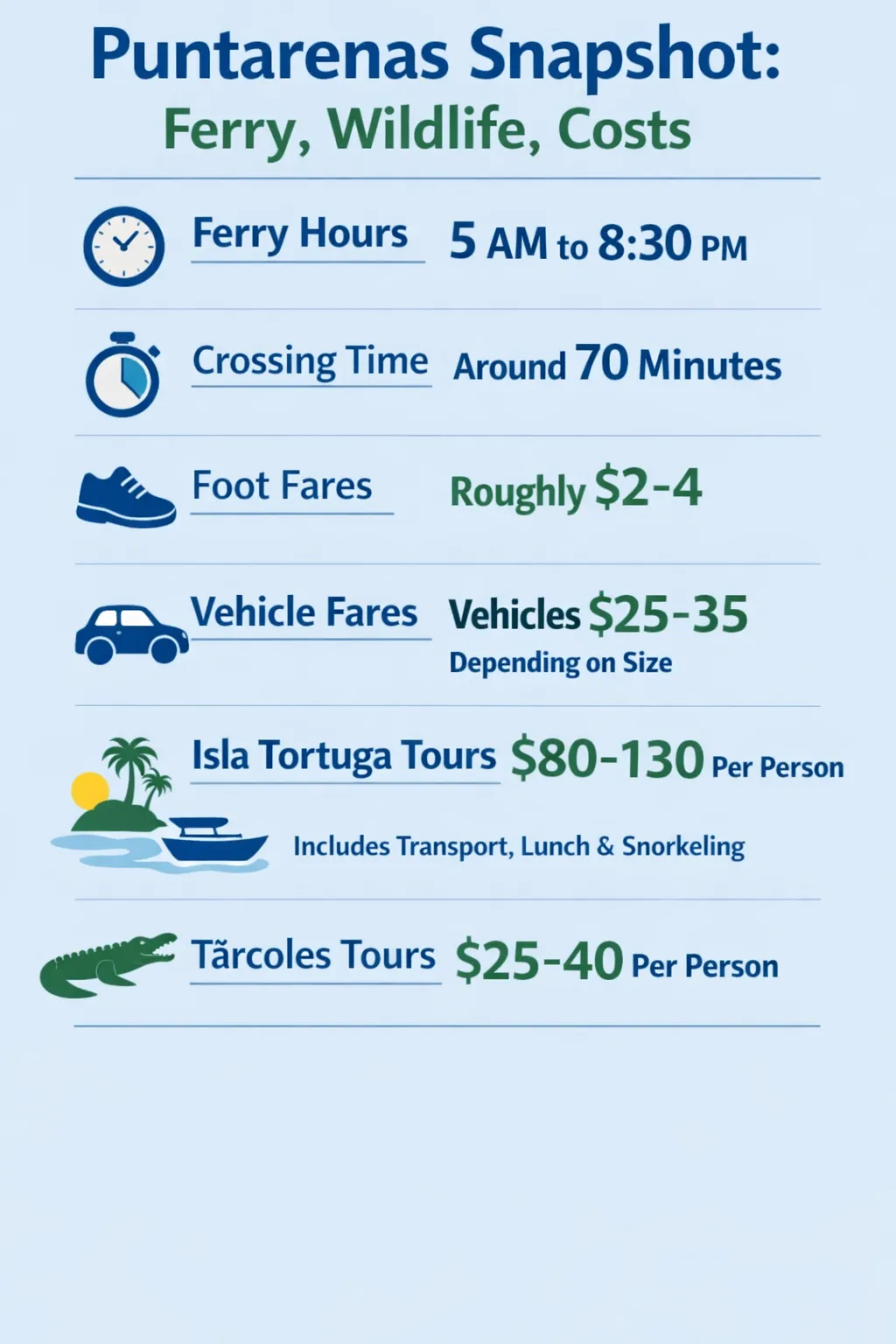 Key Puntarenas stats: Paquera ferry operates 5 AM to 8:30 PM with ~70-minute crossings; foot fares roughly $2-4; vehicles $25-35; Isla Tortuga tours around $80-130 per person.
- A working port and ferry hub to the Nicoya Peninsula and Gulf of Nicoya islands.
- Wildlife access - Tárcoles River crocodiles, Carara National Park, Monteverde Cloud Forest, and Manuel Antonio all sit within the province.
- Coastal cuisine, especially ceviche and the local Churchill shaved-ice dessert that originated on the Paseo de los Turistas.
The city itself was once Costa Rica’s primary coffee export port. When commercial shipping moved to Caldera and the rail link to San José faded, Puntarenas reinvented itself around tourism, ferries, and cruise passengers. That historical thread is still visible if you walk the malecón - the old port buildings haven’t been scrubbed clean for tourists, which is part of what makes the city feel like a real place.
Things to Do in Puntarenas, Costa Rica: The City in One Day
If you have 4-8 hours in the city itself - typical for cruise passengers, ferry travelers, or anyone passing through - here’s the realistic shortlist, ranked by worth-the-detour value:
Worth the time:
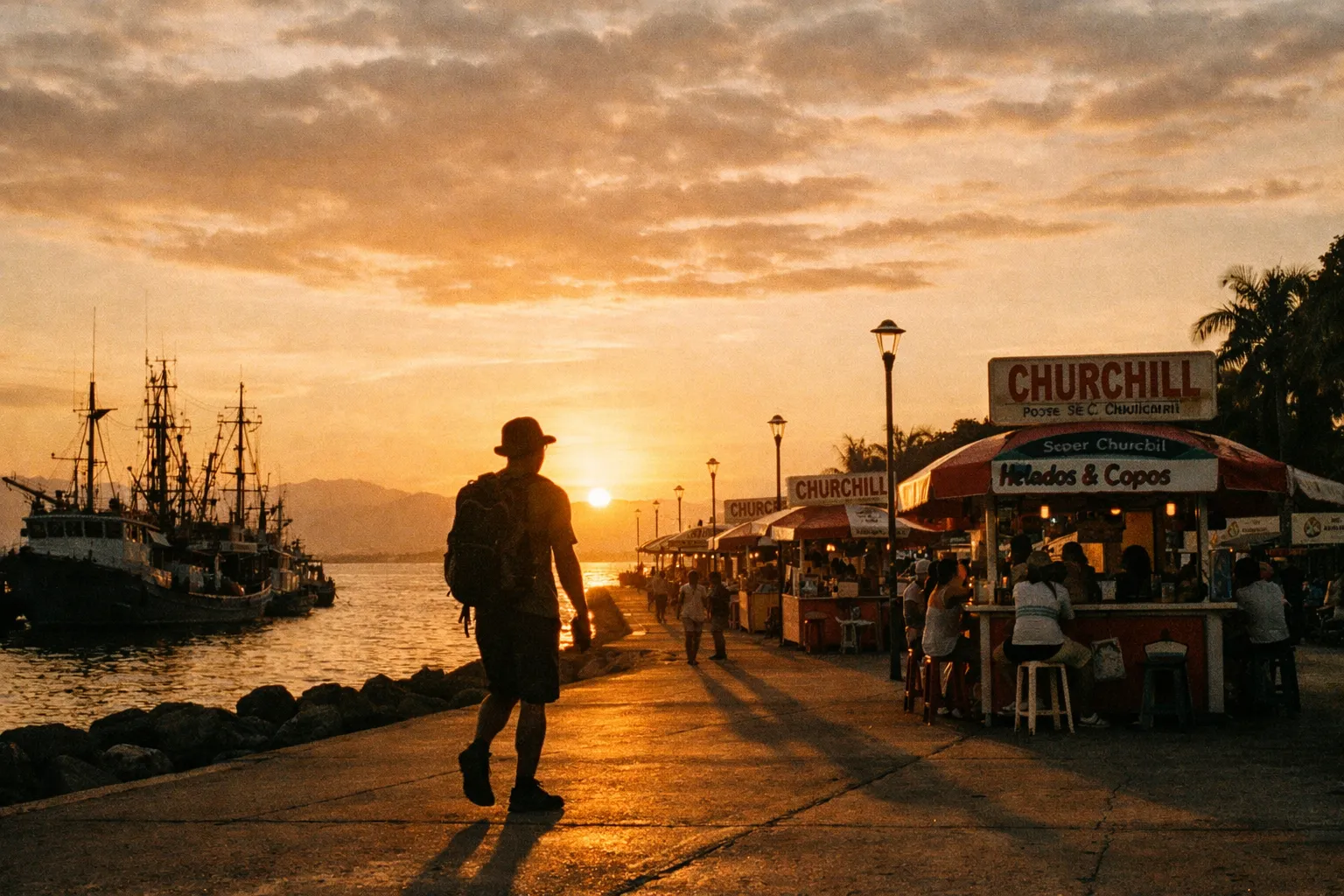
- Paseo de los Turistas. The waterfront boulevard running along the southern shore. Souvenir stalls, sodas, ceviche carts, and the original Churchill stands. Plan 60-90 minutes including a stop to eat.
- Mercado Central. Two blocks inland from the cruise dock. Better produce, better prices, and a more honest read on local life than the tourist boulevard.
- Casa de la Cultura and the old port buildings. Quick stop, 30 minutes, free. Useful context for the coffee-port history.
- Playa Puntarenas / Playa El Roble. Swimmable but not scenic - gray sand, calm water, decent for a quick dip if you’ve got time to kill. Skip if you’re heading to better beaches in the province.
Skip if short on time:
- The Marine Park (Parque Marino del Pacífico). Small aquarium, decent if you have kids and an hour to fill; otherwise the entrance fee (around $10-14 adult) isn’t competitive with what’s outside the city.
- Random beach bars on the north side of the spit - quality is inconsistent.
One-day cruise/ferry itinerary that works:
- Arrive, walk Paseo de los Turistas (1 hr)
- Ceviche or whole-fish lunch at a beachfront soda (1 hr)
- Pre-booked half-day to Tárcoles crocodile bridge + Carara walk (4 hrs)
- Churchill on the boulevard, sunset over the gulf (45 min)
- Back to ship or onward transport
Beaches in Puntarenas province worth the drive
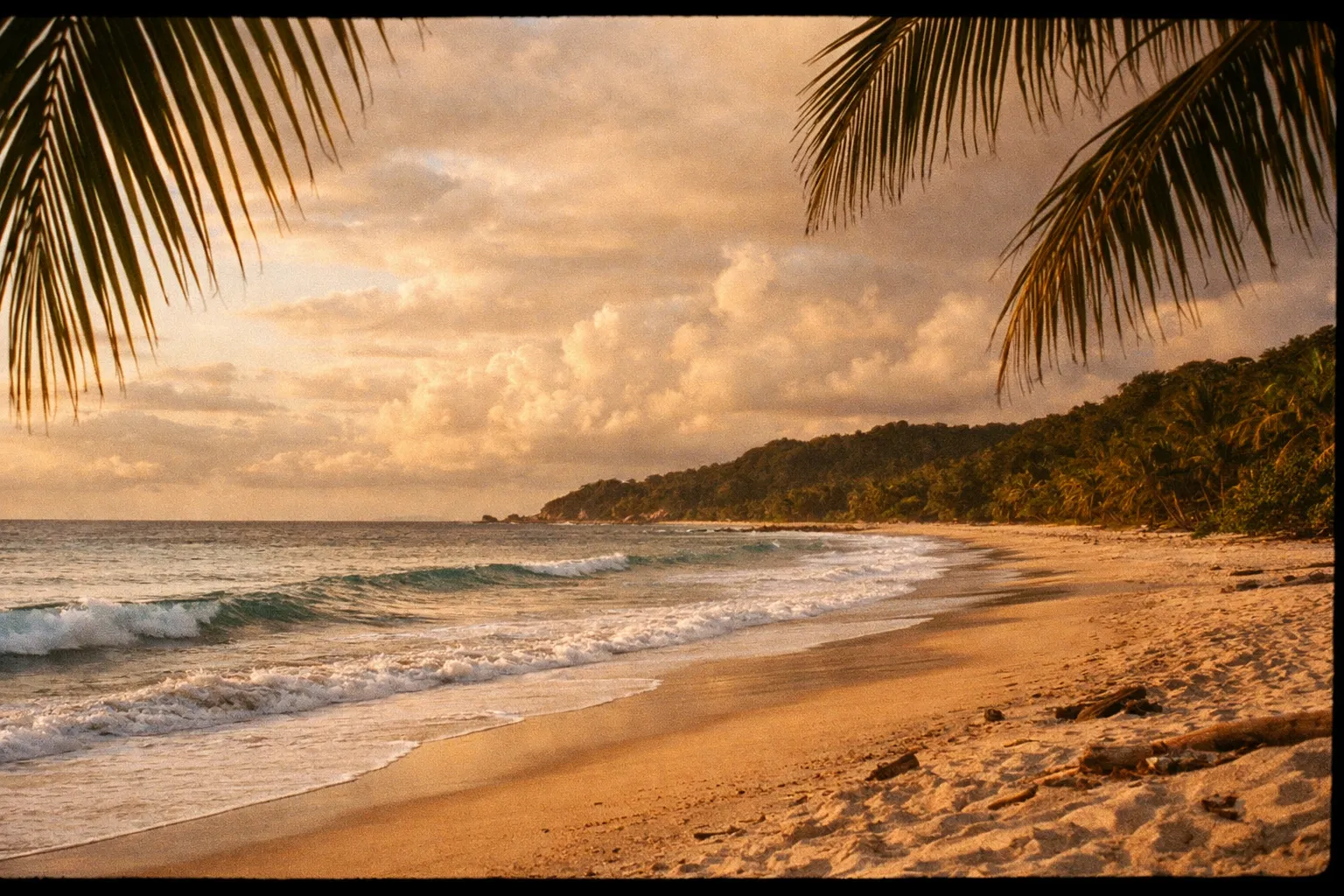
The city beach is forgettable. The province beaches are why people fly here.
North (Nicoya Peninsula, via Paquera ferry):
- Santa Teresa / Mal País. 1.5 hours from the ferry dock. Long beige beach, consistent surf, the strongest food scene outside San José. Worth the detour for surfers and longer stays.
- Montezuma. 45 minutes from Paquera. Smaller, bohemian, with the 20-meter Montezuma Waterfall a 20-minute walk from the trailhead.
- Playa Tambor. Calmer water, family-friendly, less interesting if you want nightlife.
South (central Pacific corridor):
- Playa Doña Ana. 15 minutes south of the city. Cleanest swimming beach reachable by short drive, modest entrance fee, picnic infrastructure. The pick if you have half a day and no transport for the peninsula.
- Playa Hermosa (Jacó). 1 hour south. Serious surf, not for beginners.
- Manuel Antonio. 2.5 hours south. Crowded but the wildlife-plus-beach combo is unmatched in Costa Rica. Park reservations now required - book online via SINAC at least 48 hours ahead.
Skip: Playa Naranjo (north spit area) unless you’re killing time waiting for a ferry.
What to do in Puntarenas and the Gulf islands
The Gulf of Nicoya day-trip menu is the single strongest reason to base in Puntarenas city for a night.
Isla Tortuga. 90 minutes by catamaran from the city pier. White sand, clear water in the 25-28°C range, swimming and snorkeling over rocky reef. Day tours typically run $80-130 per person including transport, lunch, and snorkel gear - confirm current pricing on GetYourGuide or Viator before booking. Worth the detour if you have a full day.
Isla San Lucas. Former penal colony, now a national wildlife refuge as of 2020. Half-day tours from Puntarenas. Decaying prison structures, forest trails, beaches. Smaller crowds than Tortuga, more history. Around $60-90 per person.
Tárcoles River crocodile tour. 45 minutes south of the city. The river is about 118 km long and supports one of the densest American crocodile populations in Central America. Boat tours run roughly 2 hours, $25-40 per person. You can view from the bridge for free - but don’t lean over the railing, and don’t feed anything. Tour operators must be licensed; the cheap unmarked options near the bridge are not.
Carara National Park. Adjacent to Tárcoles. Easier hiking than Manuel Antonio with comparable wildlife - scarlet macaws, capuchins, agoutis. Entrance around $10 USD. Two hours covers the main loop.
Mangrove kayak tours. Damas Island and the Guacalillo estuary, primarily booked from Quepos or Jacó. Good for birders and travelers who want low-effort wildlife exposure.
Monteverde Cloud Forest from Puntarenas
Monteverde sits in the province’s mountainous interior, about 2.5-3 hours from the city by car - at roughly 1,440 meters elevation, it’s a different climate entirely from the coast. The reserve contains roughly 2.5% of the world’s biodiversity and around 10% endemic flora, which is the kind of statistic that actually justifies the drive.
The road from the Pan-American Highway up to Santa Elena is partially unpaved and slow. Don’t trust GPS time estimates. I’ve seen that route add 45 minutes to what Google Maps predicted, especially after rain. Plan a full day or, better, an overnight.
What to do once there:
- Monteverde Cloud Forest Reserve. Entrance around $26 USD adults, open 7 AM to 4 PM. Reservations recommended in dry season.
- Selvatura or 100% Aventura zip lines. Multi-cable canopy tours, $50-90 depending on operator.
- Night walks. $25-35 per person, 2 hours, guided. Genuinely worth doing - different species are active after dark, and the guides are good.
- Curi-Cancha Reserve. Quieter alternative to the main reserve, with entrance fees around $12 USD adults - roughly half the main reserve cost - and consistently better bird sightings per hour of trail time according to local guides (visitcostarica.com).
If you only have one day total in the province, choose Monteverde or Manuel Antonio, not both. They’re in opposite directions and neither deserves to be rushed.
Puntarenas cruises and shore excursions
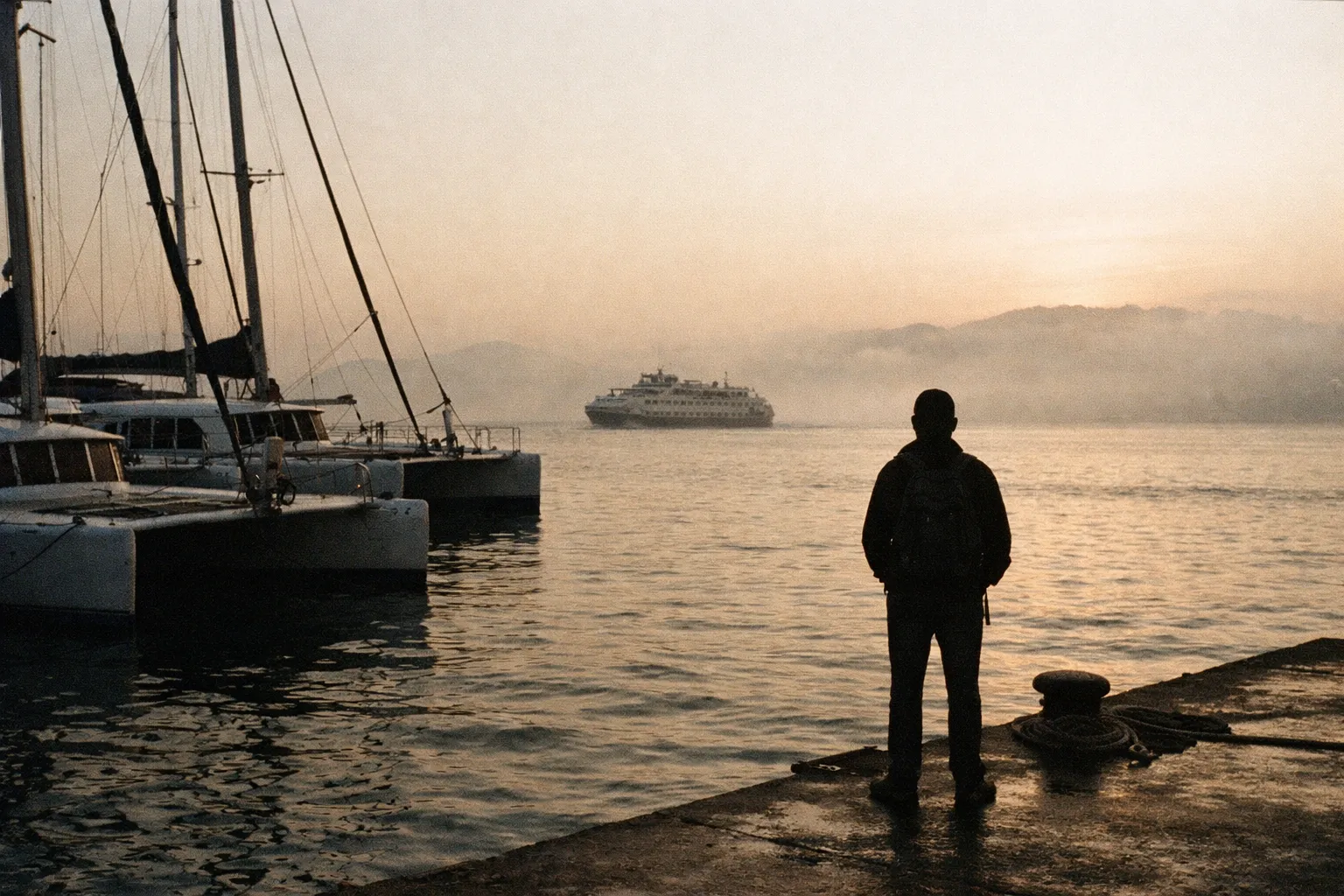
Puntarenas is one of two main Pacific cruise ports in Costa Rica (the other is Puerto Caldera, 18 km south). Most lines call it “Puntarenas” regardless of which dock they actually use - confirm with your cruise line before you book shore excursions, because the timing math differs.
Realistic shore excursion options ranked by time efficiency:
- Tárcoles + Carara combo. 5-6 hours. Best wildlife value for ship time.
- Isla Tortuga catamaran. 7-8 hours. Best beach day.
- Monteverde. 9-10 hours. Doable but tight - you’ll feel rushed.
- City walking tour + Churchill + beach. 3-4 hours. Cheapest, least memorable.
Ship excursions cost roughly 30-60% more than independently booked equivalents through GetYourGuide or local operators. The trade-off is the ship-won’t-leave-without-you guarantee, which is worth something on the Monteverde option specifically because traffic can delay returns.
People and local life
Puntarenas residents are called porteños (port people), and the city has a distinct identity from the Central Valley capital region. The pace is slower, the Spanish is faster, and the food culture leans Pacific - more fish, more coconut, less of the gallo pinto-heavy interior cuisine.
The cruise economy shapes downtown more than tourists realize. On ship days the boulevard is packed; on no-ship days many vendors don’t bother opening. If you want the more local version of the city, check the ICT (Costa Rican Tourism Institute) website for the published port schedule and visit on a day with no scheduled calls. It’s a different place.
Football matters here. Puntarenas FC plays in the Primera División, and home matches at Estadio Lito Pérez are a legitimate cultural experience if you’re in town on a match day. Tickets run $10-20. The club’s rivalry with Deportivo Saprissa - the San José-based giant that has won more Costa Rican league titles than any other side - is the fixture that gets the most attention nationally. Saprissa draws from the capital’s larger population base and a budget that dwarfs most provincial clubs; Puntarenas FC represents the port city’s working-class identity against that. When the two meet, the Estadio Lito Pérez fills faster than for any other match. If your dates overlap with a Puntarenas vs Saprissa fixture, it is worth rearranging your itinerary to attend - the atmosphere is a sharper read on local culture than anything on the tourist boulevard.
Coastal cuisine: what and where to eat
Ceviche is the city’s signature dish - typically corvina (sea bass) or tilapia, lime-cured, with onion, cilantro, and sweet pepper. Most beachfront sodas serve it for $5-9. I’ve had versions at tourist-facing restaurants on the boulevard that were fine but noticeably blander than what you get two blocks inland.
Churchill. Shaved ice with condensed milk, powdered milk, ice cream, fruit syrup, and sometimes Kola Syrup. Invented on the Paseo de los Turistas. The original stands still operate near the eastern end of the boulevard. $3-5, and worth the stop even if you’re not a dessert person.
Whole fried red snapper (pargo entero) with patacones and rice - the standard beachfront lunch. $12-18 at a soda, $20-28 at a tourist-facing restaurant.
Where to actually eat:
- La Yunta Steakhouse on the malecón. Long-running, reliable for a sit-down dinner with a view. Mid-range.
- Marisquería Kayte Negro. Local seafood, no view, better ceviche than the boulevard stands.
- Soda Macarena. Cheap casados, fast service, the kind of place porteños actually eat lunch.
Avoid restaurants with hosts pulling people in off the boulevard - those are tourist-priced and inconsistent.
Where to stay
The city itself has limited high-end inventory. Most quality lodging is either in the province (Manuel Antonio, Monteverde) or just outside Puntarenas in resort enclaves.
In the city:
- Hotel Tioga (boulevard, mid-range, dated but functional, $80-120)
- Double Tree by Hilton Puntarenas (north spit, resort-style, $180-280)
Just south (Caldera area):
- Hotel Alma del Pacifico and similar mid-range Pacific-front options.
Hostels: Several under $25/night on the spit, mostly serving ferry travelers.
If you’re using Puntarenas as a transit point only, one night in town is enough. If you’re using it as a base for province exploration, two nights minimum to make the drive math work.
Practical tips for the savvy traveler
- Currency. Colones (CRC) and US dollars both accepted in tourist zones. Carry small dollar bills for tours and tips. Exchange rates at the cruise terminal are bad - use an ATM.
- Driving. A 4WD is overkill for the central corridor but essential if you’re heading to Monteverde, Santa Teresa, or any inland reserve. Reserve rentals ahead in dry season.
- Safety. Petty theft on beaches is the main risk. Don’t leave bags unattended on the sand. Overall trip safety is high - Costa Rica is one of the more stable countries in the region.
- Water. Tap water is potable in Puntarenas city and most of the province. Stick to bottled in rural areas if you’ve got a sensitive stomach.
- Connectivity. Kolbi and Claro SIM cards are cheap and easy at the airport. eSIMs work fine in the city; coverage drops in Monteverde.
- Park reservations. Manuel Antonio and Corcovado require advance online reservations via SINAC. Monteverde does not require reservations but they help in dry season.
Bringing prescription medication to Costa Rica
Travelers ask this a lot, and most guides skip it. The short answer: yes, with conditions.
- Bring medications in their original labeled containers with the pharmacy label intact.
- Carry a copy of the prescription in English or Spanish.
- For controlled substances (ADHD stimulants, opioid painkillers, benzodiazepines), carry a doctor’s letter explaining the medical need and dosage.
- Quantity should reflect personal use for your trip duration - don’t bring a year’s supply for a two-week visit.
- Costa Rica generally follows international norms; rules align with WHO and INCB standards for controlled substances. Specific narcotics may require pre-approval from the Ministerio de Salud.
Verify with the Costa Rican consulate or your country’s embassy before travel if you take anything controlled. Policies update, and customs officers have discretion at entry.
Frequently Asked Questions
- Is it worth visiting Puntarenas, Costa Rica?
- Puntarenas city is best for short visits or as a transit hub; the province offers a full week of varied attractions. Plan accordingly to avoid wasting time in the city alone.
- What to do in Puntarenas city?
- Focus on the waterfront boulevard, local ceviche, Mercado Central, and use the city as a base for wildlife tours and island trips rather than expecting extensive city sightseeing.
- What is Puntarenas, Costa Rica known for?
- It's known for its ferry port, wildlife day trips, coastal cuisine including ceviche and Churchill desserts, and its history as a coffee export hub.
- Can I bring prescription medication to Costa Rica?
- Yes, but bring original labeled containers, prescriptions, and for controlled substances, a doctor's letter. Check with consulates for current regulations.
- How many days do I need in Puntarenas?
- One day for the city, 3-4 days for wildlife and island tours, and a full week if including Monteverde or Manuel Antonio.
- Is Puntarenas safe for tourists?
- Generally safe with petty theft as the main concern. Use registered taxis, avoid leaving belongings unattended, and stay aware in crowded areas.
- What's the difference between Puntarenas and Puerto Caldera?
- Puntarenas is the historic port and ferry terminal; Puerto Caldera is the modern commercial port 18 km south. Cruise lines may list both as 'Puntarenas' but dock locations differ.