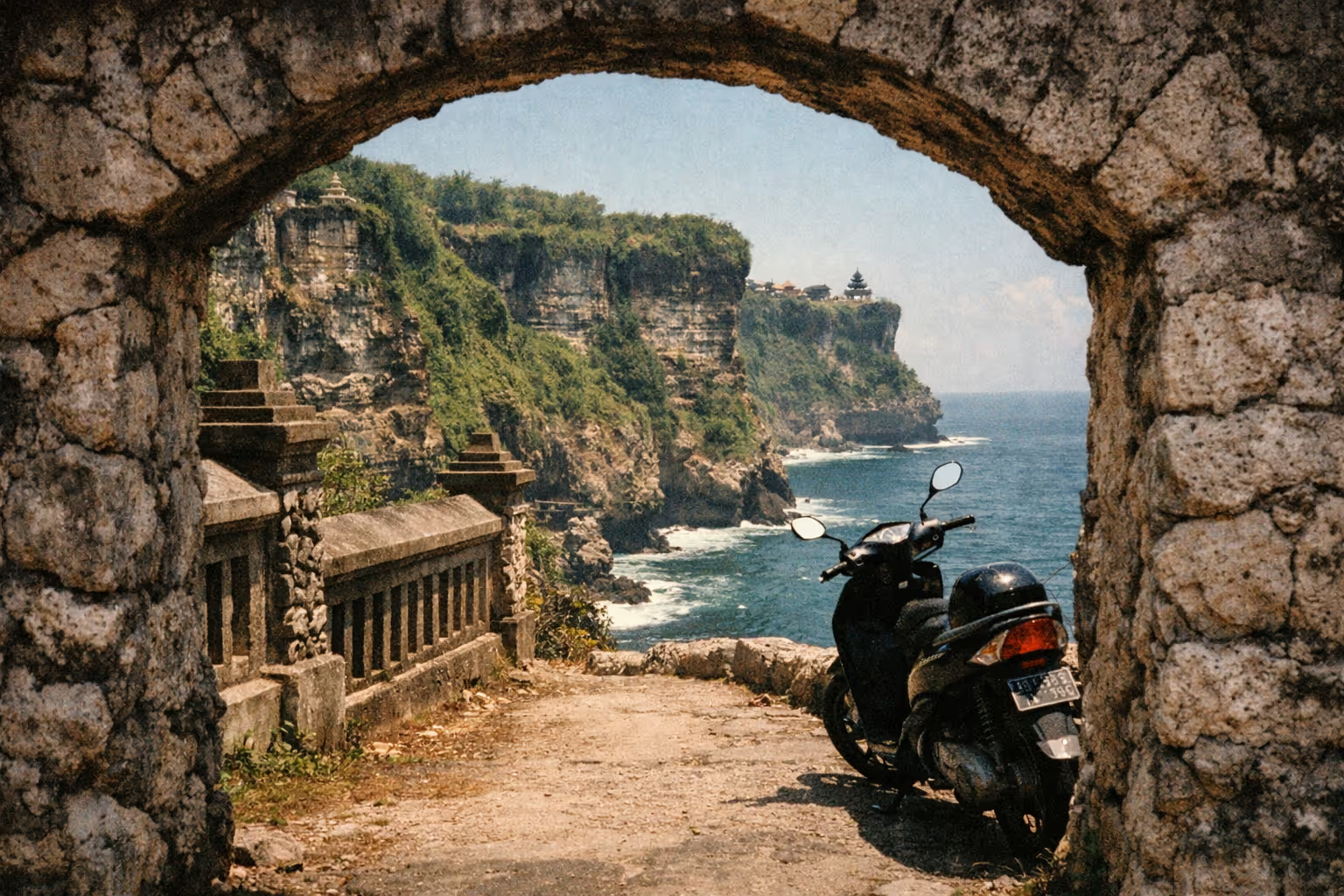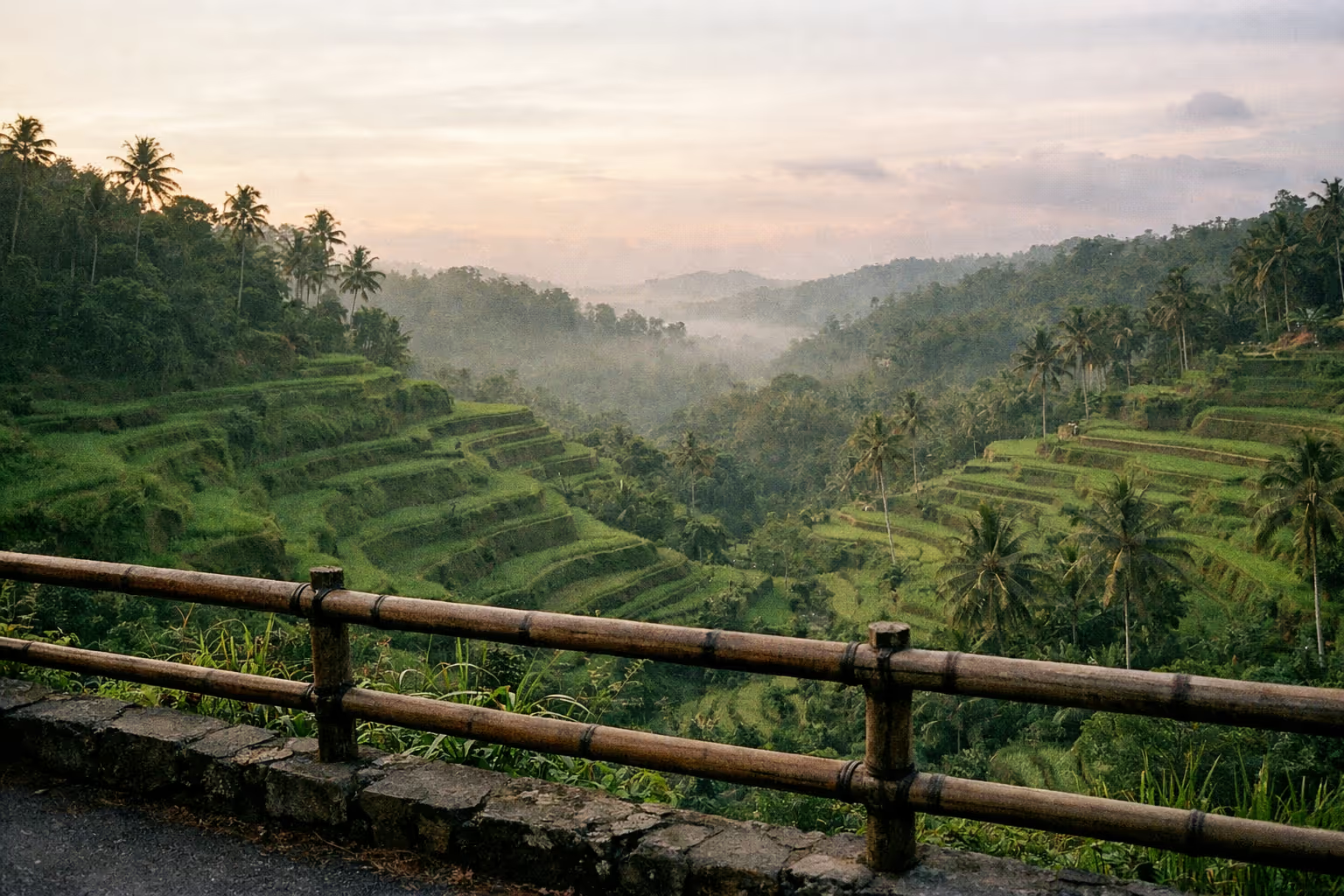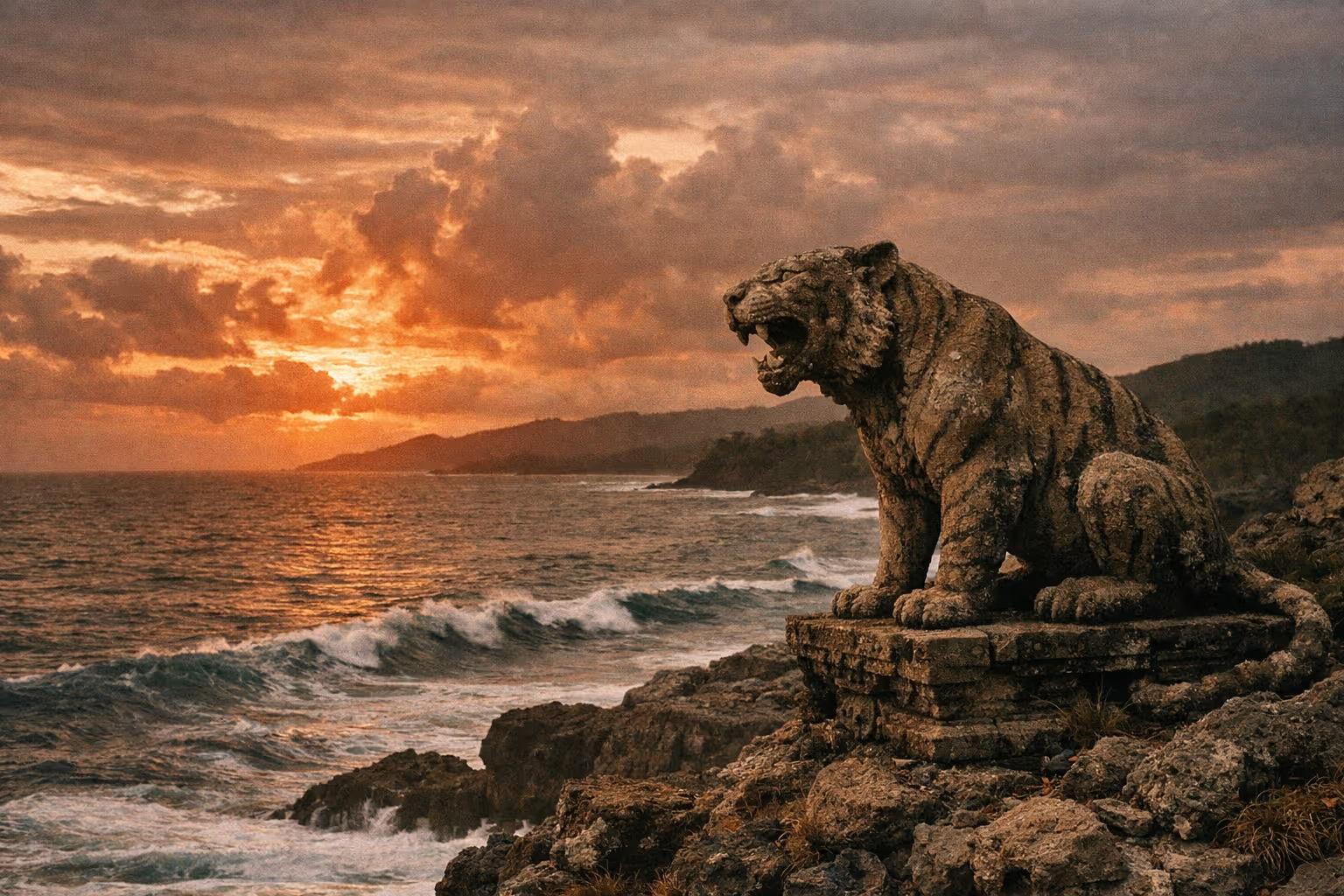
The Bali tiger has been extinct since 27 September 1937, when hunters shot the last confirmed female at Sumbar Kima in West Bali. It never had much of a chance: an island of just 2,175 square miles, Dutch-era sport hunts, and a population that likely never topped a few hundred. A 2015 PLOS ONE DNA study made the Sumatran tiger its closest living relative, and about ten skins and skulls survive in museums. Anywhere advertising a live one is showing you a different cat.
The mystique of the Bali tiger: from Panthera tigris balica to sondaica
✓ Pros
- Rich fossil and museum record - about 10 verified skins and skulls survive in collections across Leiden, London, Frankfurt, and Bogor
- Genetic legacy preserved - the 2015 PLOS ONE mitochondrial DNA study sequenced 23 specimens, informing Sumatran tiger conservation today
- West Bali National Park protects the last remnant habitat and supports critically endangered Bali myna populations
- Balinese cultural record - tiger iconography survives in Kamasan paintings, temple carvings, and the Barong Macan dance tradition
✗ Cons
- Completely extinct - zero wild individuals, zero in captivity, no verified sightings with physical evidence since 1937
- Island size capped recovery potential - at only 2,175 square miles, Bali could never have supported a large tiger population
- Protected area designation came too late - West Bali National Park was gazetted in 1941, after the population had already collapsed
- Mislabeling persists - some venues in Southeast Asia market Sumatran or Bengal tigers as Bali tigers
The Bali tiger was treated as a distinct subspecies after German zoologist Ernst Schwarz first described it in 1912, distinguishing it from the Javan tiger by its smaller size and brighter coat (1)(3).
That status didn’t survive modern genetics. A 2015 mitochondrial DNA study published in PLOS ONE analyzed 23 historical specimens and showed that Bali, Javan, and Sumatran tigers form a single monophyletic clade - the Sunda Island tigers - distinct from mainland populations (5). Bali and Javan haplotypes differ from the Sumatran haplotype by only 1-2 nucleotides, a tiny genetic gap that reflects their shared origin during the last glacial period roughly 11,000-12,000 years ago, when lower sea levels connected the islands (5).
Following the 2017 revision by the IUCN Cat Specialist Group’s Cat Classification Task Force, all three Sunda tiger populations are now grouped under Panthera tigris sondaica (1). The practical consequence: the surviving Sumatran tiger is the last living representative of the Sunda tiger lineage, carrying genetic material closely related to what was lost in Bali and Java.
What the Bali tiger looked like - and the sightings that followed
Bali tigers were the smallest of all known tiger populations - a textbook case of island dwarfism, where limited prey and confined range push large carnivores toward smaller body size over generations. The mystique of the Bali tiger endures partly because unverified sightings kept surfacing for decades after the last confirmed kill: reports from the 1940s, 1950s, and even isolated claims from 1970 and 1972 fed a persistent hope that the species had somehow survived in remote western forest. None produced physical evidence, but the stories stuck - and they still circulate in Indonesia today.
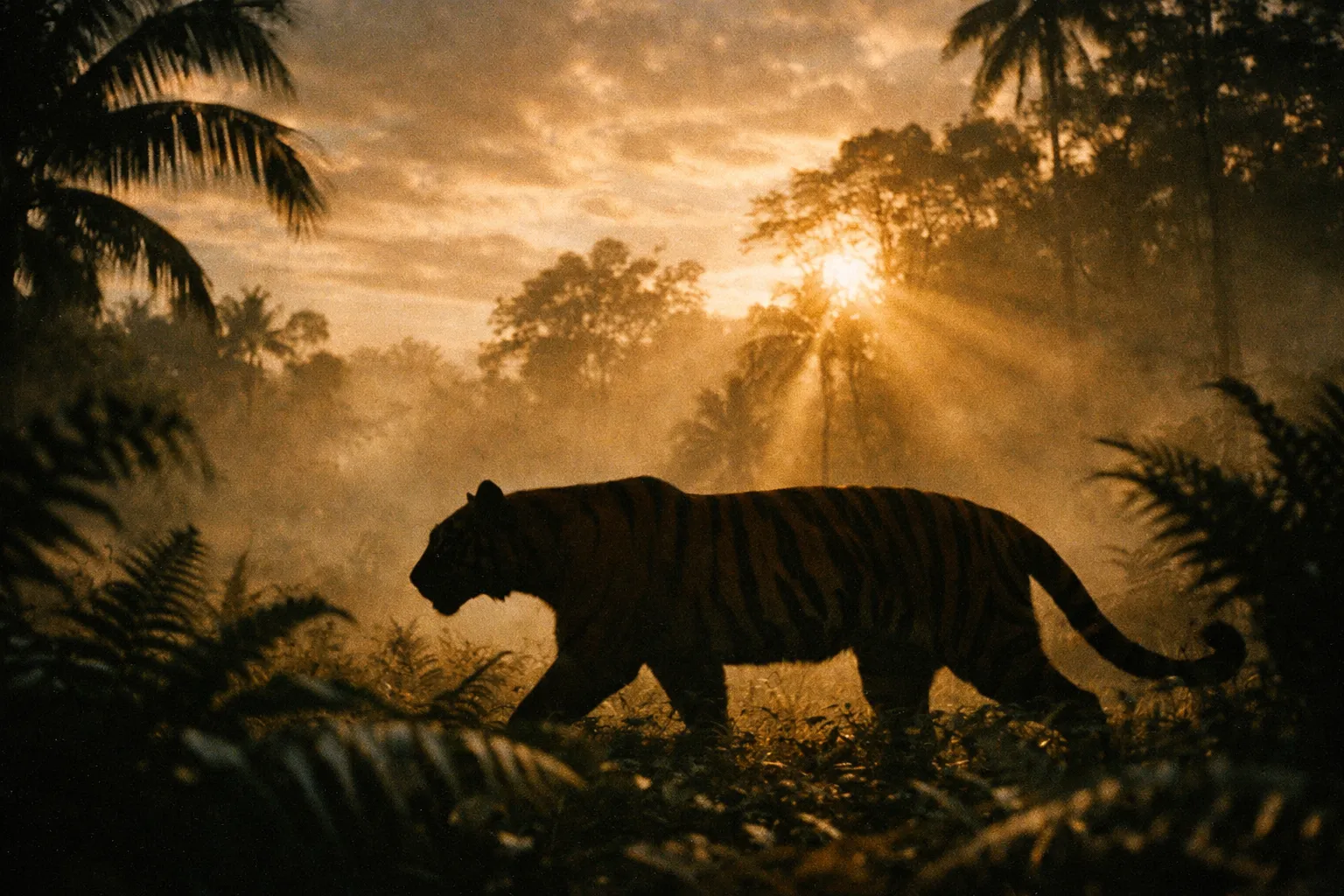
Recorded measurements from the handful of museum specimens give a fairly consistent picture:
- Adult males: roughly 220-230 lb (100-105 kg), total length around 7 to 7.5 ft (213-229 cm) (4)
- Adult females: noticeably smaller at 140-180 lb (64-82 kg) (4)
- Coat: deep, rich orange with fewer and broader black stripes than mainland tigers, often with small dark spots between the stripes
- Underbelly and facial markings: more extensive white than other tiger populations
That darker orange with sparse striping likely worked as camouflage in the dense lowland monsoon forest and mangrove edges of western and northern Bali, where the cats hunted at dawn and dusk. It’s a striking combination when you see the museum photographs - smaller than you’d expect, but unmistakably a tiger.
Habitat and prey on a small island
Bali covers only about 2,175 square miles (5,600 km²), which means the entire historical tiger range was smaller than the U.S. state of Delaware. Most of the population was concentrated in the western third of the island - the area now partially protected as West Bali National Park (Taman Nasional Bali Barat).
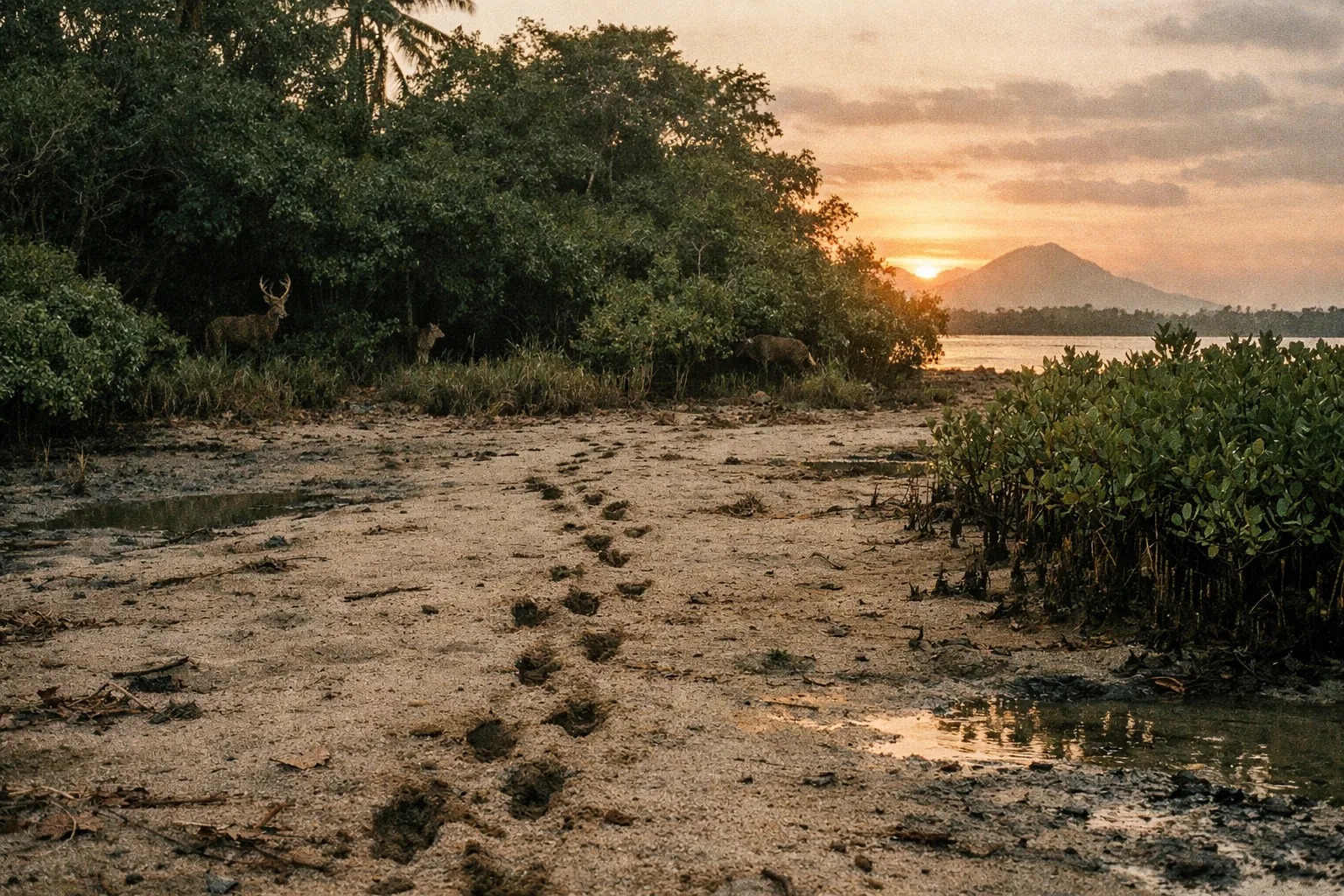
The Bali tiger’s prey base reflected what a tropical island could support (2):
- Wild boar (Sus scrofa) - the primary prey
- Rusa deer (Rusa timorensis)
- Indian muntjac (Muntiacus muntjak)
- Long-tailed macaques (Macaca fascicularis)
- Red junglefowl (Gallus gallus)
- Monitor lizards and smaller mammals
No rigorous census of the population was ever conducted. Anecdotal accounts from Dutch colonial-era hunters and naturalists suggest the total population was probably never more than a few hundred animals, and was already reduced to a few dozen by the 1920s and 1930s. On an island that small, with a starting population that thin, the species had almost no buffer against sustained pressure of any kind.
Why did the population go extinct?
Two forces, working together, killed off the population in less than fifty years.
Habitat conversion. Through the late 19th and early 20th centuries, Dutch colonial administration accelerated the conversion of Bali’s lowland forests into wet-rice terraces, coconut groves, and coffee plantations. Lowland forest was exactly the habitat the tigers needed, and once it was gone, prey populations collapsed alongside cover.
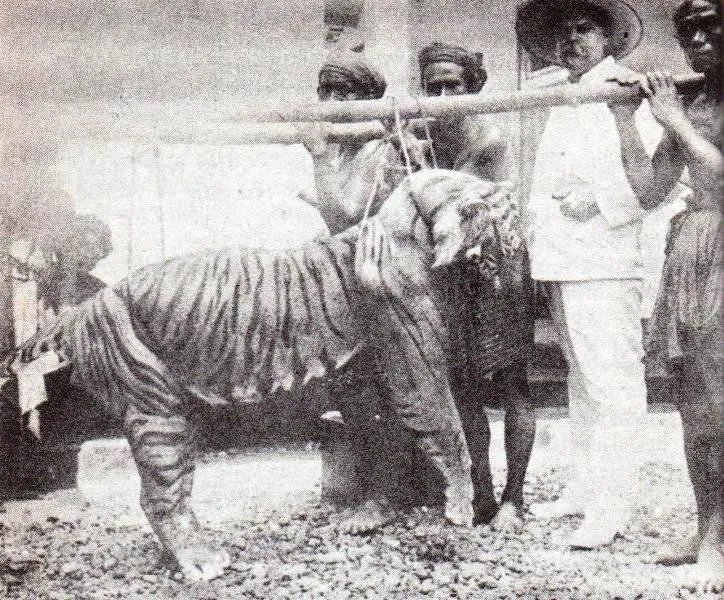
Organized hunting. This is the part popular accounts consistently understate. By the 1910s and 1920s, European hunters - frequently visiting on advertised “tiger shoots” - used baited platforms, large steel foot traps, and beaters to drive tigers into ambush positions (6). A single hunting party could account for multiple tigers in one trip. On a population that may have numbered fewer than a few hundred to begin with, this was catastrophic.
Local villagers also killed tigers in response to livestock losses, and the colonial administration paid bounties in some periods. The combination - a shrinking forest, intensive sport hunting, bounty hunting - left no recovery margin. Each factor alone might have been survivable. Together, they weren’t.
When was the last one killed?
The last confirmed Bali tiger was an adult female shot on 27 September 1937 at Sumbar Kima in West Bali (1)(3)(6). The hunter is recorded in some sources as M. Zwartkruis, with the carcass examined and documented before the skin entered museum collections.
Unverified sightings continued well after that date. Reports surface in oral histories from the 1940s and 1950s, and there are even isolated claims from 1970 and 1972 (1)(6). None have been backed by a body, a clear photograph, a track cast, or any other physical evidence accepted by mammalogists. By scientific standards, the population was functionally extinct by the late 1930s.
Two administrative dates matter as footnotes:
- The game reserve that became West Bali National Park was established in 1941, with subsequent expansion in 1947 (6) - too late to make any meaningful difference.
- The IUCN formally listed the Bali tiger as Extinct in 2008 (1).
Are there any left?
No. Zero wild individuals. Zero in captivity. Zero anywhere in the world (2)(4).
This needs to be said plainly because the question keeps coming up - and because some tour operators and zoos in Southeast Asia market “Bali tiger” experiences that are either mislabeled Sumatran tigers, Bengal tigers, or hybrids. If a venue in Bali, Java, or anywhere else claims to have a Bali tiger, they are wrong or lying. There’s no polite middle ground on this one.
What physically survives:
- About 10 verified specimens - skins and skulls - in museum collections worldwide (3). Holdings include Naturalis Biodiversity Center in Leiden, the Natural History Museum in London, the National Museum of Scotland, the Senckenberg Museum in Frankfurt, and the Zoological Museum in Bogor.
- A handful of historical photographs, mostly grim hunting trophy shots from the 1910s-1930s.
- mtDNA sequences from those museum specimens, now in public databases thanks to the 2015 PLOS ONE study (5).
That’s the entire remaining footprint of an apex predator that vanished within living memory.
Does Bali have any tigers today?
The island has no tigers - wild, captive, or otherwise. The largest predators currently on Bali are the Javan leopard (extremely rare, possibly already extirpated from the island), dholes (Asian wild dogs, also rare), and saltwater crocodiles in a few river mouths.
For travelers, this means:
- West Bali National Park (Taman Nasional Bali Barat) is worth visiting for its birdlife (including the critically endangered Bali myna), mangroves, and forest, but you will not encounter tigers. Foreigner entry fees run roughly IDR 200,000-225,000 (about USD $13-$15) per day, with mandatory guide fees of IDR 300,000-500,000 (USD $20-$35) on top.
- Bali Safari and Marine Park in Gianyar holds Sumatran and Bengal tigers, not Bali tigers. Tickets run around IDR 700,000-900,000 (USD $45-$60) for adults depending on the package (2024 pricing). Whether you visit is your call - captive tiger tourism comes with welfare and conservation questions that aren’t unique to Bali.
- “Tiger selfie” venues in parts of Southeast Asia generally rely on speed-breeding, cub separation, and sedation. They contribute essentially nothing to wild tiger conservation. Avoid them.
The tiger in Balinese culture
Tigers feature in Indonesian Hindu-Buddhist iconography across the archipelago, and on Bali they show up in temple carvings, traditional paintings (particularly in the Kamasan style from Klungkung), and in the Barong dance tradition. The Barong Macan - the tiger Barong - represents one of several animal forms the protective spirit can take, and it’s genuinely striking in performance.
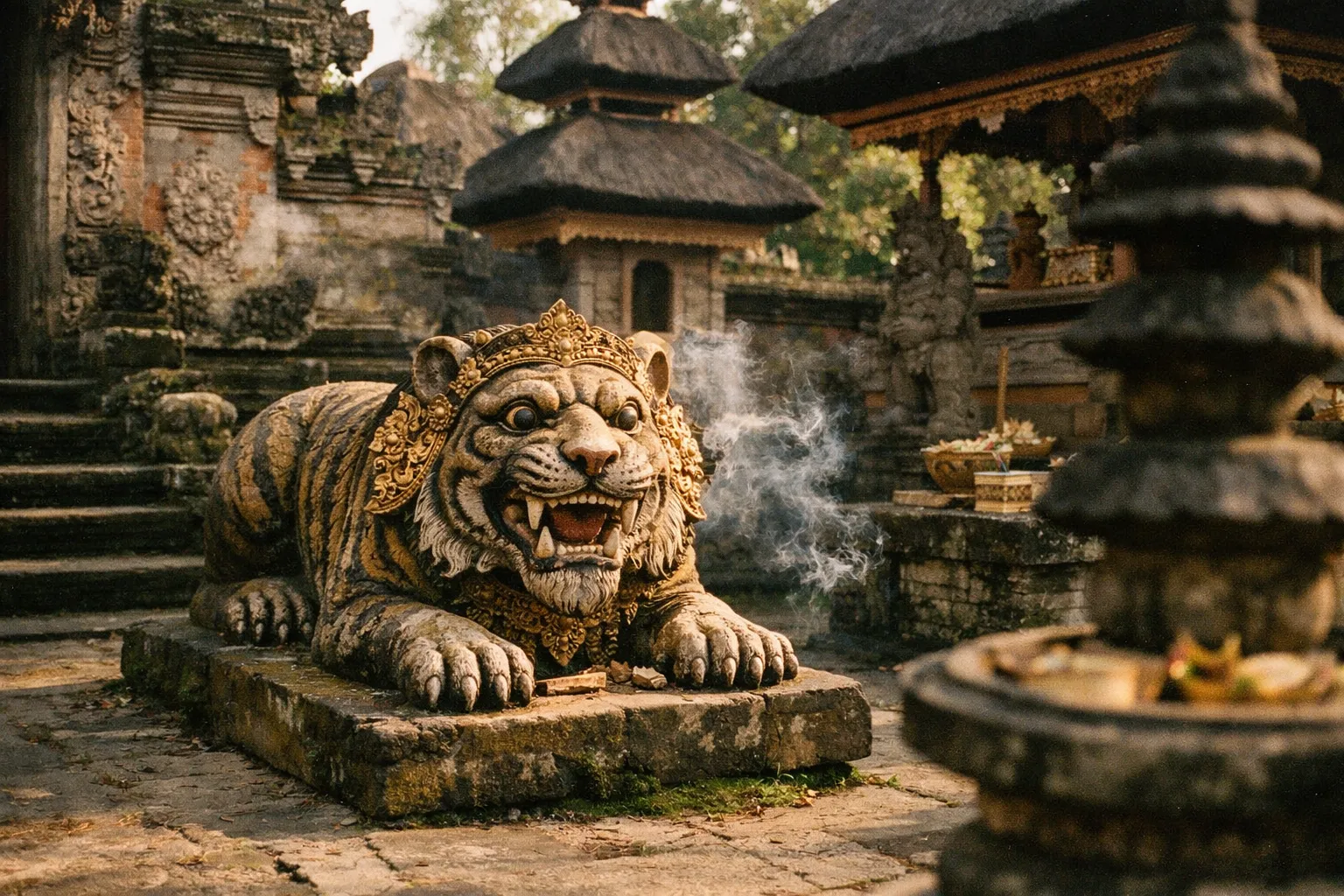
How much of this iconography is rooted specifically in the local balica population versus pan-Indonesian tiger symbolism is debated. Tigers in Balinese folklore are typically framed as forest guardians and embodiments of raw spiritual power - fearsome but not purely malevolent. After the tiger’s extinction, the imagery persisted. The animal it referred to did not.
If you want to see this material in person, the Agung Rai Museum of Art (ARMA) in Ubud and the Bali Museum (Museum Bali) in Denpasar both hold pieces featuring tiger motifs. Entry to the Bali Museum is around IDR 50,000 (USD $3.50) for foreign visitors, current as of 2024.
Etiquette note: when entering active temple grounds attached to these sites, a sarong is required (usually provided or rented for IDR 10,000-25,000), and shoulders should be covered. Staff will generally tell you, but it’s worth knowing before you arrive.
What this extinction teaches conservation
The Bali tiger is cited constantly in conservation biology coursework, and for good reason. It compresses several hard lessons into one small island.
Range size sets the ceiling. With only ~5,600 km² of habitat to start with, the Bali tiger population could never have been large. Small populations have low genetic diversity, are vulnerable to stochastic events, and can be wiped out by hunting pressure that a continental population would absorb without much consequence.
Protected areas have to come early. West Bali National Park was gazetted around the same time the population effectively collapsed. Designation matters most when the species still numbers in the hundreds, not the single digits.
Sport hunting can finish a population that habitat loss has already weakened. Neither factor alone explains the timeline. Together they explain it cleanly.
Genetic legacy can survive the population. The 2015 PLOS ONE work means Bali tiger DNA is sequenced, archived, and actively informs how we think about Sumatran tiger management (5). That doesn’t bring the population back, but it does shape what “saving the Sumatran tiger” actually means in genetic terms. For Indonesia as a whole, the Bali tiger’s disappearance was a preview: the Javan tiger followed by the 1970s, and the Sumatran tiger is now the only surviving member of the Sunda lineage, holding on in fragmented forest patches across an island facing its own land-conversion pressures.
What’s left to protect: the Sumatran tiger
If reading about the Bali tiger has any practical follow-on, it’s the Sumatran tiger (Panthera tigris sondaica in current taxonomy). The IUCN lists it as Critically Endangered, with population estimates in the range of 400 to 600 individuals in the wild as of the mid-2020s.
The pressures driving Sumatran tiger decline are familiar: oil palm and pulpwood plantations replacing lowland forest, poaching for skins and bones tied to traditional medicine markets, and human-tiger conflict around expanding agricultural frontiers. Provinces in Sumatra have lost forest cover at rates of roughly 0.5-1% per year in recent decades, based on Global Forest Watch satellite data.
For travelers already heading to Bali, adding 3-4 days in Sumatra is logistically straightforward. Domestic flights from Denpasar (DPS) to Medan (KNO) run USD $150-$250 round-trip when booked a month or more out (2024 fares on Garuda, Batik Air, and Lion Air). Guided treks in Gunung Leuser National Park - the most accessible Sumatran tiger habitat, based out of the village of Bukit Lawang - typically cost USD $80-$200 per person per day including guide, permits, food, and basic accommodation. You’re far more likely to see orangutans than tigers (tiger sightings are rare even for researchers), but the tourism revenue directly funds the forest’s protection.
If a side trip isn’t realistic, recurring donations to WWF-Indonesia, Panthera, or the WildCats Conservation Alliance start at USD $5-$10 per month. A useful framing: a typical 7-10 day Bali trip runs USD $1,000-$2,000 per person. Redirecting 1-3% of that toward wild tiger conservation in Sumatra is a small line item with real impact when aggregated across millions of visitors.
Where to see physical specimens
For researchers, writers, and the genuinely curious, the surviving physical evidence lives in a handful of European and Indonesian museum collections. Public access varies - some specimens are on display, others are in research collections requiring an appointment.
- Naturalis Biodiversity Center, Leiden, Netherlands - holds skins and skulls; general admission around €17 (USD $18), open Tuesday through Sunday.
- Natural History Museum, London, UK - research collections; free general admission, specimen access by appointment.
- National Museum of Scotland, Edinburgh - historical mammal collections; free general admission.
- Senckenberg Naturmuseum, Frankfurt, Germany - adult admission around €12 (USD $13).
- Museum Zoologicum Bogoriense, Bogor, Indonesia - research collection; access typically requires a formal request through the National Research and Innovation Agency (BRIN).
Several of these institutions have been expanding open digital collections in recent years, so high-resolution images of Bali tiger pelts and skulls are increasingly available online without travel. Publication-quality image licensing through museum permissions offices typically runs USD $50-$200 per image.
Frequently Asked Questions
- Why did the Bali tiger go extinct?
- The extinction was due to a combination of habitat loss from agricultural conversion and intensive hunting, including organized sport hunting and bounty killings. The island's small size limited population resilience.
- Are there any Bali tigers left?
- No Bali tigers remain in the wild or captivity. Verified specimens exist only in museums, and the subspecies is officially extinct.
- When was the last Bali tiger killed?
- The last confirmed Bali tiger was shot in 1937. Later sightings lack physical evidence and are considered unsubstantiated.
- Does Bali have any tigers today?
- Bali currently has no tigers. Captive tigers in parks are Sumatran or Bengal tigers, not Bali tigers. Reintroduction is not feasible due to habitat and population density.
- Could Bali tigers be brought back through de-extinction?
- De-extinction is not practical due to genetic and habitat constraints. Conservation efforts focus on the closely related Sumatran tiger instead.
- What's the closest living relative of the Bali tiger?
- The Sumatran tiger is the closest living relative, sharing nearly identical mitochondrial DNA as part of the Sunda tiger group.